

TL;DR:
- Data-driven sales uses analytics and automation to improve insurance win rates and efficiency.
- Implementing a unified CRM, data hygiene, and AI tools helps agencies make faster, smarter decisions.
- Success requires change management and integrating human judgment with technology.
Most insurance agency owners believe their best agents win deals because of charm, experience, and gut instinct. And while those qualities still matter, AI-driven data processes raise win rates in ways that pure intuition simply cannot match at scale. The insurance market in 2026 is more competitive, more complex, and more customer-driven than ever before. Agencies that cling to old-school tactics are quietly losing ground to competitors who use automation, predictive analytics, and unified data systems. This article breaks down exactly what data-driven sales means for insurance agencies, why the shift is urgent, and how to start building a smarter sales engine today.
Table of Contents
- What is data-driven sales?
- Why insurance sales must become data-driven
- Key pillars of data-driven sales for insurance agencies
- Integrating AI and automation: The game changers
- How to get started: A practical blueprint
- Data-driven sales: What most guides miss
- Unlock your data-driven sales engine with AI tools
- Frequently asked questions
Key Takeaways
| Point | Details |
|---|---|
| Data enables smarter sales | Analyzing win rates and cycles provides a clear picture of where to improve. |
| AI drives higher results | With AI tools, agencies can boost win rates and agent success faster than manual methods. |
| Start with your CRM | Centralizing data and automating processes in a CRM is the practical first step toward data-driven sales. |
| Blend data with sales art | Success requires balancing analytics with the human touch that builds client trust. |
What is data-driven sales?
Data-driven sales is the practice of using historical data, CRM records, behavioral signals, and automation to guide every sales decision, from which leads to call first to which messaging converts best. It replaces guesswork with evidence. Instead of relying on a rep’s memory or mood, your team works from a shared picture of what actually works.
The foundational pillars are straightforward: collect accurate data, analyze it for patterns, and act on the insights consistently. Sales automation basics play a major role here, handling the repetitive data entry and follow-up tasks that eat into selling time.
For insurance agencies specifically, key baselines to track include:
- Win rate: The percentage of opportunities that convert to closed policies
- Average deal size: Revenue per closed policy or account
- Sales cycle length: Days from first contact to signed policy
- Pipeline velocity: How fast leads move through each stage
“Data-driven sales starts with baselines and builds with infrastructure, testing, and AI.” Once you know your numbers, you can improve them systematically.
Here is a simple view of how traditional sales compares to a data-driven approach:
| Element | Traditional sales | Data-driven sales |
|---|---|---|
| Lead prioritization | Rep’s intuition | AI-scored lead lists |
| Follow-up timing | Based on memory | Automated triggers |
| Performance review | Monthly gut check | Real-time dashboards |
| Messaging strategy | What feels right | A/B tested templates |
The infrastructure needed to support this shift includes a unified CRM, automated data hygiene processes, and regular team reviews of pipeline health. Without clean data flowing into one central system, even the best analytics tools will produce misleading results.
Why insurance sales must become data-driven
Insurance is not a simple product sale. Policies are complex, buyers research online before they ever talk to an agent, and the sales cycle often stretches weeks or months. That complexity makes instinct-driven selling particularly risky.
Industry benchmarks tell a clear story. Median insurance win rates sit between 15 and 18 percent, meaning most agencies lose more than 80 percent of their opportunities. That is a massive gap with room to improve, and automation’s impact on insurance sales is already closing it for agencies that commit to the shift.
Here is how data-driven teams stack up against traditional ones:
| Metric | Traditional teams | Data-driven teams |
|---|---|---|
| Win rate | 15 to 18% | Up to 25%+ |
| Quota attainment | ~55% of reps | ~70% of reps |
| Sales cycle | Longer, inconsistent | Shorter, predictable |
| Lead conversion | Low, variable | Higher, measurable |
Four urgent reasons to make this transition now:
- Customer expectations have changed. Buyers expect fast, personalized outreach. Generic cold calls no longer convert.
- Competitors are already doing it. Agencies using AI tools are moving faster and winning more deals.
- Regulatory complexity is rising. Tracking compliance-related sales activities manually creates unnecessary risk.
- Talent costs are high. Automation lets you do more with your existing team instead of just adding headcount.
The agencies winning in 2026 are not necessarily the biggest. They are the ones making better decisions, faster, backed by real data.
Key pillars of data-driven sales for insurance agencies
Knowing why you need data-driven sales is one thing. Building it is another. These are the core components every insurance agency needs in place.
A unified CRM as your foundation. Winning teams build a single CRM source of truth and automate data hygiene so every rep works from the same, clean dataset. A fragmented setup, spreadsheets mixed with sticky notes and a half-used CRM, guarantees blind spots. Learn more about the value of a CRM for agents purpose-built for insurance workflows.

Automated data hygiene. Dirty data is worse than no data. It leads to duplicate outreach, missed follow-ups, and faulty reports. Standardizing how your team logs calls, stages deals, and records policy details is not glamorous work, but it is the foundation everything else rests on.
Continuous measurement and A/B testing. What you measure, you can improve. Track win rates by product line, by agent, and by lead source. Test two email subject lines. Try different call scripts for warm versus cold leads. The sales automation benefits compound when your team learns what actually moves the needle.
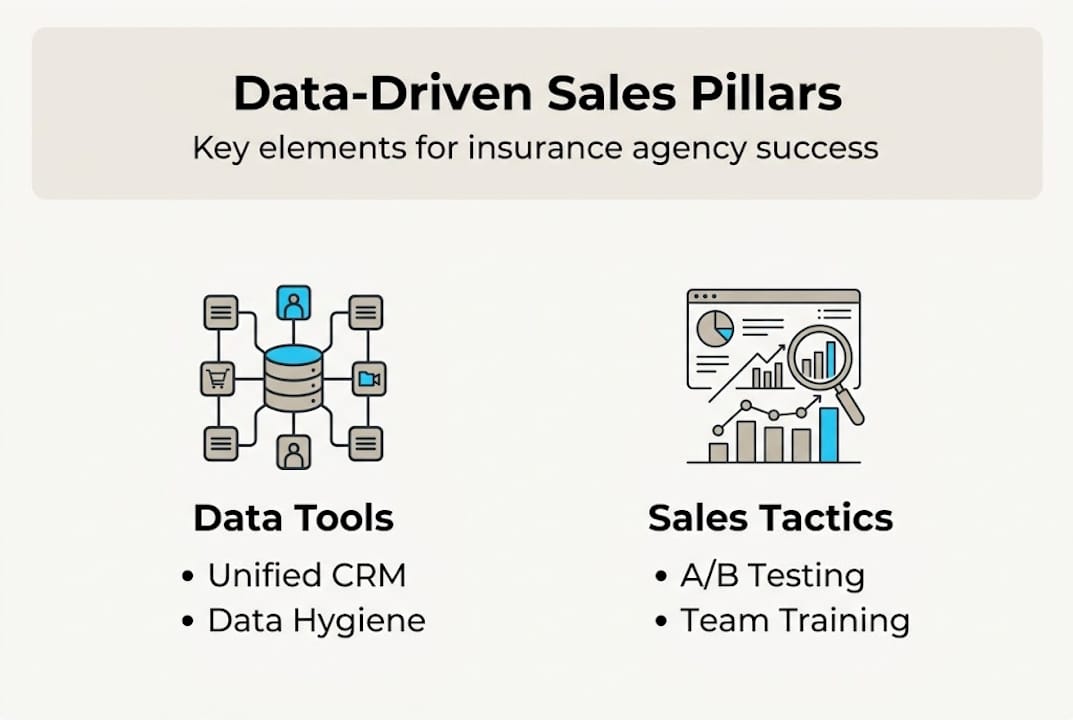
Integrated data sources. Connect your email activity, call logs, and pipeline stages into one view. When a prospect opens three emails and visits your quote page, that behavior should trigger a timely follow-up automatically, not get buried in a rep’s inbox.
Pro Tip: Assign one person on your team as the “data owner” each quarter. Their job is to review CRM completeness, flag bad data, and report on pipeline trends. This simple role prevents data quality from quietly eroding over time.
Team buy-in and training. Tools only work if your team uses them. Invest time in showing agents why the new system helps them, not just the agency. Reps who see their own dashboards improve tend to engage far more consistently.
Integrating AI and automation: The game changers
Once your data foundation is solid, AI and automation are what turn a good sales operation into a great one.
AI-powered lead scoring ranks your pipeline by close probability, so your agents focus on the most promising opportunities first. Instead of calling the leads who signed up longest ago, they call the ones most likely to buy today. This alone can transform how your team spends its hours.
Next-best-action recommendations guide reps on exactly what to do with each prospect: send a follow-up email, schedule a call, or share a specific product comparison. It takes the cognitive load off your agents and keeps deals moving forward.
Automated follow-up sequences mean no lead falls through the cracks. A prospect who requests a quote but goes quiet gets a personalized drip sequence, not silence. This consistent nurturing is something manual processes almost never sustain at scale.
The numbers back this up. AI coaching and lead qualification can raise win rates up to 47 percent on short-cycle deals and meaningfully boost new-agent success and premium growth. That is not a marginal improvement; it changes what is possible for your agency.
Specific insurance use cases include:
- Onboarding new agents faster by automating their prospecting and follow-up workflows
- Identifying cross-sell opportunities within your existing book of business
- Flagging at-risk renewals before the policy lapses
Pro Tip: Use AI for the sorting and prioritizing. Use your agents for the relationship building. The technology is not replacing human connection in insurance; it is clearing the clutter so agents can focus on real conversations. Explore how AI in insurance marketing and AI lead generation can work together for your agency.
How to get started: A practical blueprint
You do not need to overhaul everything overnight. Here is a realistic sequence that works regardless of your agency’s current tech setup.
- Audit your current sales data. Pull your last 12 months of closes, losses, and pipeline data. Identify where records are incomplete and which sources are unreliable. You cannot improve what you cannot see.
- Set your baseline metrics. Document your current win rate, average deal size, sales cycle length, and quota attainment. Start with historical data analysis for baselines before adding any new tools.
- Choose and implement a CRM built for insurance. Pick a platform that handles the specific workflows your agents use daily, like policy tracking, renewal alerts, and multi-channel follow-ups. Consolidate everything into one system.
- Automate the highest-volume, lowest-value tasks first. Follow-up emails, appointment reminders, and lead routing are ideal starting points. This gives your team immediate time savings and builds confidence in the new system. Resources on automating lead generation can help you prioritize.
- Test, measure, and refine. Run your first A/B messaging test within 30 days. Review win/loss data monthly. Let the numbers tell you what to adjust, not opinions. Explore AI marketing tools that make testing and reporting faster.
Pro Tip: Celebrate early data wins publicly with your team. When an agent closes a deal because an AI-scored lead hit the top of their queue, share that story. Culture shifts when people see real proof that the new approach works.
Data-driven sales: What most guides miss
Most step-by-step guides give you the playbook but skip the hardest part: context. Raw data without interpretation is dangerous. If your win rate drops one month, that could mean your agents are struggling, or it could mean you just started targeting a harder market segment. Metrics need human judgment to mean anything.
The biggest mistake agencies make when adopting data-driven sales is underestimating change management. Reps who have operated on instinct for years do not automatically embrace dashboards and AI recommendations. They need to see the why before they will change their daily habits.
Balancing data science with sales art is not a soft suggestion; it is a competitive necessity. Multi-threaded deals, where you engage multiple stakeholders within one account, win more often. That kind of nuanced strategy still requires human judgment. AI surfaces the opportunity. Your agent builds the relationship.
Winning agencies invest in both the technology and the culture. They use customer engagement with AI to scale personalization while also coaching reps on how to interpret data and act on it with confidence. The agencies that treat this as a pure tech project usually stall. The ones that treat it as a people-and-tech project scale.
Unlock your data-driven sales engine with AI tools
Ready to stop guessing and start winning with real data? CallBack CRM was built specifically for insurance agencies and IMOs that want to move beyond spreadsheets and cold calls into a fully automated, AI-powered sales system.
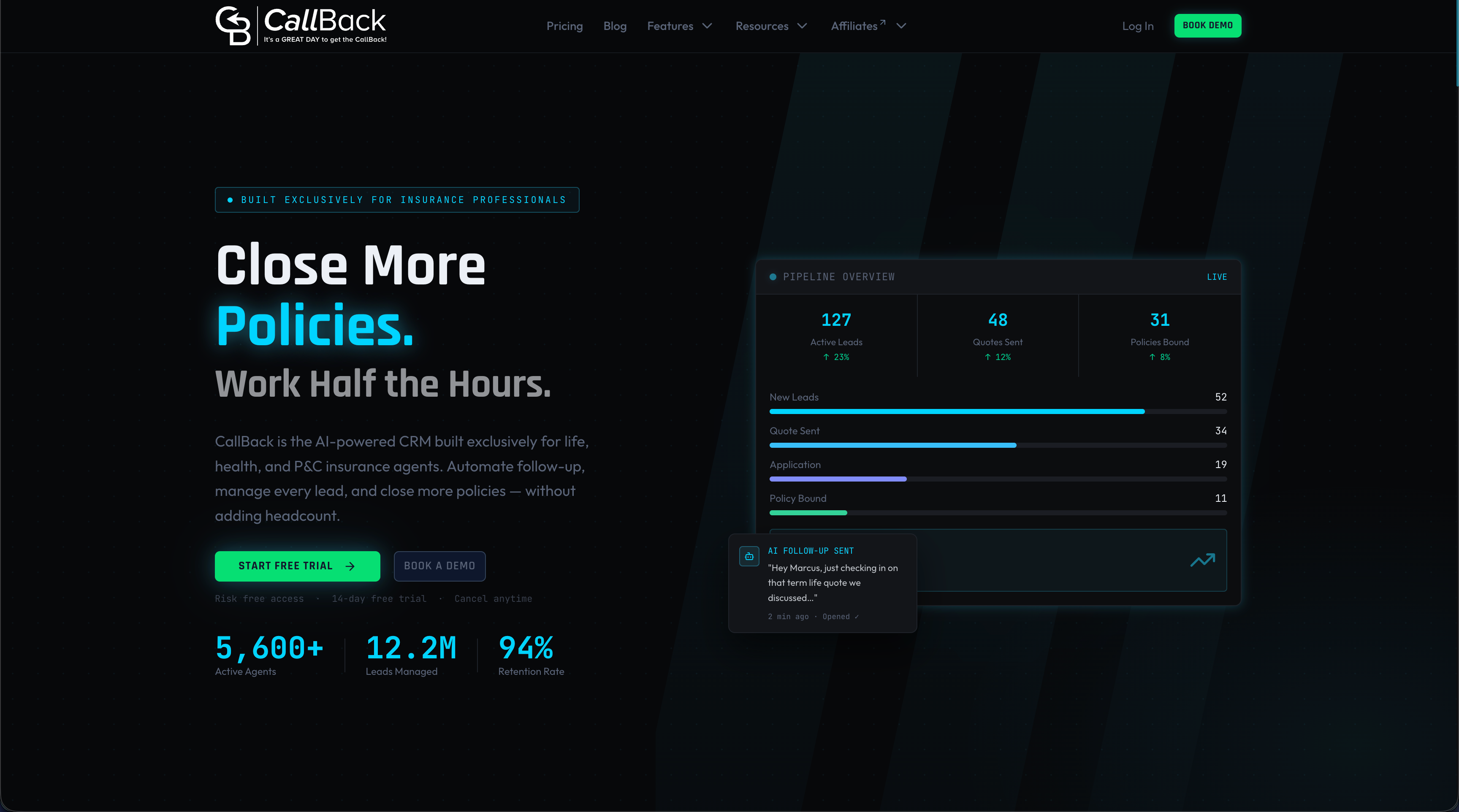
With CallBack CRM, you get a unified platform that handles lead scoring, automated follow-ups, CRM hygiene, and multi-channel outreach in one place. Explore the full suite of AI-powered CRM features designed for insurance workflows. You can also discover how SMS marketing for insurance keeps your agents top of mind with prospects at exactly the right moment. The tools are ready. Your next step is simply to start.
Frequently asked questions
What are the main benefits of data-driven sales for insurance agencies?
Data-driven teams achieve higher win rates and faster sales cycles, making quota attainment more consistent and predictable across the entire agency.
How does AI help in insurance sales?
AI boosts new-agent success rates and premium growth by automating lead qualification and giving agents clear, prioritized next steps so they focus on the right opportunities.
What is the first step to adopting data-driven sales?
Centralize your sales data in a CRM first. Start with historical data analysis to establish baseline metrics before layering in any automation or AI tools.
Is the data-driven approach suitable for smaller insurance agencies?
Absolutely. Small teams often see the fastest gains because even basic metrics tracking and simple automation tools eliminate bottlenecks that were previously invisible, and the system can scale as your agency grows.