

TL;DR:
- Most sales teams fail to close deals because of inconsistent processes rather than product weaknesses.
- Implementing a structured workflow with clear criteria, automation, and CRM enforcement significantly improves forecast accuracy and revenue.
Most sales teams lose deals not because their product is weak, but because their process is inconsistent. Without a clear step by step sales workflow, reps rely on memory and instinct, prospects fall through the cracks, and forecasting becomes guesswork. The result is a pipeline that looks full but converts poorly. This guide walks you through every stage of a structured sales process, from how to create your workflow from scratch to setting up your CRM for consistency, measuring the metrics that matter, and fixing the mistakes that quietly kill revenue.
Key takeaways
| Point | Details |
|---|---|
| Start with preparation | Define your ideal customer profile and map buyer journey stages before building any workflow stage. |
| Use objective stage criteria | Entry and exit criteria based on buyer state, not rep opinion, make forecasting reliable and coaching possible. |
| Build automation into each stage | Automate outreach sequences, lead scoring, and follow-up tasks to eliminate manual handoffs. |
| Measure conversion at every step | Track stage conversion rates and time-in-stage benchmarks to find where deals stall. |
| Enforce the process in your CRM | Validation rules and required fields prevent reps from skipping critical steps in the pipeline. |
Before you build: laying the groundwork
You cannot design a sales workflow that works if you do not know who you are selling to or how they buy. Skipping this step is the single biggest reason workflow projects fail within the first 90 days.

Start with your ideal customer profile (ICP). Document the industry, company size, role, pain points, and buying triggers that define your best customers. Then build buyer personas for each decision maker and influencer involved in a typical deal. Your workflow stages need to reflect how they move through a buying decision, not just how your reps prefer to work.
Next, map the buyer journey for your specific market. A mid-market SaaS deal has a different rhythm than an insurance policy sale. Identify the moments when buyers make real decisions, such as agreeing to a meeting, sharing budget information, or looping in a second stakeholder. Mapping buyer interactions to stage progression is what separates a workflow that reflects reality from one that just looks good on a whiteboard.
Before finalizing anything, pull your existing sales data. Review your last 20 closed deals, wins and losses, and note where time was spent, where deals slowed, and what information reps gathered at each point.
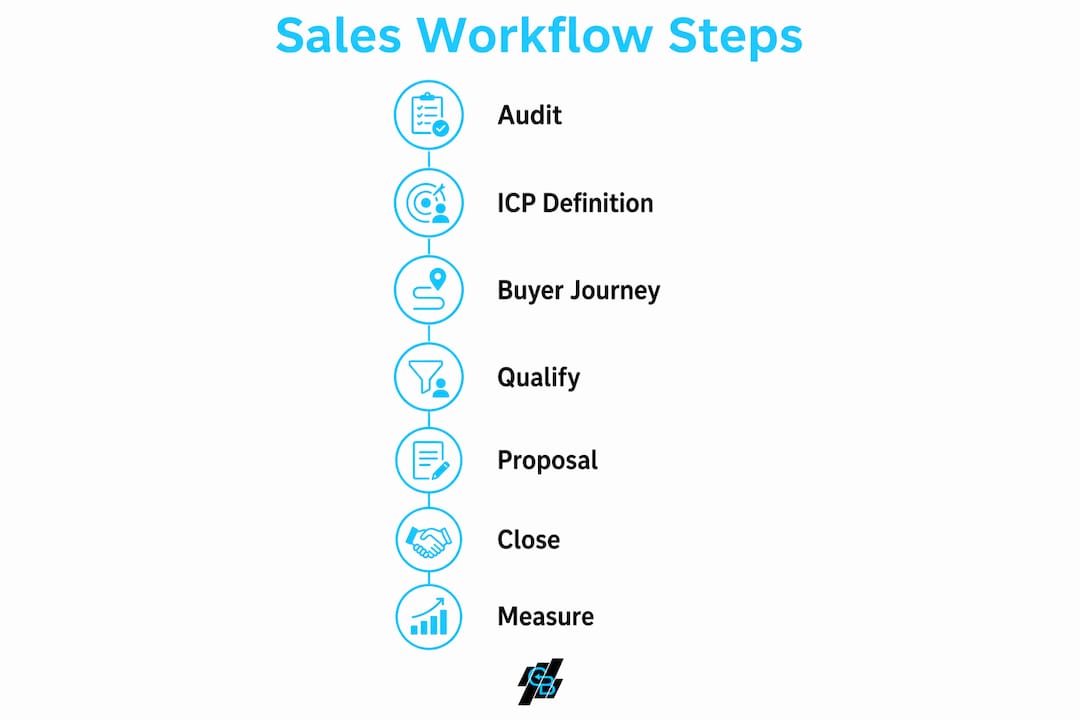
Pro Tip: Audit your last five deals twice. First, trace them chronologically. Second, trace them by buyer decision points. If these two timelines do not match, your current stages are tracking rep activity, not buyer progress.
The step by step sales workflow, stage by stage
A typical B2B workflow runs seven to eight stages. Here is a breakdown of each one with the key activities that actually move deals forward.
-
Prospecting. Identify companies and contacts that match your ICP. Use intent data, referrals, social selling, and inbound lead sources. Quality over quantity matters here. Fifty well-researched prospects outperform five hundred cold names every time.
-
Outreach. Make first contact through a multi-touch approach: personalized email, a LinkedIn connection, and a follow-up call. Outreach timing typically spans one to four weeks depending on deal size, so build a cadence that does not go silent after one message.
-
Qualification. Use a framework like BANT (Budget, Authority, Need, Timeline) or MEDDIC to assess whether a prospect is worth pursuing. Ask direct questions early. A discovery call that skips qualification wastes everyone’s time.
-
Discovery. This is your most important stage. Front-load your research and ask questions that uncover real problems, not just surface-level complaints. Structure your discovery call with open questions, silence, and summary statements. Listen more than you talk.
-
Presentation or demo. Tailor every demo to what you learned in discovery. Reference their specific situation, their team size, their stated objections. Generic demos lose to tailored ones, even when the product is identical.
-
Objection handling. Prepare a written objection guide before you need it. Map the five most common objections in your market and write three responses to each. Objections are buying signals when handled well.
-
Closing. Ask for the business clearly and directly. Avoid vague next steps like “I’ll follow up next week.” Specify the action: “Can we schedule the contract review for Thursday?” After close, hand off to onboarding with a warm introduction and documented context.
Pro Tip: The close rate benchmark for meeting-to-close sits at 20 to 30 percent for most B2B teams. If you are below that range, the problem is almost always in discovery or qualification, not in your closing technique.
Here is a quick comparison of two common qualification frameworks to help you choose the right one for your workflow:
| Framework | Best for | Core criteria | Weakness |
|---|---|---|---|
| BANT | Transactional, shorter-cycle sales | Budget, Authority, Need, Timeline | Can feel interrogative if rushed |
| MEDDIC | Complex, enterprise-level deals | Metrics, Economic buyer, Decision criteria | Requires more rep training |
CRM setup: making your workflow stick
A workflow that lives in a slide deck does not get followed. You need to operationalize your process inside your CRM so reps cannot skip stages, management can coach accurately, and your pipeline data stays clean.
The most critical thing to get right is stage criteria. Stage gating requires explicit entry and exit conditions based on verifiable buyer state, not the rep’s confidence level. Write these as checklist-style required fields. For example, before a deal moves from Qualification to Discovery, your CRM should require a confirmed budget range and a named decision maker.
Here is a sample stage criteria table for a five-stage pipeline:
| Stage | Entry criteria | Exit criteria |
|---|---|---|
| Qualified | ICP confirmed, pain identified | Budget range captured, DM identified |
| Discovery | DM meeting scheduled | Needs documented, next steps agreed |
| Proposal | Custom proposal drafted | Proposal sent and acknowledged |
| Negotiation | Verbal interest confirmed | Terms accepted or revised |
| Closed Won | Contract signed | Onboarding handoff completed |
Beyond stage gating, set up automations that eliminate the manual tasks that kill follow-through. A lead qualification workflow can be automated with prospect form fills triggering lead scoring, CRM record creation, and sales follow-up scheduling without a rep lifting a finger.
Key automations to build into your workflow:
- Outreach sequences that pause automatically when a prospect replies
- Task reminders triggered when a deal sits in the same stage for more than seven days
- Lead scoring rules that flag high-intent prospects for immediate contact
- Marketing-to-sales handoff alerts when a lead hits a score threshold
Pro Tip: Use your CRM analytics to look at time-in-stage by rep, not just by deal. If one rep’s deals average 12 days in Discovery and another’s average 26 days, that gap is a coaching conversation waiting to happen.
For insurance agents and agencies, linking your sales automation workflow to your CRM pipeline turns a manual, relationship-driven process into a predictable, scalable one.
Common mistakes that break sales workflows
Even well-designed workflows fail when teams make predictable errors. Knowing them in advance saves months of troubleshooting.
- Vague stage names. “In progress” or “Active conversation” tells you nothing. Every stage needs a specific buyer state attached to it.
- Subjective stage movement. The largest cause of unreliable forecasts is reps moving deals forward based on gut feel rather than verifiable criteria.
- No training or enforcement. A workflow without manager reinforcement becomes optional within three weeks of launch. Run weekly pipeline reviews that reference stage criteria explicitly.
- Weak follow-up. The majority of deals that go cold do so not because the prospect said no, but because the rep stopped reaching out. Build follow-up tasks into your CRM so nothing depends on memory.
- Stalling in late stages. If deals die after the proposal, the real problem is almost always a qualification or discovery failure from three stages earlier.
“Treating sales stage progression as a controlled state machine reduces ambiguous statuses and stabilizes forecasting accuracy across the pipeline lifecycle.”
Measuring success at every stage
You cannot improve what you do not measure. These are the numbers every sales leader and business owner should track weekly.
| Metric | What it tells you | Target benchmark |
|---|---|---|
| Stage conversion rate | Where deals drop off in the pipeline | Varies; meeting-to-close at 20 to 30% |
| Time in stage | Where deals stall by stage or rep | Set max days per stage, review outliers |
| Cold email reply rate | Top-of-funnel outreach effectiveness | 5 to 6 percent average, 10% for top performers |
| Overall visitor-to-customer rate | End-to-end funnel health | 2 to 5 percent for B2B |
| Average deal cycle length | Predictability of close timing | Establish baseline, then work to reduce |
Review these metrics monthly at minimum, and tie your workflow changes directly to what the data shows. If discovery-to-proposal conversion drops, revisit your discovery call structure. If proposal-to-close stalls, look at how objections are being handled.
Pro Tip: When you redesign a stage, track the specific metric tied to that stage for 30 days before drawing conclusions. Changing multiple things at once makes it impossible to know what actually worked.
For more depth on building the early stages of your pipeline, the lead generation workflow guide covers real-world automation patterns that feed your sales process consistently.
My take: why stage criteria changed everything
I’ve worked with enough sales teams to say this without hesitation: the single biggest unlock is not a better pitch or a fancier CRM. It is writing down, in plain language, exactly what has to be true for a deal to move from one stage to the next.
I’ve seen teams where “Proposal Sent” meant the rep emailed a PDF, and other teams where it meant the economic buyer had reviewed the proposal in a live session with a timeline agreed. Both used the same stage name. Their forecasting accuracy was worlds apart.
What I’ve found is that when you enforce checklist-style required deal facts, two things happen almost immediately. Reps start asking better discovery questions because they know they will need that information to advance the deal. And managers can finally have useful coaching conversations because the data actually reflects what happened.
The teams that resist this approach always cite the same reason: “Our deals are too unique for a rigid process.” My experience says the opposite. The more complex and customized your deals, the more you need a structured process to avoid chaos. Complexity is not a reason to skip criteria. It is a reason to write better ones.
The discomfort of enforcing stage criteria is temporary. The pipeline clarity it creates lasts for years.
— Kyle
How Callbackcrm powers your sales pipeline
If you are ready to move from a workflow on paper to one that runs itself, Callbackcrm was built for exactly this.
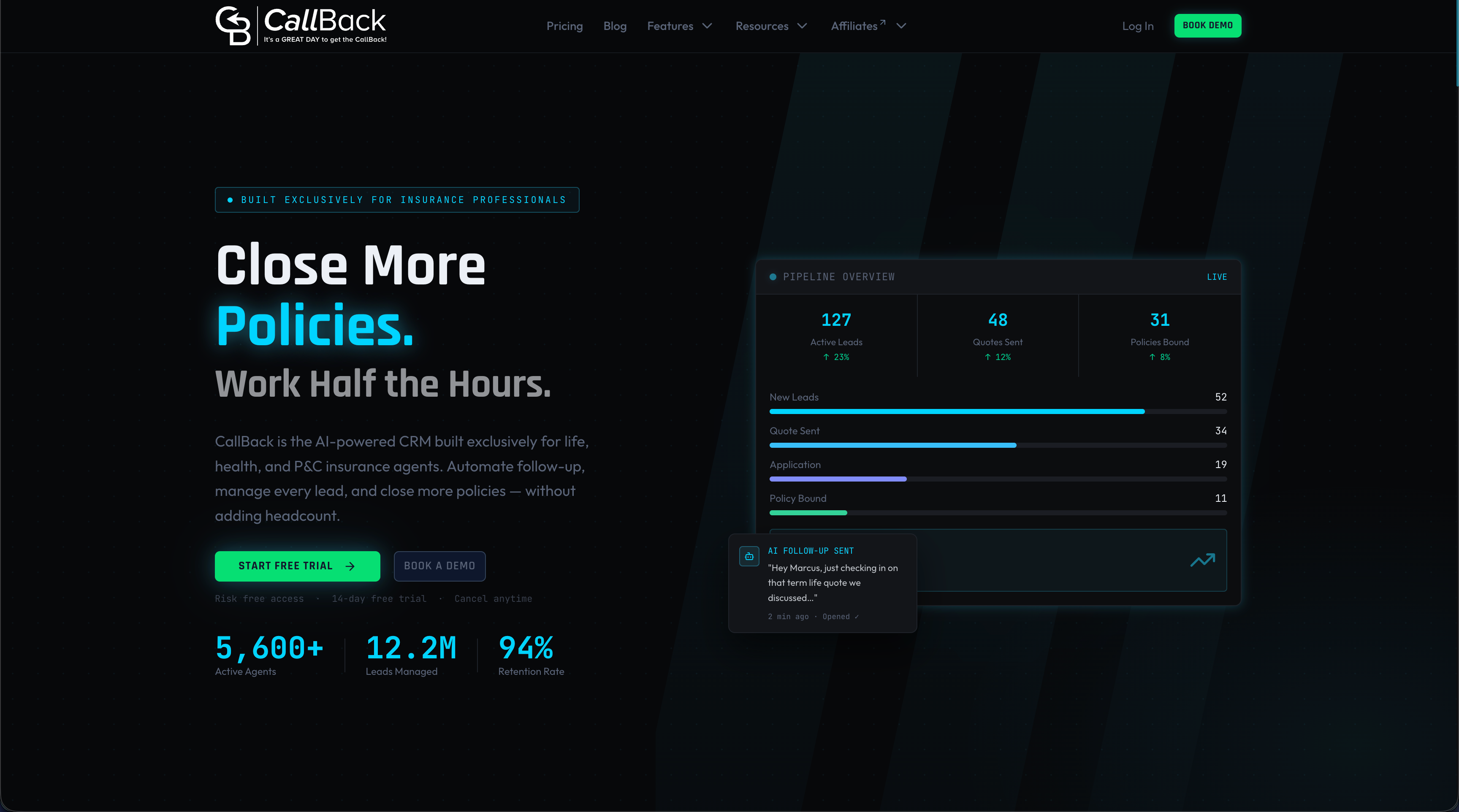
Callbackcrm gives insurance agents and sales teams a fully customizable pipeline with stage gating, required fields, and validation rules built in. You can map your exact workflow stages, set entry and exit criteria, and let the platform enforce them without relying on rep discipline alone. Automated outreach sequences, lead scoring, and follow-up reminders run in the background so no deal goes cold by accident. The platform’s AI-powered feature set also connects your marketing automation directly to your sales pipeline, so qualified leads flow in with full context already attached. Explore sales funnel tools and SMS outreach automation built specifically for scaling sales workflows without adding headcount.
FAQ
What are the main steps in a sales workflow?
A standard sales workflow covers prospecting, outreach, qualification, discovery, presentation, objection handling, and closing. Most B2B workflows run seven to eight stages depending on deal complexity.
How do I create a sales workflow from scratch?
Start by auditing your recent deals and mapping the buyer’s decision points, then define entry and exit criteria for each stage and build those stages into your CRM with required fields and automations.
What is a sales workflow example for B2B?
A B2B sales workflow example would move a prospect from ICP match and first outreach through a qualification call, a discovery session, a tailored demo, a proposal review, and finally a signed contract with a documented handoff to onboarding.
How long should each sales stage take?
Average stage timing ranges from one to four weeks per stage for most B2B deals. Outreach and closing tend to take longer than qualification and discovery. Set maximum time-in-stage limits in your CRM to flag stalled deals early.
Why do sales workflows fail?
Most workflows fail because stage progression is based on rep opinion rather than verifiable buyer criteria, making forecasting unreliable. Without CRM enforcement and manager reinforcement, even well-designed workflows become optional within weeks.