

TL;DR:
- Modern digital sales funnels manage the entire customer lifecycle, not just initial conversion, boosting revenue through automation and multi-channel strategies. They leverage behavior-driven workflows, integrated CRM systems, and continuous testing to optimize each stage from awareness to retention. Implementing these systems enables businesses to generate higher conversion rates, increase lifetime value, and build scalable, predictable revenue streams.
Most businesses treat their sales funnel as a one-way street that ends the moment a prospect converts. That thinking is costing them revenue they never even realize they’re missing. The role of digital sales funnels has shifted dramatically. Today, a well-built funnel isn’t a closing tool. It’s an automated revenue engine that manages every stage of the customer lifecycle, from first click to long-term loyalty. Understanding how these systems actually work gives marketing professionals and business owners a measurable edge in a marketplace where 79% of marketing leads never convert into sales due to poor funnel structure and optimization.
Table of Contents
- Key takeaways
- The role of digital sales funnels explained
- Core stages and functions of a modern funnel
- Technology that powers funnel execution
- Best practices for optimizing and scaling funnels
- Common pitfalls that stall funnel performance
- My perspective on the future of digital funnels
- Build smarter funnels with Callbackcrm
- FAQ
Key takeaways
| Point | Details |
|---|---|
| Funnels extend beyond the sale | Modern digital funnels manage the full customer lifecycle, including retention, upsells, and referrals. |
| Automation drives efficiency | Behavior-triggered workflows reduce manual tasks and personalize communication at scale. |
| Multi-touch strategy is required | Converting modern buyers takes an average of eight touchpoints across multiple channels. |
| Technology closes the execution gap | Funnel builders with CRM integration let teams launch and optimize campaigns faster and with more precision. |
| Post-purchase stages deliver the highest ROI | Order bumps, upsells, and loyalty loops often generate more revenue than the initial conversion. |
The role of digital sales funnels explained
A digital sales funnel maps every interaction a prospect has with your brand, from the moment they encounter an ad or search result to the point they become a paying customer and beyond. Traditional funnels were linear. A rep made calls, sent proposals, and either closed or lost the deal. Digital funnels are different in structure, speed, and scope.
Modern digital funnels are multi-touch, behavior-driven systems built across paid ads, organic search, email, SMS, and retargeting. Each channel feeds into a central workflow that responds to what prospects actually do, not just where they are in a sequence. Someone who clicks a pricing page but doesn’t convert gets routed differently than someone who downloaded a guide and hasn’t engaged since.
Here’s what separates a digital funnel from a traditional one:
- Automation with conditional logic. Actions trigger the next communication automatically based on user behavior, not a calendar.
- Segmentation from day one. Leads are tagged and sorted by source, behavior, and intent so messaging stays relevant.
- Multi-channel integration. Email, SMS, retargeting ads, and landing pages operate as one connected system rather than isolated campaigns.
- 24/7 operation. Unlike a sales rep, a well-built digital funnel works around the clock to nurture, qualify, and convert leads without human intervention.
Pro Tip: Before you build, map your existing customer journey on paper. Identify every point where a prospect could drop off and design your funnel to address each of those friction points with a specific piece of content or automated follow-up.
The importance of sales funnels lies precisely in this architecture. Without it, even high-quality traffic rarely converts at the rates your budget deserves.
Core stages and functions of a modern funnel
Understanding each stage helps you allocate resources, write better copy, and identify where your current funnel is bleeding opportunity. In 2026, top-performing funnels treat the process as a loop, not a line.
- Awareness. The prospect discovers your brand through search, social content, or a paid ad. Your job here is to create a first impression that earns the next click, not to sell.
- Interest. The prospect engages with a lead magnet, video, or landing page. This is where opt-in forms and behavior tracking begin building your segmentation data.
- Consideration. The prospect is evaluating solutions. Automated email sequences, case studies, and comparison content keep your brand top of mind while competitors go quiet.
- Conversion. The prospect becomes a buyer. Psychological pricing, clear calls to action, and distraction-free checkout pages all contribute here. Funnels deliver up to 3x higher conversions compared to standard e-commerce checkouts when personalization and automation are in place.
- Retention and loyalty. This stage is where most teams leave money on the table. Order bumps at checkout, upsell sequences after purchase, and loyalty programs that reward repeat behavior all compound revenue over time.
The circular funnel model replaces the old linear view by treating post-purchase customers as the starting point for new referral and advocacy cycles. A customer who receives a well-timed upsell or renewal reminder doesn’t just stay. They refer.
| Funnel stage | Primary goal | Key tactic |
|---|---|---|
| Awareness | Generate traffic | Paid ads, SEO content |
| Interest | Capture leads | Lead magnets, opt-in forms |
| Consideration | Build trust | Email sequences, social proof |
| Conversion | Close the sale | Optimized landing pages |
| Retention | Grow lifetime value | Upsells, renewals, loyalty loops |
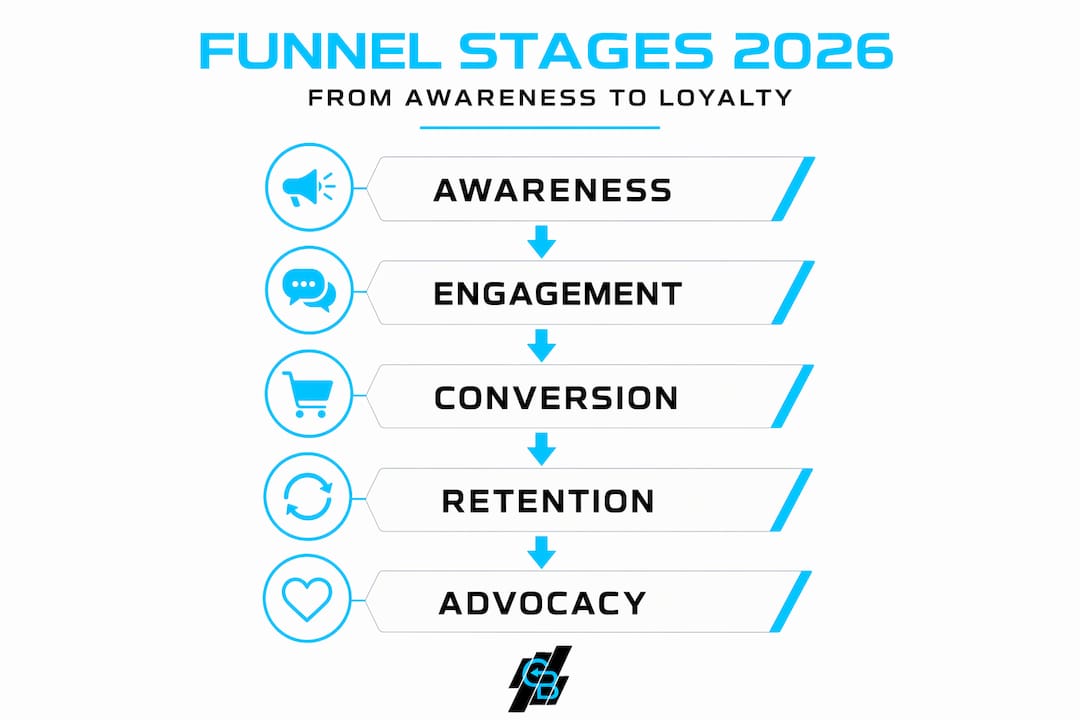
The most significant revenue gains in a properly built funnel consistently come from those post-purchase stages, not the initial conversion.
Technology that powers funnel execution
The gap between knowing what a funnel should do and actually building one that performs comes down to the tools you use. Modern funnel software handles the heavy lifting that used to require a developer, a copywriter, a CRM admin, and a media buyer working together.
Here’s what a well-equipped funnel platform gives your team:
- Landing page builders with mobile-first design. With mobile traffic dominating most ad platforms, pages that load fast and render correctly on phones aren’t optional. Purpose-built funnel software lets teams launch high-converting funnels in as little as 30 minutes.
- Integrated opt-in forms with CRM sync. Every lead captured flows directly into a CRM with source data, behavioral tags, and lead score attached. No manual entry, no data loss.
- Email and SMS automation. Sequences fire based on behavior, not arbitrary timelines. Someone who opens three emails and visits the pricing page gets a different follow-up than someone who hasn’t opened anything in two weeks.
- Built-in A/B testing and analytics. Advanced funnel builders combine dynamic personalization, built-in testing, and comprehensive analytics to maintain high-performance pipelines at scale.
Pro Tip: Track funnel drop-off rates at each stage separately, not just your overall conversion rate. Knowing that 60% of people leave after visiting your pricing page is more useful than knowing your funnel converts at 2%.
The analytics layer deserves its own emphasis. Interactive funnels with conditional logic and behavioral routing convert at 40.1% on average for quiz-based lead capture, compared to just 2 to 3% for static forms. That gap exists entirely because of the technology layer.

Platforms that combine CRM management with funnel building and email and SMS marketing automation give teams a single source of truth for pipeline health. That integration eliminates the data silos that cause good leads to fall through the cracks.
Best practices for optimizing and scaling funnels
Building a funnel is the beginning. Scaling it requires a deliberate optimization strategy built around real data and coordinated team effort.
- Commit to multi-channel nurturing. Converting a modern buyer takes an average of eight touchpoints to close. Email alone won’t do it. Combine email sequences with SMS follow-ups, retargeting ads, and content touchpoints to stay present across the channels your prospects actually use.
- Align sales and marketing around shared metrics. Unified funnel alignment eliminates the blame cycle between teams by establishing shared definitions for lead quality and conversion benchmarks. Marketing fills the pipeline. Sales closes it. Both teams measure their contribution to the same revenue outcome.
- Use geo-funnels and dynamic content. Geo-funnels dynamically adjust currency, language, and content based on a user’s location. Prospects convert at higher rates when the page feels built for them specifically.
- Run continuous A/B tests on high-impact elements. Headlines, call-to-action copy, and page layout influence conversion more than color schemes or stock photos. Test one variable at a time and hold tests long enough to reach statistical significance.
- Invest in the post-purchase funnel. Most teams stop optimizing the moment someone buys. Building upsell sequences, onboarding flows, and renewal reminders into your post-purchase funnel can double lifetime value without acquiring a single new lead.
| Optimization area | Impact level | Suggested frequency |
|---|---|---|
| A/B test landing page headline | High | Monthly |
| Review stage drop-off rates | High | Weekly |
| Update email sequence copy | Medium | Quarterly |
| Refresh post-purchase upsell offer | High | Quarterly |
| Audit CRM lead scoring rules | Medium | Every 6 months |
Multi-channel funnels paired with AI-generated content boost sales by 20 to 25% when touchpoints are coordinated and personalized. That number is achievable, but only when the optimization practice is consistent, not occasional.
Common pitfalls that stall funnel performance
Knowing what to avoid saves as much revenue as knowing what to build. These are the patterns that consistently undermine digital funnel results.
- Treating digital sales as a channel. Digital sales treated as a channel rather than a strategy limits conversion potential and misaligns teams around short-term tactics instead of full-funnel thinking.
- Ignoring post-sale stages. If your funnel ends at checkout confirmation, you’ve left the most profitable part of the journey unmapped.
- Using generic landing pages. A homepage is not a funnel page. Funnel pages have one message, one offer, and one action. Sending paid traffic to a homepage with navigation links and competing CTAs bleeds your budget without producing results.
- Underestimating the complexity of multi-touch journeys. A single email sequence is not a funnel. True digital funnel strategy requires coordinated touchpoints across multiple channels, timed to prospect behavior.
- Skipping the data review. 68% of companies have never formally evaluated the impact of their current sales funnel. You cannot improve what you don’t measure.
“Without funnel infrastructure, organic SEO traffic often fails to convert despite high rankings. The traffic arrives. The revenue doesn’t. The funnel is the missing link.”
Lead nurturing with multiple touchpoints is what separates funnels that generate predictable pipeline from ones that produce sporadic, unpredictable results.
My perspective on the future of digital funnels
I’ve watched marketing teams invest significant budget into traffic acquisition while treating their funnel as an afterthought. They build a landing page, set up one email sequence, and wonder why their cost per acquisition keeps climbing. What I’ve learned is that the funnel infrastructure determines whether traffic turns into revenue. Getting more eyeballs without fixing the conversion path is like pouring water into a bucket with holes.
The shift I find most significant is the move away from linear funnels toward circular ones. The businesses I see scaling consistently aren’t just acquiring customers at lower cost. They’re building systems where customers generate new customers through advocacy and referral loops built into the post-purchase experience. That’s a fundamentally different way to think about return on ad spend.
The uncomfortable truth is that most companies are three or four funnel optimizations away from dramatically better unit economics. They just haven’t committed to the systematic testing and data review that would reveal exactly where those gains are hiding. Speed to launch matters, but not more than the habit of continuous improvement once the funnel is live.
— Kyle
Build smarter funnels with Callbackcrm
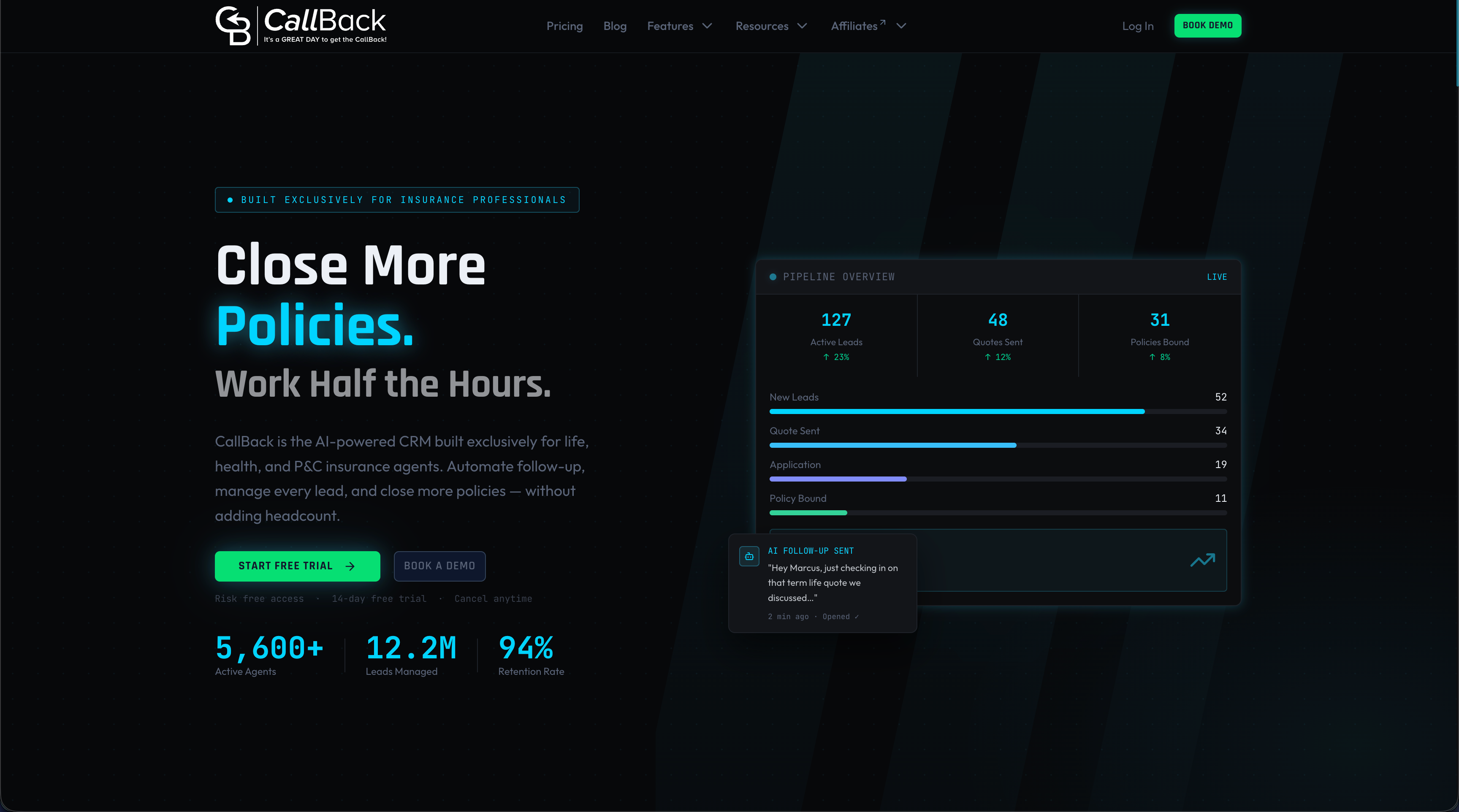
If you’re ready to move beyond basic landing pages and scattered email sequences, Callbackcrm gives you the infrastructure to build, automate, and scale digital sales funnels without stitching together five different tools. The platform’s mobile-first funnel builder lets you launch high-converting pages fast, with integrated opt-in forms, behavior-based email and SMS workflows, and CRM management built in from the start. Every lead that enters your funnel is tracked, scored, and routed automatically. You can see exactly where prospects drop off and act on that data without waiting for a developer. Insurance agents and marketing teams who want to replace guesswork with a measurable, automated pipeline can explore the full platform feature set and start a free trial to see what a purpose-built funnel system actually looks like in practice.
FAQ
What is the role of digital sales funnels in marketing?
Digital sales funnels guide prospects from first awareness through conversion and post-purchase retention using automated, behavior-driven workflows across multiple channels. Their core function is to qualify leads, reduce friction, and maximize revenue at every stage of the customer lifecycle.
How many touchpoints does it take to convert a lead?
It takes an average of eight touchpoints to convert a modern buyer, which is why single-channel approaches like email alone rarely hit competitive conversion rates. A multi-channel strategy combining email, SMS, retargeting, and content is required to reach that threshold consistently.
What makes digital funnel optimization effective?
Effective digital funnel optimization combines A/B testing on high-impact elements, regular drop-off rate analysis by stage, and continuous refinement of post-purchase sequences. Teams that review funnel data weekly and act on it systematically consistently outperform those running static campaigns.
How do you create a sales funnel that converts?
Start by mapping the full customer journey from awareness to post-purchase, then build dedicated landing pages with single, clear offers for each stage. Add behavior-triggered email and SMS sequences, integrate your CRM for lead tracking, and test one variable at a time to identify what moves conversion rates.
What are the main benefits of online sales funnels?
The core benefits of online sales funnels include 24/7 automated lead nurturing, higher average order value through upsells and cross-sells, better lead qualification before sales team involvement, and measurable ROI at each stage of the customer journey.