

TL;DR:
- Optimizing insurance sales funnels increases conversion rates by testing elements like CTAs, messaging, and mobile experience. Speedy multi-channel outreach and lead qualification significantly improve lead-to-client conversion. Continuous testing and nurturing are essential for maintaining high performance beyond initial setup.
Insurance funnel optimization is the process of refining your sales and marketing workflows to convert more leads into paying clients. The average insurance website converts at 3.8% in 2026, while top performers reach 7.2% or higher. That gap is not luck. It comes from deliberate testing of CTAs, hero messaging, mobile experience, and lead flow systems. This guide gives you the exact framework to close that gap, using evidence from 2026 industry benchmarks and proven conversion rate optimization (CRO) techniques built for insurance professionals.
What are the high-impact optimization tactics for insurance sales funnels?
The highest-return improvements in any insurance sales funnel come from three areas: calls to action, hero section messaging, and mobile experience. Testing data shows CTA changes win 35% of the time, mobile experience improvements win 38% of the time, and homepage messaging changes win 31% of the time. These are not minor tweaks. They are the levers that separate average agencies from top producers.
CTA copy, color, and placement
Your CTA is the single most tested element in insurance CRO. Changing the copy from “Get a Quote” to “See My Rates in 60 Seconds” shifts the reader’s focus from effort to reward. Color contrast matters too. A CTA button that blends into the page background loses clicks. Placement above the fold, repeated mid-page and at the bottom, captures visitors at different decision points.

Pro Tip: Test one CTA variable at a time. Changing copy, color, and placement simultaneously makes it impossible to know which change drove the result.
Hero section messaging
Benefit-oriented headlines outperform feature-oriented ones consistently. “Protect your family for less than $30 a month” converts better than “Comprehensive life insurance plans.” The hero section is where most visitors decide to stay or leave. A clear, specific benefit statement paired with a strong CTA is the highest-value real estate on your page.
Mobile experience and form simplification
Form friction and complex quote flows drive most insurance funnel abandonment. Reducing the number of form fields, using progressive disclosure (showing one question at a time), and ensuring fast mobile load times all cut drop-off rates. A visitor filling out a quote form on a phone will abandon at the first sign of friction.
Key areas to audit for mobile:
- Form field count (aim for five fields or fewer on the first step)
- Button size and tap target spacing
- Page load speed (under three seconds)
- Social proof placement near the CTA
- Simplified navigation with one clear path forward
Landing page optimization has the highest test win rate at 50% in insurance CRO. Dedicated landing pages built for specific traffic sources, such as a Medicare Advantage page for Google Ads traffic, outperform generic homepages every time.
How does optimizing lead flow and multi-channel outreach improve insurance funnel conversion?
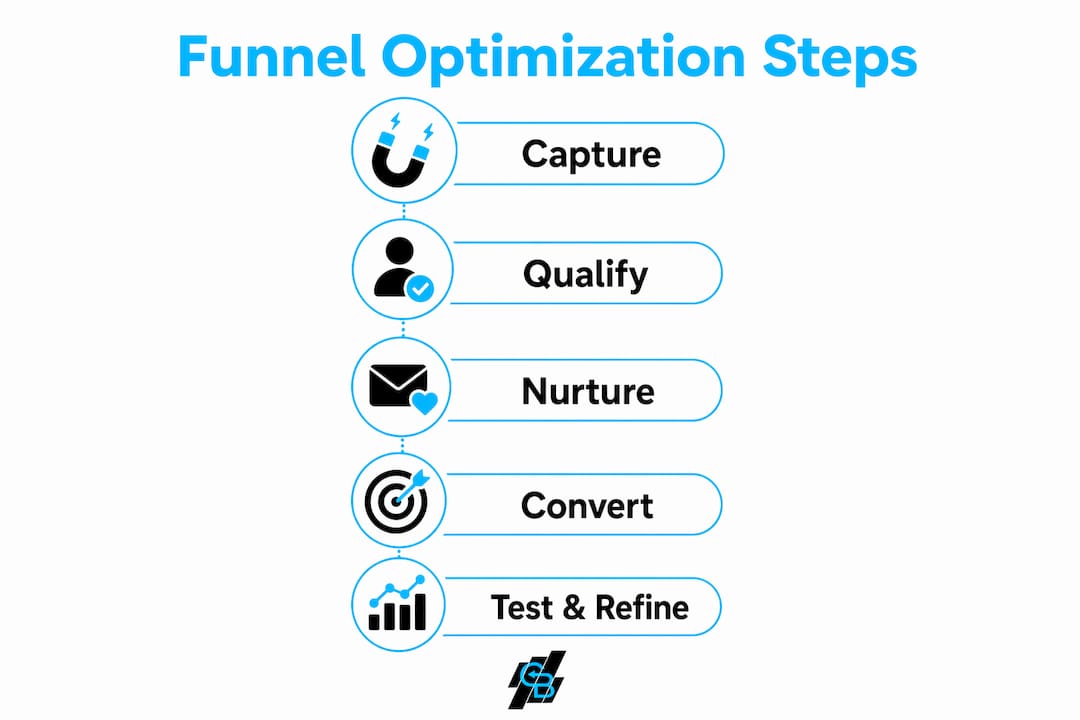
Most agents lose 80–90% of leads between initial capture and conversion. Top producers convert 15–25% of leads by managing five core stages: capture, qualification, nurture, appointment, and conversion. The biggest losses happen in the gaps between those stages, specifically when agents respond slowly or give up after one contact attempt.
Speed is the most underrated variable in insurance lead conversion. A lead contacted within 60 seconds of submitting a form is far more likely to answer and engage than one called an hour later. Failing to implement fast, multi-channel outreach cuts conversion rates by 30–50%. That is not a marginal loss. It is the difference between a profitable agency and a struggling one.
A structured outreach sequence looks like this:
- Call within 60 seconds of lead submission. If no answer, leave a brief voicemail.
- Send an SMS immediately after the call. Keep it personal and direct: “Hi [Name], I just tried calling about your insurance quote. When is a good time to connect?”
- Send a follow-up email within five minutes with a clear subject line and one next step.
- Attempt contact again at a different time of day within 24 hours.
- Continue attempts across all three channels for at least five to eight total touches over seven to ten days.
Statistic to know: 80% of successful insurance sales require five or more contact attempts, yet 50% of leads are never called more than once. Persistence is not optional. It is the strategy.
Soft skills matter as much as the sequence itself. Script development, objection handling, and needs-based selling improve close rates by 20–40%, independent of lead quality. Training your team on these skills compounds the gains from any funnel or outreach improvement.
What is the framework for qualifying and nurturing insurance leads?
Not every lead deserves the same attention. Automated qualification scoring separates buyers from browsers before you spend time on a phone call. Leads below a 40% qualification rate can be deprioritized, freeing your time for prospects who show real intent. Behavioral signals like pages visited, time on site, and form responses all feed into this score.
Top producers use automated scoring to prioritize leads above the 40% threshold. This is not about ignoring low-score leads entirely. It is about sequencing your effort so high-probability prospects get immediate personal attention while lower-probability leads enter an automated nurture sequence.
Nurturing is where most agents leave money on the table. Engaged prospects close at rates between 40–60%. Getting a lead to that “engaged” status requires consistent, valuable contact over time. Effective lead nurturing strategies include:
- Automated email sequences delivering one piece of value per message (not a sales pitch)
- Buyer’s guides specific to the policy type the prospect inquired about
- FAQ content addressing the most common objections (cost, coverage gaps, switching carriers)
- Case studies or testimonials from clients in similar situations
- Appointment reminders and re-engagement messages for cold leads
Pro Tip: Build your nurture sequence around the prospect’s decision timeline, not your sales calendar. A lead shopping for Medicare coverage in october may not be ready to buy until the annual enrollment period opens. Stay in front of them with useful content until they are.
The comparison below shows how qualification and nurture work together to improve funnel efficiency:
| Approach | Outcome |
|---|---|
| No qualification scoring | Time wasted on low-intent leads; low close rates |
| Qualification scoring only | Better time use, but cold leads fall out of the funnel |
| Scoring plus automated nurture | High-intent leads get fast attention; lower-intent leads stay warm until ready |
| Full multi-touch nurture sequence | Engaged prospects close at 40–60%; fewer leads wasted |
How can insurance professionals implement a structured CRO framework?
A structured CRO framework treats your funnel as a system to test and improve, not a one-time build. Small, evidence-informed changes based on behavioral data outperform costly full funnel redesigns. The goal is to identify one friction point, form a hypothesis, test a change, and measure the result.
The process follows four repeating steps:
- Diagnose with data. Use session recordings, heatmaps, and form analytics to find where visitors drop off. Quantitative data tells you where the problem is. Qualitative data (usability testing, error logs) tells you why.
- Form a hypothesis. “Changing the CTA from ‘Submit’ to ‘Get My Free Quote’ will increase clicks by reducing perceived commitment.” Every test needs a clear, falsifiable hypothesis.
- Run the test. A/B testing works for single-variable changes. Multivariate testing works when you need to test combinations of changes simultaneously. Run tests long enough to reach statistical significance.
- Measure and iterate. Track conversion rate, cost per acquisition, and lead quality alongside click-through rates. A higher click rate that brings in lower-quality leads is not a win.
Prioritize tests in this order based on impact potential:
| Test Type | Typical Win Rate | Priority |
|---|---|---|
| Landing page optimization | 50% | Highest |
| Mobile experience improvements | 38% | High |
| CTA changes | 35% | High |
| Homepage messaging | 31% | Medium |
| Form layout simplification | Variable | Medium |
The insurance sales funnel tutorial from Callbackcrm walks through how to automate this testing cycle so you can run more experiments without adding manual work. Automation also ensures your outreach sequences fire at the right time, every time, without relying on an agent to remember.
Key Takeaways
A well-built insurance funnel that combines fast outreach, qualification scoring, and continuous CRO testing consistently converts at rates double the industry average.
| Point | Details |
|---|---|
| Benchmark your conversion rate | The industry average is 3.8%; top performers reach 7.2% or higher. |
| Prioritize landing page tests | Landing page optimization wins 50% of tests, making it the highest-return CRO activity. |
| Contact leads within 60 seconds | Slow response cuts conversion by 30–50%; speed is your biggest outreach advantage. |
| Score and segment every lead | Deprioritize leads below 40% qualification to protect your time and focus on buyers. |
| Nurture consistently | Engaged prospects close at 40–60%; automated multi-touch sequences keep leads warm. |
Why funnel optimization is not a one-time project
Most agents treat funnel optimization as something they do once when they launch a new website or run a new ad campaign. That is the wrong mental model. The agents I have seen sustain conversion rates above 6% treat their funnel like a living system. They test something every month, review their outreach data every week, and retrain their team on objection handling every quarter.
The uncomfortable truth is that the technology side of funnel optimization is the easy part. Callbackcrm and similar platforms give you the automation, the scoring, and the testing infrastructure. What most agents neglect is the human side: the quality of the conversation when a lead actually picks up the phone, the relevance of the nurture content they send, and the discipline to follow up eight times when most agents quit after one.
I have also seen agents over-invest in lead generation while ignoring the funnel that those leads enter. Buying more leads into a broken funnel is expensive. Fixing the funnel first, then scaling lead volume, is the sequence that actually compounds. The lead generation workflow matters far less than what happens to leads after they enter your system.
The data on soft skills is worth repeating: training in script development and objection handling improves close rates by 20–40%, independent of lead quality. That is a bigger return than most CTA tests. Invest in both, but do not let the appeal of technology improvements distract you from the fundamentals of selling.
— Kyle
How Callbackcrm supports your insurance funnel
Callbackcrm is built for insurance agents who want to put their funnel on autopilot without sacrificing the personal touch that closes deals.
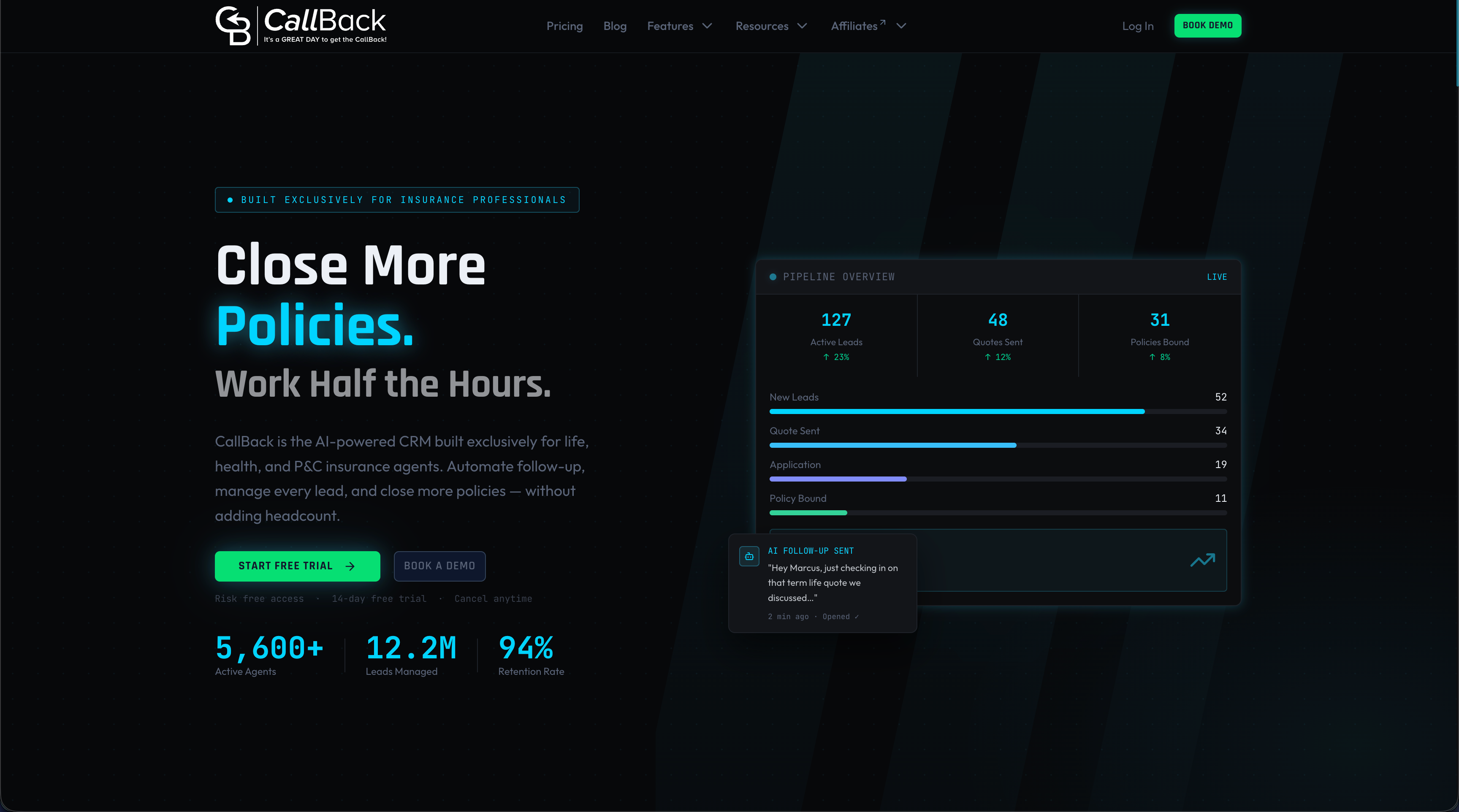
The platform’s SMS marketing tools fire instant follow-up texts the moment a lead submits a form, hitting the 60-second response window automatically. The drag-and-drop funnel and website builder lets you build dedicated landing pages for each traffic source, run A/B tests, and track conversion data in one place. AI-powered lead scoring prioritizes your highest-intent prospects so your team focuses on the right calls first. Callbackcrm offers a free trial so you can test the full system before committing.
FAQ
What is insurance funnel optimization?
Insurance funnel optimization is the process of testing and improving each stage of your client acquisition workflow to increase the percentage of leads that convert to paying clients. It covers CTA testing, lead qualification, outreach speed, and nurture sequences.
What is a good insurance website conversion rate?
The industry average is 3.8% in 2026. Top-performing insurance websites convert at 7.2% or higher, according to A/B testing benchmarks from GrowthLayer.
How many times should I contact an insurance lead?
Contact leads at least five to eight times across call, SMS, and email. Research shows 80% of successful insurance sales require five or more contact attempts, yet half of all leads are never called more than once.
How does lead qualification improve funnel efficiency?
Automated qualification scoring based on behavioral data lets you deprioritize leads below a 40% qualification threshold. This protects your time and directs personal outreach toward prospects most likely to buy.
What type of content works best for nurturing insurance leads?
Buyer’s guides, FAQ documents, testimonials, and case studies matched to the prospect’s policy interest perform best. Educational nurture content moves engaged prospects to close rates of 40–60%.