

Think funnel marketing will instantly replace cold calling and flood your pipeline overnight? That’s the dangerous myth costing agents thousands in wasted effort. Insurance funnel marketing requires strategic trust building, compliant nurturing sequences, and persistence across multiple touchpoints. This guide reveals how tailored funnel strategies transform lead generation and drive sustainable insurance sales growth in 2026.
Table of Contents
- Understanding Funnel Marketing In Insurance
- Stages Of The Insurance Marketing Funnel
- Common Misconceptions About Funnel Marketing In Insurance
- Building And Optimizing Your Insurance Funnel
- Funnel Marketing Versus Traditional Insurance Sales Approaches
- Conclusion: Transforming Insurance Lead Generation With Funnel Marketing
- Optimize Your Insurance Marketing With Callback Crm
Key takeaways
| Point | Details |
|---|---|
| Funnel marketing segments the buyer journey into awareness, interest, decision, and action stages customized for insurance complexity. | This structured approach replaces one-off cold calls with continuous, multi-touch engagement that builds trust systematically. |
| Insurance funnels emphasize regulatory compliance, trust building, and relationship nurturing at every stage. | Unlike generic marketing funnels, insurance requires transparent disclosures and credibility proof throughout the prospect journey. |
| AI and automation dramatically improve lead scoring, personalized follow-ups, and nurturing efficiency. | Modern platforms automate manual tasks while maintaining compliant, timely outreach that respects buyer behavior patterns. |
| Traditional cold calling delivers lower conversion rates compared to funnel marketing’s data-driven, persistent engagement. | Funnels produce higher-quality leads through education and relationship building rather than interruptive sales pitches. |
| Successful funnel implementation requires clear buyer personas, multi-channel strategies, and continuous metric-based optimization. | Agents must map content to each funnel stage, monitor conversion rates, and refine approaches based on performance data. |
Understanding funnel marketing in insurance
Funnel marketing in insurance is a structured methodology that systematically guides prospects through awareness, interest, decision, and action stages customized for insurance buyer behavior. Unlike generic marketing funnels, insurance funnels address complex buyer considerations like policy comparisons, coverage gaps, premium affordability, and regulatory requirements that extend decision timelines.
The primary goals include generating qualified leads, nurturing prospects with educational content, building trust through transparency, and ensuring compliance with state and federal insurance marketing regulations. Insurance funnel marketing integrates digital touchpoints like email sequences, webinars, and retargeting ads with human interactions such as consultations and personalized proposals.
This approach replaces outdated cold calling with data-driven, automated processes that respect modern buyer behavior. Prospects research extensively online before engaging with agents, making continuous digital presence and value delivery essential. Sales automation benefits include consistent follow-up, lead prioritization based on engagement scoring, and personalized outreach at scale without manual effort.
Key differences from generic funnels include:
- Insurance funnels require longer nurturing periods due to high-stakes financial decisions and complex product comparisons
- Regulatory compliance mandates transparent disclosures, opt-in consent, and documentation at every communication stage
- Trust building is paramount, requiring testimonials, credentials, carrier partnerships, and social proof throughout the journey
- Multi-product complexity demands segmented content addressing specific insurance types like life, health, auto, or commercial coverage
Modern insurance buyers expect personalized, educational experiences that answer their questions without pressure. Funnel marketing delivers this by automating timely, relevant content delivery while freeing agents to focus on high-value consultations with engaged prospects.
Stages of the insurance marketing funnel
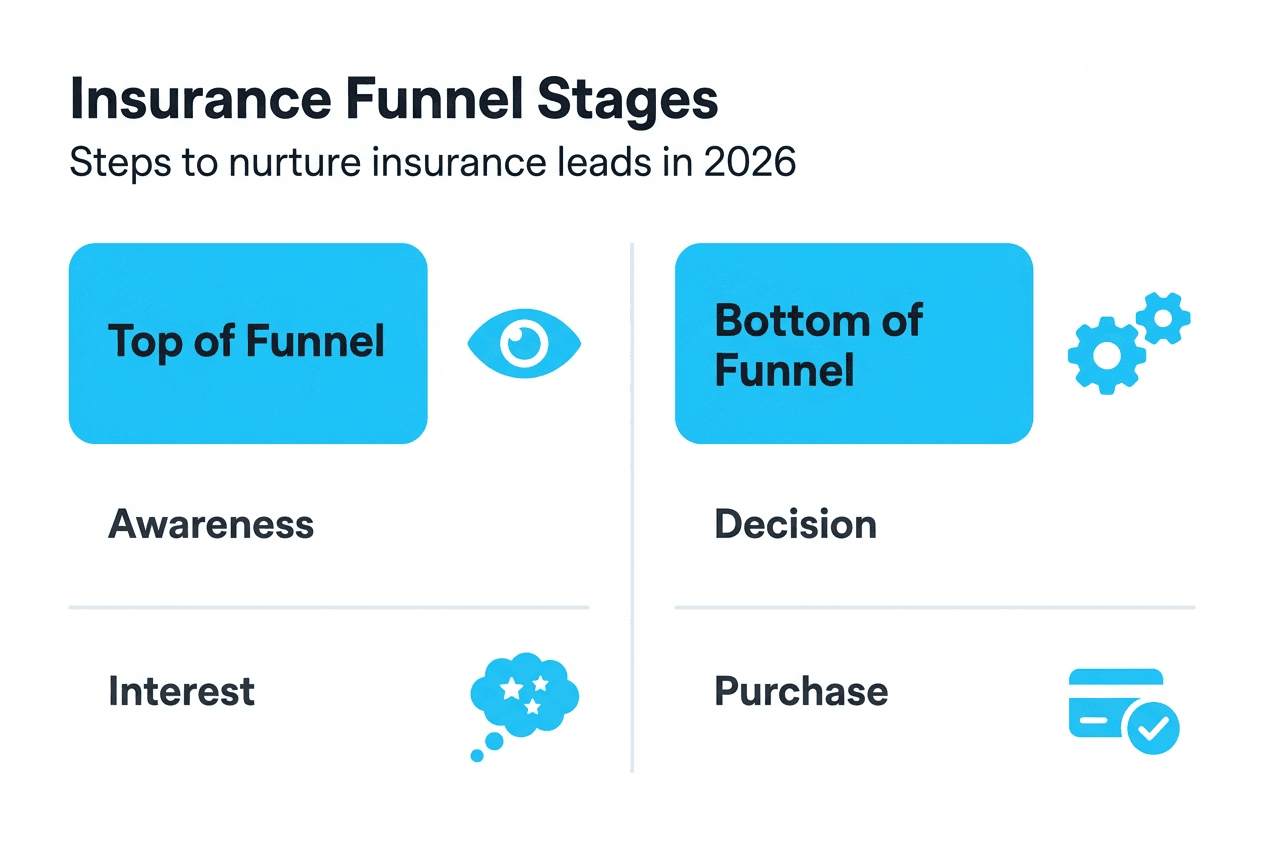
The insurance funnel uses four primary stages reflecting the complex buyer journey from initial awareness to policy purchase. Each stage requires specific content, automation strategies, and compliance considerations tailored to insurance product complexity and regulatory requirements.
-
Awareness stage: Prospects recognize an insurance need or risk exposure. Agents attract attention through educational blog posts, social media content, webinars, and paid ads addressing common insurance questions. Content focuses on problem identification rather than sales pitches.
-
Interest stage: Prospects actively research solutions and compare options. Agents capture leads with valuable assets like coverage calculators, ebooks on policy selection, or free risk assessments. Email sequences deliver personalized content based on expressed interests and engagement behavior.
-
Decision stage: Prospects evaluate specific agents and carriers. Trust building becomes critical through client testimonials, carrier partnership showcases, compliance certifications, and free consultation offers. Personalized proposals and policy comparisons address specific prospect needs and objections.
-
Action stage: Prospects commit to purchasing coverage. Clear calls to action, simplified application processes, and automated reminders reduce friction. Post-sale nurturing begins immediately to ensure satisfaction, referrals, and cross-sell opportunities.
| Funnel stage | Primary goal | Key tactics | Compliance focus |
|---|---|---|---|
| Awareness | Educate and attract | Blog posts, social media, webinars, SEO | Accurate information, no misleading claims |
| Interest | Capture and qualify leads | Lead magnets, email sequences, retargeting | Opt-in consent, privacy policy disclosure |
| Decision | Build trust and address objections | Testimonials, consultations, proposals | Transparent pricing, coverage limitations |
| Action | Convert and onboard clients | Clear CTAs, simple applications, follow-ups | E-signature compliance, policy delivery confirmation |
Trust and regulatory compliance are critical across all stages. Insurance marketing regulations require transparent communication, documented consent, and accurate product representation. Agents must balance automation efficiency with personalized human touchpoints that address complex questions and build confidence in recommendations.
Pro Tip: Map specific insurance products to funnel stages by creating separate nurturing tracks for life, health, auto, and commercial prospects. Segmented content dramatically improves relevance and conversion rates by addressing unique product considerations and buyer motivations at each stage.
The insurance lead generation workflow automates stage transitions based on engagement triggers like email opens, content downloads, and website visits, ensuring timely follow-up without manual tracking.
Common misconceptions about funnel marketing in insurance
Insurance agents often hold false beliefs about funnel marketing that create unrealistic expectations and hinder effective implementation. Correcting these misconceptions prevents frustration and enables strategic adoption of modern marketing approaches.
-
Misconception: Funnel marketing immediately replaces all cold calling and traditional prospecting. Reality: Funnels complement human sales efforts by automating initial nurturing and lead qualification, but personalized consultations remain essential for complex insurance decisions and policy customization.
-
Misconception: Insurance leads convert instantly once entering the funnel. Reality: Conversion typically requires weeks or months due to extensive prospect research, policy comparisons, budget considerations, and family decision-making processes inherent to insurance purchases.
-
Misconception: Automated funnels eliminate the need for personalized agent interaction. Reality: Automation handles repetitive tasks like email sequences and lead scoring, but high-converting funnels integrate human touchpoints at critical decision stages where expertise and trust building are irreplaceable.
-
Misconception: Any generic funnel template works for insurance marketing. Reality: Insurance funnels must address product complexity, regulatory compliance, trust barriers, and extended decision cycles that generic business funnels ignore, requiring specialized content and compliance guardrails.
-
Misconception: Once built, insurance funnels run successfully without ongoing optimization. Reality: Effective funnels require continuous monitoring of conversion metrics, A/B testing of content and CTAs, regular compliance updates, and refinement based on prospect feedback and market changes.
Patience and persistence in nurturing dramatically increase lead quality and conversion rates compared to rushing prospects toward premature sales conversations. Multi-touch engagement builds familiarity and credibility over time, positioning agents as trusted advisors rather than transactional salespeople.
Pro Tip: Set realistic conversion timeline expectations by tracking average days from lead capture to policy purchase for each insurance product type. Use this data to design nurturing sequences with appropriate touchpoint frequency and duration, preventing premature disqualification of slow-moving but high-quality prospects.
Ignoring regulatory requirements in funnel content jeopardizes campaigns and agent credibility. Every email, landing page, and ad must include required disclosures, accurate product representations, and compliant opt-out mechanisms to maintain licensing and carrier appointments.
Building and optimizing your insurance funnel
Creating an effective insurance funnel requires strategic planning, compliant execution, and continuous improvement based on performance data. Follow these practical steps to build and refine a high-converting funnel tailored to your insurance niche and target clients.
-
Define your ideal client persona: Research demographics, pain points, insurance needs, buying behaviors, and preferred communication channels. Tailor content, messaging, and automation specifically to these characteristics for maximum relevance and engagement.
-
Map funnel stages to insurance products and buyer needs: Create realistic journey paths showing how prospects move from awareness to purchase for each insurance type. Identify required content, touchpoints, and decision triggers at each stage.
-
Develop lead capture assets relevant to insurance buyers: Create valuable resources like coverage gap calculators, policy comparison guides, risk assessment tools, or educational ebooks that prospects exchange contact information to access.
-
Implement multi-channel nurturing sequences: Design email workflows, retargeting ad campaigns, webinar invitations, and SMS follow-ups that deliver timely, personalized content based on prospect behavior and engagement signals.
-
Use AI tools for efficient lead scoring and personalized follow-ups: Implement sales automation benefits through platforms that analyze engagement patterns, prioritize hot prospects, and trigger customized outreach based on behavioral data.
-
Monitor key funnel metrics: Track conversion rates at each stage, email open and click rates, landing page performance, cost per lead, and average time to conversion. Identify bottlenecks and optimization opportunities through data analysis.
-
Ensure compliance throughout funnel processes: Review all content for accurate product representations, required disclosures, opt-in consent mechanisms, and privacy policy adherence. Document compliance procedures and update materials when regulations change.
Critical optimization tactics include:
- A/B test email subject lines, CTAs, landing page layouts, and offer formats to identify highest-performing variations
- Segment prospects by insurance type interest, demographic characteristics, and engagement level for hyper-targeted messaging
- Implement behavioral triggers that automatically adjust nurturing intensity based on prospect actions like multiple email opens or website revisits
- Regularly refresh content to maintain relevance, incorporate new insurance products, and address emerging market trends
Pro Tip: Start with a single insurance product funnel rather than building multiple complex funnels simultaneously. Perfect the process, learn what resonates with your audience, and document successful tactics before expanding to additional insurance types. This focused approach accelerates learning and delivers faster ROI.
The 7 tips for lead generation provide additional strategies for attracting qualified prospects, while insurance lead generation strategies offer industry-specific best practices for 2026.
Funnel marketing versus traditional insurance sales approaches
Comparing funnel marketing to legacy sales methods reveals significant efficiency, relationship building, and conversion advantages that position agents competitively in 2026’s digital-first insurance market.

Traditional cold calling relies on high-volume, short transactional conversations with minimal relationship building. Agents face frequent rejection, gatekeepers, and prospects unprepared for sales discussions. Success rates decline as consumers increasingly screen unknown calls and resist interruptive pitches.
Funnel marketing emphasizes relationship and trust building through multiple touchpoints over extended timeframes. Prospects receive educational content addressing their questions and concerns before sales conversations begin. This approach respects modern buyer preferences for self-directed research and informed decision making.
| Comparison factor | Traditional cold calling | Funnel marketing |
|---|---|---|
| Prospect engagement | Single interruptive call | Multiple value-driven touchpoints |
| Relationship building | Minimal, transactional | Continuous trust building over time |
| Lead quality | Random, often unqualified | Pre-qualified through content engagement |
| Efficiency | Labor-intensive, low conversion | Automated nurturing, higher conversion |
| Scalability | Limited by agent call capacity | Scales infinitely through automation |
| Compliance tracking | Manual documentation | Automated audit trails and consent logs |
| Personalization | Generic pitch for all prospects | Customized content based on behavior |
Automation in funnels delivers consistent lead engagement without manual effort. Email sequences, retargeting ads, and behavioral triggers maintain prospect relationships while agents focus on high-value consultations with engaged leads. Data-driven optimization continuously improves performance through A/B testing and conversion analysis.
Funnel marketing’s continuous engagement produces higher-quality leads and better conversion rates compared to cold calling’s rapidly decreasing returns. Prospects entering funnels have demonstrated interest through content downloads or website visits, indicating readiness for insurance conversations.
Key advantages of funnel adoption include:
- Predictable lead flow through consistent content marketing and paid advertising rather than daily cold calling uncertainty
- Lower cost per acquisition as automation reduces labor hours required for lead generation and initial qualification
- Better prospect experience through educational value delivery before sales pressure, building goodwill and referrals
- Comprehensive analytics showing exact ROI and funnel performance metrics impossible to track with traditional methods
However, insurance funnels require ongoing personal and digital engagement rather than serving as fully automated replacements for human expertise. Complex policy questions, custom coverage design, and final purchase decisions benefit from agent consultation and personalized recommendations.
The lead funnel optimization strategies demonstrate how agents successfully blend automation efficiency with relationship-focused service delivery for maximum conversion impact.
Conclusion: transforming insurance lead generation with funnel marketing
Funnel marketing aligns perfectly with how modern insurance buyers research coverage options, compare policies, and make informed purchase decisions in 2026. Prospects expect educational content, transparent communication, and self-service research tools before engaging with agents for personalized recommendations.
Investment in trust building, regulatory compliance, and personalized nurturing throughout the funnel journey is essential for converting today’s informed, cautious insurance buyers. Generic sales pitches and pressure tactics fail against competitors offering value-driven, consultative approaches supported by automated yet personalized engagement.
AI and automation amplify lead management efficiency and conversion rates by handling repetitive tasks like follow-up scheduling, engagement scoring, and initial qualification. These tools free agents to focus expertise on high-value consultations, complex policy design, and relationship deepening with qualified prospects.
Adopting funnel marketing enables insurance agents to scale sales sustainably without proportional increases in labor hours or marketing costs. Automated nurturing maintains consistent prospect engagement while data analytics identify optimization opportunities impossible to spot with traditional methods.
Moving beyond outdated cold calling tactics positions agents competitively as the insurance industry continues its digital transformation. Prospects increasingly expect modern, technology-enabled experiences, and agents embracing funnel marketing meet these expectations while improving their own efficiency and work-life balance.
Optimize your insurance marketing with CallBack CRM
Ready to implement everything you’ve learned about insurance funnel marketing? CallBack CRM delivers over 50 AI-powered features specifically designed for insurance agents seeking to automate lead management, nurture prospects efficiently, and boost conversion rates.
The platform’s intelligent automation handles lead scoring, behavioral segmentation, and personalized outreach at scale while maintaining full regulatory compliance. CallBack CRM features include email and SMS marketing, funnel builders, webinar tools, and social media management integrated into one comprehensive system.
Lead management capabilities track every prospect interaction, automate follow-up sequences, and prioritize hot leads based on engagement signals. AI automation tools predict customer behavior, identify high-value prospects, and personalize communication without manual data entry or workflow management.
Try CallBack CRM risk-free today to transform your insurance funnel marketing and convert more qualified prospects into loyal clients in 2026.
FAQ
What is funnel marketing for insurance agents?
Funnel marketing is a multi-stage process guiding insurance prospects from initial awareness through interest and decision stages to final policy purchase. It focuses specifically on trust building, regulatory compliance, and persistent lead nurturing tailored to insurance product complexity. This structured approach replaces one-off cold calls with continuous, value-driven engagement that respects modern buyer research behaviors.
How does funnel marketing improve lead quality compared to cold calling?
Funnels nurture prospects with personalized, multi-touch engagement that builds trust and demonstrates expertise over weeks or months, unlike cold calling’s single interruptive conversation. Prospects self-qualify by engaging with educational content, downloading resources, or attending webinars before sales discussions begin. This results in significantly more qualified leads with higher conversion rates and better long-term client relationships.
What role does AI play in modern insurance funnel marketing?
AI automates lead scoring by analyzing engagement patterns to prioritize hot prospects requiring immediate agent attention. It enables personalized, timely follow-ups at scale by triggering customized email sequences based on specific prospect behaviors like content downloads or website revisits. AI also helps maintain compliance by controlling messaging frequency, content accuracy, and required disclosures across all automated communications. This increases overall funnel efficiency while freeing agents to focus on high-value consultation and relationship-building tasks.
How long does it usually take to convert leads with funnel marketing?
Insurance lead conversion typically requires several weeks to multiple months due to the complex research and family decision-making processes inherent to significant financial commitments like insurance policies. Prospects compare multiple coverage options, consult family members, review budgets, and evaluate agent credibility before purchasing. Multiple nurturing touchpoints delivering educational content, addressing objections, and building trust are essential throughout this extended timeline before successfully closing sales.