

Voicemail drops, including ringless voicemail, are legal for insurance outreach when the agent has documented consent, honors Do-Not-Call rules, and follows state-specific restrictions. Skip any of those three, and a single campaign can turn into a compliance problem.
Before you load a single list into a dialer or a CRM automation, check these:
- Consent: The Telephone Consumer Protection Act (TCPA) requires prior express written consent to deliver marketing messages to mobile numbers using an automated system. Informational messages to existing clients face fewer restrictions than cold marketing drops.
- Do-Not-Call exposure: Numbers on the National Do-Not-Call Registry are off-limits for marketing calls unless the recipient has an established business relationship (EBR) with your agency, and even EBR protection has time limits.
- State law layering: States like Florida, Oklahoma, and Washington have added their own telemarketing statutes that can be stricter than federal rules, so a campaign that clears the TCPA bar isn’t automatically clear everywhere.
If you don’t have documented, timestamped consent for the numbers on your list, stop here and build that first. If you do, keep reading. The rest of this guide covers the legal framework, the technical differences between voicemail-drop methods, and a compliance checklist you can hand to an operations manager today.
Key Takeaways
Voicemail drops for insurance outreach are legal and effective when agencies pair documented consent with suppression lists, audit logs, and a multi-channel follow-up sequence.
| Point | Details |
|---|---|
| Consent comes first | Confirm express written consent with a timestamp and source before any drop, marketing or informational. |
| Watch the EBR window | Existing business relationship exceptions to Do-Not-Call rules have time limits, so verify recency before contacting past clients. |
| State law can be stricter | Check the toughest state your list touches rather than assuming the federal TCPA floor applies everywhere. |
| Pair drops with other channels | Combine voicemail with email and SMS in a 3 to 5 touch sequence for better conversion than voicemail alone. |
| Use CRM-level controls | Callbackcrm centralizes consent fields, suppression lists, and exportable audit logs so campaigns stay defensible as they scale. |
Table of Contents
- Voicemail Drops Insurance Agents Need to Understand Legally
- How Ringless Voicemail, Manual Drops, and Voice Broadcasts Actually Differ
- Building a Compliance Checklist Before You Launch
- Choosing How to Deploy Voicemail Drops for Agents
- Do Voicemail Drops for Insurance Actually Work?
- What Happens When Voicemail Drop Campaigns Go Wrong
- Deploying Voicemail Drops Inside CallBack CRM the Right Way
- Getting Started: A Short Action Plan
- Where to Learn More
- Voicemail Drops for Insurance Agents: The Legal BLUF and CRM Playbook
- Run Compliant Voicemail Campaigns Without Guessing
- Frequently Asked Questions
- Sources
Voicemail Drops Insurance Agents Need to Understand Legally
The TCPA governs most of what makes voicemail drops risky or safe, and the Federal Communications Commission (FCC) has issued guidance treating ringless voicemail similarly to a live or automated call for consent purposes. That distinction surprises a lot of agents who assume that because the phone never rings, the rules don’t apply. They do.
Express written consent is the standard the FCC applies to autodialed or prerecorded marketing calls and texts sent to wireless numbers. That consent needs to specify the phone number, name the type of messages the person is agreeing to receive, and ideally live somewhere you can retrieve it years later. A checkbox buried in a 40-page policy document rarely holds up. A clear, standalone opt-in on a quote request form does.
Informational messages, such as a policy renewal reminder to a current client, are treated differently than promotional voicemail drops pitching a new product to a cold list. The line between the two matters because informational content sent to existing customers often falls under a lower consent threshold, while marketing content to a number you’ve never contacted requires the stricter written consent standard.
Ringless voicemail drops delivered without documented consent expose the sender to the same statutory penalties as an illegal robocall, because the FCC has signaled it evaluates the delivery method’s effect on the recipient, not just whether the phone physically rang.
The National Do-Not-Call Registry adds another layer. Numbers on the registry are protected from marketing calls unless you have an EBR, typically defined as an existing customer relationship within the past 18 months, or an inquiry within the past three months. That window closes. An agent who dropped a voicemail to a client who bought a policy two years ago and hasn’t renewed since is standing on shakier ground than one contacting a current policyholder mid-term.
State law is where things get genuinely uneven. Some states impose call-time restrictions tighter than the federal 8 a.m. to 9 p.m. window, require additional disclosures, or apply their own private right of action with separate statutory damages. Practitioner communities have flagged this repeatedly, noting that the legal status of ringless voicemail gets debated constantly precisely because state-level interpretation varies and the technology has outpaced clear federal rulemaking in some circuits.
Pro Tip: Before launching any campaign that crosses state lines, have compliance or outside counsel confirm the strictest state your list touches, and build your campaign to that standard rather than the federal floor.
How Ringless Voicemail, Manual Drops, and Voice Broadcasts Actually Differ
Not all voicemail drops work the same way, and the delivery mechanism affects both legal exposure and how the message lands with the recipient.
- Ringless voicemail (RVM) injects an audio message directly into a recipient’s voicemail box using server-side technology, so the phone never rings. Vendors market this as less intrusive, but the FCC has generally treated the delivery method as functionally similar to a call for consent purposes, meaning the “no ring” feature doesn’t exempt you from TCPA requirements.
- Manual drops happen when an agent personally dials a number, lets it go to voicemail, and leaves a message live or pre-recorded. Because a person initiated the call, manual drops generally face fewer autodialer restrictions, though consent rules for marketing content still apply.
- Voice broadcast systems place automated calls in bulk and can behave like a robocall if the recipient answers live, triggering stricter consent and identification requirements than either RVM or manual outreach.
The recipient’s experience shapes how a regulator or court might classify the message. A live agent leaving a two-line voicemail after a real dial attempt reads very differently than a scheduled, templated message pushed to 10,000 numbers overnight. Both can be legal. Only one of them looks obviously compliant if a complaint gets filed.
Integration matters just as much as method. Most agencies trigger drops through a CRM workflow, an API call to a vendor, or a bulk file upload. Each approach leaves a different quality of record. A CRM-triggered drop tied to a specific lead record, timestamp, and consent flag creates an audit trail automatically. A spreadsheet upload to a third-party dialer often does not, which is exactly the gap that turns into a problem during a state attorney general inquiry.
A typical compliant sequence looks like this: a new lead submits a quote request with an explicit consent checkbox, the CRM logs that consent with a timestamp, a workflow trigger fires an RVM drop 24 hours later if the lead hasn’t responded, and an SMS follow-up goes out two days after that if the voicemail wasn’t returned. Every step generates a log entry tied to the same lead record, so if anyone ever asks what happened and why, the answer is retrievable in seconds instead of buried across three disconnected systems.
Building a Compliance Checklist Before You Launch
Turning the legal framework into daily practice means building controls your team actually follows, not a policy document that sits in a shared drive nobody opens.
Start with documentation. You need express written consent records showing the phone number, the date, the method of collection (web form, signed application, IVR call), and the specific language the person agreed to. A source attribution field matters more than agents realize. If a lead came from a referral partner’s list rather than your own funnel, you may not have valid consent even if the partner claims they collected it.
List hygiene comes next. Run every campaign list against the National Do-Not-Call Registry, maintain your own internal suppression list for anyone who has opted out, and layer in state-specific suppression where required. A single opt-out that doesn’t sync across every channel, meaning someone who opts out of voicemail but still gets emailed the following week, creates both a compliance gap and a client relations problem.
Message content has its own rules:
- Informational messages to current clients need less disclosure than marketing content to cold leads.
- Every marketing voicemail should include a clear identification of your agency and an easy opt-out method.
- Time-of-day restrictions generally mirror the TCPA’s 8 a.m. to 9 p.m. recipient local-time window, and some states narrow that further.
- Frequency caps matter for deliverability and for avoiding harassment claims. Multiple drops to the same number in a short window raise red flags even when each individual drop is technically compliant.
Operational controls tie it together. Decide who inside the agency has permission to launch a campaign, keep a written audit trail of every drop (recipient, timestamp, message version, trigger source), and set a retention policy that keeps these records available for at least as long as your state’s statute of limitations for TCPA-adjacent claims.
Pro Tip: Log the consent date, source, exact message version, and delivery timestamp for every single drop, and export that data monthly into a format your compliance team can hand over on short notice. If you can’t produce a clean export within an hour of a request, your audit trail isn’t good enough.
Choosing How to Deploy Voicemail Drops for Agents
Agencies generally choose between three operational paths, and each comes with a different mix of control, scale, and risk.
Manual drops give you the most control and the least scale. An agent personally dials and leaves a message, which means every drop reflects real judgment about whether that specific contact is appropriate. It doesn’t scale past a small book of business, but the legal exposure is lower because a human initiated each call.
CRM-driven personal drops sit in the middle. The agent’s CRM triggers a pre-recorded or templated voicemail based on a workflow rule, tied to a specific lead record with consent already verified. This scales further than manual dialing while keeping the audit trail intact, because every trigger event and consent check lives inside the same system that stores the lead’s history.
Third-party ringless vendors offer the highest scale but introduce vendor risk. You’re trusting an outside company’s consent-scrubbing process, list hygiene, and delivery infrastructure. If that vendor’s compliance practices are weak, the liability often lands back on your agency anyway, since regulators tend to hold the party that benefits from the campaign responsible regardless of who technically sent it.
| Deployment method | Scale | Compliance control | Typical risk |
|---|---|---|---|
| Manual agent drops | Low | High (human judgment per call) | Low legal risk, high labor cost |
| CRM-driven drops | Moderate to high | High (automated consent checks, logged triggers) | Low to moderate, depends on CRM setup |
| Third-party RVM vendor | High | Variable (depends on vendor practices) | Moderate to high, includes vendor liability |
If you go the vendor route, insist on contract terms that specify data security obligations, indemnification if the vendor’s list hygiene fails, and your right to export full delivery and consent logs on demand. A vendor unwilling to put those terms in writing is telling you something about how seriously they take compliance.
Do Voicemail Drops for Insurance Actually Work?
Industry vendors report that ringless voicemail tends to generate meaningful callback rates because it reaches people without an interruptive ring, and personalized, targeted messages perform better than generic blasts across the campaigns they track. Treat those figures as vendor-reported and directional rather than independently audited, but the underlying logic holds up: list quality and message relevance drive results far more than the delivery method itself.
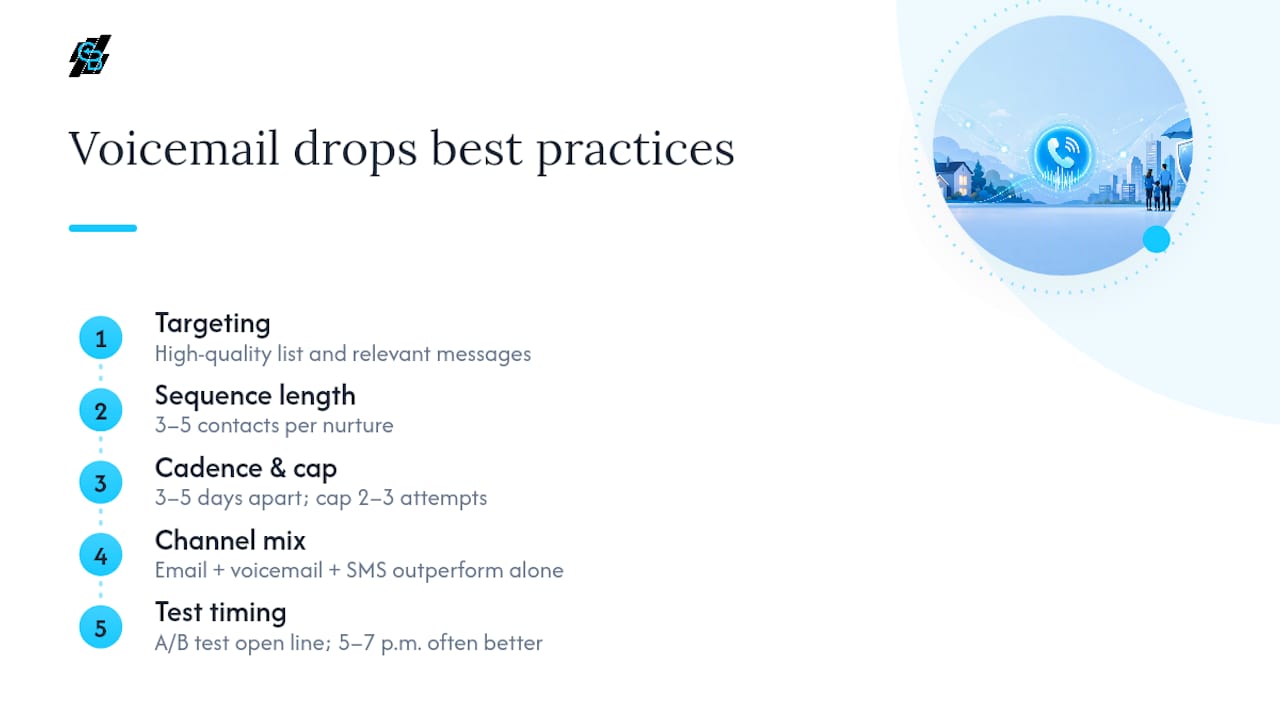
The bigger pattern in insurance lead generation is that most leads need several touches before they convert. Combining email drip sequences with voicemail and SMS tends to outperform any single channel used alone, and a well-structured 3 to 5 contact nurture sequence consistently improves close rates compared to a one-and-done outreach attempt. A voicemail drop works best as one link in that chain, not the entire strategy.
Here are four script templates built around common insurance use cases:
New-quote follow-up: “Hi, this is [Name] with [Agency]. I put together your auto quote and wanted to walk you through a couple of ways to save. Call me back at [number] whenever works, no pressure.”
Renewal reminder: “Hi [Name], your policy renews on [date]. I reviewed your coverage and have a quick update worth two minutes of your time. Give me a call back at [number].”
Cross-sell prompt: “Hi [Name], thanks again for trusting us with your home policy. A lot of clients in your situation save by bundling auto coverage too. Call me at [number] and I’ll run the numbers.”
Cold re-engagement: “Hi [Name], it’s [Name] with [Agency]. We spoke a while back about coverage options. Rates have shifted since then and I think it’s worth a quick look. Call me back at [number].”
For cadence, most agencies see reasonable results spacing drops 3 to 5 days apart within an active sequence, capped at two or three attempts before moving the lead to a lower-frequency nurture track. Track these metrics to know if a campaign is working:
A/B test your opening line and your time of day. Early evening (5 to 7 p.m. local time) often outperforms mid-morning for personal lines, though this varies by demographic and should be tested against your own list rather than assumed.
What Happens When Voicemail Drop Campaigns Go Wrong
TCPA violations carry statutory damages of $500 per violation, tripled to $1,500 for willful violations, and those numbers multiply fast across a list of any real size. A campaign that drops voicemails to 5,000 numbers without proper consent isn’t a $500 problem. It’s a five-to-seven-figure exposure if it becomes a class action, and TCPA class actions against marketers, including insurance agencies, are common enough that plaintiff’s attorneys actively watch for sloppy campaigns.
Beyond federal statutory damages, state attorneys general can pursue separate enforcement action under state telemarketing statutes, and the FCC itself can issue fines independent of any private lawsuit. Vendor risk compounds this. If a third-party ringless voicemail provider scrubbed a list poorly or misrepresented their consent-collection process, your agency is still the one whose name is on the campaign and whose brand takes the reputational hit.
The agencies that get burned worst are rarely the ones running large campaigns deliberately. They’re the ones who assumed a vendor’s marketing claims about “TCPA-compliant lists” meant the vendor had actually verified consent for every number, when in practice that verification never happened.
Operational fallout extends past legal exposure. A wave of client complaints about unwanted voicemails damages trust with the exact people you’re trying to retain, and opt-out spikes often precede broader churn. Build a rapid opt-out process that removes a number from every channel within 24 hours, and keep a remediation playbook ready that includes an apology outreach template and a compliance review trigger if complaints exceed a set threshold.
Before signing with any third-party vendor, insist on these contract terms:
- Written indemnification if the vendor’s consent or list-scrubbing practices cause a violation.
- Data security commitments meeting a recognized standard, not vague “industry best practices” language.
- Your right to export full delivery, consent, and suppression logs on demand.
- No auto-renewal clauses that lock you into a vendor before you’ve reviewed a full compliance audit.
Deploying Voicemail Drops Inside CallBack CRM the Right Way
Building this correctly inside your CRM means wiring consent, suppression, and logging together so no drop can fire without a documented, verifiable trail behind it.
- Create consent fields on every lead and client record that capture the consent date, source, and specific language agreed to, not just a yes/no flag.
- Wire webhook or API triggers so a voicemail drop only fires after the consent field passes a validation check, not on lead creation alone.
- Build suppression lists that sync National Do-Not-Call scrubs, internal opt-outs, and state-specific restrictions across every channel, not just voicemail.
- Set workflow permissions limiting who can launch a live campaign versus who can only build and test one in a sandbox environment.
- Schedule retention for consent records, delivery logs, and message versions to match your state’s applicable statute of limitations.
A practical workflow example: a new lead submits a quote request with consent checked, the CRM verifies that consent flag, an RVM drop fires 24 hours later if there’s no response, an SMS follow-up sends two days after that, and if neither generates a callback, a task auto-creates for the assigned agent to attempt a manual call. Every step logs against the same lead record. CallBack CRM’s guidance on vendor alternatives emphasizes exactly this kind of CRM-level control, consent fields, suppression lists, and exportable audit logs, as the foundation for running these campaigns without depending on a third party’s unverifiable compliance claims.
On the admin side, restrict campaign-launch permissions to a small group, maintain a separate test environment for new message copy, and build a simple dashboard tracking delivery rate, opt-out rate, and callback rate so problems surface within days instead of after a complaint arrives.
Pro Tip: Version every message script with a date and approval signature, and keep a one-page runbook for handling a compliance complaint: who gets notified, how fast the number gets suppressed, and what documentation gets pulled first. Having this written down before a complaint arrives cuts your response time from days to hours.
Getting Started: A Short Action Plan
Voicemail drops for insurance agents work legally and effectively when consent is documented, suppression lists stay current, and every drop leaves an auditable record behind it.
If you’re starting from zero, prioritize in this order:
- Stop any active campaign that lacks documented, timestamped express written consent.
- Build or clean up your consent capture process before sending another drop.
- Pilot new campaigns first with current clients under an established business relationship, where the legal exposure is lowest.
- Integrate DNC scrubbing and internal suppression lists into your CRM before scaling volume.
- Log everything, including message versions, timestamps, and consent sources, so you can produce a clean audit trail on short notice.
Consult counsel familiar with TCPA and your state’s telemarketing statutes before scaling beyond a pilot, and lean on CRM-level controls like the consent fields and suppression tools built into CallBack CRM’s workflow features to keep the operational side defensible as volume grows.
Where to Learn More
- TCPA and FCC guidance on ringless voicemail: technical background on how regulators treat RVM delivery methods.
- Lead generation strategies for insurance agents: background on pairing digital channels with nurture sequences.
- Insurance lead generation touchpoint research: data on multi-touch conversion patterns.
- Voicemail campaign CRM integration guidance: practical notes on personalization and scheduling.
- Voicemail drop for insurance agencies at scale: use-case examples for renewal campaigns.
- CallBack CRM’s compliance-first vendor comparison: implementation guidance on consent fields and suppression lists.
- Insurance email sequence playbook: reference for building the multi-channel sequence around your voicemail drops.
Voicemail Drops for Insurance Agents: The Legal BLUF and CRM Playbook
The conventional advice on voicemail drops splits into two unhelpful camps. One camp treats ringless voicemail as a legal gray zone to avoid entirely, which leaves agents ignoring a channel that, done right, is no riskier than a well-run email campaign. The other camp, often pushed by vendors selling bulk RVM services, glosses over consent requirements because acknowledging them slows down the sales pitch.
Neither position holds up against what the FCC has actually signaled about ringless delivery methods. The technology isn’t the problem. Sloppy consent practices are.
What gets overlooked most often is that the compliance work isn’t a one-time legal review. It’s an ongoing operational discipline: consent fields that get checked before every trigger, suppression lists that sync in real time, and logs that survive an audit request without a scramble. Agencies that treat compliance as a document they filed once tend to be the ones who get burned when a list ages, a state law changes, or an EBR window quietly expires without anyone noticing.
If you take one thing from this, prioritize the audit trail before you prioritize scale. A small, well-documented campaign to your existing client base under a clear EBR beats a large cold-list blast every time, both legally and in terms of actual response quality. Build the consent and suppression infrastructure first. Volume can come later, and it comes a lot more safely once the foundation is solid.
Run Compliant Voicemail Campaigns Without Guessing
Callbackcrm gives insurance agencies the consent fields, suppression lists, and audit logs this article just walked through, built directly into the CRM instead of bolted on through a separate vendor you have to trust blind. That’s the real difference: instead of piecing together compliance across a dialer, a spreadsheet, and a third-party RVM tool, you get one system where every drop ties back to a documented consent record and a retrievable log.
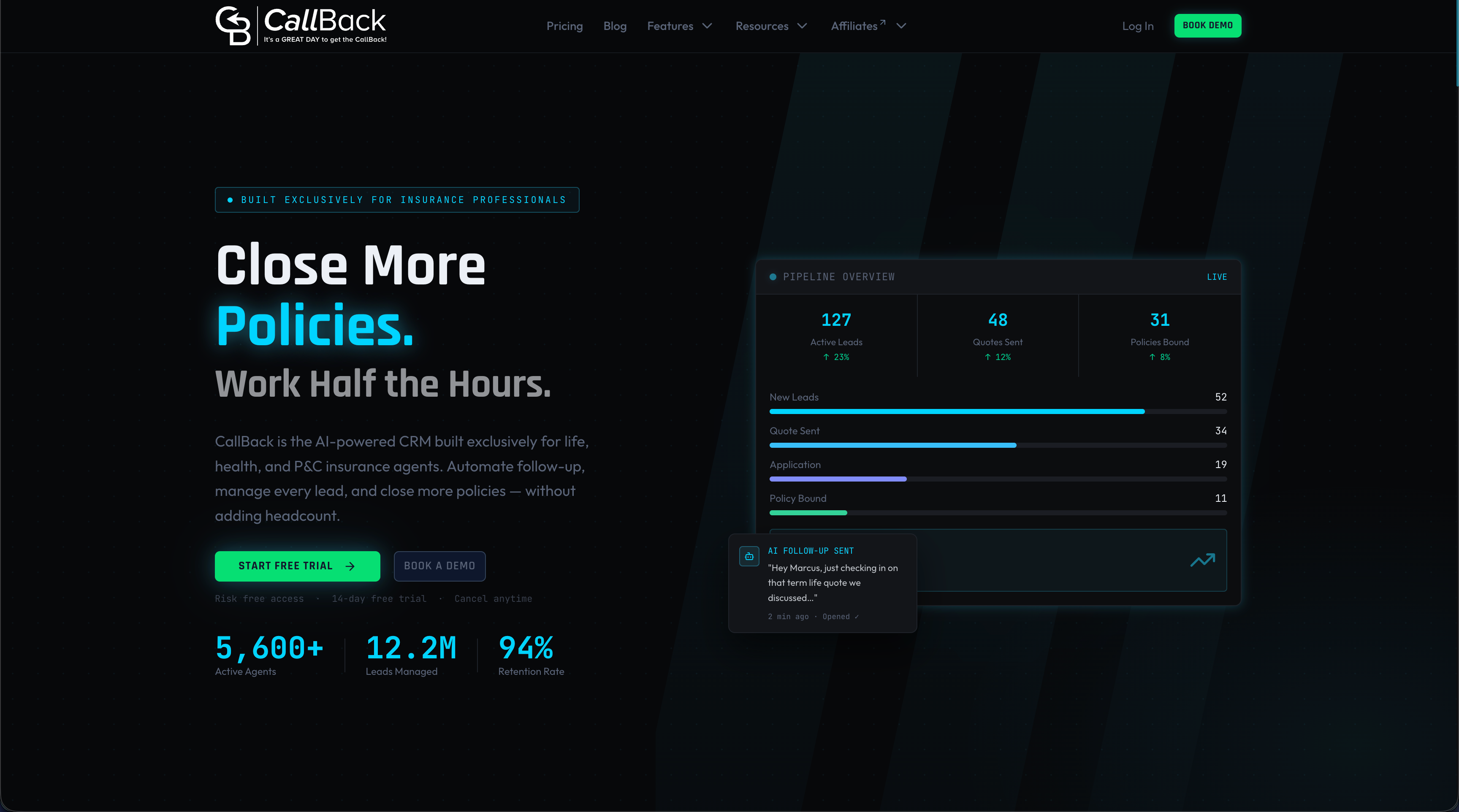
The platform’s workflow automation lets you wire the exact sequence described above, consent check, voicemail drop, SMS follow-up, agent task, without manual handoffs between tools. If you’re managing renewals or cross-sell campaigns across a large book of business, that kind of connected workflow saves hours every week compared to running each channel separately. Pair it with CallBack CRM’s website and funnel builder to give every voicemail callback a landing page built for conversion instead of a dead end.
Start a trial and set up your first compliant campaign with your existing client list this week.
Frequently Asked Questions
Is ringless voicemail legal for insurance agents to use? Yes, when the agency has documented express written consent for marketing messages, honors Do-Not-Call and EBR rules, and follows any stricter state-specific requirements. The delivery method itself isn’t the issue; missing consent is.
Do voicemail drops count as robocalls under the TCPA? The FCC has generally treated ringless voicemail as functionally similar to an automated call for consent purposes, meaning the same TCPA rules that apply to autodialed calls typically apply to RVM drops too.
What’s the difference between an informational and a marketing voicemail drop? Informational messages to current clients, like a renewal reminder, generally face fewer consent restrictions than promotional content sent to cold leads or numbers without an existing relationship.
How often should I send voicemail drops to the same lead? Most agencies see reasonable results capping attempts at two or three drops spaced three to five days apart before shifting the lead to a lower-frequency nurture sequence.
What should I look for in a third-party ringless voicemail vendor? Insist on written indemnification for consent or list-scrubbing failures, clear data security commitments, and your right to export full delivery and consent logs on demand.
This article is general information, not a substitute for advice from a qualified lawyer. Consult a qualified legal professional about your own circumstances before acting on anything here.