

A final expense funnel’s profitability comes down to one number: cost per issued policy. The single biggest lever for lowering that number is speed to contact, reaching a lead within minutes and following up on a set cadence through automation. This article covers the six funnel stages, the channels worth your budget, form design, contact sequencing, compliance rules, and the tests that improve your numbers fastest.
TL;DR:
- Reaching a lead within minutes and maintaining a structured follow-up over 10 to 14 days significantly improves contact and appointment rates.
- Using a quiz funnel for qualification yields higher quality leads by emphasizing key factors like age, tobacco use, and coverage intent, compared to multi-step forms.
- Tracking contact, presentation, and issue-pay rates weekly by source helps identify the most cost-effective channels for generating actual policies.
- Automated workflows that route leads instantly, follow up via SMS, and log consent ensure compliance and reduce manual work, boosting overall funnel efficiency.
- Exclusive leads and accurate capacity planning offer better cost per issued policy compared to cheap, shared leads with lower contact and close rates.
Table of Contents
- The six stages of a final expense funnel and what to track
- Quiz funnels vs multi-step forms for qualifying seniors
- Speed to contact and the cadence that recovers cold leads
- Automation workflows that keep the funnel moving without manual work
- Getting consent right under the one-to-one rule
- Calculating cost per issued policy and the KPIs that matter
- Running experiments that actually move the numbers
- What agents actually give up when they chase cheap leads
- Putting these workflows into CallBack CRM
- Sources
- FAQ
The six stages of a final expense funnel and what to track
A final expense sales funnel moves through six measurable stages: click, lead, contact, presentation, application, and issue-pay. Each stage has its own conversion rate, and a weak link anywhere in that chain drags down everything after it.
Small gains compound. Out of 100 leads at typical rates, roughly 16 end up as issued policies.
| Stage | What it measures | Common leak point |
|---|---|---|
| Click | Ad or landing page engagement | Weak targeting or slow page load |
| Lead | Form or call submitted | Friction in form design |
| Contact | Prospect reached by phone or text | Slow first dial |
| Presentation | Prospect hears the pitch | No follow-up cadence |
| Application | Prospect submits paperwork | Objection handling gaps |
| Issue-pay | Policy issued and first premium paid | Underwriting delays |
The contact stage is where most agents lose the most ground. A lead that goes cold before the first call rarely comes back, no matter how good the pitch would have been. Track contact rate weekly and treat any drop below your baseline as an operational fire, not a marketing problem to solve later. For a broader view of how these stages fit into agent operations, see this funnel marketing overview for insurance agents.
Quiz funnels vs multi-step forms for qualifying seniors
The choice between a quiz funnel and a multi-step form is not cosmetic. According to research on form-friction and lead quality, a quiz funnel frames qualification as a guided assessment, which tends to improve lead quality, while a multi-step form reduces perceived friction by showing fewer fields at a time. Visible fields matter more than the total step count.
For final expense specifically, four fields do most of the qualifying work:
- Age range, since eligibility bands vary sharply by carrier and product.
- Tobacco status, which affects pricing enough to shape the presentation.
- Coverage intent, meaning whether the prospect wants burial costs, debt payoff, or a set face amount.
- Beneficiary information, which signals seriousness and speeds up the application stage later.
Use progressive disclosure: ask the easy, low-commitment questions first (age range, state) and save sensitive ones (health conditions, beneficiary) for after the prospect has invested a few taps.
Pro Tip: Run a quiz funnel and a multi-step form against the same traffic source for two weeks each and compare cost per issued policy, not cost per lead, before picking a winner.
Speed to contact and the cadence that recovers cold leads
Contact rate lives and dies on timing. Practitioner data on final expense funnels shows that contact is heavily time-sensitive, and a structured multi-touch cadence over 10 to 14 days recovers contacts that a single call attempt would miss entirely.
The rules that matter most:
- Dial the first attempt within minutes of lead capture, not hours.
- Run a follow-up sequence across 10 to 14 days rather than giving up after two or three tries.
- Use SMS as a fallback when a call goes unanswered, since many seniors respond to text even when they screen calls.
- Drop a voicemail automatically on missed calls instead of relying on manual follow-up.
- Schedule retries at different times of day to catch prospects outside typical calling windows.
Inbound calls need a different script from outbound follow-up. A prospect who calls in has already raised their hand, so qualification can move faster and the presentation can start almost immediately, while outbound contacts usually need a short warm-up before the pitch. For the sequencing details behind these cadences, see this lead nurturing guide for final expense agents.
Pro Tip: Set your CRM to text a confirmation the moment a lead submits a form. Even a generic “we got your info, expect a call shortly” message keeps the prospect warm during the gap before the dial.
Automation workflows that keep the funnel moving without manual work
A minimal automation blueprint for final expense looks like this: lead capture triggers instant routing to the next available agent, which triggers an auto-dial and text sequence, which triggers an appointment confirmation once a call is booked, which triggers a follow-through reminder until the application is submitted. Each handoff removes a point where a lead could sit untouched.

Lead scoring helps decide who gets called first when volume outpaces capacity. Score by recency (newer leads first), source (live transfers and referrals above cold Facebook leads), and stated intent (a prospect who specified a coverage amount outranks one who only submitted an age range).
A platform like CallBack CRM handles this kind of routing and scoring natively for insurance-focused pipelines, running the sequence without requiring an agent to manually dial, text, or track where each lead sits. Automation workflows can route a new lead, fire the first text within seconds, queue callback attempts, and log every touch for compliance review.
Agents implementing this kind of workflow should track three outcome measures:
- Contact-rate lift, comparing weeks before and after automation.
- Time-to-first-dial, measured in minutes rather than hours.
- Appointment show rate, since a booked call that no-shows is not a real contact.
An insurance funnel optimization guide covers additional tracking templates for agents building out this kind of system.
Getting consent right under the one-to-one rule
The FCC’s one-to-one consent rule took effect on January 27, 2025, and applies to autodialed or prerecorded telemarketing calls and texts. It requires a prospect to give prior express written consent to each individual seller separately, rather than one blanket checkbox covering multiple companies at once, along with clear disclosure of what they are agreeing to.
For form-based lead generation, that means:
- Use a separate, clearly labeled consent checkbox for each seller who may contact the lead.
- State plainly what the prospect is agreeing to receive (calls, texts, or both) and from whom.
- Timestamp and store every consent record so it can be produced if a complaint arises.
- Honor opt-outs immediately and stop all autodialed contact once consent is revoked.
- Keep a non-autodialed calling option, along with email or mail, as a compliant fallback for prospects who decline text or automated call consent.
Building these habits into your funnel now protects deliverability and avoids the mess of retroactive fixes.
Calculating cost per issued policy and the KPIs that matter

Cost per issued policy divides total spend on a campaign by the number of policies that actually got issued, not just leads generated or applications submitted. It outperforms cost per lead because a cheap lead that never converts is not actually cheap.
One in six leads issuing a policy is a common illustrative benchmark from final expense funnel data, meaning cost per issued policy runs several times higher than cost per lead once you account for the leads that drop out along the way.
| KPI | What it tells you |
|---|---|
| Contact rate | Whether leads are being reached at all |
| Presentation rate | Whether reached leads hear the full pitch |
| Application rate | Whether the pitch is converting to paperwork |
| Issue-pay rate | Whether applications are clearing underwriting |
| Persistency | Whether issued policies stay in force |
Track these five numbers weekly by lead source. A source with a cheap cost per lead but a weak issue-pay rate is often more expensive per issued policy than a pricier, more targeted source.
Running experiments that actually move the numbers
Not every test is worth your time. Three experiments consistently produce the clearest signal for final expense funnels:
- Speed-to-lead changes. Cut your first-dial time in half and measure contact rate over at least 100 leads per variant.
- Qualification depth. Add or remove one field from your form and compare application rate, not just lead volume.
- Channel swaps. Shift a fixed budget from one channel to another for two full weeks and compare cost per issued policy, since shorter windows rarely produce enough issued policies to judge fairly.
Set your minimum detectable effect before you start. A change that needs a 5% lift to matter requires a far larger sample than one where a 20% lift would already justify the switch. Avoid mixing lead sources within a single test and avoid drawing conclusions from fewer than 50 leads per variant, since final expense sample sizes at the agent level are often small enough that noise looks like a trend.
What agents actually give up when they chase cheap leads
Cheap, shared leads look attractive until you calculate cost per issued policy. A batch of low-cost leads split across several agents often produces a worse outcome than fewer, exclusive leads at a higher per-lead price, because contact and close rates on shared leads tend to run lower.
Plan your dial capacity honestly before buying volume. An agent who can only make 30 calls a day gains nothing from 200 cheap leads sitting untouched, and the resulting burnout costs more than the lead spend saved. Review your own numbers by source before assuming the cheapest option is the best one.
— Kyle
Putting these workflows into CallBack CRM
CallBack CRM is built for the exact automation this article describes: instant lead routing, SMS follow-up, funnel and form building, AI assistants for qualification, consent logging, and calendar sync for appointment setting, all inside one insurance-focused platform.
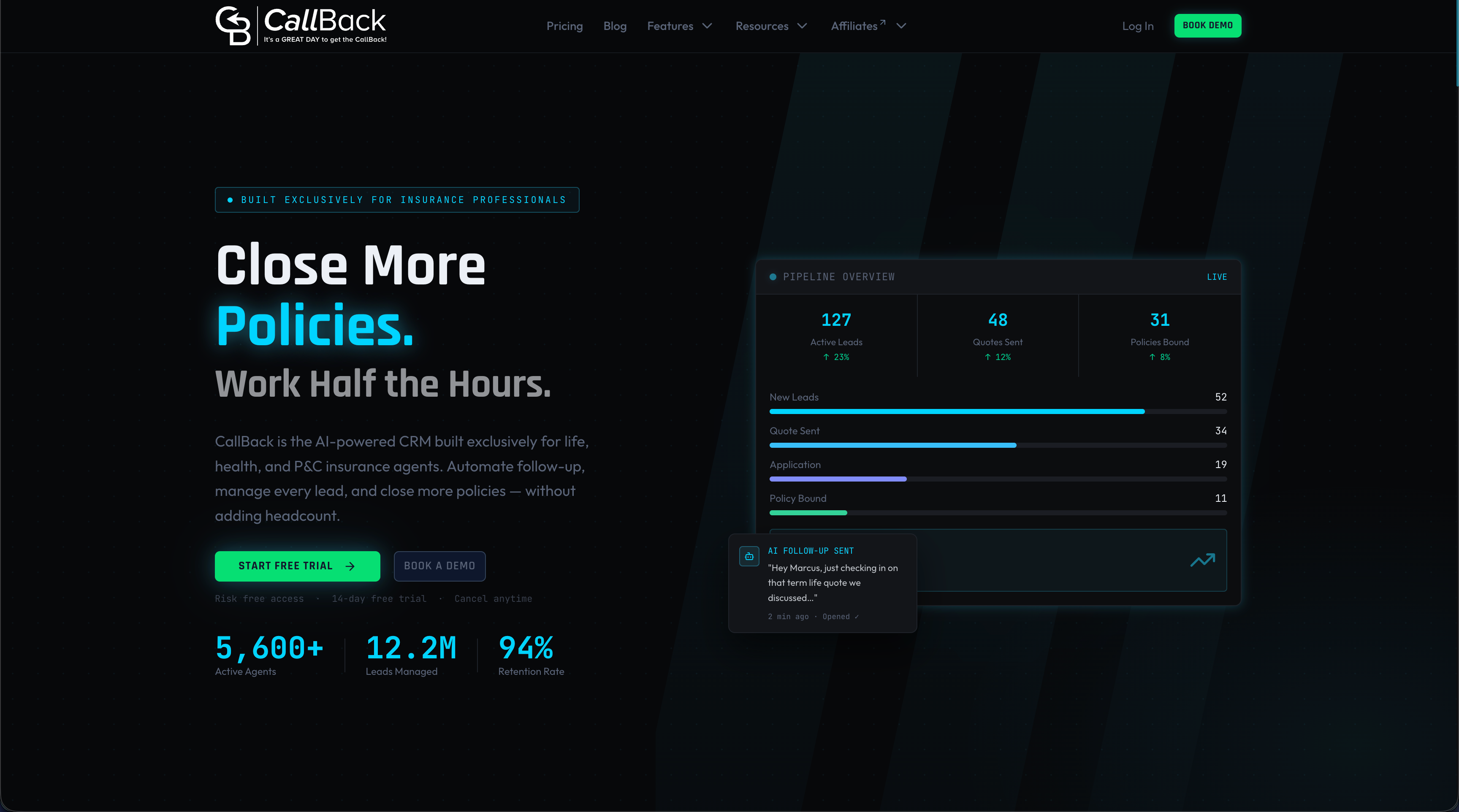
Agents running final expense funnels manually often lose leads to slow follow-up rather than bad marketing. CallBack CRM’s workflow automation handles:
- Instant routing of new leads to the right agent or queue.
- Automated SMS and voicemail sequences for missed calls.
- A funnel builder for testing quiz versus multi-step form layouts.
- Consent timestamps logged automatically for compliance records.
- Calendar sync so booked appointments show up without manual entry.
The Professional plan starts agents at $97 per month, with Enterprise options available for agencies running multiple seats. Start a trial and audit your current funnel against the workflow described above.
Sources
This guide draws on the FCC’s Second Report and Order on one-to-one consent, a stage-by-stage breakdown of the final expense funnel, a channel comparison guide for final expense marketing, and research on quiz funnels versus multi-step forms, plus a broader look at funnel and SEO tactics for lead generation.
This article is general information, not a substitute for advice from a qualified financial advisor. Consult a qualified financial professional about your own circumstances before acting on anything here.
- The Final Expense Sales Funnel, Stage by Stage
- FCC — One-to-one consent rule (Second Report and Order) text
- Quiz Funnels vs Multi-Step Forms for Lead Generation
FAQ
How do I generate my own final expense leads?
Most agents build their own pipeline through a mix of Facebook or Google ads, direct mail, and referral requests, paired with a landing page and a fast follow-up system. The channel that works best depends on your dial capacity: agents who can answer quickly do well with paid social, while those with a slower cadence often do better with direct mail.
What are the best final expense leads?
There is no single best lead type, but exclusive, higher-intent leads often produce a lower cost per issued policy than cheap, shared leads, even at a higher upfront price. Live transfers and referrals tend to convert at higher rates than cold form fills.
How much are final expense leads?
Lead prices vary widely by source and exclusivity, and this article does not quote a single figure because rates shift by market and vendor. Judge any lead price against cost per issued policy rather than the sticker price alone, since a cheaper lead that rarely converts can cost more per sale.
How much does a sales funnel cost?
Funnel cost depends on the tools and ad spend involved, not a fixed number. Platforms like CallBack CRM list plan pricing starting at $97 per month for the Professional plan, with additional usage fees for phone numbers, SMS, and AI features listed on its fees page.