

AI delivers measurable advantages for final expense insurance leads by automating qualification, personalizing outreach to senior prospects, and cutting screening costs by a wide margin. The benefits of AI for final expense leads are practical and immediate: brokers spend less time on unqualified calls and more time closing policies. Here is a clear summary of what AI brings to this workflow.
- Consistent lead qualification. AI screens every prospect against the same criteria, age 50–85, coverage interest, health conditions, and checking account confirmation, without fatigue or emotional bias.
- Personalized senior outreach. AI handles the “I don’t remember” objection the same way on every call, patiently and without frustration, which human screeners struggle to sustain across a full shift.
- Automated warm transfers. Qualified prospects are live on the line when a licensed agent picks up, so agents only speak with pre-screened leads.
- Lower qualification costs. AI screening typically costs just $0.10–$0.15 per minute, enabling significant savings in lead qualification compared to human screeners at $15–$25 per hour.
- Real-time compliance documentation. AI follows disclosure rules on every call, flagging do-not-call requests instantly and recording dual-channel audio.
- Better lead prioritization. AI scoring surfaces high-intent prospects first, so agents work the most likely conversions before the contact window closes.
- No breaks, no burnout. AI works the full morning contact window without mental fatigue, which is the period when seniors are most reachable.
Key AI use cases transforming final expense lead management
AI-driven lead generation with predictive analytics
Predictive analytics tools analyze demographic and behavioral signals, including ZIP code, content engagement, and browsing history, to identify prospects most likely to respond to final expense offers. This targeting approach has been associated with a 30% drop in cost per lead and a 50% increase in conversions in final expense marketing campaigns. Rather than buying a broad list and hoping for the best, brokers can focus spend on segments that match the profile of their best existing policyholders.
Aged leads are a specific area where this targeting pays off. Fresh exclusive leads cost $75–$150 each, while aged leads run $0.30–$10 per lead. AI maintains contact efficiency even on 30–90 day old lists, making it practical to run high-volume campaigns on lower-cost inventory.
Automated lead scoring and qualification
AI qualification for final expense follows a structured decision tree: age verification, coverage interest, health screening for product tier placement (simplified issue vs. guaranteed issue), and checking account confirmation. Human screeners, especially newer ones, often end calls prematurely when a prospect mentions diabetes or high blood pressure. A well-configured AI knows that controlled Type 2 diabetes does not disqualify a prospect from simplified issue coverage and keeps the conversation moving.

The hard disqualifiers are narrow: under 50 or over 85, currently in hospice with a terminal diagnosis, or in active substance abuse treatment. Everything else routes to either simplified issue or guaranteed issue. AI applies this logic consistently on every call, regardless of call volume or time of day.
AI-powered follow-up and senior-specific objection handling
The most common objection in final expense outbound is “I don’t remember requesting information.” Seniors who responded to a TV ad or direct mail piece weeks earlier genuinely forget. An AI system handles this by reframing: it explains that many people receive information about funeral expense coverage and offers to share details if the prospect is interested. It does not argue. It does not rush.
Seniors also take longer to process information, ask the same question multiple times, and need a patient pace. Human agents who do this work for eight hours a day burn out. AI does not. It delivers the same patience on call 500 as it does on call one, which directly protects conversion rates during the morning contact window when seniors are most reachable.
Phonely and AI warm-transfer workflows
Phonely is a specific example of AI built for final expense pre-qualification and warm transfers. It integrates with VICIdial, Trackdrive, and SIP dialers, running the full screening conversation in 60–90 seconds for calls that result in a transfer. Once a prospect clears all qualification criteria, Phonely connects them live to a licensed agent. The agent receives a pre-screened lead who is the right age, interested in coverage, and has already been through health screening.
Non-qualifiers are handled politely. Prospects under 50 receive a brief explanation. Anyone on the do-not-call list gets an instant disconnect and a flag in the system. This compliance consistency is built into the workflow rather than depending on individual agent discipline.
Underwriting and compliance automation
AI handles compliance disclosures consistently because it follows the same rules on every call. It discloses the automated system within 30 seconds as required by FCC guidelines, never presents itself as a licensed insurance agent, never quotes prices or makes coverage promises, and records all calls on dual channels. The NAIC model bulletin on AI use by insurers sets expectations for transparency and accountability in these systems, and a properly configured AI qualification workflow aligns with those standards by design.
Human agents on their 100th call of the day may skip a disclosure or pressure a confused senior. AI does not have bad days. That consistency reduces regulatory risk and creates a reliable audit trail.
CRM integration and workflow management
AI qualification tools connect directly to CRM platforms, passing lead data, health screening results, and call recordings into the agent’s workflow before the warm transfer completes. This means the licensed agent sees the prospect’s qualification details before saying a word. Brokers using data-driven marketing workflows report that this pre-call context shortens the sales conversation and reduces the back-and-forth that slows policy closings.
Pay-per-call agencies benefit particularly here. Higher-quality transfers mean fewer chargebacks and better relationships with the insurance agencies buying those transfers at $45–$80 each.
How AI improves conversion rates and reduces costs for final expense brokers
The cost comparison is direct
| Metric | AI Qualification | Human Screeners |
|---|---|---|
| Cost per minute | $0.10–$0.15 | $15–$25/hr equivalent |
| Average call duration | 60–90 seconds | Varies, often longer |
| Cost per qualified transfer | ~$7.50–$10.00 | Significantly higher |
| ROI on qualification step | 4–10x | Baseline |
| Aged lead cost per lead | $0.30–$10 | $75–$150 (fresh exclusive) |
| Availability | Full morning window | Limited by shift hours |
An AI cost per qualified transfer significantly undercuts typical transfer prices, producing multiple times return on the qualification investment. That math holds even when only one in 50 calls results in a qualified transfer.
Response time and conversion lift
Speed matters more than most brokers realize. Responding to a lead within five minutes increases conversion by 9x compared to responding after 30 minutes, according to Salesforce research. AI qualification and warm transfer workflows make that speed operationally possible at scale. A human-staffed operation cannot maintain sub-five-minute response times across a full morning campaign without significant overhead.
Pro Tip: Set your AI qualification system to prioritize inbound calls from TV and direct mail campaigns during the 8 AM–11 AM window. Seniors answer their phones in the morning, and an immediate AI response captures interest before it fades.
Reducing NIGO rates and chargebacks
Not In Good Order (NIGO) submissions and chargebacks both trace back to the same root cause: unqualified leads reaching licensed agents. When AI handles screening, the prospects who reach agents have already confirmed age, coverage interest, health tier, and payment method. Fewer unqualified transfers mean fewer policies that fall apart after submission. Pay-per-call agencies that implement AI pre-qualification report stronger buyer relationships because the transfer quality improves measurably.
Operational cost reduction at scale
BCG’s 2026 analysis of AI adoption in US property and casualty insurance found that operating costs per dollar of premium could be reduced by 15%–25% for insurers that redesign workflows around AI agents rather than simply adding AI tools to existing processes. In dollar terms, that equates to $35 billion–$60 billion in reduced operating expenses annually across US property and casualty insurance. Final expense brokerages are smaller operations, but the same principle applies: AI that replaces frontline screening frees licensed agents to focus entirely on closing.
Strategic considerations for adopting AI in final expense insurance
Clean data comes first
The most common failure in AI deployments is not the technology. It is the input. AI processes whatever data it receives efficiently, which means poor data quality produces faster processing of unqualified leads and wasted spend. Brokers who clean and maintain their lead lists before deploying AI scoring see better accuracy and higher conversion rates. Validate contact information, remove duplicates, and confirm that health screening fields are populated correctly before running any AI qualification campaign.
This step is unglamorous but determines whether every subsequent AI investment works. A list of 10,000 leads with outdated phone numbers and missing age data will produce worse results with AI than a clean list of 2,000.
Treat AI as an autonomous agent, not just a tool
BCG’s research is clear on this point: AI does not deliver its full value when dropped into legacy workflows designed for human execution. The shift to AI-first workflows requires redesigning core processes so that AI agents handle execution and humans focus on oversight, exceptions, and high-impact decisions. For final expense brokerages, this means restructuring the screening step entirely rather than using AI to assist human screeners.
Agencies that make this shift report that licensed agents spend their time closing rather than qualifying, which is where their skills and commissions actually come from.
Training agents to work alongside AI
Agents need to understand what AI qualification does and does not do. AI screens and transfers. It does not close. When a warm transfer connects, the agent receives a prospect who has confirmed age, coverage interest, health tier, and payment method. The agent’s job starts there. Training should cover how to read the pre-call data, how to pick up a warm transfer smoothly, and how to handle the rare case where a prospect’s answers during the AI screening do not match what they say to the agent.
Agents also need to understand the compliance boundaries. AI handles disclosures and DNC compliance automatically, but agents remain responsible for their own conduct once the transfer connects. Reviewing call recordings regularly keeps quality high on both sides of the handoff. For brokers building out their AI lead generation process, pairing AI qualification with structured agent training produces better results than either approach alone.
Common pitfalls and how to avoid them
- Skipping data cleaning. Running AI on a dirty lead list amplifies the problem. Clean first, deploy second.
- No human oversight on AI copy and scripts. AI qualification scripts need periodic review. A script that worked well six months ago may need updating as product tiers or compliance requirements change.
- Treating AI as a set-and-forget system. AI qualification requires monitoring. Track transfer rates, chargeback rates, and agent close rates to catch problems early.
- Ignoring compliance configuration. FCC disclosure requirements and state-specific rules must be built into the AI script from the start, not added later.
- Underestimating the cultural shift. Agents who are used to handling their own screening may resist AI qualification. Address this directly by showing close rate data before and after AI implementation.
You can also run an AI search audit on your agency’s digital presence to identify gaps in how AI systems currently find and evaluate your marketing content, which affects inbound lead quality alongside outbound qualification.
Key Takeaways
AI qualification reduces final expense lead costs to roughly $7.50–$10.00 per qualified transfer, producing a 4–10x return on the qualification step when transfers pay $45–$80 each.
| Point | Details |
|---|---|
| AI cuts qualification costs | AI screening typically costs just $0.10–$0.15 per minute, offering significant savings in lead qualification compared to $15–$25 per hour for human screeners. |
| Response speed drives conversions | Responding within five minutes increases lead conversion by 9x compared to a 30-minute delay. |
| Clean data is required | Poor input data causes AI to process unqualified leads faster, not better; clean lists before deploying. |
| Workflow redesign beats tool addition | BCG finds 15%–25% cost reductions when AI agents replace human execution rather than assist it. |
| Phonely automates warm transfers | Phonely integrates with VICIdial and completes pre-qualification in 60–90 seconds before connecting live prospects to agents. |
Put AI to work on your final expense leads with Callbackcrm
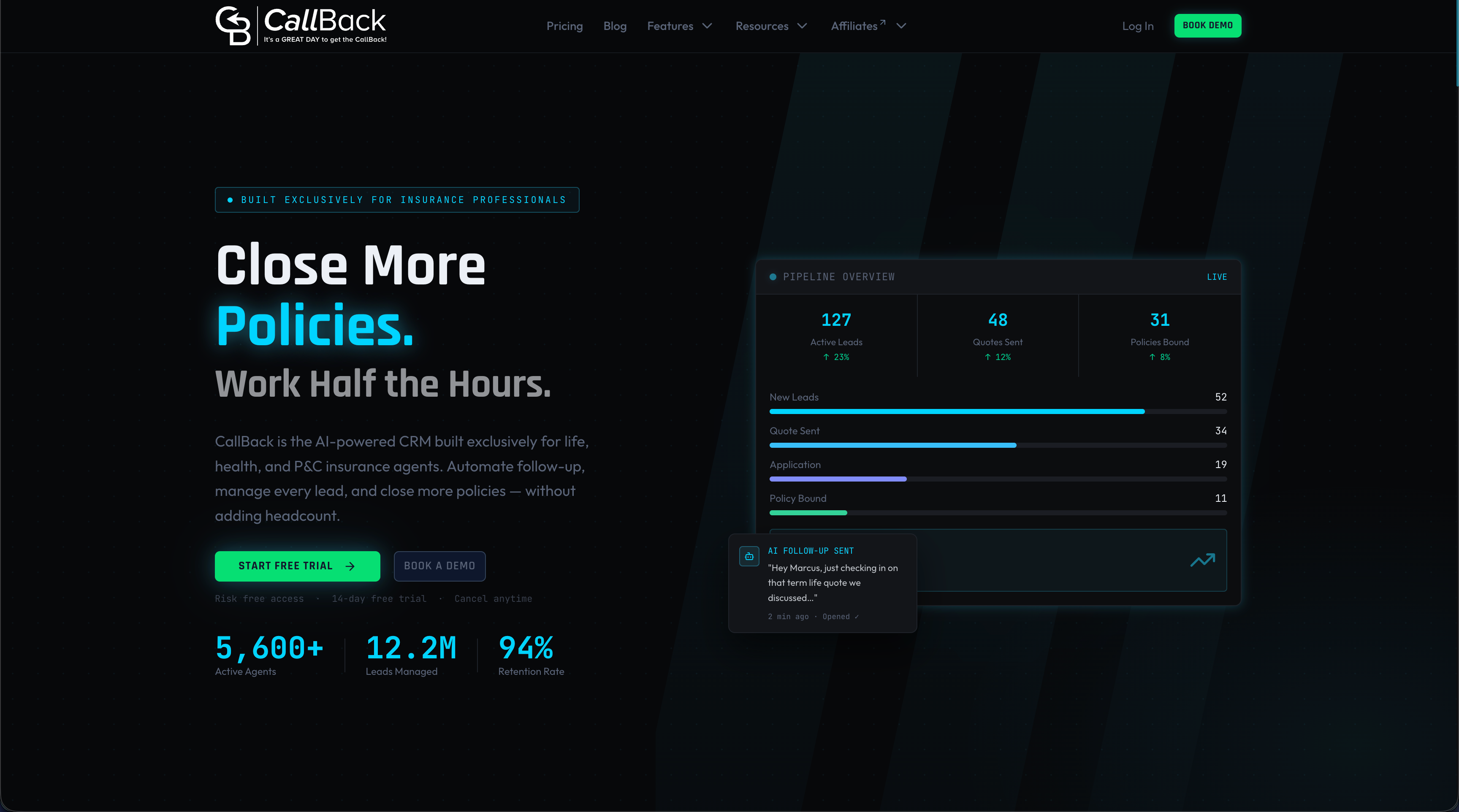
Callbackcrm is built for insurance agents and agencies that want AI handling the work that does not require a licensed agent. The platform covers CRM management, automated SMS and email outreach, lead scoring, and workflow automation in one place. Agents using Callbackcrm’s AI-powered SMS marketing tools can run follow-up sequences that respond to prospect behavior automatically, keeping final expense leads engaged between the initial contact and the policy close. The platform connects with existing dialers and CRM systems, so there is no wholesale replacement of your current setup. Start with one campaign, measure the transfer quality and close rates, and scale from there.