

Insurance agents know the frustration of watching qualified leads slip away while manually sorting through inquiries. Traditional lead generation methods delay outreach, miss critical intent signals in prospect communications, and leave agents chasing cold contacts instead of closing warm opportunities. AI-powered lead generation transforms this process by automating lead discovery, qualification, and scoring so you can focus on high-value conversations. This guide walks you through implementing AI tools specifically designed for insurance agencies to capture and convert more leads in 2026.
Table of Contents
- Understanding The Challenge: Why Traditional Insurance Lead Generation Falls Short
- Preparing For AI-Powered Lead Generation: What You Need To Get Started
- Step-By-Step Execution: How AI Automates Lead Discovery, Qualification, And Scoring
- Verifying Success And Optimizing Your AI Lead Generation System
- Boost Your Insurance Leads With CallBack CRM’s AI-Powered Tools
- Frequently Asked Questions
Key takeaways
| Point | Details |
|---|---|
| Speed matters | Delayed responses to insurance inquiries significantly reduce conversion rates and erode prospect trust |
| AI extracts better data | Natural language processing interprets unstructured lead sources like emails and call transcripts for accurate qualification |
| Integration simplifies workflow | Connecting AI tools with your Agency Management System streamlines data processing and reduces manual entry |
| Scoring reveals priority | AI evaluates both intent and fit to surface leads most likely to convert quickly |
| Automation scales results | Machine learning discovers more leads while freeing agents to focus on relationship building and closing |
Understanding the challenge: why traditional insurance lead generation falls short
Most insurance agencies still rely on methods that worked a decade ago but fail to meet modern buyer expectations. Manual lead processing creates bottlenecks that cost you revenue every single day.
The biggest problem is speed. Every minute of delay between inquiry and outreach erodes trust and conversion likelihood, directly impacting both revenue and reputation. When a prospect fills out a form requesting auto insurance quotes, they expect immediate acknowledgment. If your first contact happens 24 hours later, they have already engaged with three competitors who responded faster.
Traditional CRM systems compound this problem because they struggle with unstructured data. A prospect might email detailed information about their commercial fleet needs, but your system only captures the email address and timestamp. The critical details about fleet size, coverage gaps, and renewal dates sit buried in the message body where your lead scoring algorithm cannot access them. You need someone to manually read, interpret, and enter that information before qualification can begin.
Built-in CRM scoring tools miss lead intent entirely because they rely on fixed demographic and firmographic attributes. They can tell you company size and industry but cannot interpret the urgency in a message that says “our current policy expires in two weeks and we need better liability coverage.” That context determines whether you should call immediately or add the lead to a nurture sequence.
System fragmentation makes everything slower and less accurate. Lead forms feed into one platform, emails arrive in another inbox, and your Agency Management System operates separately. Without integration, data gets duplicated, lost, or entered incorrectly as it moves between systems. Agents waste time reconciling information instead of transforming their lead funnel with streamlined processes.
AI adoption solves these specific gaps by automating data extraction, interpreting intent from natural language, and scoring leads instantly based on your ideal client criteria. Modern insurance buyers research online, compare options quickly, and expect personalized responses. Agencies using effective lead generation strategies recognize that AI tools provide the speed and accuracy required to compete in 2026.
“The insurance industry is shifting from reactive lead handling to proactive, AI-driven engagement that meets prospects exactly when and how they want to connect.”
Preparing for AI-powered lead generation: what you need to get started
Successful AI implementation starts with proper preparation, not rushing to deploy the latest technology. You need clean data sources, clear criteria for your ideal client, and realistic expectations about integration complexity.

Begin with your Agency Management System. Integrating with an Agency Management System via a well-defined API is generally more straightforward than processing unstructured emails from a shared inbox. Your AMS already contains structured policyholder data, renewal dates, coverage types, and claim history. This clean data helps AI models learn faster and produce more accurate results from day one.
Define your ideal client profile with specific, measurable attributes. Generic descriptions like “small business owners” provide insufficient guidance for AI scoring algorithms. Instead, specify parameters like annual revenue range, employee count, industry verticals you specialize in, policy types you prefer to write, and geographic territories you serve. The more precise your criteria, the better AI can evaluate lead fit.
Inventory your current lead sources and assess data quality:
- Website contact forms with structured fields
- Email inquiries to shared agency inboxes
- Phone call recordings and transcripts
- Social media messages and comments
- Referral partner submissions
- Purchased lead lists from aggregators
Each source requires different handling. Structured form data feeds easily into AI extraction pipelines, while unstructured emails and call transcripts need natural language processing to extract key details. Start with your highest-quality sources to build momentum and demonstrate value quickly.
A modern AI lead generation stack typically combines multiple specialized tools. For insurance professionals implementing AI in 2026, this might include transformer-based language models for text extraction, reinforcement learning systems for web crawling and lead discovery, and API frameworks like FastAPI for connecting components. You do not need to build everything from scratch, but understanding the architecture helps you evaluate vendors and customize solutions.
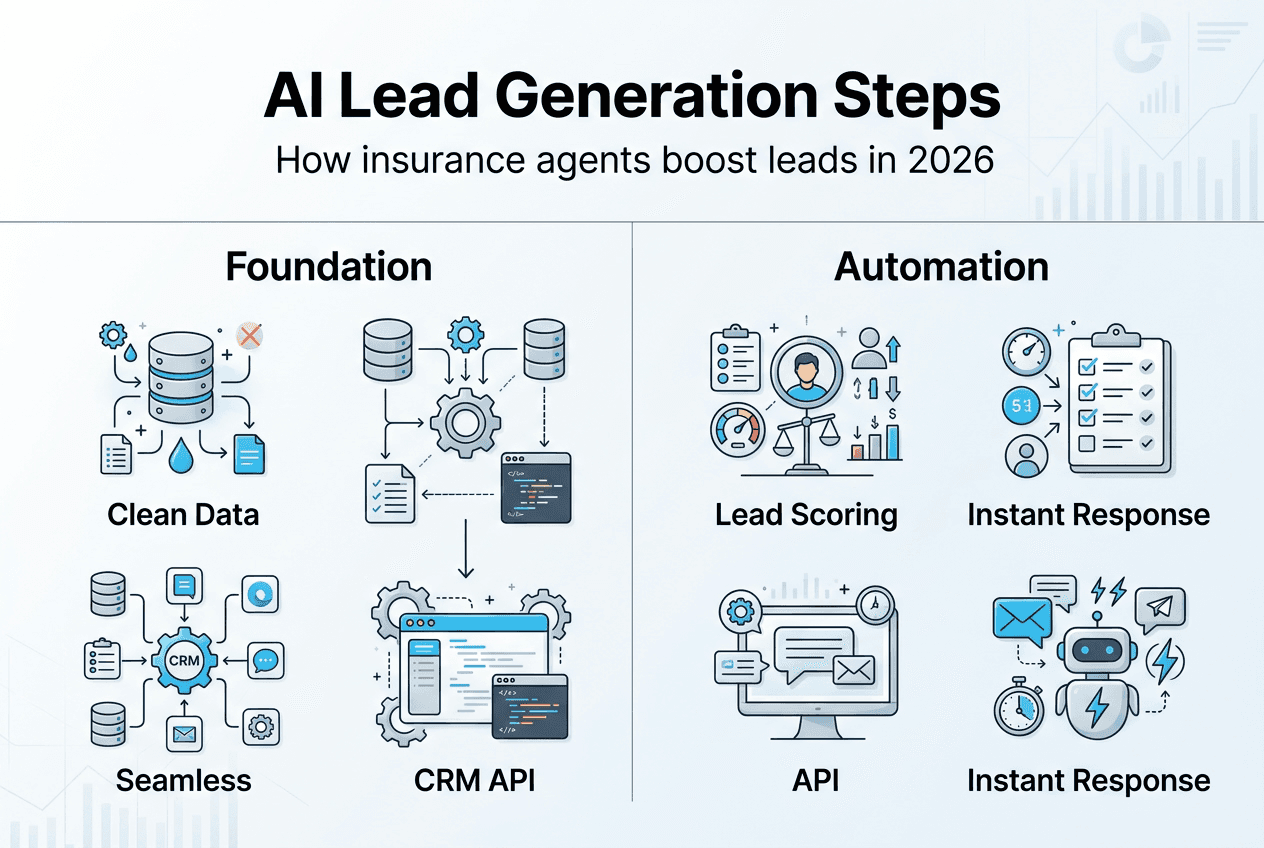
Pro Tip: Document your current lead handling process step by step before implementing AI. This baseline lets you measure improvement accurately and identify which manual tasks to automate first for maximum impact.
| Preparation Element | Purpose | Success Indicator |
|---|---|---|
| Clean AMS data | Provides training examples for AI models | 95%+ data completeness in key fields |
| Ideal client profile | Guides lead scoring and prioritization | Specific numeric thresholds for fit criteria |
| Lead source inventory | Identifies integration requirements | Complete list with data quality assessment |
| Technology stack plan | Ensures components work together | Clear data flow from source to CRM |
Explore different types of lead generation to understand which AI tools best support your preferred strategies, whether inbound content marketing, outbound prospecting, or referral network expansion.
Step-by-step execution: how AI automates lead discovery, qualification, and scoring
Implementing AI-powered lead generation follows a logical sequence that builds capability progressively. Each step adds automation while maintaining human oversight where it matters most.
-
Deploy web crawling with reinforcement learning to expand your lead discovery beyond manual searches. Advanced systems significantly outperform baseline approaches in lead discovery rate and extraction accuracy, finding prospects on business directories, industry forums, and company websites that traditional methods miss. The AI learns which sites yield high-quality insurance leads and prioritizes those sources.
-
Configure transformer-based NLP models to extract critical data points from every lead source. These models achieve F1 scores around 0.92 for insurance-specific extraction, meaning they correctly identify fields like policy type, coverage limits, fleet size, employee count, and current carrier with high accuracy. Multi-step prompting techniques improve results by breaking complex extraction tasks into focused subtasks.
-
Implement dual-axis lead scoring that evaluates both Intent and Fit. AI agents can pre-qualify insurance leads by extracting key data points from lead forms, emails, and call transcripts, scoring lead urgency and fit based on the agency’s ideal client profile. Intent signals include explicit requests for quotes, mentions of policy expiration dates, dissatisfaction with current coverage, or recent triggering events like business expansion. Fit scoring compares extracted attributes against your ideal client criteria.
-
Route qualified leads automatically based on score thresholds and agent specialization. High-intent, high-fit leads trigger immediate notifications to appropriate agents with all extracted information pre-populated in your CRM. Medium-scoring leads enter nurture sequences with personalized content. Low-scoring leads get archived or assigned to junior staff for long-term development.
-
Generate natural language summaries that give agents context before first contact. Instead of reading through email threads and form submissions, agents receive concise briefings highlighting prospect needs, pain points, timeline, and recommended talking points. This preparation makes initial conversations more relevant and productive.
Pro Tip: Start with a pilot program using one lead source and one agent. Perfect the extraction templates and scoring thresholds with real feedback before rolling out agency-wide. This iterative approach prevents overwhelming your team and surfaces issues early.
| AI Function | Input Data | Output Result | Agent Benefit |
|---|---|---|---|
| Lead discovery | Website URLs, directories | New prospect contacts | Expands pipeline automatically |
| Data extraction | Forms, emails, transcripts | Structured lead records | Eliminates manual data entry |
| Intent scoring | Message content, timing | Urgency rating 1-10 | Prioritizes hot leads |
| Fit scoring | Prospect attributes | Alignment rating 1-10 | Focuses effort on ideal clients |
| Summary generation | All extracted data | Contextual briefing | Improves first-call effectiveness |
Follow proven lead generation workflow tutorials to structure your implementation and avoid common setup mistakes. Explore comprehensive AI marketing tools that integrate multiple functions into unified platforms for easier management.
Verifying success and optimizing your AI lead generation system
Deploying AI tools is just the beginning. Continuous monitoring and optimization ensure your system delivers sustained value as market conditions and prospect behavior evolve.
Track these core metrics weekly to measure AI impact:
- Lead conversion rate from inquiry to quote request
- Average response time from lead capture to first contact
- Lead quality score correlation with actual closed business
- Agent time spent on manual data entry versus selling activities
- Cost per qualified lead compared to traditional methods
Watch for data quality degradation over time. AI models trained on historical data can become less accurate as language patterns, product offerings, and market dynamics shift. Schedule quarterly reviews where you manually audit a sample of AI-extracted records against source documents to verify accuracy remains above 90%. If performance drops, retrain models with recent examples.
Create feedback loops that improve scoring algorithms based on real sales outcomes. When leads scored as high-intent fail to convert, investigate why. Perhaps your ideal client profile needs refinement, or certain intent signals prove less predictive than assumed. When unexpected leads close quickly, analyze what the AI initially missed and adjust scoring weights accordingly.
Avoid these common pitfalls that undermine AI lead generation:
- Ignoring AMS integration and treating AI as a standalone tool disconnected from existing workflows
- Relying exclusively on unstructured email data when structured form submissions would provide cleaner training examples
- Setting unrealistic expectations for immediate perfection instead of planning for iterative improvement
- Failing to train agents on interpreting AI-generated insights and summaries
- Neglecting to update ideal client criteria as your agency’s strategic focus evolves
The insurance AI market is expanding rapidly. The global AI in Insurance market size is USD 4,681.2 million in 2024 and is expected to grow at a 33.60% CAGR through 2031, meaning more vendors will offer specialized tools and competition will intensify. Agencies that master AI lead generation now build sustainable competitive advantages.
Schedule monthly optimization sessions:
- Review metric dashboards and identify performance trends
- Collect agent feedback on lead quality and AI summary usefulness
- Test scoring threshold adjustments with small lead samples
- Update extraction templates to capture new data points your team needs
- Research emerging AI capabilities that could enhance your system
Document what works and what does not. This institutional knowledge becomes invaluable when training new agents, evaluating vendor claims, or scaling successful approaches across additional lead sources and insurance lines.
Explore advanced sales automation workflows that connect lead generation with nurture sequences, proposal delivery, and policy renewal reminders. Visit the CallBack AI strategies blog regularly for emerging best practices and case studies from agencies achieving measurable results with AI-powered lead generation.
Boost your insurance leads with CallBack CRM’s AI-powered tools
Ready to transform how your agency generates and converts insurance leads? CallBack CRM delivers over 50 AI-driven features specifically designed for insurance professionals who want to automate lead qualification, accelerate response times, and focus selling effort where it matters most.
Our platform integrates lead management, automated follow-up sequences, and intelligent scoring into one intuitive system. Manage every prospect interaction through our comprehensive CRM built for insurance agencies, then nurture leads automatically with personalized email marketing campaigns that adapt based on prospect behavior and engagement.
Discover the complete suite of AI-powered features that help agencies like yours generate more qualified leads, close deals faster, and grow revenue without hiring additional staff. Start your free trial today and experience how modern AI tools eliminate the manual tasks that slow down your sales process.
Frequently asked questions
What is AI-powered lead generation for insurance agents?
AI-powered lead generation uses natural language processing and machine learning to automatically identify, extract, and score insurance leads from multiple sources. It helps agents respond faster to inquiries, qualify prospects more accurately based on intent and fit criteria, and prioritize outreach to high-potential opportunities. Integration with existing Agency Management Systems improves data quality and eliminates manual entry tasks. Learn more about AI lead generation for insurance professionals.
How does AI improve lead qualification compared to traditional methods?
AI interprets unstructured data like emails and call transcripts to assess both urgency and alignment with your ideal client profile, whereas traditional methods rely mostly on fixed demographic attributes. This produces more precise, actionable lead lists that reflect genuine buying intent. Agents spend less time chasing unqualified prospects and more time closing deals with leads ready to purchase. Explore AI lead pre-qualification approaches for insurance sales teams.
What are the best practices for integrating AI with existing agency management systems?
Prioritize clean data sources and well-defined APIs over unstructured email parsing to reduce errors and accelerate implementation. Collaborate with your AI vendor to customize extraction templates for insurance-specific data points like policy types, coverage limits, and renewal dates. Test and tune AI models iteratively using your agency’s unique lead profiles and workflows rather than accepting generic configurations. Find additional AI integration insights for insurance technology stacks.
How long does it take to see results from AI lead generation?
Most agencies notice improved response times and data quality within the first two weeks of deployment. Measurable increases in conversion rates typically appear within 30 to 60 days as AI models learn from your feedback and scoring algorithms become more accurate. The fastest results come from starting with your highest-quality lead sources and expanding gradually to more complex, unstructured data inputs.
What skills do insurance agents need to work effectively with AI lead generation tools?
Agents need basic digital literacy to navigate dashboards, interpret AI-generated lead summaries, and provide feedback on scoring accuracy. No coding or technical expertise is required. The most successful implementations include brief training sessions that explain how AI evaluates leads and how agents should use intent and fit scores to prioritize outreach. Focus on helping your team trust and leverage AI insights rather than second-guessing every recommendation.