

TL;DR:
- AI accelerates lead qualification and enhances client engagement, enabling brokers to provide proactive advice and personalized communication.
- Automation streamlines workflows and improves decision-making through real-time analytics, ultimately increasing brokers’ efficiency and client retention.
- Successful AI adoption relies on starting small, integrating systems effectively, and implementing clear policies to maximize benefits while maintaining compliance.
Insurance brokers are under more pressure than ever. Clients expect faster answers, more personalized advice, and proactive outreach, while competition from direct-to-consumer platforms keeps growing. The benefits of AI for brokers aren’t theoretical anymore. They’re showing up in real pipelines, real retention rates, and real hours saved every single week. This guide breaks down exactly where AI delivers for insurance agents and agencies, what the practical impact looks like, and how you can start capturing those gains without turning your business upside down.
Table of Contents
- Key takeaways
- 1. Benefits of AI for brokers: smarter lead generation
- 2. Enhancing client engagement with AI insights
- 3. Streamlining operational workflows with automation
- 4. Real-time analytics for smarter decisions
- 5. AI-driven personalization at scale
- 6. AI benefits by broker specialty and business size
- 7. Preparing your brokerage for AI adoption
- My take on where AI really moves the needle for brokers
- How Callbackcrm puts these AI benefits to work for you
- FAQ
Key takeaways
| Point | Details |
|---|---|
| AI accelerates lead qualification | AI scores and filters prospects from large datasets so brokers spend time on leads most likely to convert. |
| Client engagement becomes proactive | Predictive analytics and AI assistants help brokers anticipate needs before clients even ask. |
| Administrative time drops sharply | AI auto-logs interactions and saves brokers 3 to 5 hours per week on scheduling alone. |
| Integration determines success | 82% of mortgage brokers cite system integration as the top factor when choosing AI tools. |
| AI amplifies broker value | AI reclaims time that brokers can reinvest into relationships and specialization, not just efficiency. |
1. Benefits of AI for brokers: smarter lead generation
Finding quality leads used to mean cold call lists, purchased data, and a lot of guessing. AI changes that completely by scanning enormous datasets, including web behavior, policy lifecycle signals, and demographic data, to surface prospects who are most likely to buy right now.
AI lead scoring models assign a probability score to each prospect based on dozens of variables simultaneously. A broker working commercial lines can set their AI to prioritize businesses approaching contract renewal dates, companies that recently expanded headcount, or industries with rising liability exposure. The result isn’t just more leads. It’s the right leads, delivered before competitors even know those businesses are in the market.
- AI tools boost lead quality by filtering out low-intent contacts before you spend time on outreach.
- Automated initial contact sequences warm up prospects through email and SMS so you enter every conversation with context already established.
- CRM-integrated AI tracks which lead sources convert at the highest rate and redistributes your marketing spend accordingly.
Pro Tip: Set your AI lead scoring model to weight policy expiration timing and recent life events (job change, new property purchase) at a higher priority. These signals predict buying intent far better than demographic data alone.
2. Enhancing client engagement with AI insights
The old model of client engagement was largely reactive. A client calls with a question, you answer it. AI shifts that dynamic entirely. Predictive analytics means you can reach out to a client about a coverage gap before they ever notice it themselves, which is exactly the kind of advisory value that builds long-term loyalty.
Anticipatory AI identifies patterns like low benefits utilization or billing anomalies, flagging them so brokers can step in with real financial guidance. That transforms your role from a policy processor into a trusted advisor. Clients notice the difference, and they stay longer because of it.
“The real opportunity for brokers isn’t just efficiency. It’s using AI to become the proactive advisor clients didn’t know they needed.” — Industry perspective on AI in benefits advising
AI-powered chatbots and virtual assistants handle routine inquiries around the clock, so clients get answers at 10 p.m. without waiting until morning. That responsiveness matters, especially with 37% of Gen Y and Gen Z investors actively looking to engage financial and insurance professionals within the next 12 months. Younger clients expect digital responsiveness. AI makes that possible without adding headcount.
- Cross-sell and up-sell opportunities are surfaced automatically based on policy gaps and life stage changes.
- Personalized email and SMS sequences keep clients engaged between renewal cycles without manual effort.
- Real-time sentiment analysis on client communications alerts you when a relationship may be at risk.
3. Streamlining operational workflows with automation
Most brokers spend hours every week on tasks that have nothing to do with selling or advising. Data entry, scheduling follow-ups, updating CRM records, chasing signatures. These tasks are necessary, but they’re not where your value lives.
AI sales agents automatically log every client interaction, update pipeline stages in real time, and flag stalled deals before they go cold. That kind of automatic pipeline accuracy means your forecasting is based on actual activity, not on whoever remembered to update their notes last.
- Automated CRM updates: Every call, email, and meeting gets logged without manual input, which eliminates the data quality problems that plague most brokerage pipelines.
- AI-powered scheduling: Calendar integrations eliminate the back-and-forth of booking meetings. Brokers save 3 to 5 hours per week just by automating this one task.
- Compliance monitoring: AI tools flag communications or proposed policy changes that could create regulatory exposure before they become problems.
- Document automation: Proposals, contracts, and renewals are generated from templates with client data pre-populated, reducing errors and turnaround time.
Pro Tip: Before selecting any AI workflow tool, audit the five tasks that consume the most non-revenue time in your week. Build your AI adoption plan around eliminating those specific bottlenecks first rather than adding tools for their own sake.
4. Real-time analytics for smarter decisions
You can only advise clients as well as your data allows. Outdated spreadsheets and siloed systems mean most brokers are making decisions on incomplete information. Real-time AI analytics changes that by pulling data from multiple sources, including carrier portals, CRM records, and market data, into a unified view.

82% of brokers prioritize system integration when evaluating AI tools, and that instinct is correct. An AI tool that doesn’t connect to your existing tech stack creates more work, not less. The brokerages that succeed with AI are the ones that treat integration as the foundation, not an afterthought.
| Data capability | Without AI | With AI |
|---|---|---|
| Underwriting quote speed | Hours or days | Minutes via real-time data feeds |
| Billing error detection | Manual review, often missed | Automated flagging across all accounts |
| Client risk profile updates | Annual review cycle | Continuous monitoring and alerts |
| Cross-sell opportunity ID | Broker memory and intuition | Predictive model scoring all clients |
API-ready embedded insurance infrastructure also allows brokers to connect directly into AI-powered distribution channels, which is increasingly important for agencies looking to grow their small and mid-size business book efficiently. Connectivity isn’t just a feature. It’s a competitive requirement.
5. AI-driven personalization at scale
Personalization used to mean remembering a client’s kids’ names. Now it means knowing that their business liability coverage is underpriced relative to their current revenue, sending them a customized review request at exactly the right moment, and following up automatically if they don’t respond.
Data-driven insurance marketing makes it possible to deliver this level of individual attention across hundreds of clients simultaneously. AI segments your book of business by risk profile, policy tenure, engagement level, and revenue potential, then triggers different communication tracks for each group.
The brokers who do this well stop thinking of their book as a list and start thinking of it as a portfolio that AI actively manages on their behalf. Every client gets the right message at the right time, and the broker only steps in when a real conversation is needed.
6. AI benefits by broker specialty and business size
Not every AI application delivers the same return depending on your niche. Understanding where AI advantages for brokers are strongest in your specific context helps you prioritize investment.
- Personal lines brokers handle high policy volumes with thinner margins. AI wins here through quoting automation, renewal reminders, and reducing the manual touchpoints per policy.
- Commercial and specialty brokers benefit most from AI’s analytical depth. Risk modeling, claims pattern analysis, and tailored advisory workflows justify premium pricing and deepen client relationships.
- Benefits advisors gain the most from anticipatory AI that detects billing errors and low utilization patterns, giving them concrete financial data to bring to every client meeting.
Smaller firms shouldn’t assume enterprise-grade AI is out of reach. Cloud-based platforms have made sophisticated AI tools accessible at price points that work for independent agents and small agencies. With 42% of financial advisers already using AI and 77% expecting to within two years, the competitive gap between AI adopters and non-adopters is widening fast.
| Broker type | Top AI priority | Expected impact |
|---|---|---|
| Personal lines | Quoting and renewal automation | Higher volume, lower cost per policy |
| Commercial lines | Risk analytics and advisory tools | Deeper relationships, better retention |
| Benefits advisors | Proactive utilization monitoring | Measurable client financial outcomes |
| Independent agents | Lead scoring and CRM automation | More time selling, less time on admin |
7. Preparing your brokerage for AI adoption
Knowing the benefits is one thing. Actually capturing them requires a plan. The brokerages that struggle with AI adoption typically try to do too much at once or pick tools that don’t talk to their existing systems.
Start with one workflow. Pick the task that costs you the most time for the least return, whether that’s lead follow-up, scheduling, or CRM data entry, and automate that first. Once you see results, expand. This approach also makes it easier to measure ROI clearly before committing to a larger platform investment.
AI marketing tools for agents work best when they’re built on clean data. Before you deploy any AI tool, spend time auditing your CRM for duplicate contacts, stale records, and missing fields. Garbage in still means garbage out, no matter how advanced the AI layer is.
You also need a formal AI use policy before you scale. A formal AI use policy isn’t bureaucratic overhead. It’s what keeps you compliant, protects your license, and defines how your team uses AI in client-facing situations. Think of it as your risk management framework for the AI era.
My take on where AI really moves the needle for brokers
I’ve watched a lot of brokers adopt AI tools the wrong way. They automate everything they can find, declare victory on productivity, and then realize their client relationships have gotten thinner, not richer.
The most important insight I can share is this: the real value of AI for brokers isn’t the time you save. It’s what you do with that time. Brokers who use AI to clear administrative work and then invest that freed capacity into deeper client conversations, tighter specialization, and proactive advisory are the ones pulling away from competitors.
I’ve also seen agencies skip the AI use policy because it feels like extra work. That’s a serious mistake. The policy isn’t optional. It governs everything from how AI-generated content gets reviewed before it goes to clients to how your team escalates errors. Without it, one compliance slip can cost you far more than any productivity gain.
Start small. Focus on integration quality over feature quantity. And when AI hands you back three hours on Thursday, spend them on the client conversations that no algorithm can replace.
— Kyle
How Callbackcrm puts these AI benefits to work for you
If you’re ready to move from reading about AI benefits to actually capturing them, Callbackcrm was built specifically for insurance agents and agencies who want everything in one place. The platform handles AI lead scoring, automated follow-up sequences, CRM pipeline management, email and SMS marketing, and client engagement workflows without requiring you to stitch together six different tools.
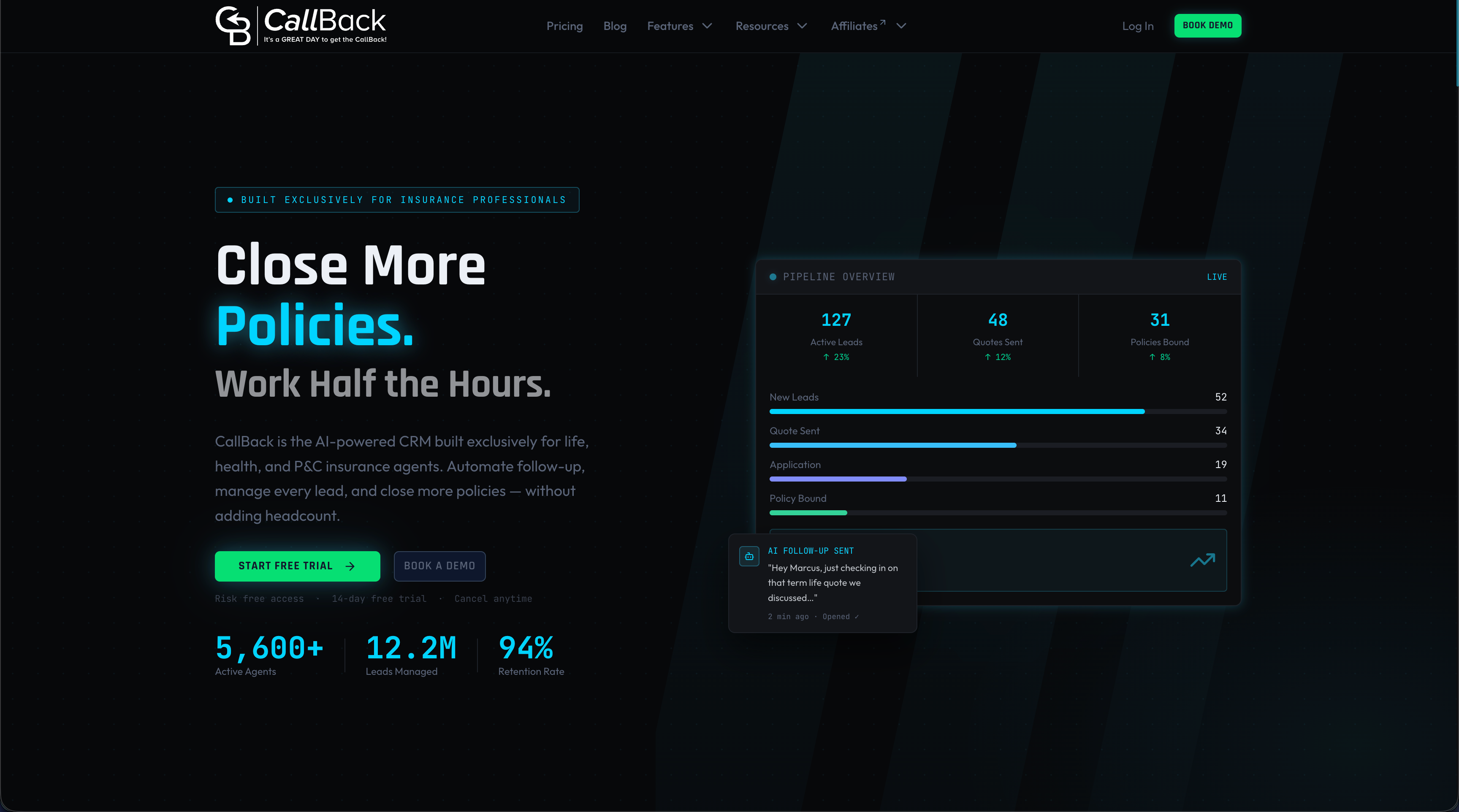
Every feature inside Callbackcrm is designed to reduce the manual work that keeps brokers off the phone and away from clients. The AI assistant handles initial outreach, the automation workflows keep prospects warm, and the CRM updates itself in real time so your pipeline always reflects reality. Explore the full suite of 50+ features built for insurance professionals and see how Callbackcrm fits your current workflow. You can also enhance your outreach with AI-powered SMS marketing tools designed to keep clients engaged between renewals.
FAQ
What are the top benefits of AI for insurance brokers?
AI helps insurance brokers qualify leads faster, automate administrative tasks, personalize client outreach at scale, and detect cross-sell opportunities through predictive analytics. The cumulative impact is more revenue-generating time and stronger client retention.
How does AI improve client engagement for brokers?
AI uses behavioral and policy data to trigger personalized communications, surface renewal and coverage gap opportunities, and power 24/7 virtual assistants that keep clients informed without requiring manual broker effort.
Is AI in insurance sales replacing brokers?
No. AI automates transactional tasks, but brokers who reinvest reclaimed time into deeper advisory work and specialization are increasing their value, not losing it to automation.
How much time can AI save an insurance broker each week?
AI-powered scheduling and automated CRM logging alone save brokers 3 to 5 hours per week, with additional gains from automated lead follow-up and document generation.
Do small independent agents benefit from AI tools?
Yes. Cloud-based AI platforms have made enterprise-grade tools accessible to independent agents at manageable costs, allowing smaller operations to compete effectively in lead generation, client communication, and pipeline management.