

TL;DR:
- AI follow-up automates personalized outreach, boosting booked calls by over 100 percent for insurance agents. It works best when timing, data quality, and human oversight are prioritized to enhance lead qualification and conversion. AI complements human efforts by handling routine tasks while agents focus on high-value relationship building.
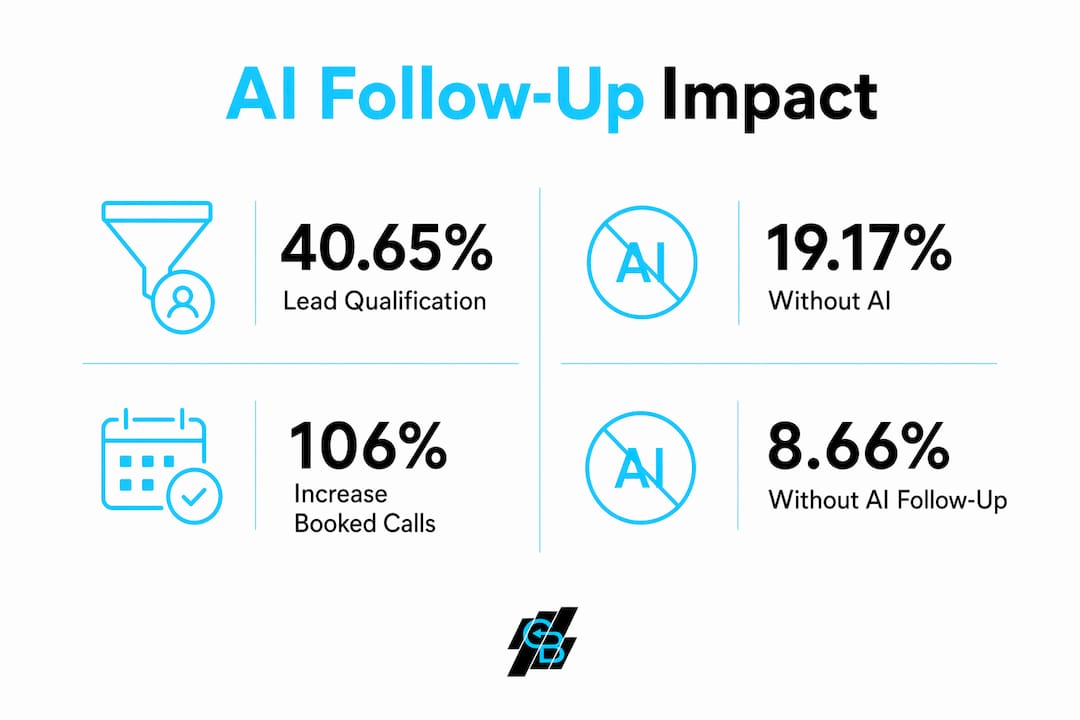
AI follow-up is the use of artificial intelligence to automate, personalize, and time customer outreach after initial contact, turning cold leads into booked appointments without manual effort. For insurance agents, the role of AI follow-up is not a future consideration. It is a present competitive requirement. Platforms like Callbackcrm and tools such as Clay AI follow-up email systems are already reshaping how agents manage pipelines. The data is direct: a single automated AI follow-up more than doubled booked calls by 106% and improved lead qualification rates by 112%. That kind of output from one automated touch changes how you should think about every lead in your CRM.
How does AI follow-up improve lead qualification and appointment booking?
AI follow-up works by reading conversation context and responding at the right moment with the right message. Traditional drip campaigns send the same email to everyone on a schedule. AI follow-up reads what a prospect said, how they said it, and what stage they are at, then adapts the message accordingly. That distinction is what drives results.

The numbers behind this are hard to ignore. Qualification rates jumped from 19.17% without follow-up to 40.65% with a single automated AI follow-up. Booked call rates rose from 8.66% to 17.84% in the same test. One automated message, deployed at the right time, essentially doubled output without adding headcount.
Timing is the other critical variable. Responding within 5 minutes increases conversion odds up to 9 times compared to responding at 10 minutes. The industry standard for AI post-meeting follow-up has moved to 15 minutes or less. No human team can consistently hit that window across every lead. AI can.
Here is what separates AI follow-up from a basic autoresponder:
- Context awareness. AI reads prior messages and adjusts tone, not just content.
- Reply detection. If a prospect responds, AI pauses the sequence and flags the lead for human review.
- Multi-channel reach. AI follow-up runs across email, SMS, and chat simultaneously.
- Variant generation. AI creates multiple message versions and selects the best fit based on lead behavior.
Pro Tip: Set your AI follow-up to trigger within 5 minutes of a form submission or missed call. That single timing adjustment will outperform most manual follow-up processes your team currently runs.
| Metric | Without AI follow-up | With AI follow-up |
|---|---|---|
| Lead qualification rate | 19.17% | 40.65% |
| Booked call rate | 8.66% | 17.84% |
| Response window standard | Variable | 15 minutes or less |
What best practices ensure successful AI follow-up in insurance sales?
The biggest mistake insurance agents make with AI follow-up is treating it as a set-and-forget system. AI follow-up effectiveness depends entirely on the quality of data feeding it and the human judgment guiding it.
Clean CRM data is the foundation. Without sufficient CRM context, AI follow-up feels generic despite technically fast execution. This is called the Visibility Trap. If your CRM shows a lead as “new” when they actually spoke to an agent three weeks ago, the AI will send a first-touch message to someone who already has a quote. That kind of error damages trust faster than no follow-up at all.
Volume control matters just as much as timing. Successful AI follow-up sequences cap automated touches at two or three. Leads tolerate one or two nudges. Exceeding that volume generates complaints and harms your domain reputation, which affects email deliverability for your entire agency.
Best practices for insurance agents implementing AI follow-up:
- Keep CRM records current. Update contact status, last interaction date, and policy interest after every touchpoint.
- Use human-in-the-loop review. Have an agent approve AI-drafted messages before they go out for high-value prospects.
- Cap sequences at 2 to 3 touches. After that, route unresponsive leads to a long-term nurture list, not more AI nudges.
- Define your offer before launching. AI cannot create strategy. You set the target list, the offer, and the goal. AI executes.
- Treat compliance as an advantage. Compliance adherence in AI follow-up builds trust and differentiates your agency from competitors cutting corners.
Pro Tip: Before activating any AI follow-up sequence, audit your CRM for duplicate records, missing phone numbers, and stale lead statuses. A 30-minute data cleanup will improve AI performance more than any prompt adjustment.
How does AI follow-up complement human sales efforts?
AI follow-up is a co-pilot, not an autopilot. That distinction matters for every insurance agent worried about what automation means for their role.
AI handles roughly 80% of repetitive tasks like drafting messages, scheduling follow-ups, and generating message variants. Humans own the offer, the target list, the final approval, and the judgment calls. That division of labor is not a threat to agents. It is a productivity multiplier.
“AI follow-up should be viewed as a co-pilot, not an autopilot, combining human strategy with AI execution.” — Tomba Blog, 2026
The practical example for insurance agents is straightforward. After a prospect submits a quote request, AI sends a confirmation message within minutes, follows up 24 hours later with a personalized policy summary, and flags the lead as hot if they open both messages. The agent then calls a warm, informed prospect instead of a cold contact who barely remembers filling out the form. The relationship work stays human. The repetitive work goes to AI.
AI meeting summaries and follow-up drafts cut prep time from 10 minutes per client to 30 seconds. For an agent managing 50 active leads, that time savings adds up to hours recovered each week. Those hours go back into calls, referrals, and relationship building, which is where insurance sales actually close.
The agents who resist AI follow-up entirely will spend their time on tasks that generate no revenue. The agents who hand off the repetitive 80% to AI will spend their time on the conversations that do.
What practical AI follow-up strategies should insurance agents adopt?
Concrete tactics matter more than general principles. These are the specific AI follow-up strategies that produce results in insurance sales environments.
-
Trigger follow-up immediately after form submissions. When a prospect fills out a quote request or contact form, AI sends a personalized acknowledgment within 5 minutes. This single tactic captures leads before they move to a competitor.
-
Run multi-channel sequences. Email alone is not enough. Combine email, SMS, and chat follow-ups in a single sequence. AI-driven lead triage screens leads across channels, confirms interest, and schedules appointments automatically.
-
Use reply-aware responses. Set AI to pause sequences the moment a prospect replies. Route that lead to a human agent immediately. A reply is a buying signal and it deserves a human response, not another automated message.
-
Deploy context-aware message variants. AI generates multiple versions of a follow-up based on the lead’s policy interest, age group, or prior interaction. A prospect who asked about life insurance gets a different message than one who asked about auto coverage.
-
Integrate AI lead triage to route hot leads fast. Businesses using advanced AI assistants report up to a 45% increase in customer retention through proactive, personalized engagement. Hot leads routed to human agents within minutes convert at significantly higher rates than those left in a queue.
-
Automate post-meeting follow-ups. After every call or video meeting, AI sends a summary, next steps, and a soft call-to-action within 15 minutes. This keeps momentum alive without requiring the agent to write anything.
Agents who want to go deeper on AI in insurance marketing will find that these tactics compound. Each automated touch that works correctly builds a data trail that makes the next follow-up smarter.
Pro Tip: Start with one AI follow-up trigger, the post-form-submission message, and measure results for 30 days before adding more sequences. Teams that succeed automate low-risk, high-volume tasks first, then expand to more complex workflows.
Key Takeaways
The role of AI follow-up in insurance sales is to automate the repetitive 80% of outreach so agents can focus on the high-value conversations that actually close policies.
| Point | Details |
|---|---|
| AI doubles key metrics | A single automated follow-up raised booked calls by 106% and qualification rates by 112%. |
| Timing is critical | Responding within 5 minutes increases conversion odds up to 9 times versus a 10-minute delay. |
| CRM data quality determines results | Incomplete CRM records cause AI to send irrelevant messages, damaging trust and deliverability. |
| Cap sequences at 2 to 3 touches | Exceeding this volume generates spam complaints and harms your agency’s email reputation. |
| AI complements agents, not replaces them | AI handles drafting and scheduling; humans own strategy, judgment, and relationship-building. |
What I’ve learned about AI follow-up after watching agents use it wrong
Most agents I’ve seen adopt AI follow-up make the same mistake. They turn it on, point it at their entire lead list, and expect the tool to do the thinking. It does not work that way. AI follow-up is only as good as the instructions and data you give it.
The agents who get real results treat AI follow-up as a precision instrument. They define exactly which leads enter which sequence, what the message says, and when a human takes over. They review AI-drafted messages for tone before activating new sequences. They check their CRM data before launching anything. That discipline is what separates a 106% lift in booked calls from a flood of unsubscribes.
The compliance angle is also underrated in insurance specifically. Agents who build AI follow-up sequences that respect opt-out requests, honor do-not-contact lists, and stay within state-specific communication rules are building something their competitors cannot easily copy. Compliance is not a cost. It is a moat.
My honest recommendation: start with AI customer engagement strategies designed for insurance professionals, not generic sales tools. The nuances of insurance sales, policy types, prospect sensitivity, and regulatory requirements, demand tools built with that context in mind. Generic AI follow-up tools will get you partway there. Purpose-built platforms will get you the rest of the way.
— Kyle
Callbackcrm’s AI tools for insurance follow-up
Callbackcrm is built specifically for insurance agents, agencies, and IMOs who need AI follow-up that works within the realities of insurance sales.
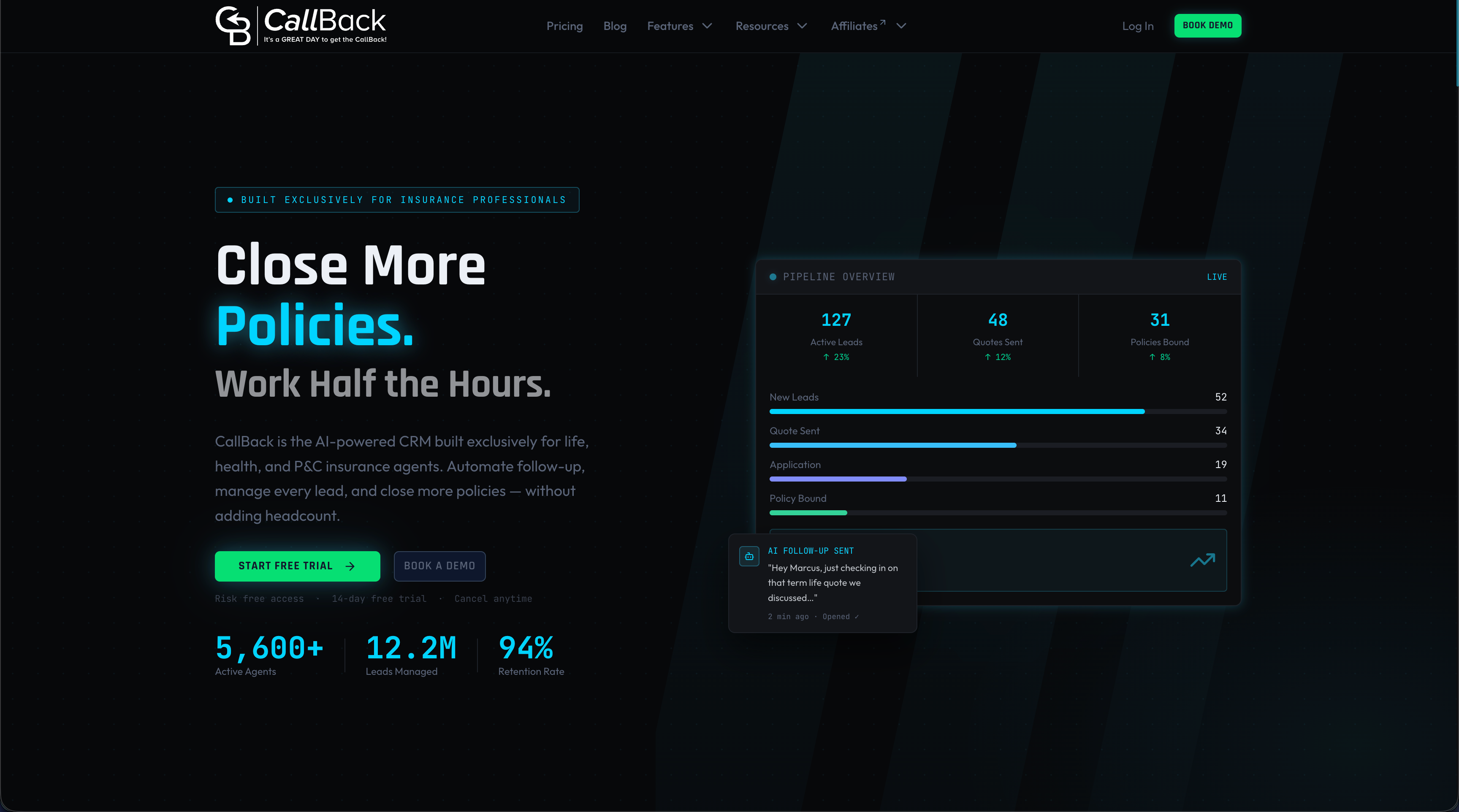
The platform’s 50+ AI-powered features cover the full follow-up workflow: automated email and SMS sequences, AI assistants that draft and send context-aware messages, lead scoring, CRM management, and reputation tools. Agents can also use Callbackcrm’s SMS marketing automation to reach prospects on the channel with the highest open rates. Every feature is designed to reduce manual work and keep agents focused on closing. If you are ready to replace manual follow-up with a system that runs while you sleep, Callbackcrm is worth a close look.
FAQ
What is the role of AI follow-up in insurance sales?
AI follow-up automates personalized outreach after initial contact, handling tasks like message drafting, timing, and lead triage. It frees insurance agents to focus on high-value conversations while AI manages the repetitive engagement work.
How much does AI follow-up improve lead conversion?
A single automated AI follow-up raised lead qualification rates from 19.17% to 40.65% and booked call rates from 8.66% to 17.84%, according to SetSmart research. That represents a 112% improvement in qualification and a 106% increase in booked calls.
How many AI follow-up messages should I send before stopping?
Cap automated sequences at two or three touches. Leads tolerate one or two nudges before marking messages as spam, which damages your domain reputation and reduces deliverability for your entire agency.
Does AI follow-up replace insurance sales agents?
AI follow-up handles roughly 80% of repetitive tasks like drafting and scheduling. Human agents retain control over strategy, offer design, final approval, and relationship-building, which are the activities that close insurance policies.
What is the biggest reason AI follow-up fails?
The most common failure is incomplete CRM data. When AI lacks context about a lead’s history, policy interest, or prior conversations, it sends generic messages that feel irrelevant and damage trust rather than build it.