

AI lead scoring works when insurance agents pilot it against a well-defined segment before rolling it out wide. The first move is not buying software. It is auditing your existing lead data and picking one segment, such as inbound Medicare or term life leads, to test against. Done right, agents typically see higher conversion on the top-scoring band and less time wasted chasing dead-end prospects.
TL;DR:
- Using a well-defined pilot segment like Medicare or term life leads helps insurers measure the true lift of AI lead scoring before wide deployment.
- Rules-based scoring provides transparency but limited flexibility, while machine learning models offer sharper predictions but require careful explanation and oversight.
- Signals such as quote request behavior, response timing, demographic fit, prior policy history, and site engagement strongly correlate with conversions.
- Conducting a randomized holdout test and regular calibration improves model accuracy and prevents overestimating its benefit.
- Ensuring fairness involves monitoring score distribution across demographic groups and maintaining thorough documentation and oversight for compliance.
Table of Contents
- What Is AI Lead Scoring Insurance, and How Does the Score Work?
- Which Signals Predict Insurance Lead Conversion?
- How Do You Set Up Lead Scoring in Your CRM Step by Step?
- What ROI Should Agents Expect From a Lead Scoring Pilot?
- How Do You Keep AI Lead Scoring Fair and Compliant?
- How Does CallBack CRM Support an Insurance Lead Scoring Playbook?
- Where Should Agents Focus First, and What Should They Skip?
- Ready to Put AI Lead Scoring to Work in Your Agency?
- Sources
What Is AI Lead Scoring Insurance, and How Does the Score Work?
A lead score is a number, usually 0 to 100, that estimates the probability a prospect converts to a sold policy. Some platforms convert that number into bands (hot, warm, cold) so agents can act without interpreting raw probabilities. The band matters more day to day than the exact decimal.
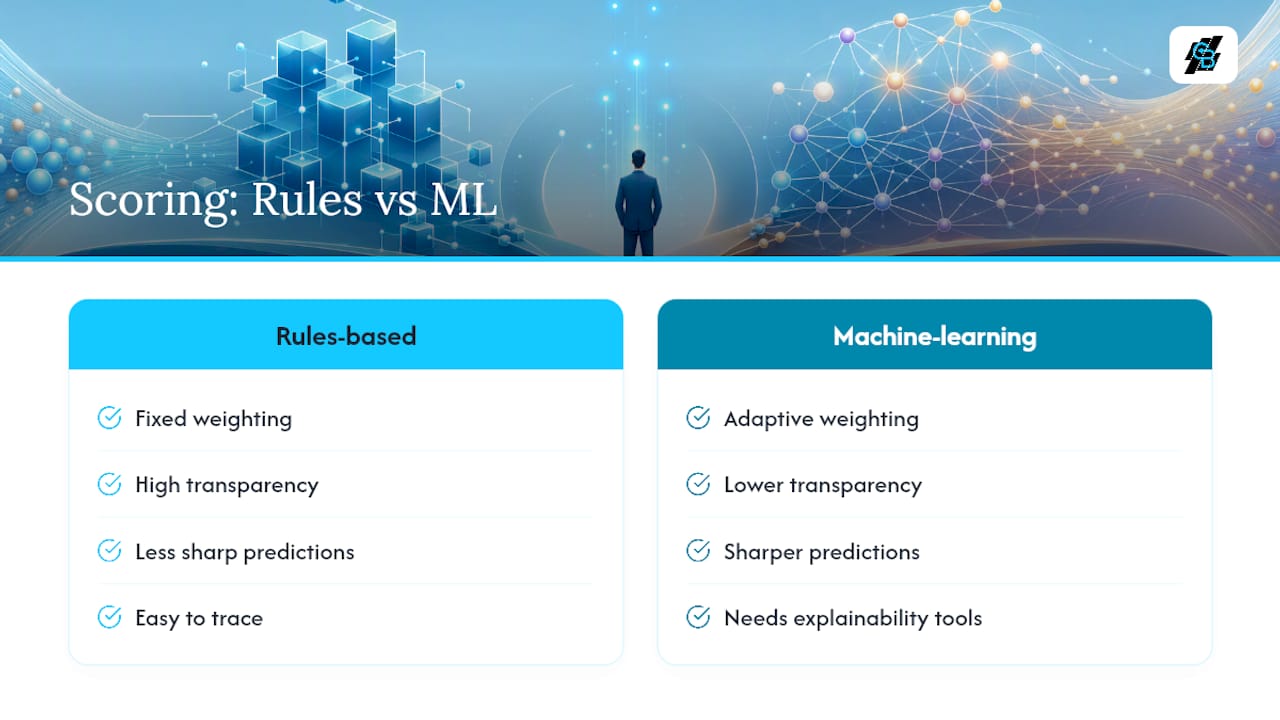
Two model types dominate insurance lead scoring models today. Rules-based scoring assigns fixed points for actions (a callback request might add 20 points, an unanswered call subtracts 5). It is transparent but rigid. Machine learning models weigh dozens of signals simultaneously and adjust weights as new outcomes come in, which produces sharper predictions but requires more explanation to a compliance team. Research on explainability techniques shows that ML models can trade some transparency for accuracy, so agencies should ask any vendor how a score can be traced back to specific behaviors.
Once a lead scores, it should route automatically: top band to a live call queue, middle band to a nurture sequence, bottom band to a low-touch drip. The score is not a verdict on the person. It is a prioritization tool for where your team spends the next hour.
Which Signals Predict Insurance Lead Conversion?
Not every data point pulls equal weight. Some signals correlate strongly with a policy sale; others are noise dressed up as data.
- Quote request behavior: A completed quote form beats a bounced landing page visit every time, and multiple quote requests in one session signal urgency.
- Response rate to outreach: A lead who answers the first call or replies to an SMS within an hour converts at a meaningfully higher rate than one who goes silent for days.
- Demographic fit signals: Zip code, age band, and household size help match a lead to the right product line, especially for Medicare and life insurance.
- Prior policy history: A lead currently insured elsewhere with a renewal date approaching often outperforms a cold prospect with no coverage history.
- Site and email engagement: Time on a rate calculator page or repeat email opens indicate active shopping, not idle curiosity.
A mid-size insurer pilot using predictive lead scoring saw conversion for high-scoring leads jump more than 3x compared to unscored outreach, while time spent on low-scoring leads dropped sharply. That gap is the entire business case for scoring: it does not create better leads, it stops you from treating every lead like it deserves the same five phone calls.
Third-party data feeds (credit-adjacent scores, household income estimates) can sharpen a model, but they carry privacy and disclosure obligations. Treat any external data source as something your compliance team should review before it touches a live model.
How Do You Set Up Lead Scoring in Your CRM Step by Step?
Building a scoring system inside an existing CRM does not require a data science team. It requires a defined pilot and discipline about what “done” looks like at each stage.
- Define your ideal customer profile and pick a pilot segment. Choose one product line and one lead source, such as Medicare Advantage leads from a single ad campaign, so results are easy to isolate. Reference Medicare if your pilot timing needs to respect annual enrollment windows.
- Audit and unify your data sources. Pull lead records, call logs, email and SMS engagement, and past conversion outcomes into one place. Gaps here (missing outcome data, duplicate records) will quietly wreck any model you build on top.
- Choose a scoring approach that matches your data volume. A few hundred labeled leads a month usually favors a rules-based start; several thousand supports a machine learning model. CallBack CRM’s lead scoring process guide walks through both paths.
- Map score bands to specific actions. Top band triggers an immediate call assignment, middle band enters an automated nurture sequence, bottom band gets a monthly check-in email. Write this mapping down before you launch.
- Run a randomized holdout test. Route half your pilot leads by score and leave the other half untouched by the model, then compare conversion after 30 to 90 days.
- Schedule a calibration review. Compare conversion by band, adjust signal weights if a band underperforms, and retrain using the most recent 90 days of outcomes.
Pro Tip: Do not skip the holdout test. Comparing scored leads only against your own gut feeling almost always overstates the model’s actual lift.
What ROI Should Agents Expect From a Lead Scoring Pilot?
The metrics that matter are simple, and you should already be capable of tracking most of them in your CRM.
- Conversion rate by score band: This is the core signal. A working model should show a clear, widening gap between top and bottom bands within the pilot window.
- Lead-to-appointment time: Faster movement for high-scoring leads suggests your routing rules are working as intended.
- Cost per acquisition (CPA): If CPA drops for the scored group compared to the holdout, the model is paying for itself.
- Lifetime value uplift: Harder to measure quickly, but worth tracking over two or three renewal cycles.
McKinsey’s research on AI adoption in insurance finds that firms treating AI as a real operational shift, not a side experiment, see measurable gains in conversion and onboarding cost. The same report warns that many insurers stall in permanent pilot mode, never scaling past the test phase. A defined calibration cadence is what prevents that stall.
How Do You Keep AI Lead Scoring Fair and Compliant?
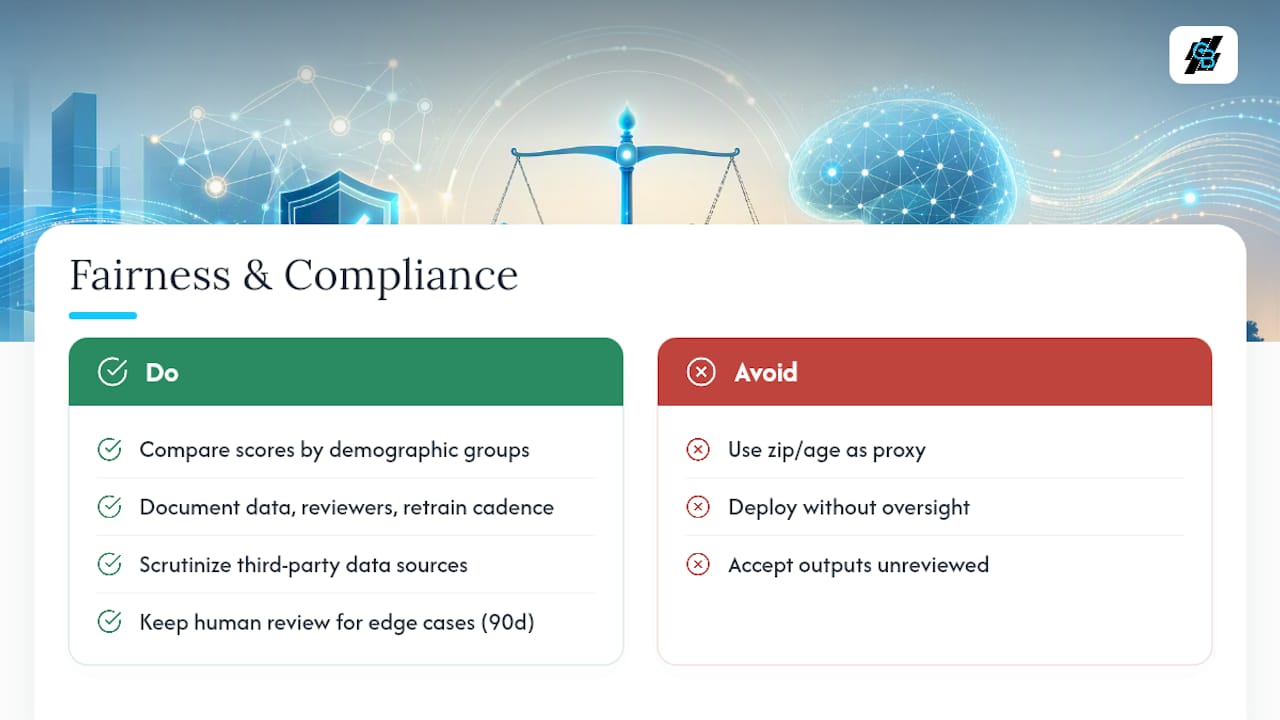
A score that quietly encodes zip code or age as a proxy for protected characteristics is a liability, not an asset. Before trusting a model in production, compare score distributions across demographic groups for similar behavioral profiles. A model that consistently scores one group lower despite matching engagement signals needs retraining or a different feature set.
NAIC’s model governance guidance points to documentation and oversight as the operational backbone of responsible AI use, not just model accuracy. In practice, that means keeping a written record of what data feeds a score, who reviews outputs, and how often the model gets retrained. Third-party data sources deserve extra scrutiny given consumer privacy expectations. Keep a human reviewing edge cases, not just accepting whatever the model outputs, especially in the first 90 days of any pilot.
How Does CallBack CRM Support an Insurance Lead Scoring Playbook?
CallBack CRM was built around the exact workflow this playbook describes: data capture through funnel and website builders, automated SMS and email routing based on engagement, and AI assistants that flag high-intent behavior as it happens. Instead of piecing together spreadsheets and a separate dialer, agents can capture a lead, score its engagement signals, and trigger the right follow-up sequence inside one platform.
For agencies building their first model, CallBack CRM’s guide on lead scoring methods breaks down rules-based versus machine learning approaches in more depth, and the AI in lead generation post covers channel-specific signal capture for agents working multiple lead sources at once.
Where Should Agents Focus First, and What Should They Skip?
Adopt scoring fast if you already have clean conversion data on a few hundred past leads. Delay it if your CRM records are inconsistent. A model trained on messy inputs will confidently produce wrong answers, and confident wrong answers are more dangerous than no model at all. This week, an agency leader should pull last quarter’s lead list, tag actual outcomes, and see if the data even supports a pilot.
— Kyle
Ready to Put AI Lead Scoring to Work in Your Agency?
An AI-powered CRM platform can help agents run this entire playbook without stitching together multiple separate tools. Instead of manually tagging leads and hoping your dialer and email platform agree on who to call next, CallBack CRM connects lead capture, scoring signals, and automated routing in one system built specifically for insurance sales.
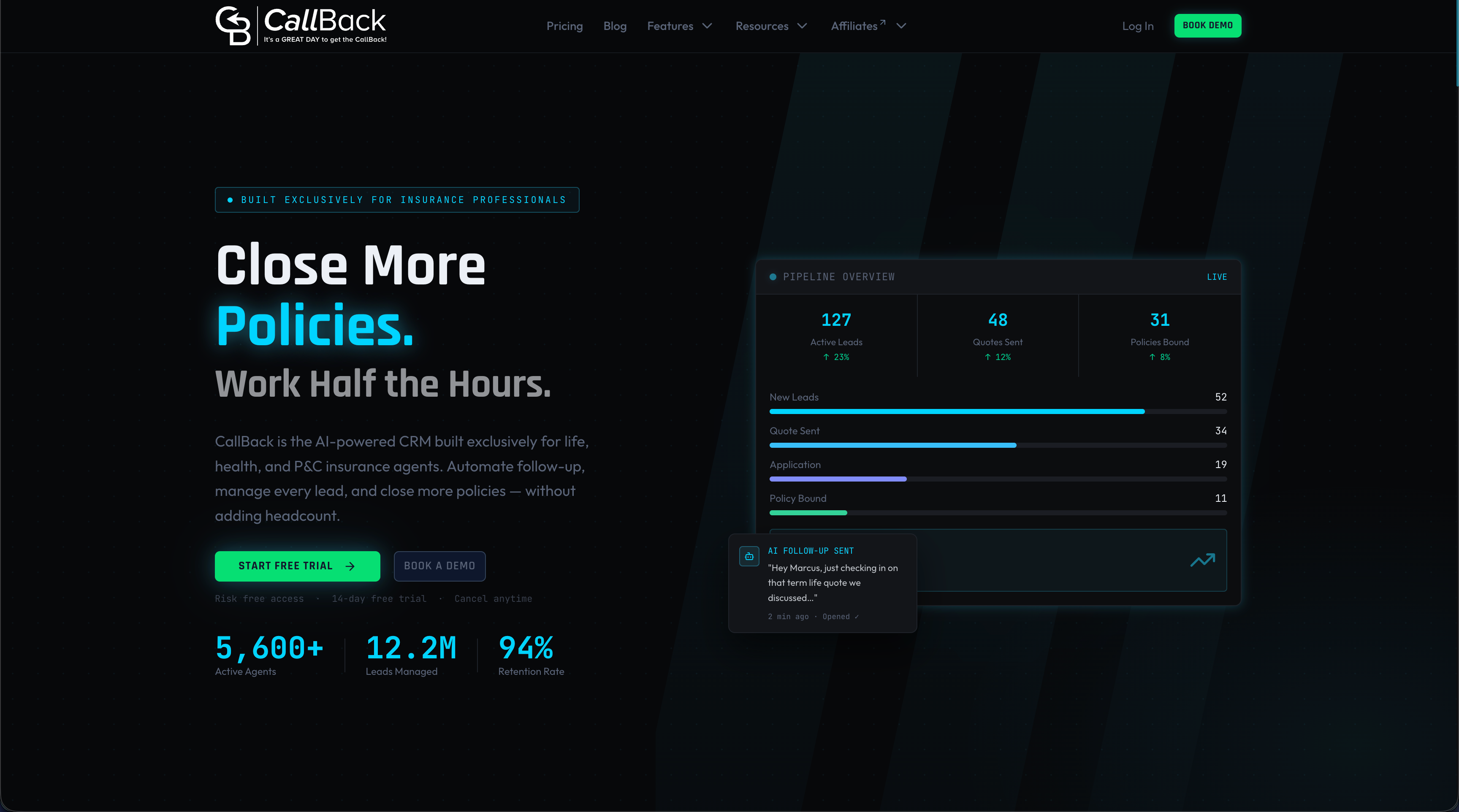
The platform’s funnel and website builder captures the quote-request and site-engagement signals that feed a scoring model, while SMS marketing features automate the follow-up sequences that top-band and middle-band leads need without manual dialing. Agencies can also draw on tactics from partners like Babylovegrowth’s guide to AI-driven lead generation to widen the top of the funnel before scoring narrows it down. Start a free trial and map your first pilot segment inside CallBack CRM this week.
Sources
- The future of AI for the insurance industry | McKinsey
- Predictive Lead Scoring Increases Insurance Company’s Top Line | NineTwoThree