

TL;DR:
- AI-driven lead scoring automatically ranks prospects using behavioral signals and predictive data.
- Proper data hygiene and ongoing model updates are critical for accurate and effective scoring.
- Most agencies fail by neglecting data prep or treating AI as a set-it-and-forget-it solution.
Your agents are spending hours chasing leads that never convert. Sound familiar? For most insurance agencies, a bloated pipeline full of low-quality prospects is not just frustrating, it is expensive. The good news is that an AI-powered lead scoring process can change that entirely. Instead of guessing which prospects are worth your team’s time, you can use real behavioral signals and predictive data to rank every lead automatically. This guide walks you through why lead scoring matters, what you need to get started, how to build the process step by step, and how to keep it performing over time.
Table of Contents
- Why lead scoring matters for insurance sales
- What you need before starting: data, tools, and groundwork
- Step-by-step: setting up your AI-powered lead scoring process
- Troubleshooting and optimizing your process
- Our take: what most agencies get wrong about lead scoring
- Automate scoring and supercharge your sales with CallBack CRM
- Frequently asked questions
Key Takeaways
| Point | Details |
|---|---|
| Modernize lead scoring | Switch from manual scoring to AI-powered tools for better accuracy and scale. |
| Clean, consistent data is essential | Collect 6-12 months of clean, complete lead data before launching your model. |
| Start simple, iterate often | Build an actionable process, then optimize as you gather results and feedback. |
| Avoid over-complication | Complex or biased models can reduce results and team adoption. |
| Automate nurturing | Connect your scoring to CRM and marketing workflows to maximize conversion. |
Why lead scoring matters for insurance sales
Every lead your agency pursues costs money. There is the time your agents spend on calls, the cost of follow-up emails, and the opportunity cost of not working a better prospect. When your team treats every lead the same, you are essentially paying premium prices for discount results.
Lead scoring solves this by assigning a numeric value to each prospect based on how likely they are to buy. Higher scores go to leads that match your ideal customer profile and show strong buying signals. Lower scores flag leads that need more nurturing or should be deprioritized entirely.
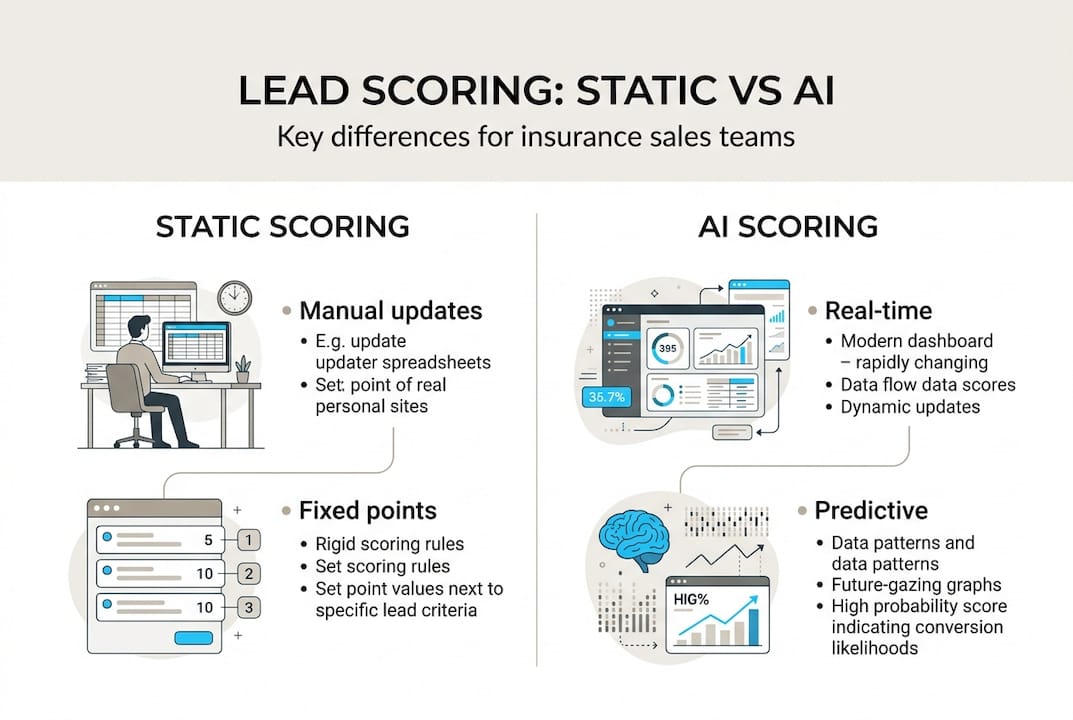
Static vs. AI-driven scoring: what’s the difference?
| Feature | Static scoring | AI-driven scoring |
|---|---|---|
| Updates | Manual, infrequent | Real-time, automatic |
| Signal sources | Basic form data | Behavioral, demographic, historical |
| Accuracy over time | Degrades | Improves with feedback |
| ROI impact | Moderate | 30%+ ROI gains |
| Best for | Small, simple pipelines | Growing agencies |
Static scoring systems work by assigning fixed point values to lead attributes like age, zip code, or policy type interest. The problem is that these attributes do not change once entered, so the score never reflects what the lead actually does after entering your funnel. A prospect who visits your life insurance page six times in a week looks identical to one who bounced after 10 seconds.
AI-driven scoring fixes this with feedback loops. Every interaction, email open, page visit, form submission, or ignored follow-up feeds back into the model and adjusts scores in real time. This is why AI in lead generation has become a competitive advantage for forward-thinking agencies.
That said, manual scoring is not worthless. If your agency is small and your pipeline is manageable, a simple spreadsheet-based system can still work. The issue is scale. Once you are handling hundreds of leads per month, manual scoring becomes a bottleneck.
Here is what a healthy lead scoring setup should track:
- Demographic fit: Age, income range, location, and life stage
- Behavioral signals: Website visits, email clicks, webinar attendance
- Engagement recency: How recently the lead interacted with your content
- Pipeline stage: Where the lead currently sits in your automated lead funnel
- Intent indicators: Specific pages visited (pricing, policy comparison, contact)
Pro Tip: Do not score leads in isolation. Cross-reference behavioral data with your best closed deals to find patterns. If your top clients all visited the same landing page before converting, that page visit should carry extra weight in your model.
The shift from static to dynamic scoring is not just a tech upgrade. It is a strategic one. Agencies that embrace predictive lead generation report stronger pipeline quality and fewer wasted sales hours. The data does the filtering so your agents can focus on closing.
What you need before starting: data, tools, and groundwork
Before you build anything, you need to be honest about what you have. Jumping into AI-powered scoring without the right foundation is the fastest way to get unreliable results and frustrated agents.

Minimum data requirements
| Requirement | Minimum threshold | Why it matters |
|---|---|---|
| Historical lead data | 6-12 months | Needed to train the model accurately |
| Closed deal records | 50+ examples | Establishes what a converted lead looks like |
| Lost deal records | 50+ examples | Teaches the model what to avoid |
| Data completeness | 80%+ fields filled | Dirty data cuts accuracy 40% |
Data hygiene is not glamorous, but it is critical. Duplicate records, missing phone numbers, and inconsistent field entries all degrade your model’s accuracy. Before you connect any AI tool, run a data audit. Remove duplicates, standardize field formats, and fill in gaps where possible.
Here is what your core tech stack should include:
- A CRM system that stores lead records, interaction history, and deal outcomes
- An AI scoring platform that can ingest your CRM data and generate predictive scores
- Workflow automation software to act on those scores automatically
- Analytics tools to monitor model performance over time
For AI for insurance lead generation, an all-in-one platform that combines CRM, AI scoring, and automation is far more efficient than stitching together three separate tools. Integration gaps between disconnected systems are a common source of data loss and scoring errors.
Team readiness matters just as much as technology. If your agents do not trust the scores, they will ignore them. Before launch, walk your team through how the model works, what the scores mean, and how they should change their daily workflow. Adoption is not automatic.
Pro Tip: Start with a pilot group of 2-3 agents before rolling out agency-wide. Their feedback will surface practical issues you would never catch in a test environment.
Step-by-step: setting up your AI-powered lead scoring process
With your data cleaned and your tools selected, here is the exact process to build and automate your lead scoring system.
-
Define your scoring criteria. List every data point your CRM captures and decide which ones correlate with conversion. Group them into categories: demographic fit, behavioral engagement, and intent signals. Assign relative weights to each category based on your historical data.
-
Integrate your CRM and AI platform. Connect your lead database to your AI scoring tool. Make sure the integration syncs in real time, not just nightly batches. Stale data produces stale scores.
-
Train the model with historical data. Feed the AI your closed won and closed lost records. This is where the model learns what a high-value insurance lead actually looks like for your specific agency. Predictive scoring models can reach 85-90% accuracy, but only when the training data is clean and segmented properly.
-
Test your scoring output. Run the model against a fresh batch of leads and compare the scores to what your agents would have ranked manually. Look for obvious mismatches. A lead your top agent would call immediately should not be scoring in the bottom third.
-
Automate your follow-up workflows. Set up triggers so that high-scoring leads get immediate outreach, mid-range leads enter a nurture sequence, and low-scoring leads receive lighter-touch content. Check out lead generation tips for building effective nurture flows, and review a lead generation workflow tutorial for a practical setup example.
Pro Tip: Build a score decay rule into your system. If a lead has not engaged in 30 days, their score should drop automatically. This prevents inflated scores from clogging your priority queue with cold prospects.
The goal is not a perfect model on day one. It is a working model that gets smarter every week as new conversion data flows back in.
Troubleshooting and optimizing your process
Even a well-built scoring system will develop problems over time. Catching them early keeps your pipeline healthy and your agents confident in the data.
Signs your model is underperforming:
- High-scoring leads are not converting at a higher rate than mid-range leads
- Agents are regularly overriding scores and working low-ranked prospects instead
- Your pipeline has a large cluster of leads stuck at the same score
- New lead sources are not being scored consistently
Biased training data is one of the sneakiest problems. If your historical closed deals skew heavily toward one demographic or product line, the model will overweight those signals and undervalue other viable prospects. Audit your training data for representation gaps before assuming the model is broken.
Score decay, mentioned earlier, is also commonly skipped. Without decay rules, inactive leads accumulate inflated scores, and your agents waste time on prospects who checked out months ago.
Do not ignore low-scoring leads entirely. Some of them are worth nurturing through automated sequences. Review lead generation types to understand which low-score segments respond best to long-term nurture versus immediate disqualification.
“The agencies that get the most from AI scoring are not the ones with the fanciest models. They are the ones that review their results every month, fix what is broken, and keep their data clean.”
For iterative updates, set a quarterly review cadence at minimum. Compare predicted scores against actual outcomes, identify where the model missed, and retrain with updated data. Check AI marketing tips for strategies on keeping your outreach aligned with scoring updates.
Team adoption is the final piece. Complex dashboards that require training to interpret will get ignored. Keep your score display simple: a clear tier label (hot, warm, cold) alongside the numeric score works better than a 10-variable breakdown that confuses everyone.
Our take: what most agencies get wrong about lead scoring
Here is the honest truth most vendors will not tell you. The technology is rarely the problem. The agencies that fail at lead scoring almost always fail for one of two reasons: they skipped the data prep, or they treated AI as a set-and-forget solution.
We have seen agencies invest in powerful AI platforms and then feed them two years of inconsistent, duplicate-filled CRM data. The output is garbage, the agents lose trust in the scores, and the whole initiative gets shelved. The tool did not fail. The foundation did.
The other mistake is assuming the model stays accurate on its own. AI scoring improves with feedback, but only if someone is actually reviewing outcomes and feeding corrections back in. Human oversight is not optional. It is the mechanism that keeps the model honest.
The agencies that win with AI for insurance sales are the ones that keep their models simple enough for every agent to understand and act on. A score your team trusts and uses daily beats a sophisticated model that sits ignored in a dashboard.
Automate scoring and supercharge your sales with CallBack CRM
Ready to make lead scoring simpler and more effective? CallBack CRM is built specifically for insurance agencies that want to stop guessing and start closing.
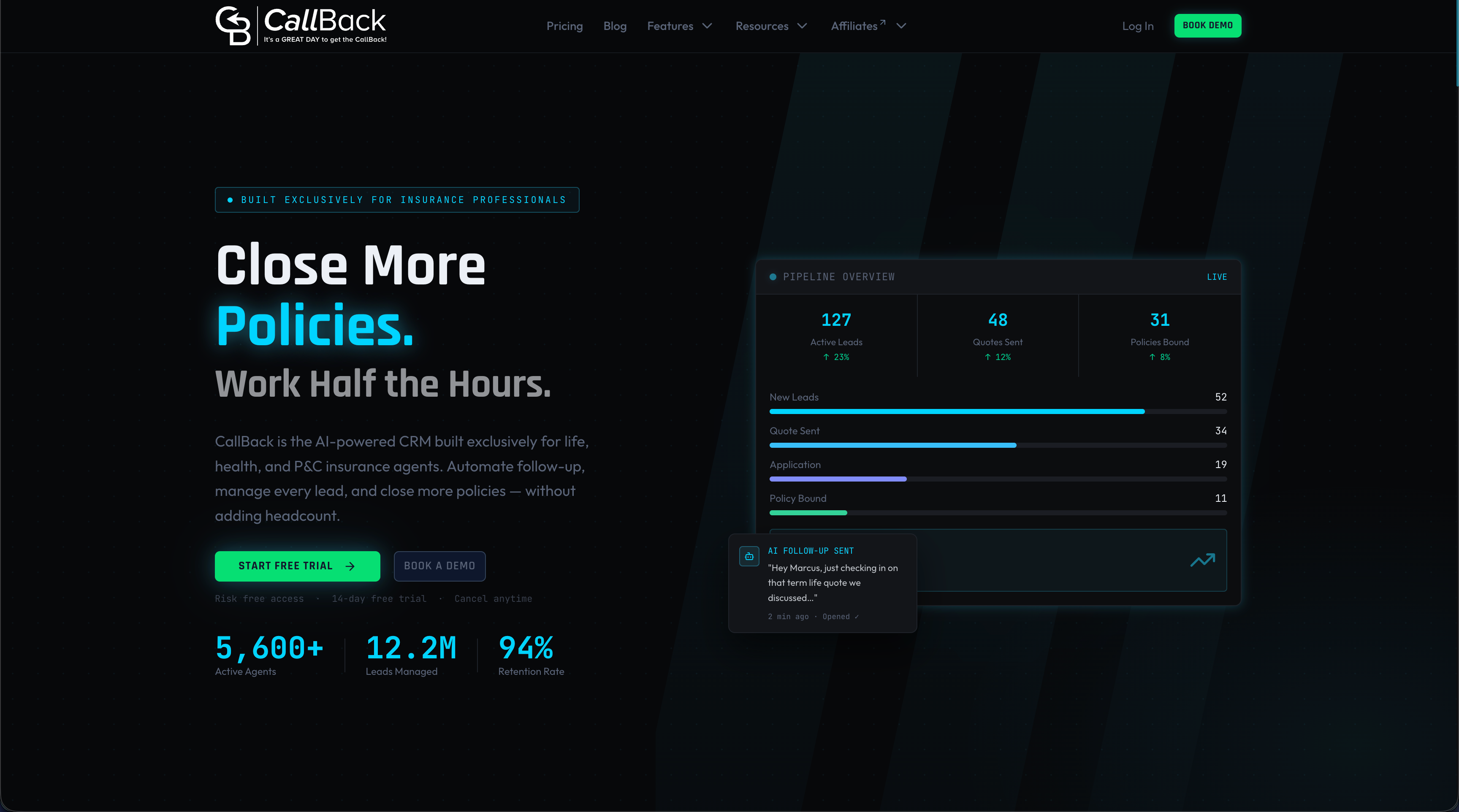
With AI-powered CRM features that handle scoring, segmentation, and follow-up automatically, your agents spend their time on the leads most likely to convert. Use the platform to build insurance sales funnels that capture and qualify prospects from the first click, and let email automation tools keep every lead warm without manual effort. CallBack CRM gives your agency the infrastructure to make AI-powered lead scoring work from day one, without the complexity of piecing together multiple tools.
Frequently asked questions
How much historical data do I need to get accurate lead scoring?
You need at least 6-12 months of relevant sales and lead data to build an AI-driven lead scoring model that works reliably. Less than that and the model will not have enough patterns to make accurate predictions.
Can I use lead scoring with only manual or basic tools?
Manual lead scoring is a solid starting point, but it becomes less effective as your pipeline grows and lacks the real-time adaptability that AI dynamic models provide. For agencies handling more than a few dozen leads per month, AI tools will consistently outperform manual methods.
What are the most common reasons lead scoring fails?
The biggest causes of failure are poor data quality, insufficient historical records, unchecked biases in training data, and overly complex models that reduce team adoption. Dirty data alone can cut model accuracy by 40%, making clean data your single most important asset.
How often should I update my lead scoring model?
Review and refine your lead scoring model at least every quarter, or sooner if you notice shifts in lead quality, conversion rates, or agent feedback about score accuracy.