

TL;DR:
- Managing a sales pipeline with structure and buyer behavior focus increases closing rates.
- Automation and AI tools streamline pipeline stages, improve follow-up, and boost productivity.
- Regular review, data accuracy, and disqualifying stagnant deals are key to a healthy, predictable pipeline.
Most insurance agents believe that filling their pipeline with as many leads as possible is the fastest path to higher sales. It isn’t. Chasing volume without structure leads to missed follow-ups, stalled deals, and unpredictable revenue. A well-managed sales pipeline gives you visibility into every opportunity, so you know exactly where each prospect stands and what to do next. In this guide, we break down what a sales pipeline really means for insurance professionals, walk through each stage, and show you how automation and AI can turn a chaotic lead list into a consistent, high-converting system.
Table of Contents
- What is a sales pipeline?
- Understanding the insurance sales pipeline stages
- The role of automation and AI in pipeline management
- Best practices: Building and maintaining a healthy pipeline
- What most insurance agents get wrong about sales pipelines
- Automate your pipeline for real results
- Frequently asked questions
Key Takeaways
| Point | Details |
|---|---|
| Define your pipeline | A sales pipeline visually tracks each prospect’s journey from lead to closed deal in insurance. |
| Focus on progress | Healthy pipelines prioritize accurate, moving deals over sheer volume. |
| Leverage automation | Automation and AI tools speed up follow-ups and improve productivity for agents. |
| Maintain pipeline hygiene | Regular pipeline reviews and clean data are critical to forecasting and success. |
| Review weekly for best results | Consistent weekly reviews help keep your pipeline effective and forecast-ready. |
What is a sales pipeline?
A sales pipeline is a visual, stage-by-stage map of how your prospects move from first contact to a signed policy. Think of it as a live snapshot of your entire book of business in progress. Each deal sits in a specific stage, and your job is to move it forward with the right action at the right time.
Many agents confuse a sales pipeline with a sales funnel. They are related but not the same. A sales funnel focuses on the buyer’s experience and how awareness narrows down to a purchase decision. A sales pipeline focuses on your sales activities and how you manage each deal from your side. Both matter, but for day-to-day management, the pipeline is your operational tool.
Why does this distinction matter? Because when you manage a pipeline, you are tracking what you need to do next, not just hoping a prospect eventually buys. That shift in mindset changes everything. Good funnel management basics complement your pipeline, but the pipeline is where revenue gets built.
For insurance agents, a well-structured pipeline provides three core benefits:
- Clarity: You always know the status of every active deal.
- Focus: You prioritize the deals most likely to close, not just the newest ones.
- Follow-up discipline: You never let a warm prospect go cold because it slipped through the cracks.
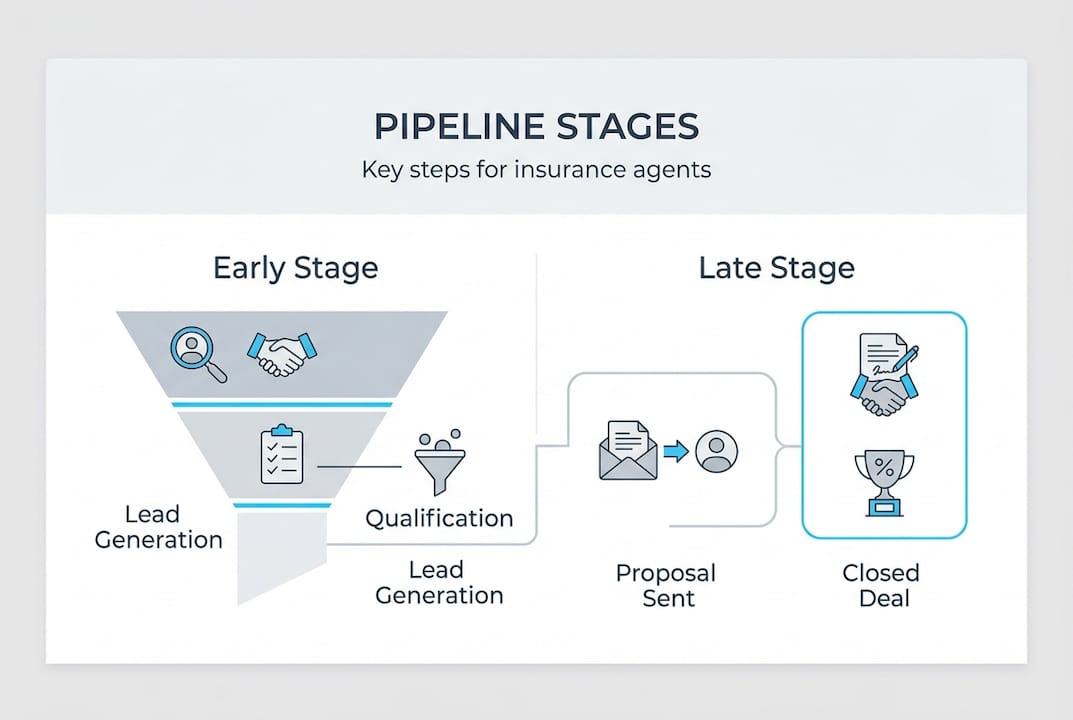
According to industry research, standard pipeline stages include Prospecting/Lead, Qualification, Needs Assessment/Discovery, Proposal/Quote, Negotiation/Closing, Contract Signing/Policy Issuance, and Post-Sale. Each stage has specific entry and exit criteria based on buyer actions, not just your gut feeling.
Pro Tip: Track a prospect’s movement through your pipeline based on what they do, such as responding to a quote or scheduling a call, not just what you do, like sending an email. Buyer actions are the real signal that a deal is progressing.
When you build your pipeline around buyer behavior, your forecasts become more accurate and your follow-up becomes more purposeful. That is the foundation of a pipeline that actually closes deals.
Understanding the insurance sales pipeline stages
With a core understanding established, let’s break down each stage of the typical insurance sales pipeline. Knowing what each stage means, and what moves a prospect in or out of it, is what separates agents who close consistently from those who are always guessing.
For insurance agents, the five core stages are Lead/Inquiry, Qualified Prospect, Proposal Sent, Commitment/Pending, and Closed/Won, each with a strict follow-up cadence including 24-hour initial contact and weekly pipeline reviews.

| Stage | Entry criteria | Key actions | Typical duration |
|---|---|---|---|
| Lead/Inquiry | Contact info captured | Initial outreach, qualify interest | 0 to 2 days |
| Qualified Prospect | Budget, need, and timeline confirmed | Needs assessment, discovery call | 3 to 7 days |
| Proposal Sent | Quote delivered | Follow-up call, answer objections | 3 to 10 days |
| Commitment/Pending | Verbal agreement received | Application, underwriting, paperwork | 5 to 14 days |
| Closed/Won | Policy issued and payment received | Onboarding, referral request | Ongoing |
Here is how a prospect typically advances through your pipeline:
- A lead submits a form or calls your office. They enter as a Lead/Inquiry.
- You contact them within 24 hours, confirm their need, budget, and timeline, and move them to Qualified Prospect.
- You complete a discovery call and send a tailored quote. They advance to Proposal Sent.
- They agree verbally to move forward. You begin paperwork and underwriting. They are now in Commitment/Pending.
- The policy is issued and payment is collected. The deal moves to Closed/Won.
You can learn more about managing each pipeline stage with a structured CRM approach that keeps every deal on track.
“A strict follow-up cadence is not optional. Initial contact within 24 hours and a weekly review of every open deal are the minimum requirements for a pipeline that produces consistent results.”
Time is a critical variable at every stage. Delays kill deals. Building a solid workflow for lead generation ensures new inquiries never sit uncontacted for more than a day.
The role of automation and AI in pipeline management
With the stages in place, the next leap is using technology to run your pipeline more efficiently. Manual pipeline management works when you have ten deals. It breaks down fast when you have fifty.
Automation and AI tools help at every stage of your pipeline. At the top, AI-powered lead scoring identifies which new inquiries are most likely to convert, so you spend your first hour of the day on the right people. In the middle stages, automated reminders and follow-up sequences make sure no proposal goes unanswered. At the closing stage, analytics flag deals that have gone quiet and need attention.
Pipeline reviews must spot bottlenecks, enforce updates, and use clear stage criteria based on buyer actions, because poor data leads to bad forecasting. Automation helps enforce those updates by prompting agents to log activity and move deals forward.
The numbers back this up. CRM adoption boosts productivity by 29%, and contacting a lead in under 5 minutes increases conversions by up to 391% compared to waiting even an hour. These are not marginal gains. They are the difference between a thriving agency and one that constantly struggles to hit quota.
Here are the top automation wins for insurance agents managing a pipeline:
- Automated lead scoring: Prioritize high-value prospects without manual sorting.
- Follow-up sequences: Trigger emails and SMS messages based on deal stage and time elapsed.
- Appointment reminders: Reduce no-shows with automated confirmations sent 24 and 2 hours before.
- Deal stage alerts: Get notified when a deal has been stagnant for too long.
- Analytics dashboards: See conversion rates by stage and identify where deals are dropping off.
Explore automation workflow strategies to see how agents are building systems that run in the background while they focus on selling. You can also review a practical automation checklist to make sure you have covered every key touchpoint.
Pro Tip: Assign one clear next step to every deal in your pipeline. If a deal does not have a scheduled action attached to it, it is not being managed. It is just sitting there waiting to die.
Best practices: Building and maintaining a healthy pipeline
Automation makes efficiency possible, but disciplined habits are key to maintaining a pipeline that actually closes deals. Technology amplifies good habits and bad ones equally. So before you automate, get your fundamentals right.
A healthy pipeline prioritizes accuracy and movement over sheer volume, with 3x quota coverage as the ideal target and weekly reviews as a non-negotiable habit. That means if your monthly quota is $10,000 in premium, you want $30,000 worth of active, realistic deals in your pipeline at all times.
| Factor | Healthy pipeline | Overfilled pipeline |
|---|---|---|
| Data accuracy | High, updated regularly | Low, lots of stale entries |
| Deal visibility | Clear stage and next step | Cluttered, hard to prioritize |
| Closing rate | Predictable and improving | Inconsistent and frustrating |
| Forecast reliability | Strong | Unreliable |
Here are the habits that separate top-performing agents from the rest:
- Review your pipeline every week without exception.
- Remove or disqualify any prospect that has been stuck for 30 or more days with no movement.
- Always log the next scheduled action before closing your CRM.
- Ask for referrals from every closed deal. Referral leads convert at a 30% higher rate than cold leads.
- 80% of sales require five or more follow-ups, so build persistence into your process, not just your personality.
The most common mistakes agents make are holding onto dead deals too long and skipping follow-ups when they get busy. Both behaviors distort your pipeline and make it impossible to forecast accurately. Learning how to convert more leads starts with removing the noise from your pipeline so the real opportunities stand out. Pair that with AI marketing tool best practices and you have a system that works even on your busiest days.
What most insurance agents get wrong about sales pipelines
Here is the uncomfortable truth: most agents treat their pipeline like a storage unit. They throw every lead in, never clean it out, and then wonder why their forecasts are always wrong.
A bloated pipeline feels productive. It looks impressive in a report. But a pipeline full of stale, unqualified deals is not an asset. It is a distraction. It hides your real numbers, wastes your follow-up energy, and gives you false confidence heading into the month.
The agents who consistently hit quota are not the ones with the most leads. They are the ones with the most accurate pipelines. They disqualify fast, follow up relentlessly, and use automation to handle the repetitive work so they can focus on real conversations.
We have seen agencies double their close rate not by adding more leads but by cutting their pipeline in half and focusing only on deals that were actually moving. That is a counterintuitive result, but it makes complete sense when you understand that clarity beats volume every time. Explore approaches to smarter selling to see how AI tools support this kind of focused, disciplined pipeline management.
Automate your pipeline for real results
Ready to put pipeline best practices into action? The right tools make the difference between a pipeline you manage manually every day and one that practically runs itself.
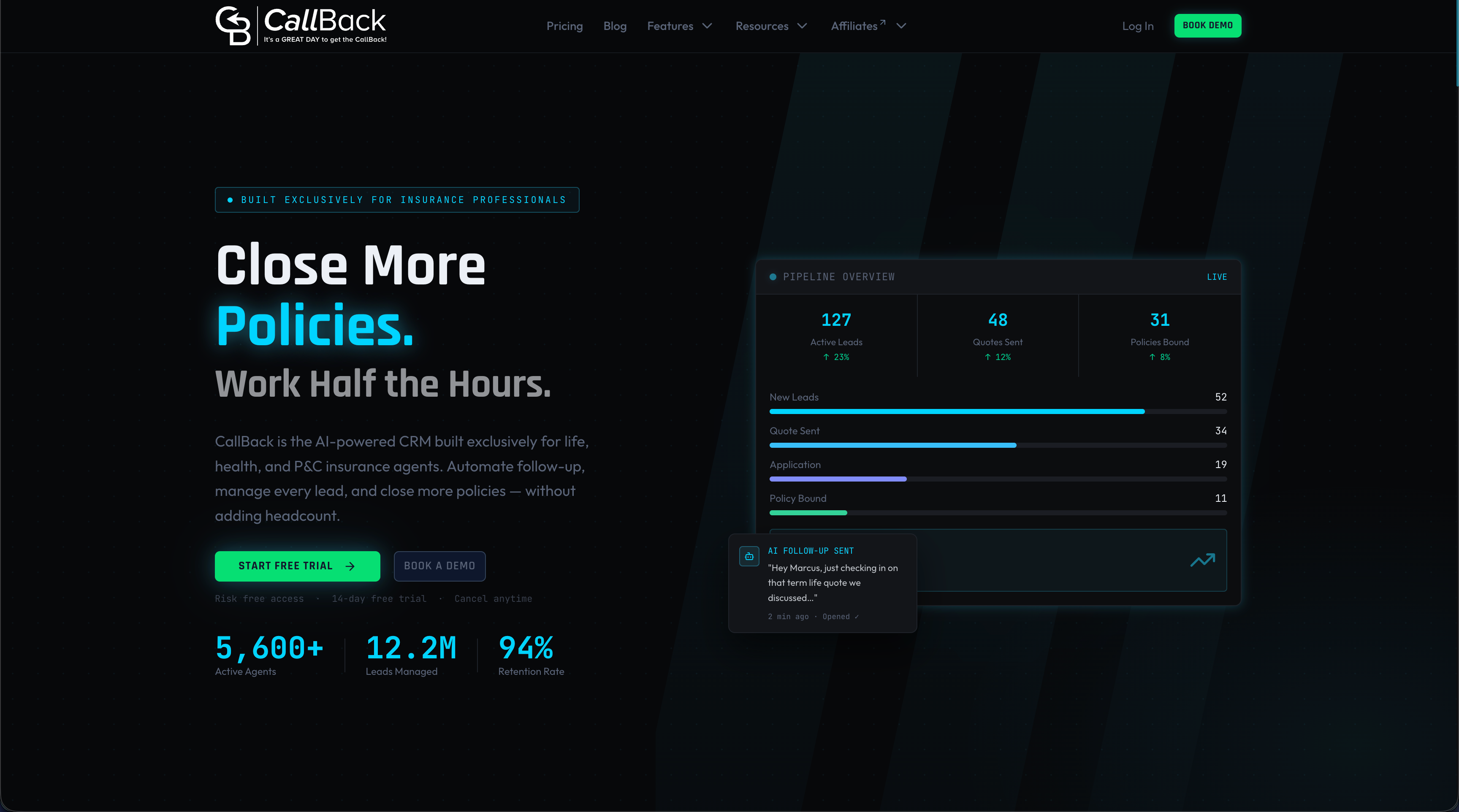
CallBack CRM gives insurance agents and agencies a full suite of automation features built specifically for pipeline management. From AI-powered lead scoring and automated follow-up sequences to deal stage alerts and analytics dashboards, every tool is designed to help you close more deals with less manual effort. As an all-in-one AI platform, CallBack CRM replaces the patchwork of tools most agencies rely on with one streamlined system. Start automating your pipeline today and turn your best practices into consistent, predictable results.
Frequently asked questions
What are the main stages in an insurance sales pipeline?
The five main stages are Lead/Inquiry, Qualified Prospect, Proposal Sent, Commitment/Pending, and Closed/Won. Each stage has specific entry and exit criteria based on buyer actions.
How quickly should I follow up with new insurance leads?
Contact new leads as fast as possible. Under 5 minutes can increase your conversion rate by up to 391% compared to waiting longer.
What is sales pipeline hygiene and why does it matter?
Pipeline hygiene means keeping your deal data accurate and consistently updated. Poor data quality leads to bad forecasting and wasted follow-up effort on deals that were never going to close.
How often should I review my sales pipeline?
Review your pipeline every week without exception. Weekly reviews keep deals moving, surface bottlenecks early, and ensure your forecast reflects reality.
Can automation replace manual pipeline management?
Automation handles repetitive tasks like reminders and follow-ups, but regular oversight and cleanup are still essential to maintain pipeline accuracy and deal quality.