

Many insurance agents confuse funnel management with their sales pipeline, but these are fundamentally different tools. Your pipeline tracks where your deals stand, while funnel management guides prospects through their entire journey from first contact to loyal client. Mastering funnel management using AI-driven tools can transform your lead conversion rates and retention outcomes. This guide breaks down exactly how funnel management works, the stages that matter most, and practical strategies you can implement today to boost your insurance sales performance.
Table of Contents
- Key takeaways
- Understanding funnel management and its stages
- Core funnel stages detailed with insurance sales benchmarks
- Advanced nuances: handling long sales cycles and leveraging AI
- Practical funnel management strategies for insurance agents
- Enhance your funnel management with CallBack CRM
- Frequently asked questions about funnel management for insurance agents
Key Takeaways
| Point | Details |
|---|---|
| Funnel vs pipeline | Funnel management guides the customer journey and is distinct from the sales pipeline which tracks deals internally. |
| Five funnel stages | The five stages are awareness, interest and consideration, decision, action, and post sale retention. |
| Speed to lead | Responding to leads within five minutes dramatically increases conversion rates compared with waiting ten minutes. |
| AI driven tools | AI driven tools accelerate responses and nurture prospects, while having defined processes lifts close rates and retention. |
Understanding funnel management and its stages
Funnel management in insurance systematically guides prospects through structured stages from awareness to client retention. This differs fundamentally from your sales pipeline, which tracks your agent-specific deals and where they stand in your closing process. Think of funnel management as the customer’s perspective and the pipeline as your internal workflow.
Your funnel encompasses five core stages. Awareness is where prospects first discover they need insurance. Interest and consideration involve educating and qualifying leads. The decision stage presents proposals and quotes. Action closes the deal and issues the policy. Post-sale focuses on retention, upselling, and generating referrals.
Your sales pipeline typically includes stages like lead qualification, needs analysis, quote preparation, proposal presentation, negotiation, and closing. These pipeline stages represent your actions, while funnel stages represent the prospect’s journey. Understanding this distinction helps you align your efforts with where prospects actually are in their decision process.
Why does funnel management matter more than ever? Because it focuses on guiding prospects rather than just tracking deals. When you optimize each funnel stage, you increase conversion rates at every transition point. This systematic approach to funnel marketing for insurance agents ensures no lead falls through the cracks and every prospect receives appropriate nurturing based on their readiness to buy.
Core funnel stages detailed with insurance sales benchmarks
Each funnel stage requires specific actions and delivers measurable outcomes. Understanding these benchmarks helps you identify where your funnel needs improvement and where you’re already performing well.

Awareness stage: Your goal is attracting qualified leads through content marketing, paid ads, referrals, and SEO. Success metrics include website traffic, lead magnet downloads, and initial contact requests. At this stage, you’re simply getting on prospects’ radar.
Interest and consideration stage: Here you nurture leads with educational content, qualify their needs, and build trust. Core stages include sending targeted emails, scheduling discovery calls, and providing value without immediate sales pressure. This stage often takes the longest in insurance due to the complexity of products.
Decision stage: You present customized proposals, quotes, and policy options. Prospects compare your offerings against competitors. Your job is demonstrating clear value and addressing objections. Timing matters enormously here.

Action stage: The prospect commits, signs paperwork, and becomes a policyholder. This includes policy issuance, payment setup, and onboarding. Speed and clarity prevent last minute dropouts.
Post-sale stage: Retention, cross-selling, upselling, and referral generation happen here. This stage often gets neglected but drives sustainable growth.
| Funnel Stage | Typical Close Rate | Key Success Factor |
|---|---|---|
| Awareness to Interest | 40-50% | Content relevance and targeting |
| Interest to Decision | 25-35% | Relationship building and trust |
| Decision to Action | 10-15% standard, 33-35% top performers | Speed and proposal quality |
| Referral Leads | 30% higher than average | Warm introduction and trust transfer |
Benchmarks indicate that standard close rates hover around 10-15%, but agents with defined processes achieve 33% higher performance. What separates top performers? Rapid response times and systematic follow-up.
Pro Tip: Responding to leads within five minutes dramatically increases conversion rates compared to waiting even 10 minutes. This speed-to-lead metric is your biggest performance differentiator and trust builder. Prospects perceive fast responses as professionalism and genuine interest. Boost conversions with automation tools that alert you instantly when leads arrive, and consider implementing a lead generation workflow tutorial to systematize your response process.
Advanced nuances: handling long sales cycles and leveraging AI
Insurance sales cycles often stretch weeks or months. Prospects research extensively, compare multiple quotes, and face complex decisions about coverage levels and premiums. This extended timeline creates unique funnel management challenges.
Long sales cycles require persistent nurturing without becoming pushy. You need multiple touchpoints, each adding value rather than just checking in. Educational content, market updates, and personalized insights keep you top of mind. However, deals stuck over 30 days without progression likely indicate a dead lead. Knowing when to move on preserves your time for viable prospects.
Compliance requirements add another layer of complexity. Qualification must verify not just interest but also eligibility and regulatory fit. Skipping proper qualification leads to wasted effort on prospects who can’t actually buy from you.
Post-sale retention deserves special emphasis because 60% of insurance revenue comes from renewals and existing client upsells. Yet many agents focus almost exclusively on new business. Your funnel shouldn’t end at the sale. It should loop back to retention, referrals, and expansion opportunities with current clients.
AI tools are transforming how agents manage these complex funnels. Augmentation empowers super brokers by automating routine tasks like data entry, lead scoring, and initial outreach. This frees your time for relationship building where human connection matters most. AI doesn’t replace you; it amplifies your effectiveness.
AI excels at:
- Identifying high-value leads based on behavioral signals and demographic data
- Automating personalized email and SMS sequences that nurture prospects systematically
- Scheduling follow-ups so nothing falls through the cracks
- Analyzing funnel metrics to identify bottlenecks and optimization opportunities
Pro Tip: Balance AI automation with authentic human interaction. Use AI to handle repetitive tasks and initial outreach, but personally engage prospects during consideration and decision stages. Clients buy insurance from people they trust, and that trust requires genuine human connection.
“Trust remains fundamentally human-driven in insurance sales. AI serves as your intelligent assistant, handling the mechanics so you can focus on building relationships that close deals and retain clients for life.”
The most successful agents view AI lead generation for insurance pros as a competitive advantage, not a threat. Early adopters of AI marketing tools for agents report significant improvements in lead quality, response times, and overall conversion rates.
Practical funnel management strategies for insurance agents
Implementing effective funnel management requires systematic processes and the right tools. Here’s your step-by-step approach:
-
Capture leads from multiple sources. Deploy lead magnets like insurance calculators, checklists, and educational guides on your website. Use paid advertising on social platforms where your ideal clients spend time. Ask existing clients for referrals systematically, not sporadically.
-
Qualify leads immediately. Not every lead deserves equal attention. Score leads based on demographics, behavior, and stated needs. Prioritize high-value prospects who match your ideal client profile and show strong buying signals.
-
Nurture with personalized content. Send targeted educational content that addresses specific concerns at each funnel stage. Someone in awareness needs different information than someone comparing quotes. Segment your communication accordingly.
-
Present compelling proposals. When prospects reach the decision stage, deliver customized quotes that clearly demonstrate value. Highlight coverage benefits, explain pricing transparently, and differentiate yourself from competitors.
-
Close with confidence and speed. Once prospects indicate readiness, move quickly. Provide clear next steps, simplify paperwork, and remove friction from the buying process. Delays create opportunities for prospects to reconsider or choose competitors.
-
Retain and expand relationships. After the sale, implement systematic check-ins, policy reviews, and cross-sell opportunities. Happy clients become referral sources and long-term revenue streams.
| Approach | Traditional Manual Funnel | AI-Driven CRM Funnel |
|---|---|---|
| Lead Response Time | Hours to days | Minutes with automation |
| Follow-Up Consistency | Sporadic, depends on memory | Systematic, never misses a touchpoint |
| Personalization Scale | Limited to high-value leads only | Every lead receives tailored content |
| Data Analysis | Manual tracking in spreadsheets | Real-time dashboards and insights |
| Conversion Rates | 10-15% industry average | 25-35% with optimization |
| Time Investment | High manual effort | Automated workflows free agent time |
CRM boosts agent productivity by 29%, and top agents achieve 35% quote-to-close rates through optimized funnels. The difference isn’t just tools but systematic implementation of best practices.
Measure everything. Track conversion rates between each funnel stage. Identify where prospects drop off most frequently. Test different approaches through A/B testing of email subject lines, proposal formats, and follow-up timing. Use data to continuously refine your funnel rather than relying on gut feel.
Pro Tip: Prioritize the highest-value leads and implement rapid response through automation. Configure your CRM to alert you immediately when qualified leads enter your funnel, and use automated workflows to engage lower-priority prospects until they show stronger buying signals. This approach maximizes your personal time on deals most likely to close.
Understanding why use CRM for agents and implementing AI-powered customer engagement processes transforms funnel management from overwhelming to systematic.
Enhance your funnel management with CallBack CRM
Managing complex insurance funnels manually leaves money on the table. CallBack CRM offers comprehensive AI-powered tools specifically designed for insurance agents who want to optimize every funnel stage and maximize conversions.
Our platform combines intelligent lead scoring, automated nurturing workflows, and rapid response systems that ensure no prospect falls through the cracks. You get actionable analytics that identify exactly where your funnel needs improvement, plus omnichannel communication tools that engage prospects on their preferred platforms.
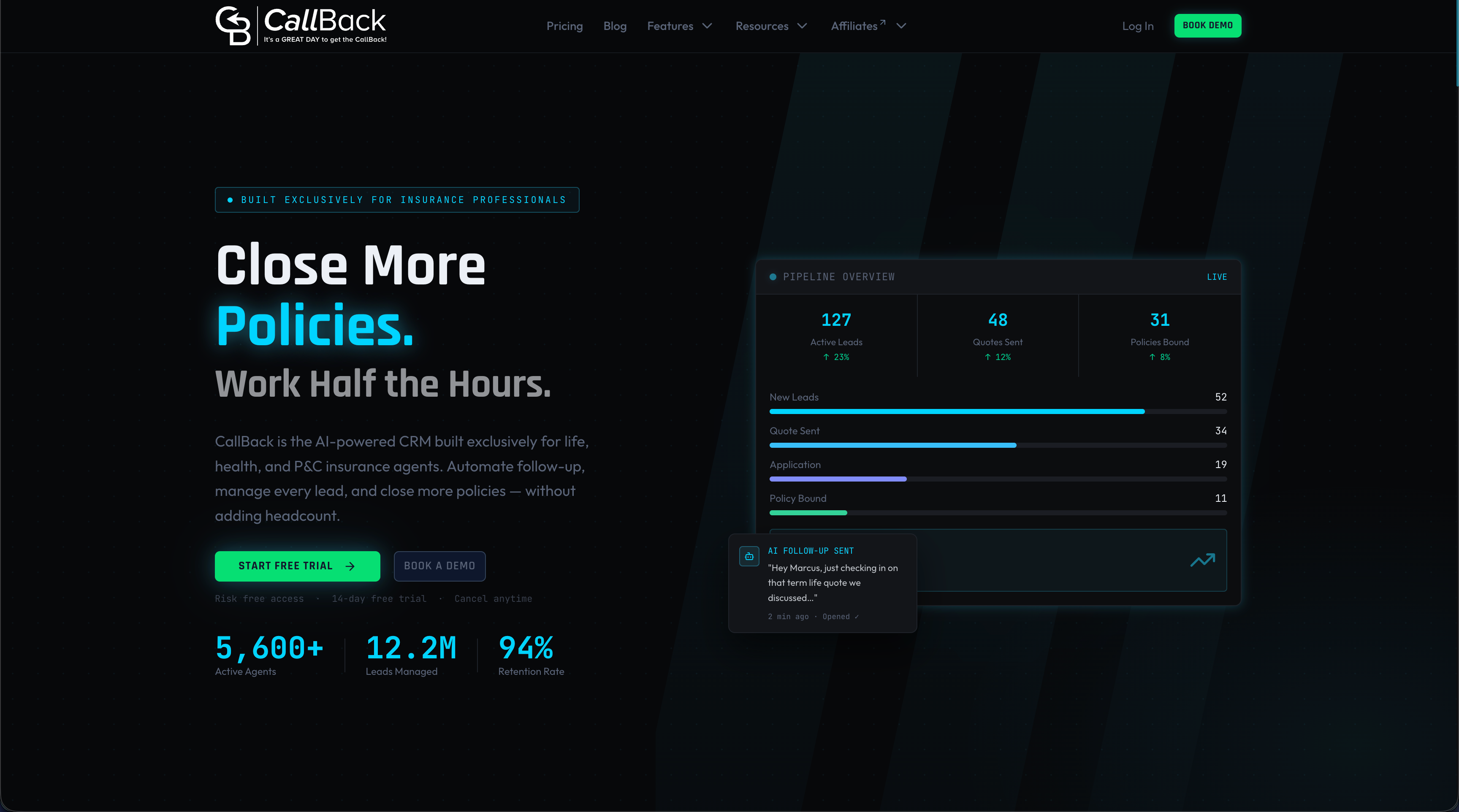
CallBack CRM’s AI features include predictive lead scoring that identifies your highest-value prospects, automated email and SMS sequences that nurture leads systematically, and intelligent workflows that trigger the right action at the right time. Our lead and customer management CRM centralizes all prospect data so you never lose track of where someone stands in your funnel.
Key features for funnel optimization:
- AI lead scoring that prioritizes prospects most likely to convert
- Automated workflows that nurture leads without manual intervention
- Omnichannel communication across email, SMS, and social platforms
- Real-time analytics dashboards showing funnel performance metrics
Try CallBack CRM free and discover how task automation streamlines your funnel management, boosts conversion rates, and frees your time for building the client relationships that drive sustainable insurance sales growth.
Frequently asked questions about funnel management for insurance agents
What is the difference between funnel management and sales pipeline for insurance?
Funnel management focuses on the customer’s journey from awareness through retention, guiding prospects through stages based on their readiness to buy. Your sales pipeline tracks your internal deal progress and where each opportunity stands in your closing process. The funnel is customer-centric; the pipeline is agent-centric.
How long should I nurture a lead before considering it dead?
Typically, insurance deals stuck over 30 days without meaningful progression indicate an unviable prospect. However, context matters. Complex commercial policies may require longer consideration periods than simple personal lines. Track engagement signals like email opens, website visits, and response rates to distinguish genuinely interested prospects from dead leads.
How can AI increase my funnel conversion rates?
AI automates timely follow-ups that manual processes often miss, personalizes engagement based on prospect behavior and preferences, and identifies high-value leads deserving immediate attention. AI also analyzes funnel data to reveal bottlenecks and optimization opportunities you might overlook manually. The combination of speed, personalization, and data-driven insights significantly boosts conversions at every funnel stage.
What funnel stage should I focus on to improve retention?
Post-sale nurture and systematic upsell efforts are crucial for renewal revenue and long-term client value. Implement regular policy reviews, proactive communication about coverage gaps, and educational content that reinforces the value of adequate protection. Retention generates 60% of insurance revenue, yet many agents neglect this stage entirely in favor of chasing new business.
Are referral leads more valuable in funnel management?
Yes, referral leads convert approximately 30% higher than average leads because they enter your funnel with pre-established trust from the referral source. They typically move through consideration and decision stages faster and require less nurturing. Systematically asking satisfied clients for referrals should be a core component of your post-sale funnel strategy, not an afterthought.