

TL;DR:
- Small insurance agencies can achieve high ROI and revenue growth through structured email marketing.
- Lifecycle-based, targeted automated emails improve client retention, increase conversions, and reduce workload.
- Compliance, timing, and relevance are critical for building trust and maximizing email marketing effectiveness.
Most insurance agents assume email marketing is a game reserved for large carriers with big budgets and dedicated marketing teams. That assumption is costing you clients. Industry case studies prove that even solo agents and small agencies are seeing 58x ROI and 20% revenue growth from structured email campaigns. Retention improves, lead conversion climbs, and renewals stop slipping through the cracks. This guide walks you through exactly how to build, automate, and optimize an email marketing strategy that fits your agency, whether you have one producer or twenty.
Table of Contents
- Why email marketing matters for insurance agents
- Understanding the insurance email lifecycle
- Segmentation and automation: Driving results at scale
- Best practices: Compliance, timing, and trust
- Our take: Why value and timing beat design and volume
- Take the next step: Transform your insurance email marketing
- Frequently asked questions
Key Takeaways
| Point | Details |
|---|---|
| Lifecycle-driven strategy | Mapping and automating emails to each client stage boosts retention and conversions for insurance agents. |
| Segmentation and automation | Personalizing communications and automating campaigns increases open and conversion rates while reducing manual workload. |
| Compliance and trust | Strictly follow regulations and prioritize trust to maintain strong client relationships and avoid marketing pitfalls. |
| Focus on timing and value | Well-timed, valuable emails outperform frequent or flashy designs, leading to better engagement and commercial results. |
Why email marketing matters for insurance agents
Email is not a relic. It remains one of the highest-return marketing channels available to insurance agents, and the numbers from real agencies back that up. The agents who dismiss email marketing are usually the ones relying on referrals alone, crossing their fingers at renewal time, and chasing cold leads that go nowhere.
The evidence is hard to ignore. Agents using platforms built for their industry report that email-driven campaigns create compounding returns over time. Each touchpoint reinforces trust, keeps your agency top-of-mind, and nudges clients toward renewals, referrals, and additional coverage.
“Agencies using structured email campaigns are not just communicating more. They are converting more, retaining more, and growing faster than those relying on phone calls and reactive outreach alone.”
Here is what well-run email programs deliver for insurance agencies:
- Revenue growth: Agencies report 20% increases in total revenue within the first year of consistent email campaigns.
- Retention lift: A 3% improvement in retention adds up significantly across a book of business, especially for health and life agents.
- Lead conversion: An 11% boost in lead-to-client conversion rates from nurture sequences alone.
- Workload reduction: Automated campaigns eliminate hours of manual follow-up every single week.
Many agents hesitate because they worry about low open rates, compliance pitfalls, or simply not knowing where to start. Those concerns are valid but solvable. The barrier is not technical ability. It is having the right framework in place.
Understanding why email marketing is critical starts with accepting that your clients want to hear from you. They want clarity about their policies. They want reminders before deadlines. And they want a trusted advisor who reaches out before a problem occurs, not after.
Engagement and lead generation through email is not passive. When done correctly, it actively pulls prospects into your pipeline while keeping existing clients loyal. Agents who treat boosting engagement and leads as an ongoing strategy, not a one-time campaign, consistently outperform those who send emails sporadically.
Understanding the insurance email lifecycle
Every client has a journey with your agency. From the moment they request a quote to the day they file a claim or upgrade their coverage, there are predictable moments where the right email can strengthen or break the relationship. Mapping that journey is the foundation of an effective email marketing process.
Here is how the core lifecycle stages break down and what each one requires:
| Lifecycle stage | Email goal | Timing || |—|—|—| | Onboarding | Build trust, set expectations | Day 1, 3, 7 after bind | | Engagement | Educate, cross-sell gently | Monthly or quarterly | | Renewal | Retain, reduce lapse risk | 60 days before expiration | | Cross-sell | Expand coverage | After positive claim or life event | | Claims support | Empathy, guidance | Immediately during claim process |
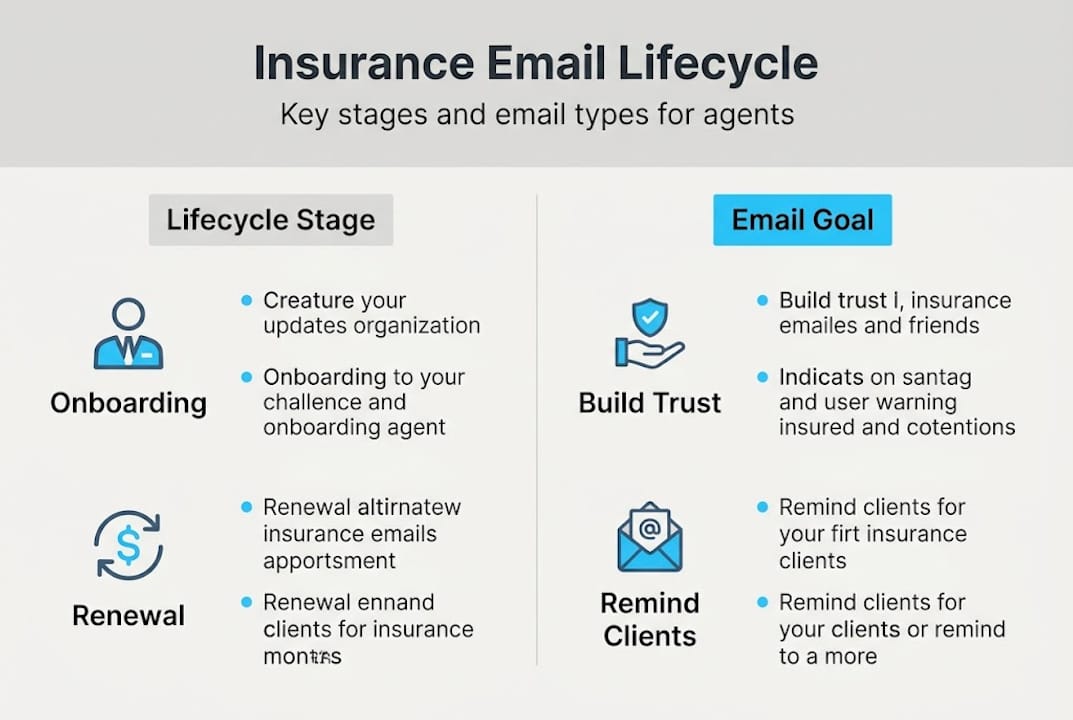
The timing column is critical. Renewal sequences starting 60 days early reduce lapses by double digits. Most agents wait until 30 days out or less, which is already too late for clients who are shopping competitors.
Here is the order of operations for building your lifecycle sequence:
- Write your onboarding series first. It sets the tone for the entire relationship.
- Build your renewal sequence next. This protects your existing revenue.
- Add engagement emails in between to provide value without selling.
- Layer in cross-sell campaigns only after positive interactions.
- Create a claims empathy sequence to support clients when they need it most.
The most damaging mistake agents make is sending a cross-sell email right after a claim. Clients who just went through a stressful claims process are not ready to hear about adding a life policy. That kind of mistimed message erodes trust fast.
Pro Tip: Use email automation for agents to trigger lifecycle emails based on real client events, like a policy bind date or a submitted claim, rather than arbitrary calendar dates. Event-based triggers convert far better than scheduled blasts.
Lifecycle emails outperform every other email strategy because they are relevant by design. The client gets the right message at the right moment, and that relevance translates directly into higher opens, more clicks, and stronger retention numbers.
Segmentation and automation: Driving results at scale
Once you have mapped the lifecycle, the challenge becomes executing it consistently across dozens or hundreds of clients without burning out your team. That is where segmentation and automation become your biggest assets.

Segmentation means dividing your list into smaller groups based on shared characteristics. Policy type, age bracket, renewal date, coverage tier, and life stage are all useful segmentation variables for insurance agents. When someone on your list gets an email that speaks directly to their situation, open rates climb and unsubscribes drop.
The proof is in real campaign results. A pet insurance segmentation campaign delivered a 32% conversion lift simply by targeting pet owners with relevant messaging instead of blasting the entire list. Same message could not have worked for auto or home clients. Specificity wins.
Automation takes segmentation and runs it on autopilot. Instead of manually sending renewal reminders or onboarding emails, you set up a workflow once and let the system handle execution. Acces Conseil automated their campaigns and achieved a 70% reduction in manual workload alongside 80% open rates. Those are not typos.
Here is how manual campaigns compare to automated, segmented campaigns:
| Metric | Manual batch campaign | Automated segmented campaign |
|---|---|---|
| Open rate | 15 to 22% average | Up to 80% in top cases |
| Conversion rate | 2 to 5% | 17 to 32% with targeting |
| Time investment | High, weekly manual sends | Low, set once and optimize |
| Compliance risk | High, manual errors | Lower with built-in guardrails |
Key tactics that consistently drive results:
- Personalized drip sequences for new quote requests, following up at day 1, 3, and 7.
- Renewal automation triggered 60 days before expiration with escalating urgency.
- Cross-sell triggers activated after positive claim resolution or life events like a new home purchase.
- Re-engagement campaigns targeting clients who have not opened an email in 90 days.
Pro Tip: Start with just two automated sequences: onboarding and renewal. Those two alone will deliver the highest immediate return. Once they are dialed in, layer in the email drip campaigns for cross-sell and re-engagement.
Agents who understand the automation benefits stop thinking of email as a task and start treating it as a system. Systems scale. Tasks do not.
Best practices: Compliance, timing, and trust
Strategy and automation mean nothing if your emails land in spam folders, violate regulations, or damage client trust. These best practices are not optional extras. They are the foundation.
Compliance in insurance email marketing covers several key areas:
- CAN-SPAM compliance: Every commercial email must include a clear unsubscribe option, your physical mailing address, and an honest subject line.
- Consent management: Capture and document consent at the point of lead generation. This protects you legally and improves deliverability.
- Data security: Store client email data on secure, encrypted platforms. Your clients trust you with sensitive financial and health information.
- Unsubscribe processing: Honor opt-out requests within 10 business days as required by law, but ideally within 24 hours.
Compliance is the foundation, not a hurdle, and agents who treat it as a baseline advantage build stronger client trust than those who treat it as a checkbox.
Trust-building in email goes beyond following the law. It requires a consistent service-first tone. Your emails should primarily educate and support, not sell. When clients associate your name in their inbox with useful information rather than pressure, they open more, click more, and renew more.
Timing is just as important as content. Send renewal notices at least 60 days before the policy expiration date. Send claims follow-up emails within hours, not days. Send educational content on Tuesday or Wednesday mornings when open rates are typically highest for B2C financial services audiences.
Mistakes that quietly destroy trust:
- Sending a cross-sell pitch within days of a claim filing
- Using vague or clickbait subject lines that mislead
- Sending too frequently without providing genuine value
- Never personalizing beyond the first name
Pro Tip: Use a compliance-reviewed email template that your agency updates quarterly. Include a legal review checklist as part of your campaign approval process. A five-minute review can prevent a five-figure compliance fine.
Every email you send is either depositing into or withdrawing from your trust account with that client. Make every message count.
Our take: Why value and timing beat design and volume
Here is something most email marketing guides will not tell you: your clients do not care how beautiful your email template looks. They care whether the message is relevant to them right now.
We see agents invest time obsessing over color schemes, logo placement, and header images. Meanwhile, their renewal sequences are still going out at 30 days, their onboarding emails are generic, and they have never once segmented their list. Pretty design is not the problem to solve first.
The agents seeing the biggest results focus relentlessly on timing and lifecycle structure over creative execution. They prioritize commercial outcomes like renewals and cross-sell revenue over vanity metrics like raw open rates. A 20% open rate on a perfectly timed renewal email will always outperform a 40% open rate on an irrelevant blast.
The counterintuitive truth is that fewer, well-timed emails build more revenue than frequent, unfocused ones. One genuinely useful email sent at the right moment in a client’s lifecycle is worth ten generic newsletters. And with AI tools for insurance leads, predicting those moments is no longer guesswork. It is a data-driven advantage available to any agent willing to use it.
Take the next step: Transform your insurance email marketing
If you read this far, you already understand that email marketing is not just a nice-to-have. It is a revenue engine when built correctly. The lifecycle framework, the segmentation strategy, and the compliance practices outlined above are all actionable starting points.
The challenge for most agents is not knowing what to do. It is having the right tools to execute it without adding more to an already full plate. CallBack CRM is built specifically for insurance agents, giving you automated lifecycle campaigns, smart segmentation, compliance safeguards, and AI-powered lead scoring under one roof. Explore the full suite of insurance marketing features and see how quickly your agency can move from scattered outreach to a system that works while you focus on clients.
Frequently asked questions
What types of emails should insurance agents send?
Send onboarding series, renewal reminders, claims support messages, and lifecycle-based cross-sell offers timed after positive client experiences, not during stressful ones.
How can insurance agents increase email open and conversion rates?
Segment your list by policy type and lifecycle stage, then automate personalized sequences. Agents using automation have reported 80% open rates and 17% conversion rates with this approach.
Is it better to send batch emails or targeted drip campaigns?
Targeted drip campaigns win every time. Segmented and drip-based campaigns have produced 32% conversion lifts and measurably reduced client churn compared to batch-blast approaches.
What compliance issues should insurance emails address?
Always meet CAN-SPAM requirements for consent, unsubscribe options, and truthful subject lines. Compliance builds trust and protects your agency from costly regulatory penalties.
How soon before policy renewal should you start email outreach?
Start renewal outreach at least 60 days before the expiration date. Early renewal sequences reduce policy lapses by double digits compared to last-minute reminders.
Recommended
- Why email marketing matters for insurance agents in 2026 | CallBack CRM Blog
- Insurance Email Marketing: Boost Engagement and Leads | CallBack CRM Blog
- Lead generation tips for agents: boost your insurance sales | CallBack CRM Blog
- Why lead generation is vital for insurance agents in 2026 | CallBack CRM Blog