

The insurance industry is experiencing a seismic shift as artificial intelligence transforms how agents and brokers generate and qualify leads. The global AI in Insurance market size is USD 4,681.2 million in 2024 and is expected to grow at a 33.60% CAGR through 2031, proving AI isn’t just hype. This article breaks down AI lead scoring, pre-qualification techniques, data extraction, compliance requirements, and practical applications that help you work smarter, not harder. You’ll discover how to leverage these tools to boost your conversion rates and stay competitive.
Table of Contents
- How AI Is Revolutionizing Lead Generation In Insurance
- Decoding AI Lead Scoring And Pre-Qualification Techniques
- Integrating AI Data Extraction And Compliance Considerations
- Practical AI Applications To Boost Insurance Lead Conversion
- Discover Callback CRM’s AI-Powered Lead Management Tools
Key takeaways
| Point | Details |
|---|---|
| AI market growth | The insurance AI market is expanding at 33.60% annually, offering significant ROI opportunities for early adopters. |
| Lead scoring efficiency | AI analyzes historical data to predict conversion likelihood, helping agents prioritize high-value prospects automatically. |
| Compliance requirements | FCC’s 2024 ruling requires prior express consent for AI voice calls, with penalties up to $1,500 per violation. |
| Response time impact | AI-driven workflows can reduce lead response times from over an hour to under two minutes. |
| Data quality matters | Clean, consistent data sources improve AI prediction accuracy and overall lead qualification effectiveness. |
How AI is revolutionizing lead generation in insurance
Artificial intelligence has moved from experimental to essential in insurance sales. The technology automates repetitive tasks that traditionally consumed hours of agent time, from initial lead qualification to customer data entry. This shift allows you to focus on relationship building and closing deals rather than administrative work.
AI-powered systems analyze thousands of data points to identify patterns human agents might miss. They score leads based on conversion probability, route high-value prospects to the right team members, and personalize outreach at scale. These capabilities create a competitive advantage that’s becoming harder to ignore.
Insurance professionals who adopt AI tools report dramatic improvements in lead quality and sales efficiency. The technology doesn’t replace human judgment but enhances it by surfacing insights buried in your data. You get faster qualification, better targeting, and more time for meaningful client conversations.
Key benefits insurance agents see from AI adoption include:
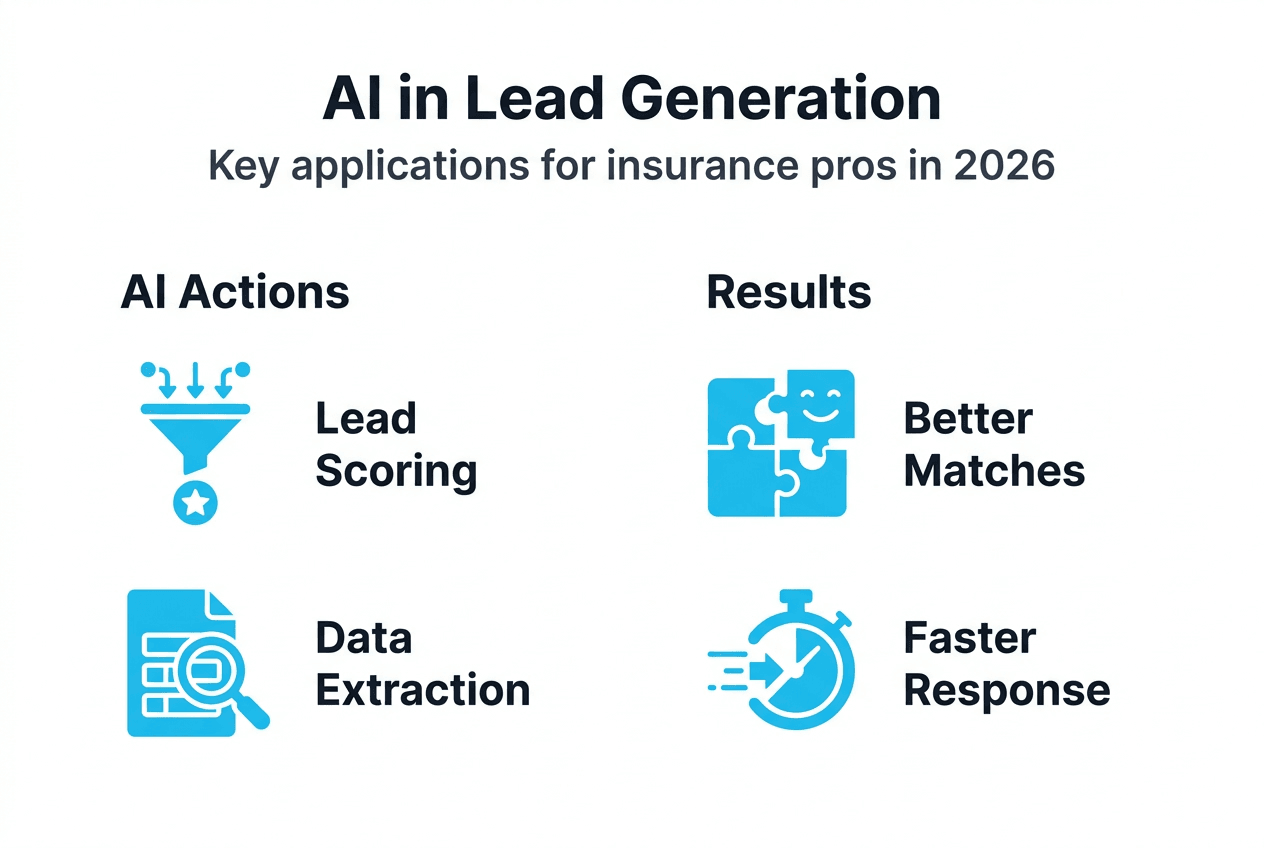
- Automated lead scoring that identifies hot prospects within minutes
- Intelligent routing that matches leads with the best-suited agents
- Personalized engagement based on prospect behavior and preferences
- Reduced time spent on data entry and administrative tasks
- Predictive analytics that forecast customer lifetime value
The AI advantage for small business isn’t limited to enterprise-level operations. Even solo agents and small agencies can leverage these tools to compete with larger firms. The barrier to entry has dropped significantly as platforms integrate AI capabilities into user-friendly interfaces.
Pro Tip: Start with one AI feature like lead scoring before expanding to full automation. This approach helps your team adapt gradually while building confidence in the technology.
Decoding AI lead scoring and pre-qualification techniques
AI lead scoring relies on machine learning models trained on your historical sales data. Oracle Sales AI Lead Score is calculated from 0 to 100% based on historical data and updated every 12 hours, requiring significant data thresholds. The system needs substantial datasets to identify which lead attributes correlate with successful conversions.
Your AI model learns from past wins and losses. It examines factors like industry type, company size, engagement level, and response patterns. Over time, the algorithm recognizes subtle signals that indicate a lead’s readiness to buy. This continuous learning means your scoring improves as you feed it more data.

The beauty of AI pre-qualification lies in its speed and consistency. AI agents reduced unqualified discovery calls by 40% and cut lead response times from over an hour to under 2 minutes in a 12-person agency. You eliminate wasted hours chasing prospects who won’t convert while accelerating contact with serious buyers.
| Scoring Factor | Weight | Update Frequency |
|---|---|---|
| Engagement history | High | Real-time |
| Demographic fit | Medium | Every 12 hours |
| Budget indicators | High | Real-time |
| Timeline urgency | Medium | Every 12 hours |
| Source quality | Low | Weekly |
Modern AI systems handle missing data gracefully through attribute substitution. If your agency lacks certain data points, the model adapts by emphasizing available information. This flexibility ensures you benefit from AI scoring even with imperfect datasets.
Implementing effective lead scoring requires these steps:
- Collect at least six months of historical sales data for training
- Define clear conversion goals and success metrics
- Configure score thresholds for different follow-up actions
- Monitor score accuracy and adjust weights as needed
- Train your team to interpret and act on AI recommendations
Pre-qualified leads arrive at your desk with context. The AI has already assessed their needs, budget range, and purchase timeline. You skip the discovery phase and jump straight to solution presentation, dramatically shortening your sales cycle.
The sales automation benefits extend beyond time savings. Consistent qualification criteria eliminate subjective bias, ensuring every lead receives fair evaluation. Your conversion rates become more predictable as you work primarily with prospects the AI identifies as sales-ready.
Pro Tip: Review your lowest-scoring converted leads monthly. These outliers reveal gaps in your AI model that need refinement.
Integrating AI data extraction and compliance considerations
AI excels at pulling structured information from unstructured sources like emails, call transcripts, and web forms. AI extracts data points such as fleet size and policy types from 1,500 lead emails to improve qualification. This automated extraction eliminates manual data entry while capturing details human agents might overlook.
The technology uses natural language processing to understand context and intent. When a prospect mentions they’re expanding their business, AI flags this as a buying signal. It categorizes responses, identifies pain points, and populates your CRM fields automatically. Your database stays current without constant manual updates.
Data quality directly impacts AI accuracy. Clean, consistent formatting helps algorithms parse information correctly. Standardize how you collect email addresses, phone numbers, and company names. Remove duplicates regularly and validate entries against external databases when possible.
Legal compliance becomes critical when using AI for outbound communications. FCC’s 2024 ruling classifies AI-generated voices under robocall rules with $500-$1,500 penalties per TCPA violation. You must obtain prior express written consent before making AI voice calls to prospects.
The Telephone Consumer Protection Act applies equally to human callers and AI systems. Many agents mistakenly assume AI calls occupy a gray area, but regulators treat them identically to traditional robocalls. Documenting consent protects your agency from costly violations and reputational damage.
Follow these compliance steps when implementing AI voice outreach:
- Obtain explicit written consent mentioning AI-generated calls
- Maintain detailed records of all consent agreements
- Provide clear opt-out mechanisms in every communication
- Honor do-not-call requests immediately and completely
- Review state-specific regulations beyond federal TCPA rules
- Audit your AI call scripts for compliant language
Some states impose stricter requirements than federal law. California, for example, mandates additional disclosures about automated calling systems. Research your target markets thoroughly before launching AI voice campaigns.
“The integration of AI into insurance sales processes requires balancing innovation with regulatory responsibility. Agents who prioritize compliance build sustainable competitive advantages.”
Data privacy regulations like GDPR and CCPA also apply to AI systems. Ensure your AI vendor encrypts data, limits access appropriately, and allows prospects to request data deletion. Transparency about AI usage builds trust rather than eroding it.
The lead generation tips for insurance agents emphasize permission-based marketing. AI amplifies your reach but doesn’t exempt you from fundamental consent requirements. Smart agents use AI to personalize compliant outreach, not to bypass regulations.
Pro Tip: Include AI disclosure language in your consent forms now, even if you’re not using voice AI yet. This future-proofs your compliance as you expand capabilities.
Practical AI applications to boost insurance lead conversion
Implementing AI successfully requires strategic integration into your existing workflow. Start by identifying bottlenecks where automation delivers immediate value. Most agencies find lead scoring and initial response automation offer the quickest wins.
Prioritize high-intent leads using AI-powered scoring models. High-intent leads get scored, routed, and assigned in under two minutes thanks to AI-driven workflows. This speed ensures you contact motivated prospects while their interest peaks, dramatically improving conversion odds.
Real-time routing matches leads with agents based on expertise, availability, and past performance. The AI considers factors like product specialization, language preferences, and geographic territory. Your best closer handles your hottest prospects automatically, maximizing revenue potential.
Automate repetitive follow-up sequences while maintaining personalization. AI tracks engagement patterns and adjusts messaging cadence accordingly. Prospects who open emails receive different timing than those who ignore outreach. This adaptive approach prevents annoying engaged leads while staying visible to passive ones.
Implement these AI applications in your agency:
- Deploy chatbots for after-hours lead capture and basic qualification
- Use predictive analytics to identify cross-sell opportunities in your existing book
- Automate appointment scheduling based on prospect availability and agent calendars
- Generate personalized quote presentations using AI-powered proposal tools
- Monitor customer sentiment through AI analysis of email and call interactions
- Trigger renewal campaigns automatically based on policy expiration dates
Data hygiene makes or breaks AI effectiveness. Schedule monthly audits to remove duplicates, correct formatting errors, and fill missing fields. The cleaner your data, the smarter your AI becomes. Garbage in guarantees garbage out, regardless of how sophisticated your algorithms are.
Team training ensures adoption and maximizes ROI. Your agents need to understand how AI scoring works, when to override recommendations, and how to interpret insights. Regular workshops keep everyone current as you add capabilities and refine processes.
The lead generation workflow tutorial demonstrates how AI fits into proven sales processes. Technology enhances your strategy but shouldn’t dictate it. Start with solid fundamentals, then layer AI to amplify what already works.
Monitor key performance indicators to measure AI impact. Track metrics like lead response time, qualification accuracy, conversion rates by score range, and agent productivity. Quantifying results justifies investment and identifies areas needing adjustment.
Pro Tip: Run A/B tests comparing AI-scored leads against traditional qualification for 90 days. The data will reveal exactly where AI adds value in your specific market.
Discover CallBack CRM’s AI-powered lead management tools
Ready to transform your insurance lead generation with AI? CallBack CRM delivers the automation capabilities discussed throughout this article in one integrated platform. Our AI business automation features help you score leads, route prospects intelligently, and personalize outreach at scale.
The platform combines powerful CRM functionality with intelligent automation that learns from your sales patterns. You’ll manage leads and customers effortlessly while AI handles repetitive tasks in the background. Free up hours each week to focus on client relationships and strategic growth.
Our automation engine lets you automate tasks and boost profitability without technical expertise. Build sophisticated workflows using simple drag-and-drop tools. Start your free trial today and experience how AI elevates your insurance sales process.
FAQ
What is AI lead scoring and how does it benefit insurance agents?
AI lead scoring analyzes historical sales data to predict which prospects are most likely to convert. It assigns numerical scores based on factors like engagement level, demographic fit, and buying signals. This helps agents prioritize their time on high-value opportunities rather than chasing every lead equally.
How does AI pre-qualification reduce unqualified calls in insurance sales?
AI systems evaluate leads using data from forms, emails, and previous interactions before routing them to agents. The technology filters out prospects who don’t meet basic criteria like budget, timeline, or need. One study showed this approach reduced unqualified discovery calls by 40% while cutting response times to under two minutes.
What compliance considerations should insurance agents keep in mind when using AI voice calls?
The FCC’s 2024 ruling treats AI-generated voices the same as traditional robocalls under TCPA regulations. You must obtain prior express written consent before making AI voice calls to prospects. Violations can result in penalties ranging from $500 to $1,500 per call, so documenting consent is essential. Always provide clear opt-out mechanisms and honor do-not-call requests immediately.
What are the best practices for integrating AI into an insurance lead generation workflow?
Maintain high-quality, clean data sources since AI accuracy depends on input quality. Schedule regular data audits to remove duplicates and correct errors. Train your sales team on AI capabilities, compliance requirements, and how to interpret AI recommendations. Automate lead routing and follow-up sequences to minimize response times while monitoring performance metrics to refine your approach continuously.