

Manually tracking client details and follow-ups with sticky notes and spreadsheets quickly becomes overwhelming for insurance agents. In a fast-paced market, even one missed callback or misplaced renewal date can cost you valuable sales. The good news is, modern CRM systems have evolved from simple communication logs into comprehensive customer-focused solutions that help agents build loyalty and improve service quality. This article explains how AI-driven CRM transforms client relationships and sales processes, giving you the edge to stay ahead.
Table of Contents
- What CRM Means For Insurance Agents
- AI Automation And Lead Management Benefits
- Personalized Customer Engagement Strategies
- Efficiency Gains Over Manual Processes
- Choosing CRM Over Traditional Methods
Key Takeaways
| Point | Details |
|---|---|
| CRM Systems Enhance Efficiency | Implementing a CRM automates data entry, follow-ups, and reporting, allowing agents to reclaim significant time for selling. |
| AI Automation Improves Lead Management | AI-driven CRM features prioritize high-potential leads and automate communication, increasing conversion rates without extra manual effort. |
| Personalization Drives Customer Engagement | Tailored outreach based on individual client behavior and preferences boosts trust and enhances sales opportunities. |
| CRM Facilitates Business Scalability | A centralized CRM system streamlines operations, supports team collaboration, and efficiently manages growing client bases. |
What CRM Means for Insurance Agents
A CRM (Customer Relationship Management) system is your digital command center for managing every interaction with prospects and clients. For insurance agents, it’s far more than a contact list—it’s the backbone of modern sales operations.
Traditional insurance sales relied on paper files, sticky notes, and memory. You tracked client callbacks in a notebook, manually entered data, and hoped nothing fell through the cracks. A modern CRM replaces all of this with centralized, intelligent systems.
Here’s what a CRM does for insurance agents:
- Stores all client information in one searchable location—policies, contact history, family details, renewal dates
- Tracks interactions automatically—emails, calls, texts, and meetings create timestamped records without manual entry
- Schedules follow-ups so you never miss a renewal, anniversary, or opportunity to cross-sell
- Organizes pipeline stages so you see exactly where each prospect stands in the sales journey
- Generates performance reports that show which activities convert to sales
But here’s what makes modern CRM different: CRM systems have evolved from basic communication tracking to comprehensive customer-focused solutions that actually improve service quality and client loyalty.
Without a CRM, you’re managing relationships manually. You remember Mrs. Johnson mentioned her daughter turning 25 last month, but you forget when she’s likely to need life insurance. You know your closing rate is “pretty good,” but you can’t identify which cold calls actually convert.
With a CRM, you know exactly what Mrs. Johnson discussed during her last call. You get an automated reminder that her daughter just turned 25—the perfect time for a policy recommendation. You see that emails from prospects who said “call me in two weeks” have a 34% conversion rate, while cold calls do not.
A CRM transforms insurance agents from reactive responders to strategic planners who understand their entire client book and can predict what customers need before they realize it themselves.
For health insurance and final expense agents specifically, a CRM means you can track client coverage needs, policy anniversary dates, and family changes in one place. When a client’s spouse enrolls in Medicare, your system flags it. When a family member turns 26 and loses employer coverage, you already have context to reach out with the right solution.
This isn’t about technology for technology’s sake. It’s about reclaiming hours lost to administrative work and redirecting that time toward selling.
Pro tip: Start by mapping your current sales process into your CRM—track where prospects enter, what moves them forward, and where they drop off. This single view of your pipeline often reveals that 80% of your sales come from 20% of your activities, immediately showing you what to replicate.
AI Automation and Lead Management Benefits
AI automation transforms how insurance agents qualify leads, prioritize prospects, and manage their pipeline. Instead of manually sorting through dozens of leads daily, you get intelligent systems that identify which prospects are actually ready to buy.
Traditional lead management is painful. You receive 50 leads, manually review them, make judgment calls about who to contact, and waste time on prospects who aren’t serious. You call someone at the wrong time and lose the opportunity. You follow up inconsistently because you’re juggling multiple tasks.
AI-powered automation eliminates this guesswork. Here’s what changes:
- Lead scoring automatically rates prospects based on engagement patterns—who opened your email, clicked links, visited your website, stayed on pages longest
- Segmentation groups prospects by characteristics—age, location, policy type, life stage—so you send targeted messages instead of generic ones
- Chatbots answer initial questions instantly, qualifying leads 24/7 while you sleep or handle other clients
- Automated follow-ups send reminders, documents, and next-step communications without you typing a single message
- Predictive analytics flag which leads are most likely to convert based on historical data
The result? AI-driven lead scoring and segmentation identify high-potential leads for focused effort, so you spend time on prospects with genuine buying intent instead of tire-kickers.

For health insurance and final expense agents, this matters enormously. An AI system recognizes when someone is comparing Medicare supplement plans—a clear buying signal—and routes them to you immediately. It identifies families shopping for final expense coverage and automatically sends relevant information about options and pricing.
Automation reduces manual tasks and improves lead qualification significantly. Data entry vanishes. Lead research happens automatically. Follow-up sequences run without intervention.
Consider this: You manually contact 40 leads weekly, converting 4 (10% rate). AI identifies your 15 hottest leads and routes them to you while automatically nurturing the other 25 with targeted content. You contact those 15 with confidence, converting 6 (40% rate) because they’re genuinely interested. Your team handles the other 25 through automation sequences. You’ve just tripled your sales output without working longer hours.
AI automation doesn’t replace your relationship-building skills—it eliminates the administrative busywork so you can focus entirely on conversations that close deals.
This also maintains consistency. A prospect gets the same professional follow-up whether you’re busy or not. Messages go out at optimal times automatically. Nothing gets forgotten because a human forgot to follow up.
Pro tip: Start by analyzing your past 20 sales—identify the common characteristics of prospects who converted versus those who didn’t. Feed this pattern into your AI lead scoring system so it learns your specific buying signals and automatically prioritizes similar prospects.
Personalized Customer Engagement Strategies
Personalization is what separates agents who close deals from those who struggle. When a prospect feels like you understand their specific situation, they’re far more likely to buy from you instead of a competitor.
Generic outreach doesn’t work anymore. Sending the same email to everyone or calling with the same pitch wastes time. A prospect who’s 28 and single has completely different insurance needs than someone who’s 55 and planning retirement. Yet most agents treat them identically.
AI-powered CRM systems change this by creating truly personalized experiences. Here’s what happens:
- Behavioral analysis tracks what prospects engage with—which topics they read, which emails they open, how long they stay on pages
- Preference detection learns communication style preferences—does someone prefer phone calls, texts, or emails? Early morning or evening contact?
- Content recommendations suggest the most relevant information based on each person’s situation and interests
- Timing optimization sends messages when prospects are most likely to engage, not when it’s convenient for you
- Dynamic messaging changes the tone and focus of outreach based on each prospect’s profile and history
For health insurance agents, this means recognizing when a prospect is comparing plans for a family member versus themselves. For final expense agents, it means understanding whether someone is planning ahead or helping a grieving family. AI-enabled CRM systems leverage predictive analytics and personalization engines to deliver highly tailored experiences that actually resonate.
Consider Mrs. Rodriguez, age 62. Your CRM knows she’s within five years of Medicare eligibility. It noticed she visited your Medicare supplement page twice and opened three emails about transition planning. Your next message doesn’t pitch life insurance—it specifically addresses Medicare supplement options for her age group and health profile. Conversion rate? Dramatically higher.
Contrast this with random outreach. You call a prospect cold with no context about their needs. They hear the same pitch everyone hears. Decision: probably not buying.
Advanced clustering and machine learning enable dynamic real-time personalization that adapts to customer behavior. This means your engagement strategy improves automatically over time. The system learns what works and adjusts accordingly.
Personalization transforms prospects from anonymous leads into understood individuals, building trust and dramatically increasing conversion rates.
Personalization also improves retention. A client who receives relevant renewal reminders at the right time, personalized recommendations based on life changes, and proactive support stays with you longer. They’re not searching for another agent because you’re already meeting their needs.
Pro tip: Create three customer segments for your insurance book—by life stage (young professionals, families with kids, near-retirees). Tailor your messaging, policy recommendations, and follow-up frequency to each segment. This simple segmentation alone increases engagement by 40-60% because messages suddenly feel relevant instead of generic.
Efficiency Gains Over Manual Processes
Time is your most valuable asset as an insurance agent. Every hour spent on administrative work is an hour not spent selling. Manual CRM processes drain productivity at an alarming rate.
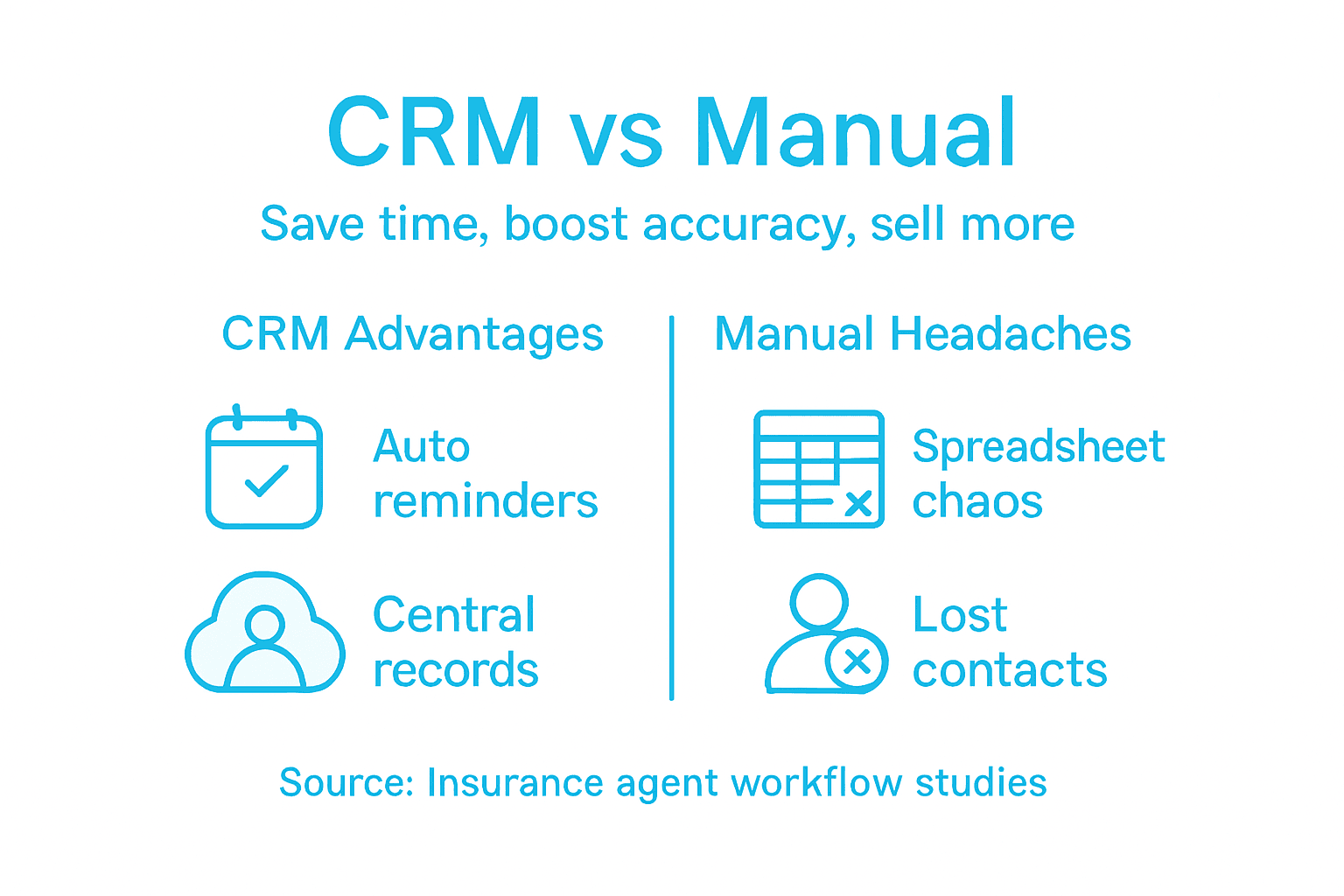
Consider your typical day without automation. You spend 45 minutes entering new leads into a spreadsheet. Another 30 minutes manually updating contact information. You search through emails to find client details instead of having them organized. You write the same follow-up message to 20 prospects because you didn’t automate templates. By day’s end, you’ve sold zero policies—you’ve been too busy with paperwork.
Manual tasks in sales, such as data entry and follow-ups, consume significant time and are prone to errors. Automation eliminates this drain completely.
Here’s what happens when you implement CRM automation:
- Data entry vanishes - Lead information automatically populates from forms, emails, and integrations
- Follow-up sequences run on their own - Emails, SMS, and reminders send at perfect timing without you touching anything
- Client histories are instantly accessible - Stop searching through files; everything about a prospect appears in seconds
- Duplicate work disappears - You’re not reentering information across multiple systems or documents
- Calendar conflicts prevent missed appointments - Scheduling integrates with your calendar automatically
- Reporting happens automatically - You get weekly performance summaries instead of manually calculating metrics
The time savings are substantial. You reclaim 10-15 hours weekly that previously went to administrative overhead. For a typical agent, that’s 520-780 hours annually—equivalent to 13-20 extra work weeks.
What do you do with those recovered hours? Close more sales. An agent who previously closed five policies monthly because they only had five hours weekly for actual selling can now close 8-10 policies monthly with 12-15 selling hours available. That’s an additional $12,000-20,000 in annual commission for most agents—just by reclaiming lost time.
Automation doesn’t reduce your work—it redirects your work from paperwork to profit-generating activities.
Accuracy improves dramatically too. Manual data entry has a 3-5% error rate. Automated entry has near-zero errors. Wrong phone numbers, misspelled names, and duplicate records disappear. This means fewer failed follow-ups and fewer embarrassed calls asking clients to repeat information.
Consistency becomes effortless. A prospect gets the same professional message whether you’re swamped or not. A renewal reminder goes out on schedule regardless of how busy you are. Nothing falls through the cracks because humans forgot.
Pro tip: Calculate your true hourly value by dividing your annual commission by 2,000 (annual work hours). If you earn $120,000 annually, your hour is worth $60. Reclaiming 10 hours weekly at $60/hour equals $31,200 in recovered productive capacity annually—money you’re currently losing to manual work.
Key time and productivity gains with AI-powered CRM automation:
| Activity | Manual Time Weekly | Automated with CRM |
|---|---|---|
| Data entry | 3-5 hours | Less than 30 minutes |
| Lead qualification | 2 hours | Instantly prioritized |
| Follow-up communication | 4 hours | Runs automatically |
| Sales analysis & reporting | 2 hours | Instant summaries |
| Error correction | 1 hour | Errors nearly eliminated |
Choosing CRM Over Traditional Methods
Many insurance agents still rely on spreadsheets, paper files, and email folders to manage their business. It works—barely. But it’s like driving a car with a broken transmission. Technically possible, completely inefficient.
Traditional methods create constant friction. You search through 200 emails to find a client’s phone number. You update information in three different places because you never know which spreadsheet is current. A prospect falls through the cracks because their follow-up reminder was on a sticky note you threw away. You miss renewal dates because tracking them manually is unreliable.
Worse, you can’t scale. When you’re managing 100 clients with spreadsheets, you’re okay. When you hit 300 clients, the system collapses. Adding an agent to your team means duplicating messy processes and praying data doesn’t conflict.
Here’s what you lose with traditional methods:
- Scattered information - Client details exist in multiple places, creating confusion and errors
- No visibility into pipeline - You guess at how many prospects are close to buying
- Manual reporting - Creating performance reports consumes hours weekly
- Limited team collaboration - Your team can’t access shared information efficiently
- Zero analytics - You don’t know which activities actually drive sales
- Scaling is impossible - Adding clients or team members breaks your system
CRM fixes all of this. CRM software centralizes all customer data, tracks interactions over time, and enables team collaboration while providing automation and reporting tools that traditional methods lack.
Imagine knowing exactly where every prospect stands. You see that Marcus called last Tuesday, asked three questions about Medicare coverage, and opened two of your follow-up emails. The system suggests your next action: call him Thursday afternoon when he’s typically available. You call, he buys. Meanwhile, another 50 prospects are getting automated nurturing—something impossible with spreadsheets.
Team growth becomes seamless. You hire another agent, they log in, they see everything about every client. No confusion. No duplicated work. They start closing deals immediately.
CRM transforms your business from a one-person operation barely managing chaos into a scalable system where growth is possible without burnout.
Compliance and records become manageable. Every interaction is timestamped and documented automatically. If a client disputes something, you have evidence. If regulators ask questions, you have organized records. With paper and email, you’re scrambling.
Pro tip: List the top 10 time-wasting tasks you do weekly—searching for files, updating information across systems, manual data entry, creating reports. Calculate hours spent. A CRM typically eliminates 70-80% of these tasks, recovering 8-12 hours weekly. Use that recovery to calculate ROI; most agents see payback in under 60 days.
Here’s how CRM and traditional methods compare in daily insurance operations:
| Aspect | CRM System | Traditional Methods |
|---|---|---|
| Data Storage | Centralized and searchable | Scattered across files and emails |
| Lead Tracking | Automated, real-time updates | Manual notes, high error risk |
| Task Reminders | Automated, never missed | Easily forgotten, inconsistent |
| Scalability | Grows with business, seamless | Breaks down as clients grow |
| Team Collaboration | Instant, shared access | Difficult, prone to duplication |
| Analytics & Reporting | Automatic with insights | Manual, time-consuming |
Transform Your Insurance Sales with AI-Powered CRM Automation
The article highlights the common challenges insurance agents face such as manual data entry, scattered client information, missed follow-ups, and inefficient lead management. These pain points slow down sales and cause lost opportunities. If you want to stop juggling spreadsheets and sticky notes and start focusing on personalized customer engagement and strategic lead prioritization, then leveraging a modern CRM system with AI capabilities is the game changer. Terms like lead scoring, AI automation, and personalized outreach are not just buzzwords but essential tools to boost your closing rates and reclaim valuable selling time.
CallBack CRM is designed to solve these exact challenges for insurance agents by delivering an all-in-one platform that automates data entry, lead qualification, and customer communication. With features including AI assistants, automated workflows, and real-time lead scoring, you can cut down on administrative tasks and focus your energy on conversations that close deals. Plus, the platform’s mobile app, proposal tools, and integration options make managing your pipeline smoother and scalable whether you are a solo agent or growing agency.
Ready to replace outdated manual processes with intelligent automation and personalized customer engagement that drives real results Fast action today with CallBack CRM and experience firsthand how AI-powered CRM transforms your insurance business. Start boosting sales, strengthening client relationships, and reclaiming your time now at https://callbackcrm.com. Don’t wait for tomorrow to modernize what you do every day.
Frequently Asked Questions
What is a CRM and how does it benefit insurance agents?
A CRM (Customer Relationship Management) system helps insurance agents manage client interactions and streamline sales processes. It stores all client information in one location, tracks interactions automatically, schedules follow-ups, organizes sales pipelines, and generates performance reports, which ultimately boosts efficiency and sales.
How can AI automation improve lead management for insurance agents?
AI automation enhances lead management by scoring leads based on engagement, segmenting prospects for targeted outreach, utilizing chatbots for instant communication, and automating follow-up processes. This results in more efficient use of an agent’s time and higher conversion rates from engaged prospects.
Why is personalization important in CRM for insurance agents?
Personalization in CRM is crucial because it tailors communications and recommendations to individual client needs. By analyzing client behavior and preferences, agents can create more relevant outreach, enhancing the likelihood of closing deals and improving customer retention.
How does using a CRM system compare to traditional methods for managing client relationships?
Using a CRM system offers centralized data storage, automated task reminders, real-time lead tracking, and easy team collaboration. In contrast, traditional methods often rely on scattered information across files and emails, leading to inefficiencies, high error rates, and difficulties in scaling operations.
Recommended
- 5 Ways AI Can Transform Your Small Business in 2025
- Unlock AI Insights: Transform Your Small Business by 2025
- Boost Your Small Business with AI Advantage Today
- Boost Your Business with CallBack’s AI Automation Insights
- Selling your property in the most effective way - Living on the Côte d’Azur
- Estimation Valeur Bien Immobilier | IZIKOZI | Agence Immobilière | Bruxelles Woluwe Schaerbeek