

TL;DR:
- Most insurance agencies mistake marketing automation as simple email scheduling, which harms client retention. Effective automation responds to client behavior, strengthens workflows, and concentrates on outcomes like renewals and reduced lapses. Implementing strategic, audited routines with the right tools boosts efficiencies, scales relationships, and improves policy results.
Most insurance agents assume marketing automation is just a fancier way to blast out emails on a schedule. Set it up once, hit launch, and wait for leads to roll in. That assumption is costing agencies real money and real clients. True insurance marketing automation is a living system built on behavioral triggers, strategic workflows, and outcomes that actually matter, like policy renewal rates and lapse reduction, not just how many people opened your last campaign.
Table of Contents
- What is insurance marketing automation?
- Core benefits and real-world impact for insurance agencies
- Key strategies for implementing successful automation
- Choosing the right tools for insurance marketing automation
- Why insurance marketing automation is misunderstood—and how to get it right
- Streamline your agency’s marketing automation with Callback CRM
- Frequently asked questions
Key Takeaways
| Point | Details |
|---|---|
| Automation is strategic | Successful insurance marketing automation focuses on policy outcomes, not just activity metrics. |
| Behavior-driven workflows | Trigger automation based on real client actions for better engagement and conversion. |
| Process mapping first | Map buyer journeys and audit workflows before automating any steps. |
| Best-of-breed solutions | Choose tools that integrate seamlessly and support personalized, compliant automation. |
| Enhance relationships | Automation enables agents to scale communication while maintaining personal connection with clients. |
What is insurance marketing automation?
Insurance marketing automation is the use of software to execute marketing and communication tasks based on rules, triggers, and data, without requiring manual input for every step. In practical terms, it means a prospect who requests a quote automatically receives a follow-up sequence. A client approaching their renewal date gets a tailored reminder series. A lapsed policyholder receives a re-engagement message at exactly the right moment.
The key distinction that agencies often miss is the difference between static automation and behavioral automation. Static automation fires based on fixed data, like sending every new lead the same onboarding email regardless of how they found you. Behavioral automation responds to what a prospect or client actually does, like clicking a specific policy page, abandoning a quote form, or engaging with a particular email topic.
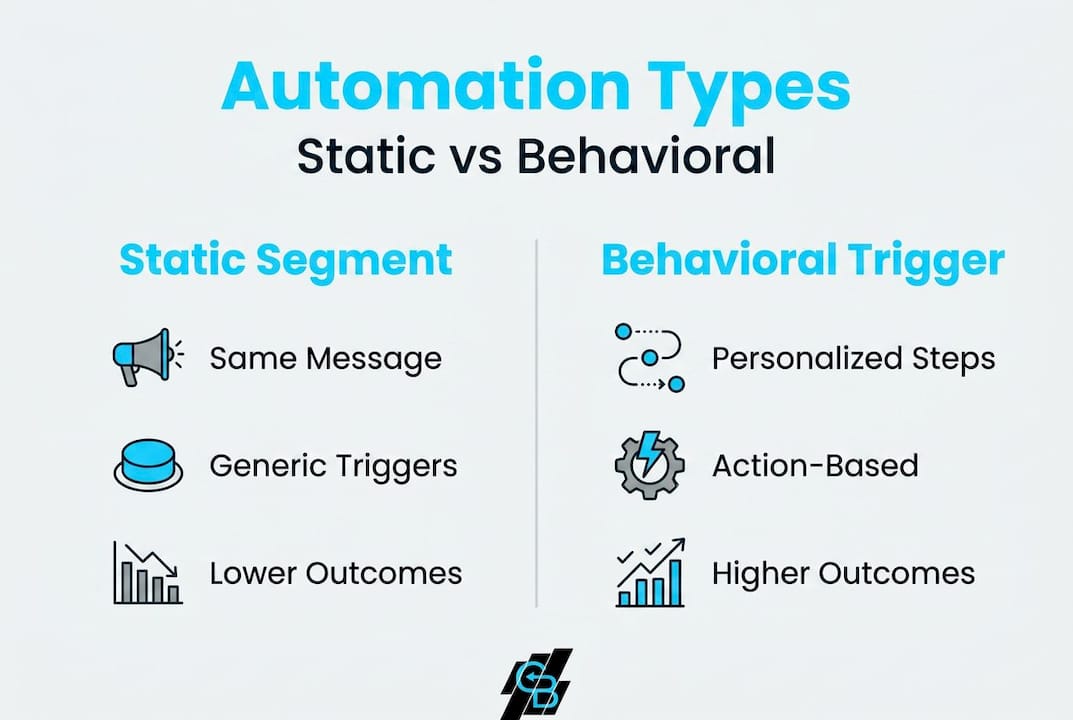
Here is a quick comparison to make that distinction concrete:
| Trigger type | Example | Outcome quality |
|---|---|---|
| Static segment | All new leads get welcome email | Generic, lower conversion |
| Behavioral trigger | Lead views auto policy page twice | Highly relevant, higher conversion |
| Static segment | Renewal reminder at fixed 30 days | Missed early opportunities |
| Behavioral trigger | Renewal series starts at 60 to 90 days with value reinforcement | Better retention, reduced lapses |
Common automation workflows that insurance agencies rely on include renewal reminders, quote follow-up sequences, cross-sell campaigns, claims status updates, and lead nurturing drips. According to expert guidance on insurance workflows, you should audit abandonment points first before building any new workflow, because automating a broken process just accelerates failure.
Key workflows worth building early:
- Renewal reminders: Automated messages starting 60 to 90 days before expiration, each reinforcing value rather than just reminding.
- Quote follow-up: A sequence triggered when someone requests or abandons a quote.
- Lead nurturing drips: Content-driven sequences that educate leads over time.
- Cross-sell campaigns: Triggered when a client reaches a life event milestone like a home purchase.
- Re-engagement sequences: Sent to contacts who have gone cold for a defined period.
The benefits of automation are most powerful when your workflows map to real buyer psychology rather than just your internal calendar. Understanding how clients think and when they are most receptive makes every automated touchpoint more effective.
Pro Tip: Always measure policy outcomes over vanity metrics. Lapse rates, renewal conversion percentages, and cross-sell revenue tell you far more than email open rates ever will.
Core benefits and real-world impact for insurance agencies
Once you understand what automation actually is, the next question is simple: what does it do for your bottom line? The answer is substantial, provided you implement it strategically.

The most immediate benefit is scale without overhead. A solo agent or small agency can maintain what feels like a personal relationship with hundreds of clients simultaneously because automation handles the consistent, predictable touchpoints. The agent’s time is freed for the complex conversations that genuinely require a human, like claims disputes, coverage counseling, or high-value policy reviews.
Efficiency gains are equally important. Lead follow-up is one of the most time-sensitive activities in insurance sales, yet manual follow-up often slips when agents are busy. Automation ensures no lead goes cold because someone forgot to send a second email. This alone has a measurable impact on close rates.
“Automation excels in scale and personalization but fails without strategic buyer psychology, compliance layers, and process mapping first. It enhances relationships, it does not replace them.”
That distinction matters deeply. Automation cannot substitute the judgment an experienced agent brings to a difficult client situation. What it can do is make sure that client feels consistently cared for between those high-value human interactions. When integrated properly, as explored in resources covering CRM and marketing integration, automation becomes the connective tissue between every client touchpoint.
Real business impact by the numbers is compelling. Agencies that adopt behavioral automation consistently report stronger results than those using basic static campaigns because behavioral triggers respond to actual client intent rather than assumptions about it.
Key benefits insurance agencies see from proper automation include:
- Better renewal rates because clients receive value-focused communication, not just transactional reminders.
- Reduced churn because lapsed or at-risk clients are identified and re-engaged earlier.
- Increased lead follow-up speed because sequences fire immediately when a trigger is met.
- Improved cross-sell conversion because campaigns are triggered by relevant life events.
- Stronger compliance documentation because automated logs create audit trails.
Pro Tip: Before you automate anything, map your buyer journey end to end. Identify where prospects drop off, where clients disengage, and where your manual processes are slowest. Compliance and process mapping should always come before workflow building. Reviewing CRM workflow examples from agencies similar to yours is a practical shortcut to discovering what works.
Key strategies for implementing successful automation
Knowing the benefits is motivating. Knowing the exact steps to implement automation successfully is where agencies separate from competitors who just dabble with the tools.
Here is a straightforward implementation framework:
- Map your current processes first. Document every manual touchpoint in your marketing and sales cycle. Quote requests, renewals, onboarding, claims communication, and referral requests all need to be mapped before a single workflow is built.
- Audit abandonment points. Where do leads stop responding? Where do renewal conversations stall? These gaps are your automation priorities, not the processes that already work fine manually.
- Layer in compliance requirements. Insurance marketing is regulated. Every automated message must meet state-specific disclosure requirements, opt-out rules, and communication standards. Build compliance into the workflow design, not as an afterthought.
- Select behavioral triggers over static ones. Design your sequences to respond to what contacts do, not just where they are in your database.
- Build and test one workflow at a time. Launching ten workflows simultaneously makes it impossible to attribute what is working. Start with your highest-volume process, test thoroughly, then expand.
- Review and evolve regularly. Automation is not set-and-forget. Buyer psychology shifts, regulations change, and your agency’s offerings evolve. Quarterly workflow audits keep your automation aligned with reality.
To illustrate the difference in approach between two critical workflows, here is a comparison:
| Workflow | New lead process | Renewal process |
|---|---|---|
| Trigger | Form submission or ad click | 60 to 90 days before expiration |
| First touchpoint | Immediate personalized welcome | Value summary of coverage benefits |
| Sequence length | 5 to 7 emails over 2 weeks | 4 to 6 touchpoints over 60 days |
| Key goal | Book discovery call or quote | Secure renewal, upsell if relevant |
| Success metric | Quote conversion rate | Renewal rate, upsell revenue |
| Common mistake | Generic welcome blast | Sending only one reminder at 30 days |
The renewal workflow column deserves particular attention. Best practices for renewal automation are clear: start 60 to 90 days out and use each touchpoint to reinforce the value the client is already receiving, not just remind them a bill is coming. Clients who feel the relationship is valuable renew at significantly higher rates.
Pro Tip: Your renewal automation should feel like a conversation about the client’s coverage and peace of mind, not a billing notification. Each touchpoint in the sequence should answer the silent question every client has: “Is staying with this agency worth it?”
Comprehensive resources like the guide on email marketing for insurance and detailed lead generation workflows provide the tactical specifics you need to build each stage of your automation stack.
Choosing the right tools for insurance marketing automation
Strategy without the right tools is just theory. Selecting the right platform for insurance marketing automation is one of the most consequential decisions your agency will make, because the wrong choice can lock you into a siloed system that cannot scale or integrate with the rest of your stack.
The single most important principle here comes from hard-won industry experience: best-of-breed platforms that integrate with each other consistently outperform all-in-one insurtech silos that promise everything but deliver rigidity. The ability to connect your CRM, communication tools, compliance management, and reporting is worth more than any single feature set.
Must-have features for insurance marketing automation platforms include:
- Behavioral trigger support: The platform must be able to respond to contact actions, not just time-based rules.
- Advanced segmentation: Group contacts by policy type, engagement level, life stage, or custom attributes.
- SMS and email integration: Multi-channel communication is essential; clients respond to different channels at different stages.
- Automated renewal and follow-up workflows: Pre-built or customizable sequences for the most common insurance scenarios.
- Compliance workflow support: Tools that help document opt-ins, manage opt-outs, and generate audit logs.
- AI-powered personalization: Dynamic content and predictive lead scoring that improves over time.
- Scalable reporting: Dashboards focused on policy outcomes, not just email metrics.
When evaluating platforms, use this four-factor framework:
Scalability means the tool should grow with your agency without forcing a migration when you double your client base. Interoperability means it integrates cleanly with your current tools, whether that is a carrier management system, a quoting platform, or a telephony setup. Support means 24/7 availability because insurance agencies work outside of business hours and need responsive help when workflows break. Compliance means built-in features that help you stay within regulatory boundaries without needing a separate compliance software stack.
A well-designed sales automation workflow covers every stage from lead capture to policy issuance. Using an automation checklist for agents before committing to any platform helps ensure you are evaluating the right capabilities for your specific agency size and market focus.
Pro Tip: Resist the temptation to choose a platform based on the longest feature list. Choose based on the depth of integration, the quality of behavioral automation, and whether the vendor understands the regulatory realities of insurance marketing.
Why insurance marketing automation is misunderstood—and how to get it right
Here is an uncomfortable truth the industry rarely says out loud: most agencies that struggle with automation are not using bad tools. They are using good tools badly. The problem is almost never the software. It is the belief that deploying automation means the work is done.
Automation in insurance is treated like a vending machine. You stock it once, press a button, and expect results indefinitely. But the reality is that client behavior shifts, regulations evolve, competitive offers change, and the workflows you built 18 months ago may be actively hurting your renewal rates today. Agencies that stay ahead of their competitors audit their workflows regularly and treat automation as a living strategy, not a one-time project.
The second misunderstanding is the vanity metrics trap. It feels productive to watch email open rates climb. It feels like progress. But an agency can have a 40% open rate and a declining renewal book if the content of those emails is not reinforcing the value of staying. The real indicator is whether policy outcomes like lapse rates, renewal conversion, and cross-sell revenue are moving in the right direction.
The third and perhaps most damaging misunderstanding is using automation to scale bad processes. If your manual follow-up sequence generates complaints, automating it will generate more complaints faster. The audit-first principle exists for this reason. Fix the process, then automate it.
The agencies winning with automation right now are not necessarily the ones with the most complex workflows. They are the ones that deeply understand their clients’ decision-making psychology, build automation that respects that psychology, and review their results against actual business outcomes every single quarter.
Streamline your agency’s marketing automation with Callback CRM
You now have a clear picture of what insurance marketing automation should look like and what separates the agencies making it work from those spinning their wheels.
CallBack CRM was built specifically for insurance agencies and agents who want to move from theory to results. The platform brings together all the tools covered in this guide, including AI-powered lead segmentation, SMS marketing features, behavioral triggers, renewal workflows, and compliance-ready communication tools, under one roof. You can explore the full range of all-in-one AI features that replace manual processes with intelligent automation, or use the website and funnel builder to capture leads directly into your automation stack. If you are ready to build automation that actually moves your renewal rates and lead conversion numbers, CallBack CRM gives you the infrastructure to do exactly that.
Frequently asked questions
How does insurance marketing automation boost client retention?
Automation sends timely renewal reminders and value-reinforcing messages starting 60 to 90 days before expiration, keeping clients engaged and dramatically reducing policy lapses compared to single-reminder approaches.
What is a behavioral trigger versus a static segment in automation?
A behavioral trigger fires based on what a contact does, like requesting a quote or clicking a coverage page, while a static segment groups contacts by fixed data points like location and often misses timely opportunities to engage clients at the right moment.
Can automation replace agent-client relationships?
No. Automation enhances relationships by handling consistent touchpoints at scale, but an agent’s judgment, expertise, and human connection are irreplaceable when clients face complex coverage decisions or claims situations.
Should agencies automate every step of their marketing?
No. Only workflows that have been audited and proven to support real policy outcomes should be automated. Broken or redundant processes must be fixed first, because automation amplifies both good processes and bad ones equally.
Recommended
- Why use marketing automation? Top benefits for insurance agencies | CallBack CRM Blog
- Boost insurance sales 30%+ with automation workflows | CallBack CRM Blog
- Integrate sales and marketing for insurance: better leads | CallBack CRM Blog
- The role of AI in marketing agencies for 2026 success - Palmador Blog