

Insurance agents often wonder if AI will replace them or if it’s just another expensive tech fad. The truth is more nuanced and far more empowering. AI-powered marketing tools increase qualified leads by 42% while freeing agents to focus on relationship building and complex client needs. This guide reveals how machine learning, chatbots, and predictive analytics transform lead generation, personalization, and customer engagement without replacing the human expertise that clients value most.
Table of Contents
- Key takeaways
- How AI transforms lead generation and customer segmentation
- Automating multi-channel engagement with chatbots and workflows
- Balancing AI benefits with regulatory compliance and human oversight
- Practical steps for insurance agents to adopt AI marketing tools
- Discover CallBack CRM’s AI-powered marketing tools
- FAQ
Key Takeaways
| Point | Details |
|---|---|
| Lead quality boost | AI powered marketing tools increase qualified leads by 42 percent while freeing agents to focus on relationship building and complex client needs. |
| Hyper personalized segmentation | Machine learning enables segmentation beyond basic demographics by clustering policyholders based on life stage, risk tolerance, policy gaps, and engagement history for targeted campaigns. |
| Predictive analytics | Predictive analytics forecast churn and renewal likelihood months in advance, enabling proactive retention campaigns. |
| Chatbots and workflows | AI chatbots reduce wait times by 35 percent and support multi channel engagement across email, SMS, and chat. |
| Gradual AI adoption | Start with simple lead scoring rules in your CRM before investing in complex machine learning platforms to improve adoption and return on investment. |
How AI transforms lead generation and customer segmentation
Traditional lead generation relies on broad demographic filters and manual qualification processes that waste time on low-intent prospects. AI fundamentally changes this equation by analyzing behavioral signals like website visits, email engagement, quote requests, and social media interactions to identify which leads are most likely to convert.
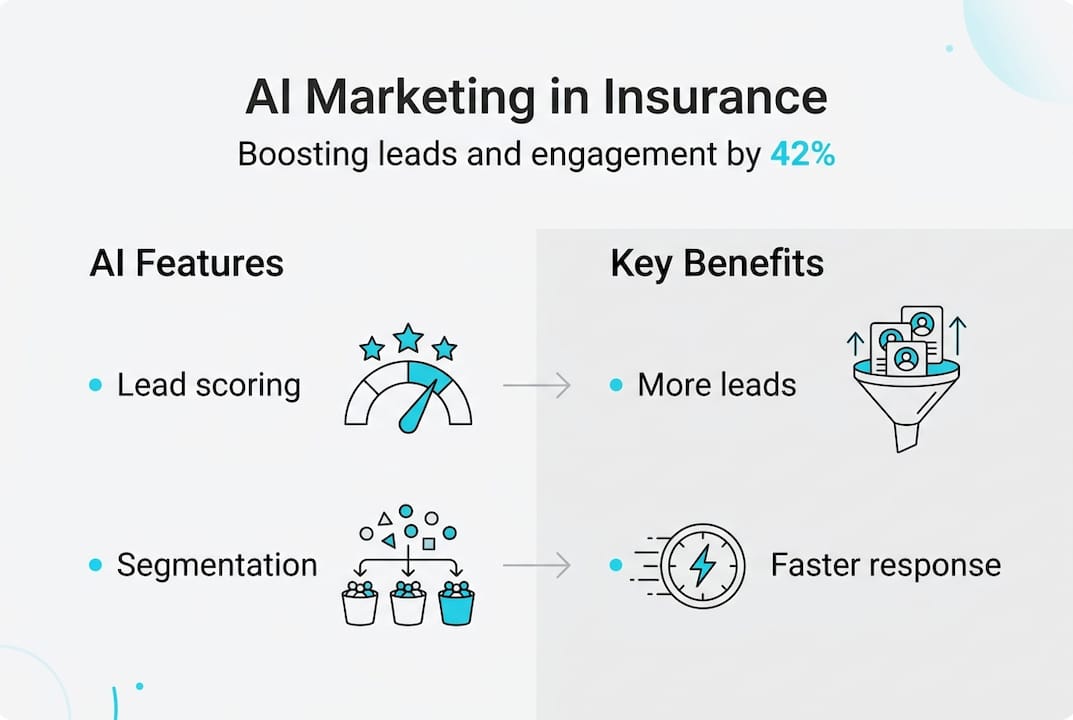
Lead scoring via behavioral data increases qualified leads by 42% because machine learning models detect patterns human agents miss. An algorithm might notice that prospects who view three specific policy pages within 48 hours convert at five times the rate of casual browsers. This insight lets you prioritize follow-up efforts where they matter most.
Machine learning takes segmentation beyond basic age and income brackets. AI segments customers for hyper-personalized campaigns by clustering policyholders based on life stage, risk tolerance, policy gaps, and engagement history. A young family that recently bought homeowners insurance might receive targeted auto bundle offers, while retirees see Medicare supplement content.
Predictive analytics forecast customer churn and renewal likelihood months in advance. Models analyze payment patterns, claim history, communication frequency, and competitor activity to flag at-risk policies. You can launch retention campaigns before customers start shopping elsewhere, dramatically improving AI lead generation for insurance professionals in 2026.
Pro Tip: Start with simple lead scoring rules in your existing CRM before investing in complex machine learning platforms. Score leads based on three to five key behaviors like quote completion, email opens, and phone inquiries to build confidence in AI-driven prioritization.
Consider this performance comparison:
| Metric | Traditional Methods | AI-Powered Approach | Improvement |
|---|---|---|---|
| Lead conversion rate | 2.3% | 3.8% | +65% |
| Time to qualification | 4.2 days | 1.1 days | -74% |
| Cost per qualified lead | $127 | $73 | -43% |
| Customer lifetime value | $8,400 | $11,200 | +33% |
These gains compound over time as AI marketing tools for insurance leads learn from every interaction and continuously refine targeting accuracy.
Automating multi-channel engagement with chatbots and workflows
Customers expect instant responses regardless of the hour, but hiring staff for 24/7 coverage is cost-prohibitive for most agencies. AI-powered chatbots bridge this gap by handling routine inquiries, providing instant quotes, and capturing lead information around the clock.
Chatbots reduce customer wait times by 35% while simultaneously increasing qualified lead volume. A well-designed insurance chatbot can answer common questions about coverage types, explain policy terms, calculate preliminary quotes, and schedule agent callbacks for complex scenarios. This immediate engagement prevents prospects from abandoning your website to check competitor sites.
Automated multi-channel marketing orchestrates touchpoints across email, SMS, and chat based on individual customer behavior. When a prospect requests an auto insurance quote but doesn’t complete the application, an AI workflow might send a personalized email within two hours, followed by an SMS reminder the next day, then trigger a chatbot prompt if they return to your website. This coordinated approach keeps your agency top of mind without manual intervention.

Behavior-driven AI workflows lift renewal consent to 57% by timing outreach perfectly. Instead of generic renewal notices 30 days before expiration, AI systems analyze when each policyholder is most likely to engage and what messaging resonates with their segment.
Follow these steps to implement behavior-driven workflows:
- Map your customer journey from initial inquiry through policy renewal, identifying key decision points
- Define behavioral triggers like quote abandonment, policy review dates, claim resolution, and coverage gaps
- Create message templates for each segment and trigger, personalizing content with policyholder data
- Set up automated sequences with appropriate timing delays between touchpoints
- Configure escalation rules that route complex inquiries to human agents
- Monitor performance metrics and A/B test subject lines, send times, and content variations
This systematic approach to AI-powered customer engagement for insurance transforms sporadic outreach into a consistent, data-driven system that nurtures relationships at scale.
Pro Tip: Review chatbot conversation logs weekly to identify questions the bot struggles to answer. Use these insights to expand your knowledge base and determine when human handoff should occur. Complex questions about exclusions, claims, or unique situations require the human expertise that automation supports, not replaces.
The efficiency gains free agents to focus on high-value activities. Instead of answering the same basic questions repeatedly, you spend time on consultative conversations, complex risk assessments, and relationship building that truly differentiate your agency. Automating customer engagement for insurance leads amplifies your impact rather than diminishing your role.
Balancing AI benefits with regulatory compliance and human oversight
AI systems can generate impressive results, but they also introduce risks that insurance professionals must manage carefully. Machine learning models occasionally produce inaccurate outputs or “hallucinations” where the system confidently presents false information as fact. A chatbot might misstate coverage limits or incorrectly explain exclusions, creating liability exposure.
AI can’t replace agents because human oversight is essential to catch these errors before they reach customers. Every AI-generated quote, policy recommendation, and marketing message should flow through validation checkpoints where experienced agents verify accuracy and appropriateness.
Privacy regulations like GDPR, CCPA, and state insurance laws impose strict requirements on how you collect, store, and use customer data. AI systems that process policyholder information must comply with these frameworks, including obtaining proper consent, enabling data deletion requests, and maintaining audit trails. Failure to comply can result in significant fines and reputational damage.
Bias in AI models poses another serious concern. If your training data overrepresents certain demographics or contains historical discrimination patterns, machine learning algorithms will perpetuate and amplify these biases. This can lead to unfair pricing, discriminatory targeting, and regulatory violations. Regular audits of AI model outputs across different customer segments help identify and correct bias issues.
Insurers are increasingly excluding AI risks from professional liability coverage, leaving agencies exposed if AI-driven marketing causes harm. This makes compliance and oversight even more critical as you can’t simply transfer AI-related liability to your errors and omissions carrier.
Implement these best practices to manage AI risks effectively:
- Validate all AI-generated content before customer delivery, especially quotes and policy information
- Maintain detailed documentation of AI system decisions for regulatory audits
- Conduct quarterly bias assessments across customer segments and model outputs
- Establish clear escalation protocols for AI uncertainty or complex scenarios
- Train staff on AI limitations and appropriate use cases
- Review and update AI governance policies as regulations evolve
“AI augments but does not replace human judgment in insurance marketing. The technology handles repetitive tasks and pattern recognition brilliantly, but agents provide the empathy, ethical reasoning, and contextual understanding that clients need when making important coverage decisions.”
This balanced perspective recognizes AI’s power while respecting its limitations. Using CRM for insurance to boost sales and retention works best when technology and human expertise complement each other strategically.
Governance frameworks mitigate bias and privacy risks in insurance AI marketing by establishing clear accountability, testing protocols, and compliance checkpoints. Designate a team member as your AI governance lead responsible for monitoring system performance, coordinating audits, and staying current on regulatory developments.
AI CRM tools for insurance agencies cut manual tasks while maintaining the human touchpoints that build trust and loyalty. The goal is efficiency with integrity, not automation at any cost.
Practical steps for insurance agents to adopt AI marketing tools
Starting with AI doesn’t require massive budgets or technical expertise. Focus on quick wins that deliver measurable value while building your confidence and capabilities.
Begin your AI marketing journey with these steps:
- Audit your current marketing processes to identify repetitive, time-consuming tasks like lead data entry, initial qualification, and routine follow-up emails
- Research AI tools that integrate with your existing CRM and marketing platforms rather than requiring complete system replacements
- Start small with pay-as-you-go AI chatbot services that require minimal setup and offer free trials
- Implement basic lead scoring rules based on three to five key behavioral signals like quote requests, email opens, and website visits
- Create automated email sequences for common scenarios like quote follow-up, renewal reminders, and cross-sell opportunities
- Monitor performance metrics weekly, comparing AI-assisted campaigns against your baseline results
- Gradually expand to more sophisticated features like predictive analytics and multi-channel orchestration as you gain experience
This phased approach balances innovation with risk management, letting you prove ROI before making larger investments.
| Tool Category | Beginner Options | Advanced Platforms | Key Difference |
|---|---|---|---|
| Chatbots | Simple FAQ bots with template responses | Conversational AI with natural language processing | Complexity of interactions handled |
| Lead Scoring | Rule-based scoring (5-10 criteria) | Machine learning models analyzing 50+ signals | Predictive accuracy and adaptability |
| Email Automation | Triggered sequences based on actions | Dynamic content personalization with A/B testing | Level of customization |
| CRM Integration | Basic data sync and task creation | Full workflow automation with predictive insights | Depth of intelligence |
Beginner tools typically cost $50 to $200 monthly and require minimal technical setup, making them ideal for solo agents and small agencies. Advanced platforms range from $500 to $2,000+ monthly but deliver sophisticated capabilities for larger operations.
Maintain these compliance checkpoints throughout your AI adoption:
- Document all AI system configurations and decision logic for regulatory audits
- Obtain explicit customer consent before using personal data for AI-driven marketing
- Establish review protocols ensuring human verification of AI-generated quotes and recommendations
- Test AI outputs across diverse customer segments to identify potential bias
- Update privacy policies to disclose AI use in marketing and customer interactions
- Train all staff on appropriate AI use cases and escalation procedures
Pro Tip: Use AI personalization in your CRM for immediate impact on email and SMS campaigns. Simple merge tags that insert policyholder names, coverage types, and renewal dates can boost open rates by 25% with minimal effort. This quick win demonstrates AI value to skeptical team members.
Hyper-targeted AI-driven campaigns quickly improve engagement because they deliver relevant content when customers are most receptive. A homeowner who just filed a claim might appreciate information about umbrella policies, while a young professional who recently got married could benefit from life insurance education.
Continuous monitoring and feedback loops refine your AI systems over time. Review campaign performance monthly, noting which segments respond best to different messaging approaches. Feed these insights back into your AI models to improve targeting accuracy and message relevance.
Gradual implementation also helps manage change resistance within your team. Understanding why to use CRM for agents and how AI enhances rather than replaces their expertise makes adoption smoother. Involve agents in selecting tools, designing workflows, and interpreting results so they see AI as a valuable assistant rather than a threat.
Seven practical tips for lead generation include leveraging AI for initial qualification while reserving complex consultations for human agents. This division of labor maximizes efficiency without sacrificing the personal touch that differentiates successful agencies.
Discover CallBack CRM’s AI-powered marketing tools
CallBack CRM integrates the AI capabilities discussed throughout this guide into one comprehensive platform designed specifically for insurance professionals. The system combines lead scoring, chatbot automation, and multi-channel campaign management with secure policyholder data handling and compliance features.
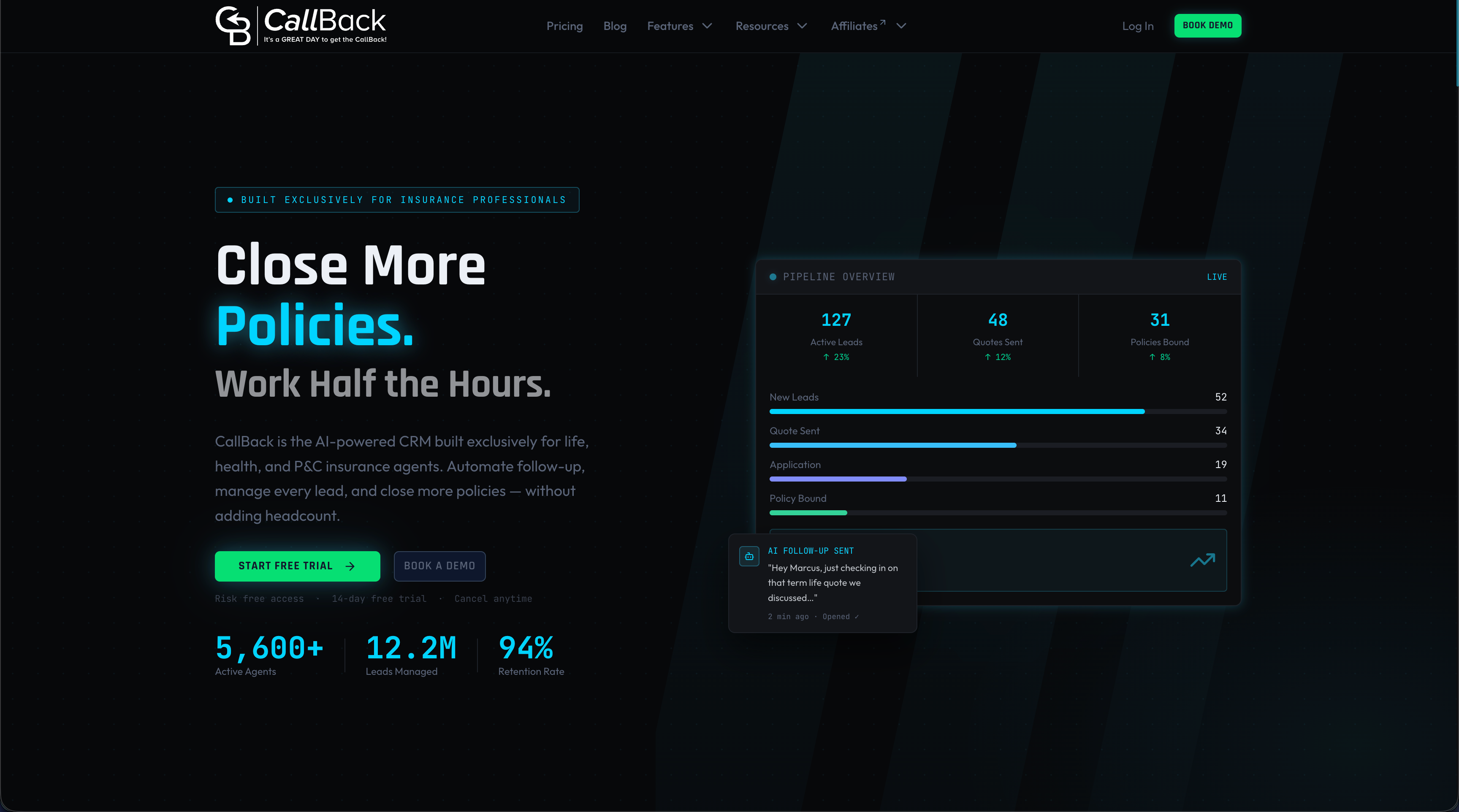
You can automate email and SMS sequences using behavior-driven triggers while maintaining full visibility into customer interactions. CallBack CRM’s AI tool features include predictive lead scoring that identifies high-value prospects, conversational chatbots that capture inquiries 24/7, and workflow automation that nurtures relationships at scale.
Lead management capabilities track every touchpoint from initial inquiry through policy renewal, giving you complete context for personalized outreach. Email marketing automation tools let you create sophisticated campaigns without technical expertise, using drag-and-drop builders and pre-designed templates optimized for insurance scenarios.
The platform handles data security through enterprise-grade encryption and Google Cloud infrastructure while providing the compliance documentation you need for regulatory audits. Try a free demo to experience how AI can transform your insurance marketing efficiency and effectiveness without replacing the human expertise your clients value.
FAQ
What is AI lead scoring and how does it benefit insurance agents?
AI lead scoring uses machine learning to analyze behavioral data like website visits, email engagement, and quote requests, then ranks prospects by conversion likelihood. This lets agents prioritize follow-up efforts on high-intent leads rather than wasting time on casual browsers. The result is higher conversion rates, shorter sales cycles, and more efficient use of agent time.
How can insurance agents ensure AI marketing stays compliant with regulations?
Agents must follow data privacy laws like CCPA and GDPR, obtain proper customer consent for data use, and maintain human review of all AI-generated quotes and recommendations. Regular audits of AI model outputs help identify bias issues before they cause problems. Staying current on evolving regulations and insurer AI exclusions protects your agency from liability exposure.
What are practical first steps for brokers new to AI in marketing?
Start with simple chatbots that answer common questions and capture lead information, then add basic lead scoring rules to your existing CRM. Focus on automating one or two repetitive tasks like quote follow-up emails rather than trying to transform everything at once. Look for tools offering free trials or pay-as-you-go pricing so you can test effectiveness before committing to long-term contracts.
Can AI chatbots handle complex insurance questions effectively?
AI chatbots excel at routine inquiries about coverage types, policy terms, and basic quotes but struggle with nuanced scenarios involving exclusions, claims disputes, or unique risk situations. The best approach is configuring chatbots to handle straightforward questions while routing complex issues to human agents. This hybrid model provides instant responses for simple needs while preserving expert consultation for important decisions.
How long does it take to see ROI from AI marketing investments?
Most agencies see measurable improvements in lead quality and engagement within 60 to 90 days of implementing basic AI tools like chatbots and automated email sequences. More sophisticated applications like predictive analytics and advanced segmentation may take four to six months to deliver full value as the systems learn from your data. Starting with focused, high-impact use cases accelerates time to ROI compared to attempting comprehensive transformation immediately.