

Most insurance agents still chase cold leads manually, but AI-driven predictive lead generation transforms that outdated approach. Predictive lead generation uses artificial intelligence to analyze historical data and identify prospects most likely to convert, delivering conversion rates 20-40% higher than traditional methods. Insurance professionals face unique challenges like maintaining data quality and responding to high-intent leads quickly. Understanding how predictive systems work, what data they need, and how to avoid common pitfalls can dramatically improve your sales pipeline and close more policies with less effort.
Table of Contents
- Key takeaways
- What is predictive lead generation and how does it work?
- Data challenges and nuances specific to insurance predictive lead generation
- Benefits and practical implementation tips for insurance agents
- Common pitfalls and how to avoid them when using predictive lead generation
- Discover how CallBack CRM powers predictive lead generation
- Frequently asked questions
Key Takeaways
| Point | Details |
|---|---|
| 20 to 40 percent uplift | Predictive lead generation delivers a 20 to 40 percent higher conversion rate than traditional methods. |
| Data quality matters | Reliable results depend on clean historical data spanning six to twelve months to train accurate models. |
| Continuous model retraining | Models must continuously retrain on new data to stay accurate as conditions change. |
| Fast response to high intent | Respond quickly to high intent leads to dramatically higher success rates. |
What is predictive lead generation and how does it work?
Predictive lead generation represents a fundamental shift from static lead scoring to dynamic, AI-powered prioritization. Instead of manually assigning points based on fixed criteria, predictive lead generation uses AI and ML algorithms to analyze thousands of data points from your historical leads and identify patterns that signal purchase readiness. Machine learning models examine past successful insurance sales to understand which characteristics, behaviors, and engagement signals consistently predict conversion.
The difference between traditional and predictive lead scoring is substantial. Traditional methods rely on rigid rules you set manually, like assigning 10 points for opening an email or 20 points for visiting your pricing page. These rules remain static until you manually update them, and they treat all leads identically regardless of context. Predictive systems continuously learn from new data, adapting their scoring criteria as market conditions and customer behaviors evolve. When a predictive model notices that leads from specific zip codes convert at higher rates during certain months, it automatically adjusts scoring weights without human intervention.
The benefits extend beyond simple automation. Predictive systems deliver higher conversion rates because they identify subtle patterns humans miss. They provide better targeting by segmenting leads based on complex behavioral combinations rather than single attributes. Most importantly, they create dynamic feedback loops where each closed deal or lost opportunity refines future predictions, making the system smarter over time.
Predictive lead generation systems comprise five essential components:
- Data collection from CRM systems, website analytics, email engagement, and external sources
- Model training using historical lead data to identify conversion patterns and signals
- Lead scoring that assigns probability scores based on learned patterns and current behaviors
- Prioritization that ranks leads by conversion likelihood and potential policy value
- Feedback loops that incorporate actual sales outcomes to continuously improve predictions
For insurance agents adopting AI in lead generation, this technology eliminates guesswork and allows you to focus energy on prospects genuinely ready to buy. Instead of calling 100 lukewarm leads, you contact 20 high-probability prospects identified by AI analysis of thousands of behavioral signals.
Data challenges and nuances specific to insurance predictive lead generation
Data quality makes or breaks predictive lead generation systems. The models are only as accurate as the information they learn from, and insurance lead data presents unique complications. You need clean historical data spanning 6-12 months minimum to train effective models, but many agencies lack organized records of lead sources, touchpoints, and outcomes. Incomplete data creates blind spots where the AI cannot learn accurate patterns.

Common data biases severely distort predictions if left unchecked. Selection bias occurs when you train models only on leads your team pursued, ignoring those you skipped. This teaches the AI to replicate your existing biases rather than discovering new opportunities. Another critical issue involves conflating engagement metrics with genuine purchase intent. A lead who opens every email might seem highly engaged, but if they never request quotes or ask policy questions, that engagement may not signal buying readiness. The AI needs to distinguish between casual interest and serious intent.
Data quality issues that degrade model performance include:
- Inconsistent lead source tracking that prevents identifying which channels produce best prospects
- Missing demographic or firmographic data that limits segmentation capabilities
- Outdated contact information that wastes outreach efforts on disconnected numbers
- Incomplete outcome records where won and lost deals lack detailed notes explaining why
- Duplicate records that artificially inflate certain lead characteristics in training data
Continuous model retraining addresses another critical challenge. Insurance markets shift as regulations change, new products launch, and economic conditions evolve. A model trained on 2024 data may perform poorly in 2026 if you never update it with recent outcomes. Models decay over time as the patterns they learned become less relevant to current market dynamics.
Cultural and operational obstacles compound technical challenges. Only 7% of insurers fully scale AI due to resistance from sales teams, lack of technical expertise, and difficulty integrating AI tools with existing workflows. Agents accustomed to gut instinct may distrust AI recommendations, especially when the system prioritizes leads that don’t match their mental profile of ideal customers.
Pro Tip: Start with a thorough data audit before implementing predictive lead generation. Identify gaps in your historical records, establish consistent data entry standards, and create feedback mechanisms where sales outcomes flow back into the system immediately. This foundation prevents garbage in, garbage out scenarios that undermine AI accuracy.
For insurance professionals, building effective lead generation workflows requires addressing these data challenges systematically. Clean data creates accurate predictions, which build trust in the system, which encourages adoption, which generates more data to improve the models further.
Benefits and practical implementation tips for insurance agents
The measurable benefits of predictive lead generation justify the implementation effort. Predictive lead scoring delivers 15% average conversion rates compared to 10-12% for traditional methods, and closes 36% more deals overall. For insurance agents, this translates directly to more policies sold with the same or less effort. The system handles lead prioritization automatically, freeing your time to focus on relationship building and closing conversations rather than sorting through contact lists.
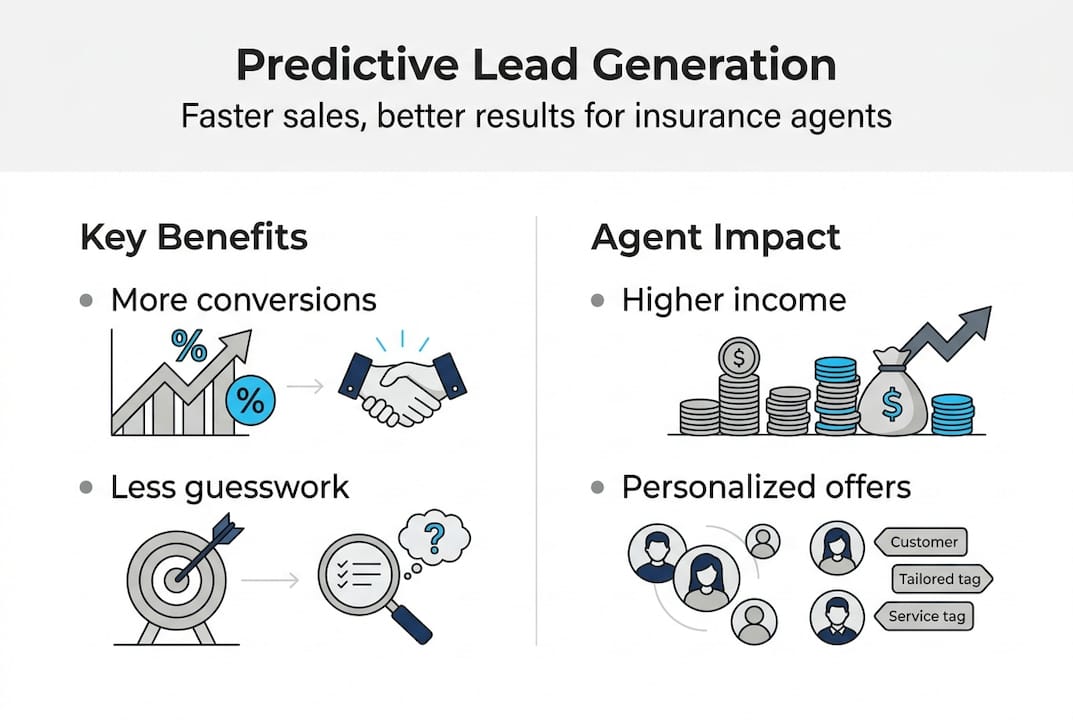
Improved personalization represents another significant advantage. Predictive systems identify which insurance products each lead is most likely to purchase based on demographic patterns and behavioral signals. An agent can tailor outreach to emphasize life insurance for young families or Medicare supplements for seniors approaching 65, increasing relevance and response rates.
| Aspect | Traditional lead generation | Predictive lead generation |
|---|---|---|
| Conversion rate | 10-12% average | 15% average, up to 40% improvement |
| Adaptability | Static rules require manual updates | Continuously learns and adjusts automatically |
| Bias management | Reinforces existing human biases | Can identify and mitigate bias with proper monitoring |
| Transparency | Clear rule-based logic | Black box AI requires hybrid approaches for explainability |
| Implementation complexity | Simple to set up manually | Requires data infrastructure and model training |
Implementing predictive lead generation follows a structured process:
- Audit your existing lead data to assess quality, completeness, and historical depth across all sources
- Choose no-code AI platforms designed for insurance agents that integrate with your current CRM system
- Integrate data sources so the platform can access lead information, engagement metrics, and sales outcomes
- Train the initial model using 6-12 months of historical data with clear win and loss labels
- Establish feedback loops where sales results automatically update the model to improve future predictions
- Monitor performance metrics weekly and retrain models monthly as new outcome data accumulates
Key practical tips for maximizing predictive lead generation effectiveness:
- Prioritize high-intent leads who exhibit multiple buying signals like quote requests and policy comparisons
- Tailor models to insurance buyer profiles by training separate models for different product lines or customer segments
- Use hybrid approaches that combine AI scoring with traditional rules for transparency and control
- Set up alerts for leads crossing high-probability thresholds so you can respond immediately
- Track which lead sources feed the highest-scoring prospects and allocate marketing budget accordingly
Pro Tip: Prioritizing high-intent leads enables contact within 5 minutes, which research shows improves conversions by 100x compared to waiting even 10 minutes. Configure your system to send instant mobile notifications when leads score above your threshold, and make immediate outreach your top priority.
For insurance agents looking to leverage AI for lead generation, these practical steps transform predictive technology from abstract concept to daily sales advantage. The key is starting with solid data foundations and maintaining consistent feedback loops that keep models accurate as your business evolves.
Agents who master AI in insurance marketing combine predictive lead scoring with automated nurture sequences, ensuring high-probability prospects receive timely, relevant communications that move them toward purchase decisions efficiently.
Common pitfalls and how to avoid them when using predictive lead generation
Even well-implemented predictive systems can fail if you fall into common traps. Overfitting represents a frequent technical mistake where models become too specialized to historical data and perform poorly on new leads. This happens when you train on small datasets or use overly complex models that memorize past leads rather than learning generalizable patterns. The solution involves using larger training datasets, simpler model architectures, and validation techniques that test performance on unseen data.
Selection bias from using only pursued leads creates skewed predictions. If your historical data includes only leads your team contacted, the AI cannot learn to identify promising prospects you previously overlooked. Predictive lead generation can fail due to bias when training data reflects human prejudices rather than objective conversion signals. Combat this by including all leads in training data, not just those your team pursued, and regularly auditing model outputs for unexpected patterns that might indicate bias.
Ignoring segment-specific scoring undermines accuracy. A single model trained on all your leads treats life insurance prospects the same as commercial property leads, missing important distinctions. Different insurance products attract different customer profiles with unique buying behaviors. Create separate models for major product lines or customer segments to capture these nuances.
Conflating engagement metrics with purchase intent distorts predictions. A lead who opens every email but never takes action scores high on engagement but low on buying readiness. The AI needs training data that distinguishes between these scenarios, labeling engaged non-buyers differently from engaged buyers. Without this distinction, models chase the wrong signals.
Common pitfalls to watch for:
- Neglecting continuous monitoring allows model performance to degrade as market conditions change
- Failing to retrain models regularly means predictions become stale and less accurate over time
- Over-relying on AI without human validation can miss context the system cannot capture
- Ignoring low-scoring leads entirely may discard prospects who need different nurture approaches
- Not testing model assumptions against real outcomes prevents identifying and fixing errors
Model decay poses a persistent threat. As months pass, the patterns your model learned become less relevant to current leads. New competitors enter the market, regulations change, economic conditions shift, and customer preferences evolve. A model trained in early 2025 may perform significantly worse by late 2026 without retraining. Establish monthly retraining schedules where the system incorporates recent sales outcomes and adjusts its predictions accordingly.
Hybrid approaches combining AI scoring with traditional rules maintain transparency and control. Pure AI systems can feel like black boxes where you cannot understand why certain leads score high or low. Layering traditional rules on top, like automatically boosting scores for leads from proven referral sources, preserves institutional knowledge while leveraging AI’s pattern recognition capabilities. This combination often outperforms either approach alone.
Pro Tip: Regularly validate AI predictions against real sales outcomes by tracking conversion rates across different score ranges. If leads scoring 80-90 convert at similar rates to those scoring 60-70, your model needs recalibration. Use these validation insights to adjust model parameters and improve accuracy continuously.
For agents seeking to automate lead generation effectively, avoiding these pitfalls requires ongoing attention rather than set-it-and-forget-it implementation. Predictive systems demand active management, regular validation, and continuous improvement to deliver sustained results.
Discover how CallBack CRM powers predictive lead generation
Implementing predictive lead generation becomes straightforward when you have the right platform. CallBack CRM delivers comprehensive AI-driven tools specifically designed for insurance agents who want to leverage predictive analytics without technical complexity. The platform combines intelligent lead scoring with automated nurture sequences, ensuring high-probability prospects receive timely outreach that maximizes conversion rates.
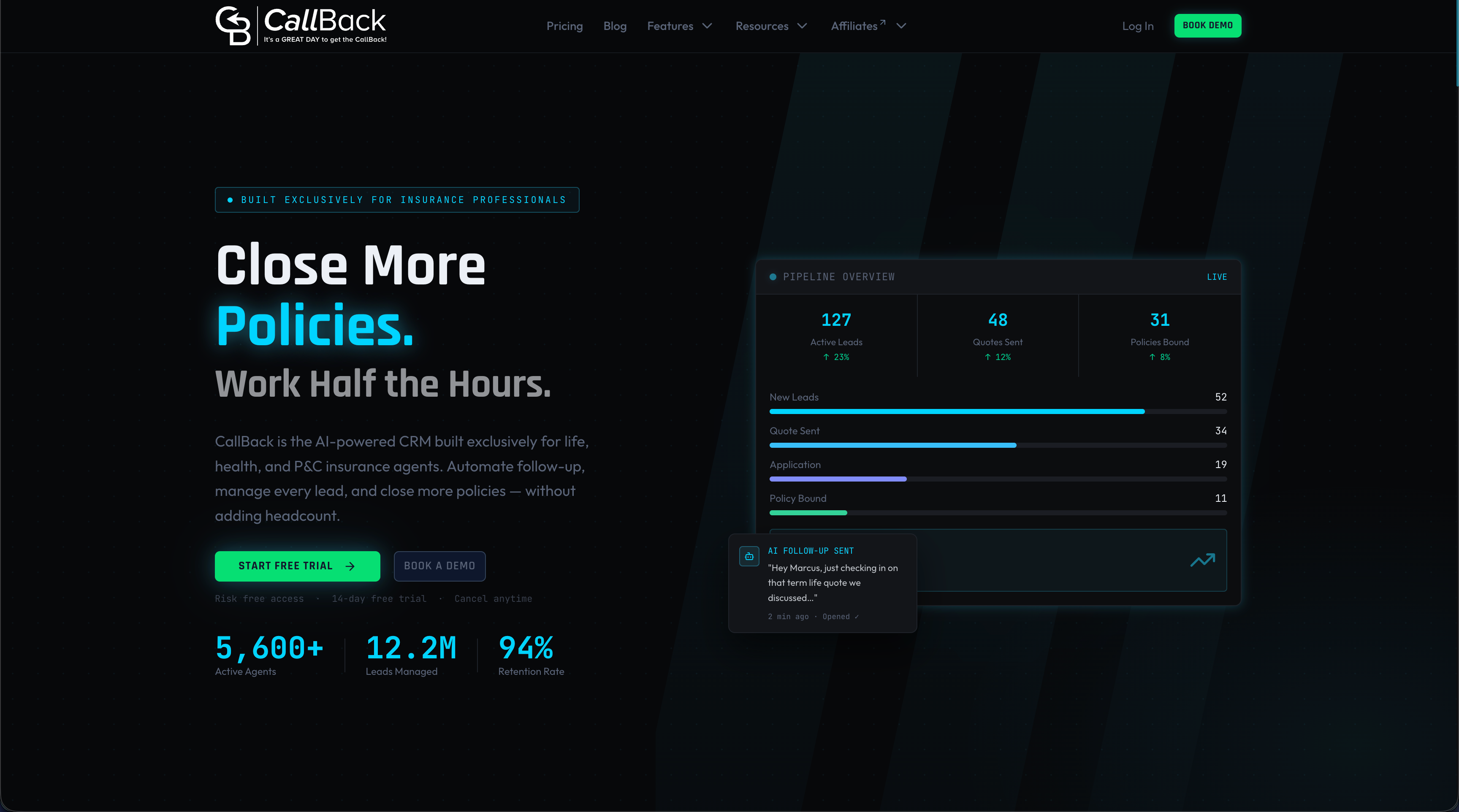
CallBack CRM’s all-in-one AI features integrate seamlessly with your existing workflows, eliminating the need to juggle multiple disconnected tools. The automation capabilities handle repetitive tasks like data entry and follow-up scheduling, while SMS marketing features enable instant communication with high-intent leads. For insurance agents ready to modernize their lead generation approach, CallBack CRM provides the complete infrastructure to implement predictive systems that identify your best prospects and help you close more policies efficiently.
Frequently asked questions
What is predictive lead generation?
Predictive lead generation uses artificial intelligence and machine learning algorithms to analyze historical lead data and identify prospects most likely to convert. The system assigns probability scores based on behavioral patterns, demographic characteristics, and engagement signals, allowing insurance agents to prioritize outreach efforts on leads with the highest conversion potential.
How is it different from traditional lead generation?
Traditional lead generation relies on static, manually-defined rules that assign fixed point values to specific actions or attributes. Predictive systems continuously learn from new data, automatically adjusting scoring criteria as patterns evolve. This dynamic approach delivers 20-40% higher conversion rates because it identifies subtle behavioral combinations that static rules miss and adapts to changing market conditions without manual intervention.
What data is needed to use predictive lead generation effectively?
Effective predictive lead generation requires clean historical data spanning at least 6-12 months, including lead sources, demographic information, engagement metrics like email opens and website visits, and clear outcome labels indicating which leads converted and which did not. The data must be comprehensive across all touchpoints and consistently formatted to enable accurate pattern recognition and avoid biases that skew predictions.
Why is rapid follow-up important with AI-generated leads?
Research shows that contacting high-intent leads within 5 minutes improves conversion rates by 100x compared to waiting even 10 minutes. Predictive systems identify prospects exhibiting multiple buying signals who are actively researching insurance options right now. Immediate response capitalizes on this peak interest before they move to competitors or their urgency diminishes, dramatically increasing your chances of closing the sale.
Can insurance agents implement predictive lead generation without coding skills?
Yes, modern no-code platforms designed specifically for insurance professionals enable predictive lead generation implementation without technical expertise. These platforms provide intuitive interfaces for connecting data sources, training models, and setting up automated workflows. Agents can leverage sophisticated AI capabilities through simple point-and-click configurations rather than writing code or hiring data scientists.