

TL;DR:
- Most insurance agents have low close rates because of strategy misconceptions.
- Defining quality leads and using digital and offline tactics with automation can significantly improve results.
Most insurance agents close somewhere between 10 and 15% of their leads. That gap between effort and results isn’t a motivation problem. It’s a strategy problem. The agents who consistently hit their numbers aren’t working harder. They’re working with sharper criteria, smarter tools, and a system that keeps leads moving through the funnel even when they’re not actively selling. This guide breaks down exactly how to define quality leads, attract them through digital and offline channels, automate follow-up, and build a pipeline that compounds over time. Every tip here is practical and built for how insurance sales actually works in 2026.
Table of Contents
- Set clear criteria for quality leads
- Top digital strategies to attract more leads
- Offline tactics that still drive high-value leads
- Automation and CRM tools: Streamlining lead management
- What most agents miss: Nurturing non-ready leads
- Supercharge your lead generation with the right tools
- Frequently asked questions
Key Takeaways
| Point | Details |
|---|---|
| Define lead quality | Establish clear criteria for lead value based on your ideal customer profile and readiness to buy. |
| Combine digital and offline | Integrate digital marketing with offline tactics for broader reach and stronger trust. |
| Automate your follow-ups | Leverage CRM tools to boost productivity and never let a lead go cold. |
| Nurture non-ready leads | Consistent, segmented communication keeps 80% of leads engaged until they’re ready to convert. |
Set clear criteria for quality leads
Before you spend a single dollar on ads or an hour on outreach, you need to know what a good lead actually looks like for your book of business. This sounds obvious, but most agents skip it. They chase volume instead of fit, and then wonder why their close rate stays flat.
Start by defining your ideal client profile. Think about the traits that your best current clients share: age range, life stage, income bracket, geographic area, and the type of coverage they needed. These aren’t just demographic boxes. They’re signals that someone is likely to need what you sell, afford it, and stay with you long-term.
Once you know who you’re targeting, you need to understand where they are in the buying process. The best framework for this is the lead funnel, which moves prospects from awareness to consideration to conversion. A lead in the awareness stage just learned they might need life insurance after having a child. A lead in the consideration stage is comparing quotes. A lead in the conversion stage is ready to sign. Each stage needs a different message and a different level of urgency from you.
Here’s what to look for when scoring lead quality:
- Life trigger events: Marriage, new baby, home purchase, business launch, or retirement planning are strong buying signals.
- Engagement level: Did they open your email, click a link, or fill out a form? Engaged leads are warmer than cold contacts.
- Policy gap: Do they have coverage that’s clearly insufficient for their situation? That’s an opening.
- Decision timeline: Are they shopping now or just browsing? Knowing this helps you prioritize follow-up.
- Referral source: Leads from referrals or trusted partners close at higher rates than cold traffic.
Understanding the different lead generation types available to you makes it easier to match your sourcing strategy to your ideal client profile. Once you’ve defined quality, you can build a lead workflow that filters, scores, and routes leads automatically so your time goes to the ones most likely to close.
Pro Tip: Review your last 20 closed deals and find the three traits they all shared. Use those as your lead scoring baseline.
Top digital strategies to attract more leads
With your criteria defined, let’s look at digital techniques that help you fill your sales funnel more efficiently. The good news is that digital channels give you measurable, scalable reach. The better news is that SEO leads close at 14.6% on average, which is significantly higher than most outbound methods.

Here’s a quick comparison of the main digital channels and how they perform for insurance agents:
| Channel | Best for | Cost | Speed to results |
|---|---|---|---|
| SEO and content | Long-term organic traffic | Low ongoing | Slow (3 to 6 months) |
| Paid search ads | High-intent buyers now | Medium to high | Fast (days) |
| Social media | Brand awareness and referrals | Low to medium | Medium |
| Email marketing | Nurturing existing leads | Very low | Fast |
| Webinars | Education and trust-building | Low | Medium |
For SEO, focus on local intent keywords like “life insurance agent in [your city]” and educational content that answers the questions your ideal clients are actually searching. Google rewards helpful, specific content, and insurance buyers do a lot of research before they reach out.
For paid ads, Google Search campaigns targeting high-intent queries work well, but they require tight budget management. Facebook and Instagram ads can build awareness and retarget website visitors at a lower cost per click.
For list building, offer something genuinely useful in exchange for contact information. A free coverage gap checklist, a retirement income guide, or a short video series on term vs. whole life insurance can convert website visitors into email subscribers.
Automation is where digital strategy really accelerates. Instead of manually following up with every lead, you can set up sequences that send the right message at the right time based on behavior. Check out these lead gen tips and AI lead strategies to see how agents are using automation to score, segment, and nurture leads at scale. The right AI tools for agents can handle the repetitive outreach so you focus on conversations that are ready to convert.
Pro Tip: Set up a simple email sequence that triggers when someone downloads your lead magnet. Even three emails over two weeks will outperform a single follow-up call.
Offline tactics that still drive high-value leads
Digital strategies are powerful, but proven offline methods still have an edge for trust-building. Here’s how to use them effectively alongside your online efforts.
Face-to-face interaction creates a level of credibility that no email sequence can fully replicate. When someone meets you at a community event, hears you speak at a local seminar, or gets a personal referral from a friend, they arrive with a baseline of trust already established. That trust shortens the sales cycle considerably.
“Offline engagement complements digital outreach by building the personal trust that drives higher conversion rates, especially for complex insurance products.” Insurance Journal
Here are the offline tactics worth prioritizing in 2026:
- Host educational workshops: Partner with a local financial planner, CPA, or real estate agent to co-host a free workshop on financial protection topics. You share the audience and the cost.
- Attend community events: Sponsoring a local sports team, charity run, or neighborhood fair puts your name in front of families who are exactly the kind of clients you want.
- Build a structured referral program: Give current clients a clear, simple way to refer friends and family. A thank-you gift card or a donation to their favorite charity goes a long way.
- Cross-promote with complementary businesses: Mortgage brokers, car dealerships, and HR consultants all interact with people who need insurance. A mutual referral agreement benefits everyone.
- Follow up in person: For high-value prospects, a handwritten note or a brief in-person check-in after a digital touchpoint can be the thing that tips the decision.
The key is to connect your offline activity back to your digital system. When you meet someone at an event, get their contact information and add them to your CRM immediately. Tag them with the event source so you know where they came from. Then let your offline lead workflows take over with automated follow-up that keeps you top of mind without requiring manual effort every time.
Automation and CRM tools: Streamlining lead management
Ready to increase efficiency? Let’s look at automation and CRM solutions that top agents use for best-in-class results. A well-configured CRM isn’t just a contact database. It’s the engine that keeps your entire lead pipeline moving.
The numbers back this up. CRM adoption boosts productivity by 29% for sales professionals, which for an insurance agent translates directly into more conversations, more quotes, and more closed policies.
Here’s what a modern CRM should handle for you:
| Feature | What it does for you |
|---|---|
| Lead segmentation | Groups leads by stage, source, or product interest |
| Automated follow-up | Sends emails and texts based on lead behavior |
| Task reminders | Alerts you when a lead needs a personal touchpoint |
| Pipeline tracking | Shows where every lead stands at a glance |
| Reporting | Tells you which sources and campaigns produce closers |
Here’s a simple numbered workflow for moving a lead from first contact to closed policy using automation:
- Lead enters your CRM via a web form, ad, or manual entry after an event.
- Automatic welcome email goes out within minutes, setting expectations and offering a resource.
- Lead is scored based on profile data and engagement behavior.
- Segmented nurture sequence begins, tailored to the lead’s product interest and funnel stage.
- Task is created for you to call when the lead hits a score threshold or opens a key email.
- Proposal is sent digitally through the CRM after your conversation.
- Follow-up reminder triggers if the proposal isn’t opened within 48 hours.
- Policy is closed and the client moves into a retention and cross-sell sequence.
Every step after the first one can be automated. Learn more about CRM benefits for agents, explore how to automate lead generation, and see how to optimize your funnel so fewer leads fall through the cracks.
What most agents miss: Nurturing non-ready leads
Here’s the uncomfortable truth that separates average agents from top performers: most of the leads in your pipeline right now aren’t going to buy this month. About 80% of leads need ongoing nurturing through segmented email before they’re ready to convert. The agents who understand this build systems around it. The ones who don’t keep buying new leads to replace the ones they gave up on too early.
Chasing new leads constantly is expensive. Nurturing the ones you already have is nearly free, especially with automation. A lead who isn’t ready today might be your best client in six months after a job change, a new baby, or a policy renewal that disappoints them with their current carrier.
The compounding value here is significant. Every lead you nurture correctly becomes a potential referral source, even if they never buy from you. People remember agents who stayed helpful and consistent without being pushy.
Set up segmented nurture sequences based on product interest and life stage. Use AI nurturing strategies to personalize outreach at scale without spending hours writing individual emails. The agents who win long-term aren’t the ones with the biggest ad budgets. They’re the ones with the best follow-through.
Supercharge your lead generation with the right tools
Take the guesswork out of lead management and boost your close rates with proven, integrated solutions. Everything covered in this guide, from defining lead quality to running automated nurture sequences, works best when it lives inside one connected platform.
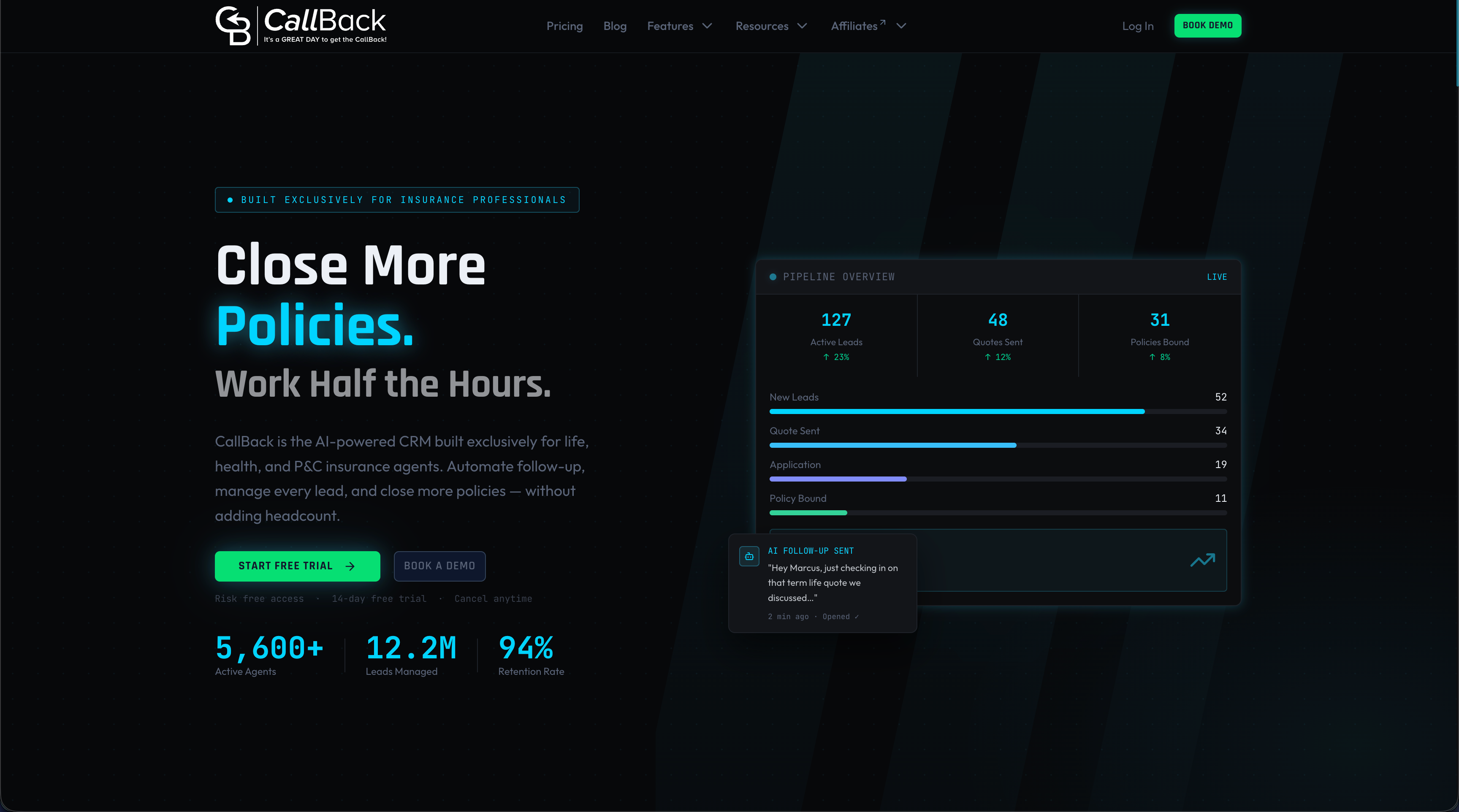
CallBack CRM brings together all-in-one CRM features, email automation solutions, and a powerful website and funnel builder so you can apply every strategy in this guide without juggling five different tools. Whether you’re capturing leads from a seminar, running a paid ad campaign, or nurturing a cold contact from six months ago, everything connects. Start a free trial and see how much faster your pipeline moves when your tools actually work together.
Frequently asked questions
What is the best way for insurance agents to generate leads in 2026?
The most effective approach combines digital marketing, SEO, automation tools, and personal connections through events and referrals. SEO leads close at 14.6% on average, making organic search one of the highest-value channels available to agents.
How does CRM software boost agent productivity?
CRM software streamlines lead tracking, automates follow-ups, and increases productivity by 29% for insurance agents, freeing up more time for high-value conversations.
Why is lead nurturing important if most leads aren’t ready to buy?
Nearly 80% of leads require consistent nurturing through segmented email before they’re ready to convert, making follow-through one of the highest-return activities an agent can invest in.
How can offline strategies complement digital lead generation?
Offline tactics like networking events and referral programs build personal trust that accelerates digital conversions, especially for complex products like life or disability insurance where relationships matter most.