

TL;DR:
- Insurance agents waste time on low-quality leads and ineffective outreach methods. Implementing AI, automation, and multi-channel strategies can improve lead qualification, response time, and conversion rates. Validating data and connecting offline sales ensure more accurate measurement and higher return on investment.
Insurance agents spend enormous energy chasing leads that never convert. Wasted calls, stale contact lists, and generic email blasts drain hours from your week while your pipeline stays thin. The pressure to find qualified prospects has never been higher, especially as consumer expectations for fast, personalized outreach continue to rise. This article gives you concrete, actionable examples of lead generation methods built for the modern insurance market, showing exactly how AI and automation can help you spend less time on bad leads and more time closing the right ones.
Table of Contents
- What to look for in insurance lead generation methods
- Landing pages and inbound digital marketing
- AI-powered qualification, scoring, and real-time routing
- Multi-channel outreach and CRM-powered nurture sequences
- Comparing lead types: Shared, exclusive, and live-transfer
- A fresh take: Why AI alone isn’t the silver bullet for insurance lead generation
- Next steps: Automate your insurance lead generation
- Frequently asked questions
Key Takeaways
| Point | Details |
|---|---|
| Criteria drive success | Effective insurance lead generation starts by applying clear decision criteria, including speed, quality, and measurement. |
| AI transforms processes | AI and automation dramatically cut manual workload and improve lead qualification and conversion rates. |
| Multi-channel outreach wins | Using several channels and CRM-backed nurture ensures more leads stay engaged through the buying journey. |
| Lead quality matters | Comparing shared, exclusive, and live-transfer leads helps you invest in the types that fit your sales strategy best. |
| Measurement drives ROI | Tying campaign data to actual policy sales maximizes returns and exposes the tactics that really work. |
What to look for in insurance lead generation methods
Before jumping into tactics, you need a clear filter for evaluating what actually works. Not every lead generation method is worth your time or budget, and the sheer number of tools claiming to “transform” your pipeline can make the selection process overwhelming.
The most important factors to evaluate include:
- Lead quality and qualification speed: A high volume of low-quality leads wastes more resources than it generates. Look for methods that filter intent signals early so your team focuses on realistic prospects.
- Multi-channel reach: Your leads live on different platforms. A method that only captures email addresses, for example, will miss prospects who prefer SMS or social media.
- Sales-connected measurement: Counting form fills is not the same as counting new policies. Your measurement system needs to connect marketing activity to actual downstream revenue.
- Automation and personalization at scale: Insurance lead generation strategies typically mix inbound acquisition such as SEO and digital advertising with automated lead capture and multi-step follow-up. You need both volume and relevance.
- Validated data, not vendor promises: Many lead vendors inflate their performance claims. Always validate results against your own CRM data before scaling spend.
Critically, lead response time and contactability issues often dominate real-world results. Leads go cold fast. If your system cannot respond within minutes, even the highest-quality lead can fail to convert. Automation is the practical solution to this problem.
For a broader foundation, explore these lead generation tips for agents and a deeper look at AI in insurance lead generation to understand where the industry is heading.
Pro Tip: Before committing to any lead source or tool, run a 30-day pilot and track results all the way to issued policies, not just form submissions. This reveals your true cost per sale.
With the criteria established, let’s see how these work in specific, real-world lead generation examples tailored for insurance.
Landing pages and inbound digital marketing
A focused landing page built around a single insurance product, such as auto, homeowners, or term life, is one of the most reliable ways to capture high-intent leads. When a prospect clicks a pay-per-click ad or an organic search result and lands on a page directly related to their need, the conversion opportunity is strongest.
Here is a practical setup that works well for most agencies:
- Build product-specific pages. A page titled “Affordable Auto Insurance in Texas” attracts visitors with clear intent. Generic pages bleed conversions.
- Add an AI chatbot above the fold. Automated lead capture on the page means an AI assistant can begin qualifying the visitor immediately, even at 2 AM when your team is offline.
- Set up instant automated follow-up. The moment a lead submits their information, trigger an SMS or email within 60 seconds. This single step can dramatically increase the chance of a real conversation.
- Connect offline outcomes to your ad campaigns. Measurement improvements that connect lead activity to offline sales significantly raise lead-to-sale conversion and improve ROI. Feed issued policy data back into your ad platform so the algorithm optimizes toward actual buyers.
“The biggest mistake agencies make with landing pages is measuring success by form fills rather than issued policies. Connecting your offline data to your digital campaigns changes everything about how you allocate budget.”
Understanding inbound marketing strategies at a deeper level will also help you structure your SEO and content approach to attract organic traffic that complements your paid campaigns.
Pro Tip: Keep your landing page forms short. Ask for name, ZIP code, and phone number only. Additional fields reduce submissions significantly. Collect extra data during the AI chatbot conversation instead.
To streamline this entire process, automate your insurance lead generation so every captured lead enters a consistent follow-up workflow automatically, eliminating manual handoffs that cause delays.

AI-powered qualification, scoring, and real-time routing
Speed and accuracy in qualifying leads is where AI creates its biggest advantage for insurance agents. Traditional processes involve manual reviews, delayed calls, and subjective judgment calls about who is worth pursuing. AI replaces that guesswork with structured, objective scoring in seconds.
Here is how the process works in practice:
- A prospect fills out a web form expressing interest in homeowners insurance.
- Within seconds, the AI system pulls in additional data points, enriches the lead profile with property information, estimated income bracket, and homeownership status, and assigns a score based on your predefined criteria.
- Leads scoring above your threshold are immediately routed to an available agent with a notification. Leads scoring below that threshold enter an automated nurture sequence without any agent needing to make a manual decision.
The operational impact is significant. AI-powered lead qualification for insurance can materially reduce manual lead handling by automating scoring, enrichment, and routing across tools while compressing time-to-first response from hours to seconds.
| Process step | Manual approach | AI-powered approach |
|---|---|---|
| Lead enrichment | 15 to 30 minutes per lead | Under 10 seconds |
| Qualification decision | Subjective agent review | Scored against set criteria |
| Routing to agent | Manual assignment | Automatic, based on availability |
| Follow-up trigger | Relies on agent memory | Automated via CRM workflow |
| Hot lead response time | 30 minutes to several hours | Under 2 minutes |
Effective AI workflow design in insurance requires connecting qualification systems to your existing stack, including CRM, email, SMS, and team communication tools. You also need clearly defined threshold logic so the system knows exactly what makes a lead hot, warm, or cold, and what action follows each classification.
An integrated setup using an AI-based lead scoring guide helps you build those thresholds intelligently, using your historical data rather than guesswork. From there, you can use those scores to generate leads with AI more efficiently by doubling down on the sources and channels that produce your best-scoring prospects.
Pro Tip: Audit your lead scoring logic quarterly. As your policy mix evolves, your ideal lead profile changes too. Outdated thresholds mean well-qualified prospects fall through the cracks.
Multi-channel outreach and CRM-powered nurture sequences
Most insurance leads do not convert on the first contact. Research consistently shows that it takes multiple touchpoints across different channels before a prospect becomes a buyer. This is exactly where CRM-powered drip campaigns and multi-channel outreach deliver outsized returns.
A multi-channel outreach approach combined with CRM-backed drip campaigns is widely recommended for insurance agents because it prevents leads from going stale after a single unanswered call. Here is what a realistic sequence looks like:
- Day 0: Immediate automated SMS and email within 60 seconds of lead submission.
- Day 1: Personal-feeling email with a short value proposition specific to the product they inquired about.
- Day 3: Follow-up SMS with a calendar link to book a call.
- Day 7: Educational email, such as “5 things your current auto policy might not cover.”
- Day 14: Final value email with a soft call to action before transitioning to a low-frequency long-term nurture.
| Channel | Best for | Average open or response rate |
|---|---|---|
| Nurturing, education, policy updates | 20 to 35 percent | |
| SMS | Immediate alerts, appointment reminders | 85 to 98 percent read rate |
| Phone calls | Warm leads, complex policy discussions | Highest conversion, lowest reach |
| Social media retargeting | Re-engaging cold or unresponsive leads | Variable, supports other channels |
The key detail that separates effective CRM automations from generic ones is conditional logic. Your CRM should trigger different messages based on prospect behavior. A lead that opens every email but never clicks should get a different follow-up than one who clicked twice but never responded. Actionable lead generation tactics include using landing pages tied to product intent, rapid automated first response, conditional nurture sequences, and CRM-based routing and scoring.
For agencies new to this approach, starting with an email drip campaign guide helps you build sequences that actually resonate with insurance buyers. Pair that with AI in insurance marketing to layer in personalization at scale.
Deeper expert email marketing tips can also help you improve subject lines, send timing, and segmentation logic to maximize engagement across your sequences.
Pro Tip: Always include an SMS opt-in on your landing page forms. Agents who add SMS to their outreach sequences typically see 40 to 60 percent more responses than those relying on email alone.
Comparing lead types: Shared, exclusive, and live-transfer
Not all insurance leads are created equal, and the economics of each type vary significantly. Choosing the wrong lead type for your sales process is one of the most common reasons agencies waste their lead budget.
Here is how the three main lead types break down:
| Lead type | Average cost | Competition level | Typical conversion rate | Best for |
|---|---|---|---|---|
| Shared | Lowest | High (multiple buyers) | 2 to 5 percent | High-volume, fast-response teams |
| Exclusive | Medium to high | None | 8 to 15 percent | Agents with strong follow-up systems |
| Live transfer | Highest | None | 15 to 30 percent | Experienced closers, complex products |
Lead type benchmarks vary considerably by sub-vertical and lead quality. Shared leads cost the least per unit but require you to contact the prospect before competing agents do. Without an automated, sub-60-second response system, shared leads become a losing game.
Exclusive leads remove the competition factor but cost significantly more upfront. They work best when you have strong follow-up infrastructure and a consistent process for converting warm prospects. Live-transfer and pay-per-call models put a prospect on the phone with you in real time, making them the warmest leads available. Conversion rates are highest, but so is cost per lead. This model fits experienced closers best.
Key considerations when choosing lead types:
- Team size matters. A solo agent may not have the bandwidth to work shared leads competitively. Exclusive or live transfer fits a smaller operation better.
- Your product complexity matters. Life insurance and annuities benefit from live transfers because the conversation is inherently more personal. Auto insurance can be quoted quickly, making shared leads more viable.
- Your automation maturity matters. If your CRM response workflows are not already running smoothly, do not buy shared leads. The system needs to respond faster than a human can.
A fresh take: Why AI alone isn’t the silver bullet for insurance lead generation
Here is something the AI tool vendors rarely say out loud: the technology is only as good as the process it is built on. Agencies that bolt AI onto a broken workflow end up with a faster, more expensive broken workflow.
The agencies that see the strongest results from AI-powered lead generation share a few characteristics. First, they have already documented their sales process before automating it. They know exactly what makes a lead qualified for their specific product mix and team structure. Second, they measure results all the way to issued policies, not just lead volume or cost per lead. Benchmark and lead-cost figures vary widely by sub-vertical and lead type, and many vendor claims are optimistic at best. Validating with your own CRM data and offline conversion measurement is critical.
Third, and most importantly, they treat automation as a support system for their agents, not a replacement. AI handles the repetitive work of scoring, routing, and initial outreach. Your agents handle the relationship, the context, and the close. Understanding automation’s role in sales is about knowing where the handoff between machine and human should happen.
The agents who struggle with AI tools are usually ones who expected the technology to generate results without requiring ongoing calibration. Lead scoring models need regular updates. Drip sequences need A/B testing. Routing rules need revisiting as team capacity changes. Treat your AI-powered lead system like a sales team member, reviewing its performance regularly and adjusting based on outcomes.
Next steps: Automate your insurance lead generation
Every tactic covered in this article, from AI lead scoring and product-specific landing pages to multi-channel drip sequences and live-transfer economics, shares one foundation: automation that connects marketing activity to real sales outcomes.
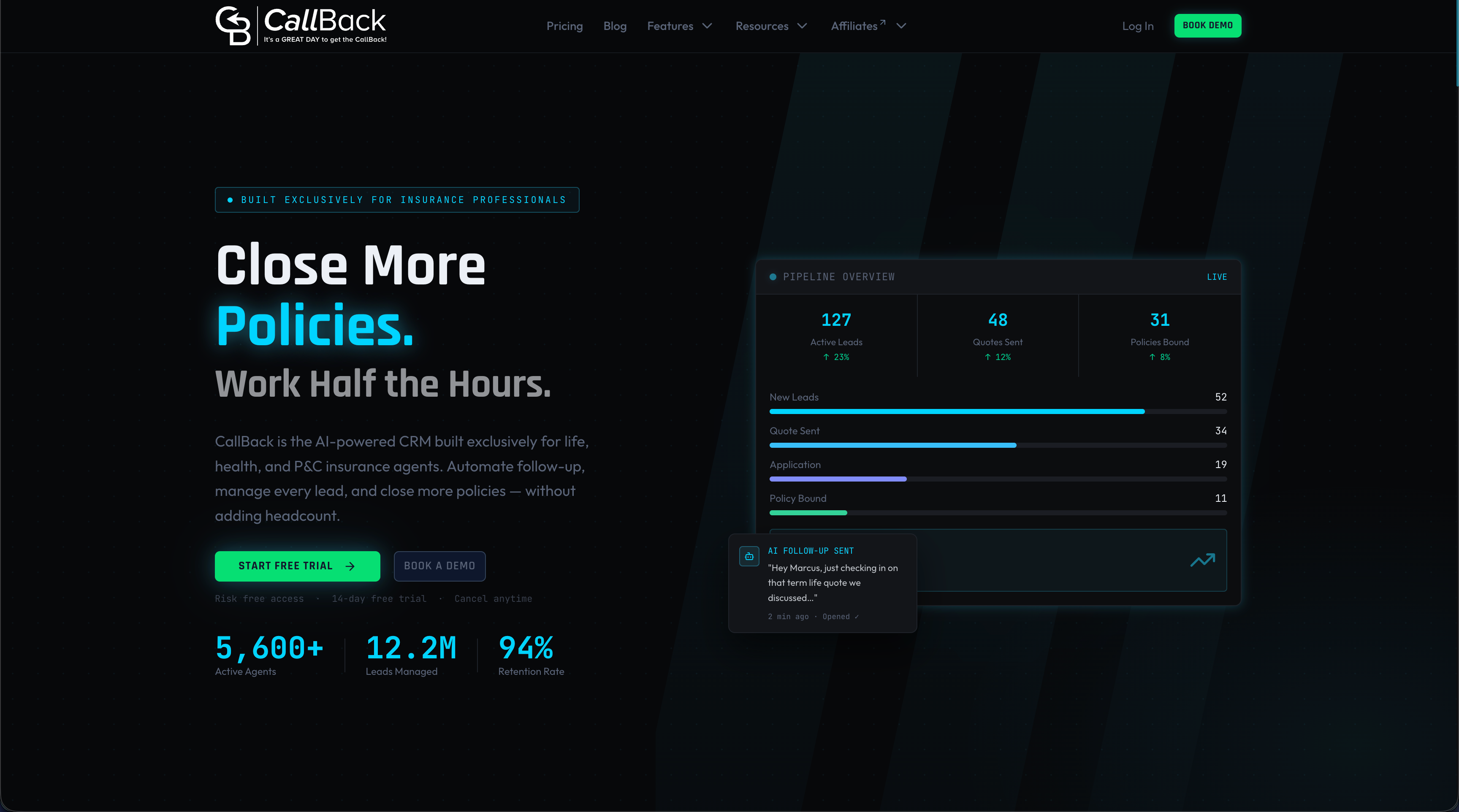
CallBack CRM brings all of these capabilities into a single platform built specifically for insurance agents and agencies. With AI tool features that handle lead scoring, CRM automation, funnel building, and proposal management, and SMS marketing tools that trigger personalized outreach within seconds of lead capture, you can run the exact workflows described in this article without stitching together five different platforms. Start your free trial today and discover how quickly your agency can move from manual follow-up to a fully automated, AI-powered lead engine.
Frequently asked questions
What is a live-transfer lead in insurance?
A live-transfer lead is a prospect connected directly to an agent by phone in real time, allowing for immediate qualification and conversation. These real-time engagement models carry the highest conversion rates but also the highest cost per lead.
How fast should I respond to new insurance leads?
Lead response should happen within seconds to minutes of submission. Delayed lead response is one of the most common reasons qualified leads go cold before an agent ever makes contact.
What is the difference between shared and exclusive insurance leads?
Shared leads are sold to multiple agencies simultaneously, while exclusive leads go to a single buyer. Conversion rates vary materially by lead type, with exclusive leads typically converting at a significantly higher rate than shared ones.
How does AI improve insurance lead scoring?
AI automates qualification by enriching lead data and applying scoring logic instantly after form submission. AI-powered lead qualification reduces manual handling and compresses response time from hours to seconds, improving both accuracy and conversion.
Can measuring offline sales improve my marketing ROI?
Yes, significantly. Connecting issued policy data back to your marketing campaigns lets your ad platforms optimize toward actual buyers rather than form fills, and offline conversion measurement consistently raises lead-to-sale efficiency across campaigns.