

TL;DR:
- Email drip campaigns are accessible and effective for all insurance agents to nurture leads automatically.
- Structuring campaigns with specific triggers, content segmentation, and measurement improves conversions.
- Maintaining compliance, regular review, and targeted timing enhances ROI and reduces unsubscriptions.
Most insurance agents assume that sophisticated email automation is reserved for large carriers with dedicated marketing teams. That assumption is costing you leads. An email drip campaign is one of the most practical tools available to any agent, regardless of agency size, and it works quietly in the background to nurture prospects while you focus on closing. Whether you are following up on a quote request or re-engaging a cold lead from six months ago, a well-structured drip sequence keeps your name in front of the right people at exactly the right moment. This guide breaks down how drip campaigns work, why they outperform manual follow-up, and how to build one that actually converts.
Table of Contents
- What is an email drip campaign?
- Key elements and how drip campaigns work
- Why drip campaigns excel in insurance lead nurturing
- Best practices and compliance tips for insurance email drip campaigns
- Our take: What most insurance agents miss with drip campaigns
- Ready to automate? Unlock smarter drip campaigns with CallBack CRM
- Frequently asked questions
Key Takeaways
| Point | Details |
|---|---|
| Automate lead nurture | Drip campaigns let you build relationships automatically and consistently with insurance leads. |
| Segment and comply | Deep segmentation and legal compliance are crucial for effective, trusted campaigns. |
| Focus on outcomes | Real value comes from policy conversions, renewals, and customer lifetime value—not just opens. |
| Start with proven templates | Begin with tested sequences and refine as you measure results tailored to your agency. |
What is an email drip campaign?
At its core, an email drip campaign is a series of automated emails sent to recipients over time, triggered by specific actions or schedules, designed to nurture leads and build relationships. The word “drip” refers to the steady, consistent pace of communication, not a flood of messages all at once, but a deliberate sequence that guides a prospect through a decision.
For insurance agents, this looks like a new auto insurance lead submitting a quote request on your website. Instead of hoping you remember to follow up on day three and again on day seven, a drip campaign does it automatically. The lead receives a welcome email immediately, an educational piece about coverage options two days later, a comparison guide on day five, and a soft call to action on day eight. You stay top of mind without lifting a finger after the initial setup.
Here is what makes drip campaigns different from other email marketing formats:
- Newsletters go to your whole list on a set schedule, regardless of where each person is in their journey
- Email blasts are one-time sends, usually promotional, with no follow-up logic built in
- Drip campaigns respond to behavior and timing, making them far more relevant to the individual
Common triggers that kick off a drip sequence in insurance include:
- A prospect requesting a quote online
- A renewal date approaching within 60 or 90 days
- A policy lapse or missed payment
- A new policyholder completing onboarding
- A lead downloading a resource like a coverage checklist
“The power of a drip campaign is not in the volume of emails. It is in the relevance. The right message at the right moment builds trust faster than any cold call.”
When you think about optimizing your lead funnel, drip campaigns are the connective tissue between initial interest and a signed policy. They fill the gaps that manual follow-up almost always misses, especially when you are juggling dozens of active prospects at once. Understanding drip campaign fundamentals is the first step toward making your outreach work harder for you.
Key elements and how drip campaigns work
Now that you understand what a drip campaign is, let us look at what actually makes one effective for insurance professionals. A campaign is only as good as its structure, and structure starts with four core components: triggers, schedule, content, and measurement.
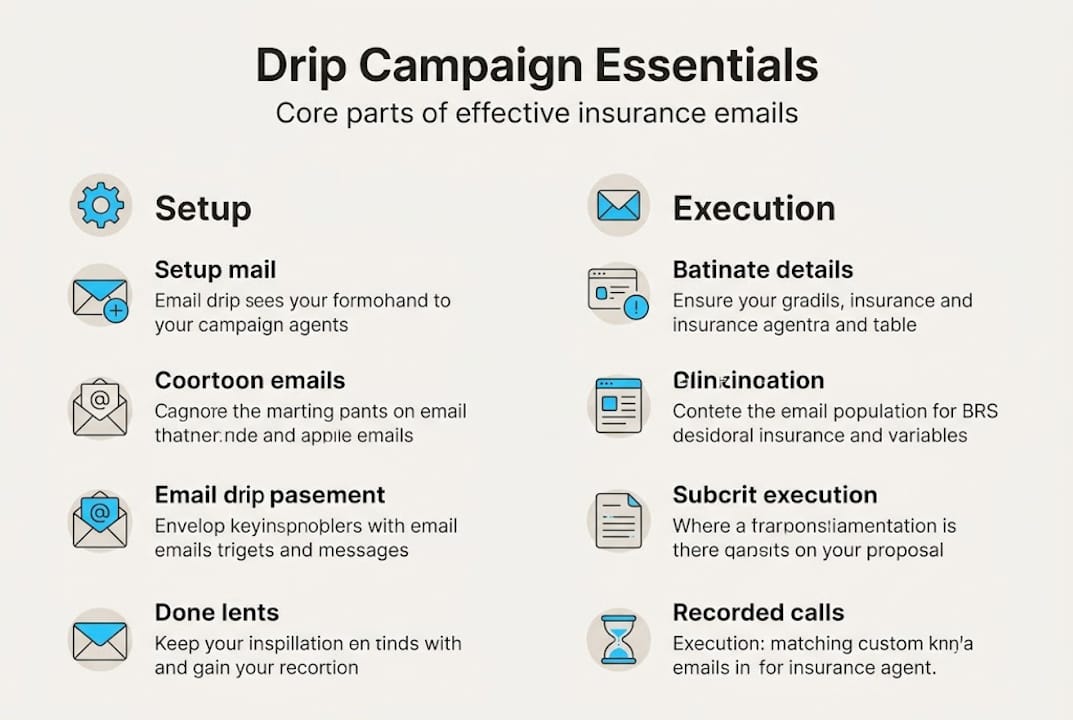
1. Triggers are the events that start a sequence. A quote request, a renewal reminder, a clicked link, or a form submission can all fire off a campaign automatically. The more specific your trigger, the more relevant your emails will feel.
2. Schedule refers to the timing and frequency of your emails. For most insurance leads, a sequence spaced every two to four days works well in the early stages, then slows to weekly or bi-weekly as the lead matures.
3. Content planning means segmenting your audience before you write a single word. A prospect shopping for life insurance needs different messaging than someone renewing their commercial auto policy. Segment by policy type, lead stage, and engagement level.
4. Measurement goes beyond vanity metrics. Yes, track open rates and click rates, but what you really want to watch is conversions. Did the lead schedule a call? Did they request a full quote? Did they buy?
Here is a simple framework for a five-email insurance drip sequence:
| Timing | Purpose | |
|---|---|---|
| Email 1 | Immediately | Welcome and set expectations |
| Email 2 | Day 3 | Educate on coverage options |
| Email 3 | Day 6 | Address common objections |
| Email 4 | Day 10 | Social proof or testimonial |
| Email 5 | Day 14 | Clear call to action |
For insurance email automation to work well, you also need to respect compliance boundaries. Aged leads require value-first re-education, not urgency-based messaging. Over-sending is one of the fastest ways to earn an unsubscribe. Aim for monthly or bi-monthly contact with older leads, and always monitor bounce rates, keeping them under 2%.
Pro Tip: For aged leads that have gone cold, lead with education rather than a sales push. A helpful article about policy gaps or a short video explaining coverage types will warm them up far more effectively than a discount offer.
When automating lead generation, the goal is not to replace human connection but to make sure no lead falls through the cracks while you are busy with active clients. The nuances of lead nurturing are what separate agents who scale from those who stay stuck.
Why drip campaigns excel in insurance lead nurturing
Manual follow-up is exhausting and inconsistent. Even the most disciplined agent misses callbacks, forgets to send that third follow-up email, or simply runs out of time. Drip campaigns remove the human error from the equation without removing the human touch from the message.

Consider the difference between three approaches:
| Approach | Consistency | Personalization | Scalability |
|---|---|---|---|
| Manual follow-up | Low | High | Very low |
| Email blast | High | Low | High |
| Drip campaign | High | Medium to high | High |
Drip campaigns win on two of the three dimensions and can be made more personal with smart segmentation. That combination is hard to beat.
For insurance specifically, lifecycle focus on quote abandonment and renewals yields the highest return on investment. Think about how many leads request a quote and never hear from you again after day one. A drip sequence that automatically follows up over two weeks can recover a significant portion of those lost opportunities.
Here is where drip campaigns fill common gaps in the insurance sales funnel:
- Quote follow-up: Leads who request a quote but do not buy often need two to five more touchpoints before they are ready to decide
- Post-sale cross-sell: A new auto policyholder is a warm prospect for home or life coverage. A drip sequence can introduce that conversation naturally over 30 to 60 days
- Renewal retention: Automated renewal reminders sent 90, 60, and 30 days out dramatically reduce policy lapses
- Re-engagement: Leads that went cold six months ago can be reactivated with a well-timed value-focused sequence
The ROI case is strong. When you factor in the cost of acquiring a new lead versus retaining an existing policyholder, even a small improvement in renewal rates has a major impact on lifetime value. A solid lead generation workflow that incorporates drip campaigns at every stage of the funnel gives you a compounding advantage over time. Review the insurance marketing results data and you will see that agents who automate lifecycle communications consistently outperform those who rely on manual outreach alone.
Best practices and compliance tips for insurance email drip campaigns
Turning strategy into results requires more than good intentions. Here are the practices that separate effective campaigns from wasted effort.
Legal requirements you cannot skip:
- Always use double opt-in to confirm subscriber consent before adding anyone to a drip sequence
- Include a clear and easy unsubscribe link in every email, no exceptions
- Use honest subject lines. Deceptive headers are a CAN-SPAM violation and a trust killer
- Keep your physical mailing address in the footer of every email
Segmentation that actually works:
Do not send the same sequence to a 28-year-old shopping for renters insurance and a 55-year-old reviewing their life insurance options. Segment by policy type, life stage, engagement history, and lead source. The more specific your segment, the more relevant your message, and the higher your conversion rate.
Staying out of spam folders:
- Avoid spam trigger words like “free,” “guaranteed,” and “act now” in subject lines
- Keep your email list clean by removing hard bounces immediately
- Send from a verified domain and warm up new sending addresses gradually
Performance monitoring beyond open rates:
Open rates tell you if your subject line worked. Click rates tell you if your content was interesting. But for insurance agents, what matters most is whether the lead scheduled a call, requested a quote, or bought a policy. Build your tracking around those outcomes.
Pro Tip: Always A/B test your subject lines and time of send. Even small improvements in open rate, say 3 to 5 percentage points, can translate to dozens of additional conversations per month at scale.
For lead generation best practices that go deeper, and to explore AI lead generation tools that can enhance your segmentation, the resources are already out there. Staying current on insurance compliance essentials is not optional. It is the foundation that keeps your campaigns running and your reputation intact.
Our take: What most insurance agents miss with drip campaigns
Here is the uncomfortable truth: most agents set up a drip campaign, watch the open rates climb, and call it a win. Open rates are not a win. A 40% open rate with zero policy conversions is a failure dressed up in a flattering metric.
The real opportunity in drip campaigns is not volume. It is timing and lifecycle relevance. A renewal reminder sent at 90 days out, followed by a value-focused check-in at 60 days, and a clear action step at 30 days will outperform a 12-email sequence sent to a cold list every single time. Context beats volume.
We also see agents over-automate. They build elaborate sequences and then let them run untouched for years. Markets shift, messaging ages, and what worked in 2024 may feel tone-deaf in 2026. A well-maintained sales automation workflow requires periodic review, not just setup.
Start small. Build one sequence for quote follow-up. Measure it. Iterate. Then add a renewal sequence. Then a cross-sell campaign. Agents who wait for the perfect 20-email system never launch. Agents who launch a five-email sequence and refine it every quarter build real, compounding results.
Ready to automate? Unlock smarter drip campaigns with CallBack CRM
Building an effective drip campaign does not have to mean starting from scratch with a blank screen.
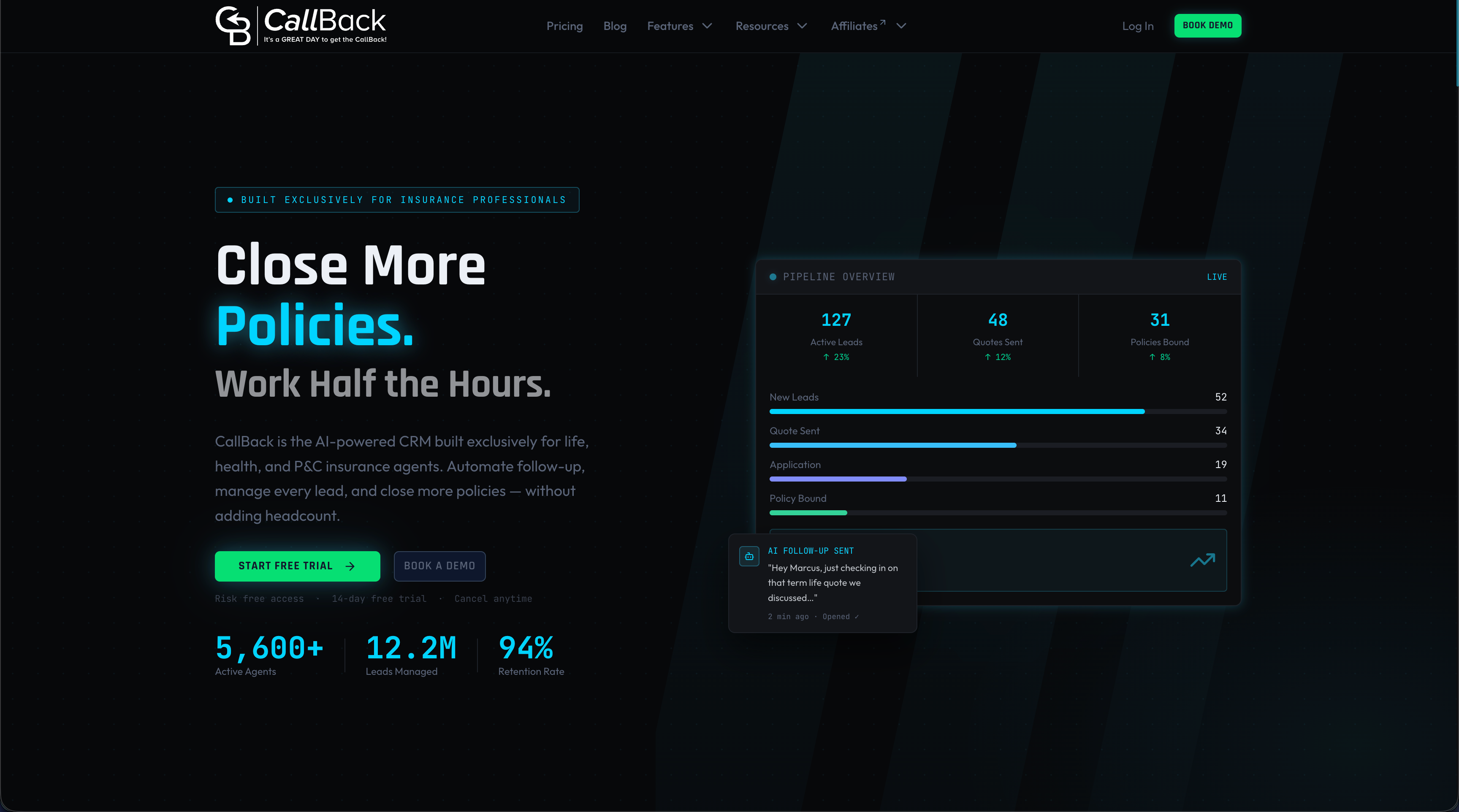
CallBack CRM gives insurance agents and agencies ready-to-use tools designed specifically for insurance lead nurturing. From pre-built email automation features to fully customizable automation solutions that trigger based on policyholder behavior, the platform handles the heavy lifting so you can focus on relationships. Not sure where to start? A free marketing audit will show you exactly where your current follow-up process is leaking leads and how automation can close those gaps fast. Your next policy could already be sitting in your CRM, waiting for the right email at the right moment.
Frequently asked questions
How many emails should be in a drip campaign for insurance leads?
Most effective insurance drip campaigns use 4 to 7 emails spaced over several weeks. This keeps engagement strong without overwhelming leads, especially since over-sending monthly or bi-monthly to aged leads tends to drive unsubscribes.
What triggers should I use to start an email drip campaign?
Common triggers include online quote requests, renewal reminders, abandoned applications, and new policyholder onboarding. These action-based triggers ensure your emails arrive when the lead is already thinking about coverage.
Are drip campaigns compliant with CAN-SPAM?
Yes, as long as you use double opt-in and clear unsubscribe options and avoid deceptive subject lines. Following these steps keeps your campaigns both legal and trustworthy.
What metrics matter most beyond open and click rates?
For insurance agents, the metrics that move the needle are policy conversions, renewal rates, and customer lifetime value. Track conversions and renewal lift rather than just opens and clicks to measure true campaign success.