

The insurance market has never been more competitive, and AI has fundamentally changed how agents find, qualify, and close new clients. Agencies that once relied on referrals and cold calls are now competing against tech-savvy operations running automated funnels, AI dialers, and predictive scoring models around the clock. Picking the wrong lead generation tool doesn’t just waste budget; it costs you pipeline momentum and client relationships. This guide breaks down the top tools available in 2026, using real conversion data and practical criteria so you can make a confident, informed choice.
Table of Contents
- How to choose the best lead generation tool
- Top AI-powered lead generation tools for insurance agents
- Comparing results: Conversion rates, costs, and ROI benchmarks
- Beyond acquisition: Maximizing lead nurture and workflow integration
- Real-world impact: Case studies and expert insights
- Our take: Avoiding common lead gen tool mistakes
- Try AI-powered automation with Callback CRM
- Frequently asked questions
Key Takeaways
| Point | Details |
|---|---|
| AI transforms lead gen | Artificial intelligence automates qualification, improves response time, and boosts conversion rates for insurance agents. |
| Quality over quantity | Exclusive, well-qualified leads with fast follow-up deliver better ROI than higher lead volume alone. |
| Workflow integration crucial | Using lead gen tools that sync with your CRM and automations streamlines nurture, compliance, and closing. |
| Benchmarks matter | Know your conversion rates, costs per lead, and speed-to-lead benchmarks to select and optimize the right tool. |
How to choose the best lead generation tool
To select the right solution, you first need a clear set of criteria. Not every tool is built for insurance, and the ones that are vary widely in quality, compliance, and ROI. Before you sign up for anything, evaluate each platform against these core factors:
- Automation depth: Can the tool automatically qualify, route, and follow up with leads without manual input?
- Lead quality signals: Does it provide verified contact data, intent scores, or behavioral triggers?
- CRM integration: Will it sync cleanly with your existing agency management system or CRM?
- Regulatory compliance: Does it support TCPA requirements, including consent documentation and opt-out management?
- Speed-to-lead capability: Can it trigger outreach within seconds of a lead entering the system?
- Transparent ROI data: Does the vendor share real conversion benchmarks, not just vanity metrics?
AI and automation are now integral to effective insurance lead generation, and any tool that doesn’t leverage both will fall behind fast. AI handles the heavy lifting of sorting high-intent prospects from tire-kickers, which means your producers spend time on conversations that actually convert.
Compliance is non-negotiable. TCPA violations can cost agencies thousands per incident, so any tool you use must document consent and support compliant outreach workflows. Pair this with lead generation tips using AI to build a process that scales without legal exposure.
Pro Tip: Always ask vendors for verified conversion rate data from agencies in your specific insurance line. Auto, life, and health leads behave very differently, and a tool optimized for one may underperform in another.
Finally, understand the types of lead generation available to you, from paid search and social ads to live transfers and content-driven inbound. The best tool for your agency depends on which channels your ideal clients actually use.
Top AI-powered lead generation tools for insurance agents
With these criteria in mind, let’s examine best-in-class tools trusted by insurance pros.
SalesTank is purpose-built for insurance agencies. SalesTank delivers AI/ML-powered automated, high-quality insurance leads tailored for agencies, using machine learning to match lead profiles to the right carriers and agents. The platform’s automation layer handles distribution, so leads reach the right producer instantly rather than sitting in a queue.
AgentAi takes a real-time qualification approach. AgentAi uses AI to qualify exclusive insurance leads as they come in, and agencies using the platform have reported $300K or more in new business within 90 days. That kind of result comes from combining fast qualification with exclusive lead delivery, meaning you’re not competing with five other agents on the same prospect.
LeadCapture.io focuses on compliance and verification. LeadCapture.io ensures TCPA compliance with real-time verification and TrustedForm certificates, which creates a documented consent trail for every lead. For agencies worried about regulatory exposure, this is a critical differentiator.
“The agencies winning in 2026 aren’t just buying more leads. They’re buying better leads and responding faster. AI makes both possible at scale.”
Key features to look for across these platforms:
- Real-time lead qualification and scoring
- Exclusive vs. shared lead options with transparent pricing
- Automated compliance documentation
- Native or API-based CRM integration
- Campaign speed controls and drip sequencing
Pro Tip: Test any new lead source with a small budget over 30 days before scaling. Track contact rate, conversation rate, and issued policy rate separately so you know exactly where leads are dropping off.
When you generate leads with AI, the goal isn’t just volume. It’s matching the right prospect to the right agent at the right moment. Understanding AI in lead generation helps you ask better questions when evaluating any vendor’s claims.
Comparing results: Conversion rates, costs, and ROI benchmarks
To make these choices concrete, it helps to look at the numbers for each tool and method.
| Lead type | Avg. cost per lead | Conversion rate | Best use case |
|---|---|---|---|
| Exclusive auto leads | $40 to $100 | 6 to 9% | High-volume auto agencies |
| Shared auto leads | $15 to $35 | 2 to 4% | Budget-conscious testing |
| Live transfers | $80 to $150 | 15 to 25% | High-close-rate producers |
| Inbound content leads | $10 to $40 | 5 to 12% | Long-term brand builders |
Exclusive auto insurance leads cost $40 to $100 and convert at 6 to 9%, while shared leads cost $15 to $35 and convert at a noticeably lower rate. The math often favors exclusive leads when you factor in producer time and follow-up costs.
Live transfers can deliver 15 to 25% conversion, and speed-to-lead increases conversion by up to 391%. That second stat is the one most agencies underestimate. A lead that waits 30 minutes for a callback is already cold.
Key ROI insights by insurance line:
- Auto insurance: High competition, but AI dialers and fast routing can offset the noise
- Life insurance: Longer sales cycles reward nurture automation over speed alone
- Health insurance: Compliance complexity makes verified, consent-documented leads worth the premium
Using predictive lead generation models, agencies can identify which prospects are most likely to convert before spending a dollar on outreach. This shifts your budget from spray-and-pray to targeted investment with measurable returns.
Beyond acquisition: Maximizing lead nurture and workflow integration
Generating leads is just the first step. Managing and converting them requires the right workflow.
The agencies with the highest close rates aren’t necessarily buying the most leads. They’re running tighter follow-up sequences, integrating their lead sources directly into their CRM, and using automation to handle the repetitive touchpoints that producers hate doing manually.

AgentFront’s predictive AI scoring and campaign management boosts close rates by 35% and cuts response times by 70%. That’s not a marginal improvement. It’s the difference between an agency that struggles to hit quota and one that consistently exceeds it.
EZLynx and Applied Epic combine agency management, AI, and quoting to streamline operations for independent agencies, connecting the lead pipeline directly to the quoting and policy issuance workflow.
Effective nurture workflows should include:
- Multi-touch sequences: Email, SMS, and voicemail drops triggered by lead behavior
- Lead scoring updates: Scores that adjust based on opens, clicks, and page visits
- Automated re-engagement: Campaigns that activate when a lead goes cold after a set number of days
- CRM sync: Every interaction logged automatically, no manual data entry required
Pro Tip: Set up a 90-day nurture sequence for every lead that doesn’t convert in the first two weeks. Life insurance leads in particular often need multiple touchpoints before a prospect is ready to talk.
When you automate lead generation workflows, you free up producer time for the conversations that actually require a human. Combine this with lead generation tips and insurance marketing AI tips to build a system that compounds over time.
Real-world impact: Case studies and expert insights
What do these tools accomplish when put to the test? Recent results demonstrate their impact.
The numbers from agencies that have adopted AI-powered lead generation are hard to ignore:
- Generali achieved 3x leads, while Conversely AI reduced cost per acquisition by 22%, and Salesforce-powered agencies saw 28% revenue growth after integrating AI into their sales workflows
- Agencies using live transfer leads with AI-assisted routing report contact rates above 85%, compared to 30 to 40% for traditional internet leads
- Response time automation alone, triggering an SMS within 60 seconds of a lead form submission, can double the number of conversations an agency has per week
The pattern across these results is consistent. Speed, qualification accuracy, and workflow integration are the three variables that separate high-performing agencies from average ones. Technology amplifies whatever process you already have, so if your follow-up is weak, no tool will fix it.
“Agencies that combine AI lead scoring with automated multi-touch outreach consistently outperform those relying on manual processes, regardless of lead source.”
Understanding why lead generation is vital in 2026 goes beyond just filling a pipeline. It’s about building a predictable, scalable system that doesn’t depend on any single producer’s hustle.
Our take: Avoiding common lead gen tool mistakes
Here’s the uncomfortable truth most vendors won’t tell you: the tool is rarely the problem. The process is.
We’ve seen agencies invest in top-tier AI lead platforms and still miss their numbers because they didn’t fix their follow-up cadence first. They assumed the technology would compensate for a weak workflow. It never does. The tool surfaces the opportunity; your team has to close it.
Another common mistake is ignoring integration requirements until after purchase. A lead gen tool that doesn’t connect cleanly to your CRM creates data silos, manual re-entry, and compliance gaps. Ask for a technical integration checklist before you sign anything.
Agencies also tend to overvalue novelty. The newest AI feature isn’t always the most useful one. Focus on tools that solve a specific, documented problem in your current pipeline, not ones that promise to revolutionize everything at once.
The smartest approach is to start with your conversion data, identify the single biggest drop-off point, and choose a tool that directly addresses it. Explore AI marketing tools for insurance with that specific problem in mind, and you’ll make a far better decision than chasing the most-hyped platform.
Try AI-powered automation with Callback CRM
Ready for a practical solution? Here’s how Callback CRM helps you put these principles into action.
Callback CRM brings together lead capture, CRM management, automated nurture, and compliance tools in one platform built specifically for insurance agents and agencies. You don’t need five separate subscriptions to run a modern lead generation operation.
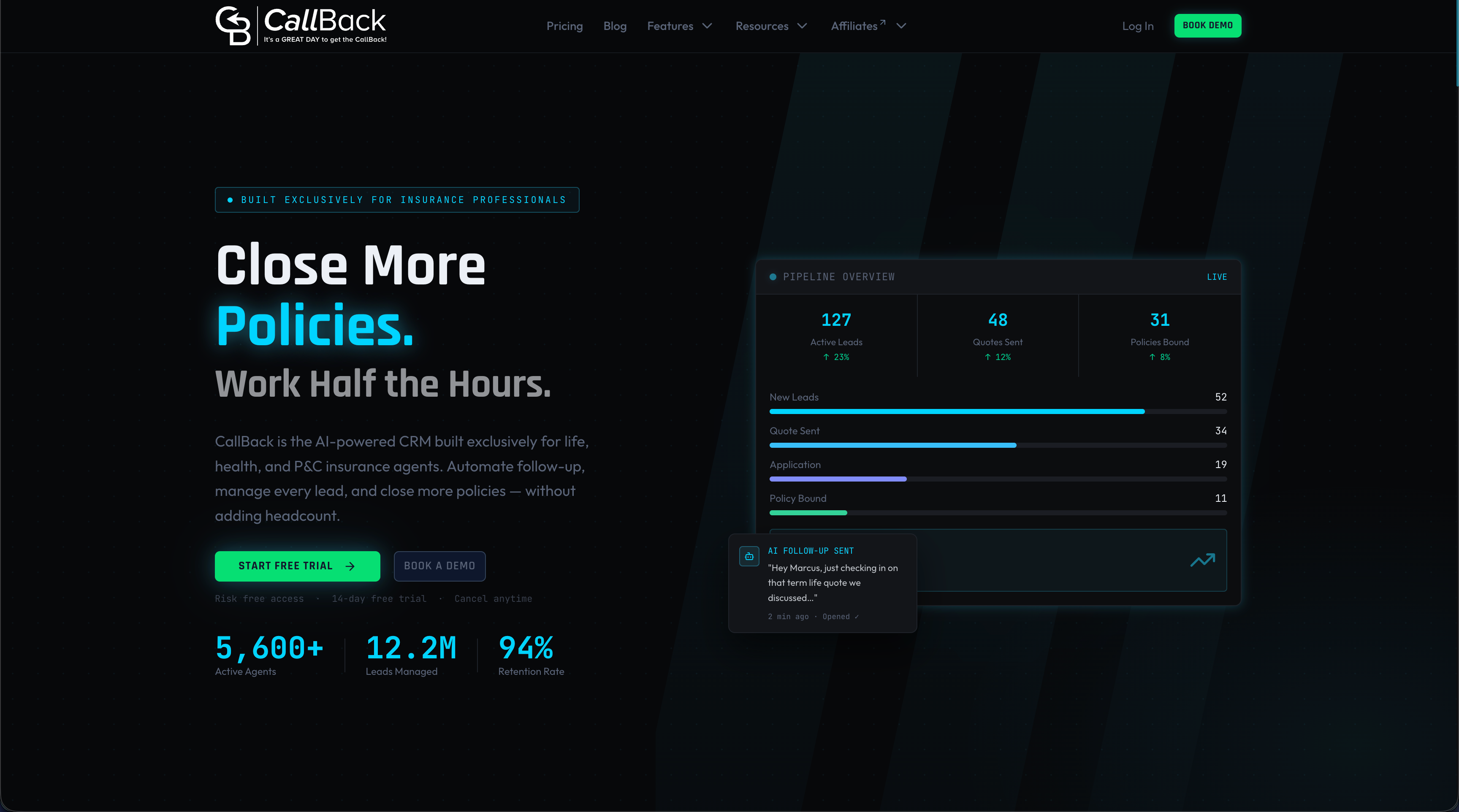
Explore the full range of AI tool features designed for insurance workflows, from predictive scoring to multi-channel outreach. Use automate agency tasks to eliminate manual follow-up and keep every lead moving through your pipeline. Add SMS marketing for insurance to trigger instant, compliant text outreach the moment a new lead comes in. Book a demo and see how agencies are closing more business with less manual effort.
Frequently asked questions
What is the average lead-to-sale conversion rate for insurance leads?
Exclusive insurance leads convert between 6 and 9%, while live transfers can reach 15 to 25% depending on the insurance line and how quickly agents respond.
Why is speed-to-lead so important for insurance agents?
Contacting a lead within one minute can boost your conversion rate by nearly 400%, because speed-to-lead increases conversion by up to 391% compared to slower follow-up responses.
How does AI improve insurance lead generation?
AI enhances lead gen by automating qualification, distribution, scoring, and compliance documentation, which means faster responses and higher-quality conversations for your producers.
What should insurance agencies look for in a lead gen tool?
Prioritize automation, CRM integration, regulatory compliance, and verified performance data. LeadCapture.io offers TCPA compliance and real-time verification as a strong example of what compliance-first lead capture looks like in practice.