

Many insurance agents dismiss email marketing as outdated or ineffective, believing social media and paid ads deliver better results. This misconception costs agencies thousands in missed opportunities. Email marketing remains one of the highest ROI channels for insurance professionals, driving consistent client engagement and converting leads at rates that surpass most digital platforms. This guide reveals why email marketing is essential for insurance agents and how automation tools transform campaigns into powerful revenue engines. You’ll discover proven strategies to boost open rates, nurture prospects efficiently, and turn subscribers into loyal policyholders.
Table of Contents
- Key takeaways
- Understanding the impact of email marketing for insurance agents
- How automation transforms email marketing effectiveness
- Comparing email marketing ROI with other digital channels for insurance agents
- Practical steps to optimize your insurance email marketing strategy
- Enhance your email marketing with CallBack CRM
- Frequently asked questions
Key Takeaways
| Point | Details |
|---|---|
| Direct channel control | Email provides a direct, controllable channel to prospects that is not subject to platform algorithms. |
| Cost effective outreach | Email campaigns reach thousands of prospects for pennies per contact, making it a cost efficient option for agencies of all sizes. |
| Personalization drives trust | Segmenting by coverage type, life stage, or previous interactions allows relevant offers that build trust and improve engagement. |
| Automation accelerates conversions | Automation can cut lead conversion time by 47 percent by delivering timely follow ups and tailored content. |
Understanding the impact of email marketing for insurance agents
Email marketing creates a direct communication channel that insurance agents control completely. Unlike social media platforms where algorithms determine who sees your content, email lands directly in your prospect’s inbox. This direct access builds relationships through consistent, valuable touchdowns that keep your agency top of mind when clients need coverage.
The cost effectiveness of email marketing makes it particularly attractive for insurance agencies of all sizes. You can reach thousands of prospects for pennies per contact, while paid advertising costs continue climbing. Email campaigns let you educate prospects about complex insurance products at their own pace, providing detailed information that builds confidence in your expertise.
Personalized messaging transforms generic outreach into meaningful conversations. When you segment your email list by coverage type, life stage, or previous interactions, you send relevant offers that resonate. A young family receives information about life insurance and college savings plans, while retirees get Medicare supplement comparisons. This targeted approach builds the trust essential for insurance sales.
Automation can cut lead conversion time by 47%, dramatically boosting your agency’s efficiency. Automated workflows ensure every prospect receives timely follow-up without overwhelming your team. Insurance agents using strategic email marketing report measurable improvements in both engagement metrics and closed policies.
The compound effect of consistent email communication cannot be overstated. Each valuable email strengthens your relationship with subscribers, positioning your agency as a trusted advisor rather than just another salesperson. When life changes trigger insurance needs, your subscribers think of you first because you’ve maintained regular, helpful contact.
Pro Tip: Track which email topics generate the highest engagement rates, then create more content around those themes. If policy comparison guides get twice the clicks of general newsletters, shift your content strategy accordingly.
How automation transforms email marketing effectiveness
Marketing automation refers to software platforms that execute email campaigns based on predetermined triggers and schedules. For insurance agents, this means prospects receive perfectly timed messages based on their actions, without manual intervention. When someone downloads your auto insurance guide, automation immediately sends a welcome series explaining coverage options and inviting them to get a quote.
Automated workflows nurture leads through the entire sales journey systematically. Here’s how the process works in practice:
- A prospect submits their email to access your free insurance checklist
- They immediately receive the checklist plus a welcome email introducing your agency
- Three days later, automation sends educational content about common coverage gaps
- After another week, they receive a case study showing how you helped a similar client
- The system tracks engagement and alerts your team when the prospect shows high interest
- Your agent reaches out personally at the optimal moment with a tailored offer
This systematic approach ensures no lead falls through the cracks. Every prospect receives consistent nurturing regardless of how busy your agency gets. The benefits multiply quickly: consistent follow-up increases conversion rates, personalized touches build rapport, time savings let agents focus on closing ready prospects, and data insights reveal which messages drive results.
Automation boosts insurance lead conversions by 35-40% by streamlining communication workflows. These improvements stem from perfect timing and relevance. Automated systems send messages when prospects are most receptive, using behavioral triggers that manual processes cannot match.
Pro Tip: Segment your email list by insurance type interest (auto, home, life, health) and create separate automation workflows for each. A prospect interested in homeowners insurance receives different nurturing content than someone researching life insurance, dramatically improving relevance and response rates.
The email automation capabilities available today let even small agencies compete with large carriers. You can set up sophisticated drip campaigns once, then let automation handle delivery while you focus on personal consultations. The technology handles repetitive tasks while you provide the human expertise that closes deals.

Advanced email marketing automation solutions integrate with your CRM, ensuring every interaction updates the prospect’s profile. This creates a complete picture of each lead’s journey, informing better conversations when you connect personally.
Comparing email marketing ROI with other digital channels for insurance agents
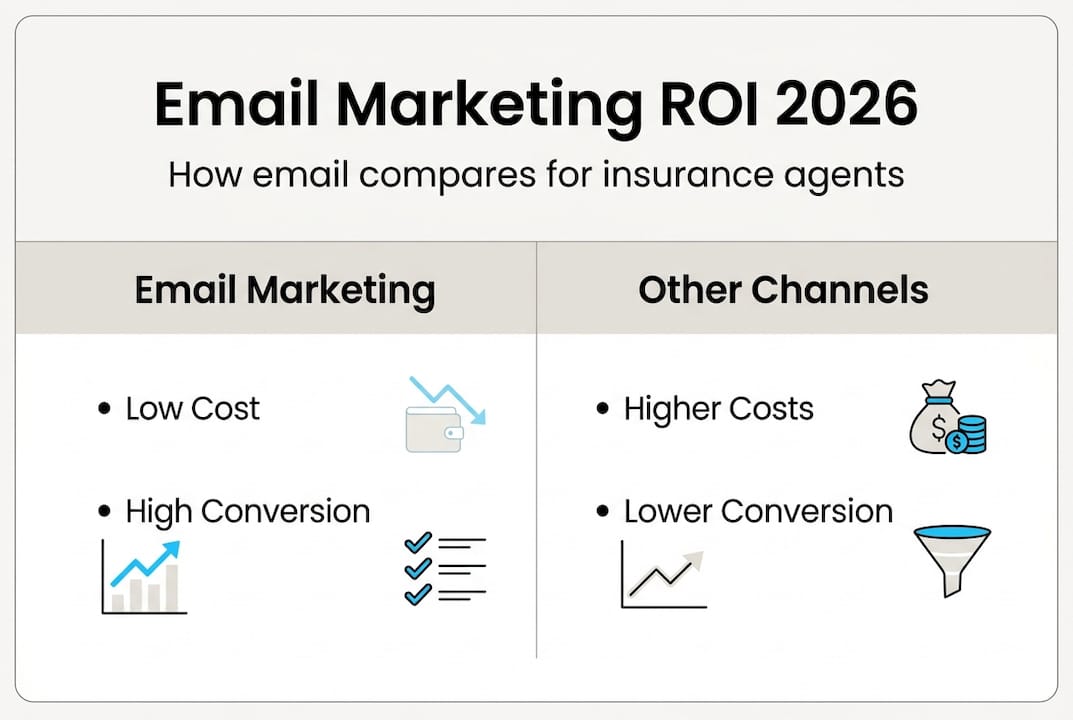
Email marketing consistently outperforms other digital channels in both cost efficiency and conversion rates for insurance agents. While social media builds brand awareness and paid ads drive traffic, email converts prospects into policyholders more reliably. The numbers tell a compelling story about where insurance agencies should allocate marketing budgets.
| Channel | Average Cost Per Lead | Typical Conversion Rate | ROI Multiple |
|---|---|---|---|
| Email Marketing | $8-15 | 3.2-4.8% | 42:1 |
| Social Media Ads | $25-45 | 1.1-2.3% | 18:1 |
| Google Paid Search | $35-65 | 2.5-3.9% | 22:1 |
| SMS Marketing | $12-22 | 2.8-4.1% | 28:1 |
Email marketing generates higher ROI and engagement compared to many other marketing platforms. The personal and direct nature of email suits insurance sales particularly well. Insurance purchases require trust and education, both of which email delivers effectively through detailed content prospects can review at their convenience.
Social media excels at building brand awareness but struggles with conversion. Your posts compete with countless distractions, and platform algorithms limit organic reach. Paid social ads can drive traffic, but the cost per qualified lead typically runs two to three times higher than email marketing.
Paid search advertising captures high-intent prospects actively searching for insurance, making it valuable for immediate lead generation. However, the competitive bidding environment drives costs up, and you’re constantly paying for visibility. Email marketing costs remain stable once you build your list, providing predictable economics.
SMS marketing offers impressive open rates but limited space for education. Text messages work well for appointment reminders and time-sensitive offers, but cannot replace email’s capacity for detailed policy explanations and comparison tools.
Pro Tip: Integrate email marketing with AI tools that analyze campaign performance to identify your highest-value prospects. AI can predict which subscribers are most likely to convert based on engagement patterns, letting you prioritize outreach effectively.
The combination of low cost, high conversion rates, and complete control makes email marketing the foundation of successful insurance marketing strategies. Other channels complement email but rarely replace its efficiency and effectiveness.
Practical steps to optimize your insurance email marketing strategy
Implementing an effective email marketing strategy requires systematic planning and execution. Insurance agents who follow proven frameworks consistently outperform those using ad-hoc approaches. Start by building a solid foundation, then layer in optimization tactics that compound results over time.
Segmenting your email list transforms generic broadcasts into targeted conversations. Create segments based on:
- Insurance type interest (auto, home, life, health, business)
- Life stage (young professionals, families, retirees)
- Current customer status (prospect, policyholder, lapsed client)
- Engagement level (highly engaged, moderately active, dormant)
- Geographic location for state-specific regulations and offerings
Automated drip campaigns educate and nurture prospects systematically. Design a welcome series that introduces your agency, establishes expertise, and builds trust before making sales offers. Follow with educational sequences that address common insurance questions and concerns. Each email should provide genuine value while subtly moving prospects toward a consultation.
Compelling subject lines determine whether prospects open your emails. Test different approaches: questions that spark curiosity, benefit-focused statements, personalization with the recipient’s name or location, and urgency when appropriate (but avoid overuse). Keep subject lines under 50 characters for mobile optimization.
Calls to action must be clear and specific. Instead of generic “Learn More” buttons, use action-oriented language like “Get Your Free Quote,” “Download the Coverage Comparison Guide,” or “Schedule Your Policy Review.” Place CTAs prominently and repeat them for longer emails.
AI marketing tools significantly boost performance by analyzing campaign data and suggesting optimizations. AI identifies which subject lines generate opens, which content drives clicks, and which offers convert prospects. This intelligence informs smarter decisions about future campaigns.
Follow this checklist to set up and measure campaigns efficiently:
- Define your campaign goal (lead generation, policy renewal, cross-sell, education)
- Identify the target segment and craft messaging that addresses their specific needs
- Create valuable content that educates first and sells second
- Design mobile-responsive email templates with clear CTAs
- Set up automation triggers and workflow sequences
- Establish tracking for opens, clicks, conversions, and revenue
- Launch the campaign and monitor initial performance
- Analyze results after sufficient data collection (typically 2-3 weeks)
- Implement improvements based on performance data
- Document successful approaches for future campaigns
The comprehensive email automation guide provides detailed instructions for implementing these strategies. Insurance agents who systematically apply these principles report dramatic improvements in engagement and conversion rates.
Optimizing your lead funnel through strategic email sequences accelerates the journey from prospect to policyholder. Each touchpoint should advance the relationship while providing genuine value that justifies the prospect’s continued attention.
Enhance your email marketing with CallBack CRM
Transforming your email marketing from basic broadcasts to sophisticated automation requires the right platform. CallBack CRM provides insurance agents with comprehensive tools designed specifically for your industry’s unique needs. The platform combines powerful email automation capabilities with intelligent lead management and AI-powered optimization.
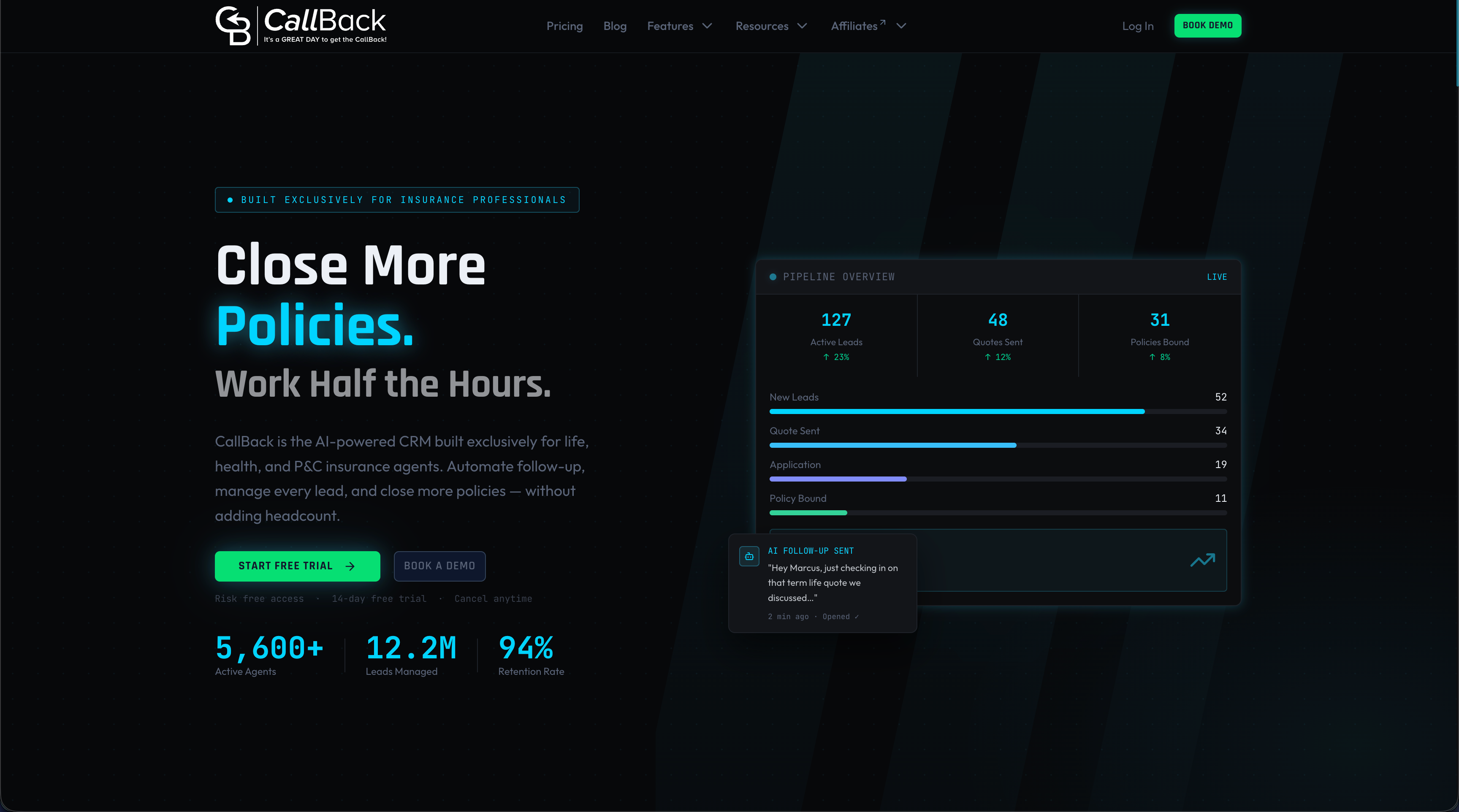
The integrated CRM system tracks every prospect interaction, ensuring your email campaigns leverage complete customer data for maximum personalization. Automated workflows nurture leads systematically while AI tools identify your highest-value prospects and optimal outreach timing. Insurance agents using CallBack CRM report significant improvements in conversion rates and time savings.
Explore the complete suite of AI-powered features designed to modernize your insurance marketing and sales operations. From email automation to lead scoring, funnel builders to reputation management, CallBack CRM provides everything you need to compete effectively in today’s digital landscape.
Frequently asked questions
What is the best frequency for insurance email marketing?
Send one to two emails per week for optimal engagement without overwhelming subscribers. Monitor your unsubscribe rates and engagement metrics to find the sweet spot for your specific audience. Some segments may appreciate more frequent educational content, while others prefer monthly check-ins. Test different frequencies and let data guide your strategy rather than arbitrary schedules.
How can insurance agents measure the success of email marketing campaigns?
Track open rates to gauge subject line effectiveness, click-through rates to measure content relevance, conversion rates to assess offer appeal, and revenue generated to calculate true ROI. Advanced CRM analytics platforms provide comprehensive reporting that connects email engagement to closed policies. Set benchmarks based on industry standards, then work to exceed them consistently through testing and optimization.
What role does personalization play in insurance email marketing?
Personalization increases open rates by 26% and dramatically improves response rates by sending relevant, timely offers tailored to individual needs. Use subscriber data like coverage interests, life stage, previous interactions, and behavioral triggers to customize messages. Simple personalization includes using the recipient’s name and location, while advanced approaches deliver dynamic content blocks that change based on subscriber characteristics. The more relevant your emails, the stronger your relationships become.
Are automation tools necessary for small insurance agencies?
Automation saves significant time and enables consistent follow-up that small teams cannot maintain manually. Even a two-person agency can nurture hundreds of leads simultaneously through automated workflows, competing effectively against larger competitors. The efficiency gains let you focus on high-value activities like personal consultations and policy customization. Automation levels the playing field, making sophisticated marketing accessible regardless of agency size.