

TL;DR:
- Insurance agents need connected digital tools to effectively generate leads, manage clients, and stay compliant. Integrating CRM, automation, analytics, and compliance platforms into one ecosystem improves performance and reduces risks. Callbackcrm offers a unified platform tailored for insurance professionals to streamline operations and boost conversions.
Independent Marketing Organization (IMO) marketing support tools are defined as integrated digital platforms and services that insurance professionals use to manage leads, automate outreach, maintain compliance, and measure campaign performance. The types of IMO marketing support tools available today span CRM systems, lead generation programs, marketing automation platforms, compliance management tools, and analytics dashboards. Each category serves a distinct function, yet the most effective IMO support solutions connect all five into one unified ecosystem. Insurance agents who treat these tools as separate purchases consistently underperform compared to those who build a connected stack from the start.
1. What are the types of IMO marketing support tools?
IMO marketing support tools fall into five core categories: CRM and client management, lead generation and done-for-you marketing, marketing automation, compliance and regulatory support, and analytics and performance measurement. Effective marketing tools from a quality IMO cover all five. Agents who pick tools from only one or two categories create gaps that cost them leads and create compliance risk. The sections below break down each category in depth.
2. CRM tools for client management and compliance
CRM systems are the foundation of every productive insurance marketing operation. They centralize client data, track every interaction, and trigger automated follow-ups so no prospect falls through the cracks. When an IMO provides or recommends a CRM, it typically configures the system to match insurance workflows, including policy renewal reminders, beneficiary updates, and annual review scheduling.

Compliance is where a well-configured CRM separates itself from a generic contact database. Integrated CRM and IMO tools create scalable, compliant workflows tailored for independent financial professionals. That means audit trails are generated automatically, client consents are stored securely, and regulatory deadlines trigger alerts before they become violations.
Key CRM features insurance agents should require from their IMO platform:
- Automated audit trail creation for every client interaction
- Secure document storage for disclosures, consents, and signed applications
- Policy renewal and compliance deadline reminders
- Integration with IMO quoting and contracting systems
- Lead status tracking from first contact through policy issuance
Pro Tip: Before committing to any CRM, confirm it connects directly to your IMO’s contracting portal. A CRM that requires manual data entry between systems doubles your administrative workload and introduces errors.
3. Lead generation and done-for-you marketing programs
Lead generation is the area where IMOs deliver the most immediate, measurable value. Top IMOs provide vetted lead lists, co-op marketing funds, pre-built landing pages, and email and SMS templates that agents can deploy within days of onboarding. This “done-for-you” model removes the guesswork of building campaigns from scratch.
The results are concrete. Proven IMO marketing funnels yield conversion rates of 15% or higher. That benchmark matters because the average self-built insurance landing page rarely clears 5%. The difference comes from tested copy, compliant disclosures, and pre-warmed audiences that IMOs have refined over years of campaign data.
Done-for-you programs typically include:
- Pre-built landing pages optimized for Medicare, life, and annuity products
- Email drip sequences with compliant language already approved for use
- SMS outreach templates for appointment setting and policy reviews
- Social media content calendars with product-specific messaging
- Co-op advertising funds that offset paid media costs
Insurance agents gain measurable lifts in lead conversion and operational efficiency when they use IMO marketing programs alongside automation. The key is not just using the templates but connecting them to a CRM so every lead is tracked and nurtured automatically.
4. Marketing automation platforms for scaling outreach
Marketing automation is the engine that turns a good lead generation program into a repeatable, scalable system. Modern automation platforms orchestrate multi-channel campaigns, personalize outreach, and automate repetitive marketing tasks across email, SMS, and digital advertising simultaneously.
For insurance agents, the practical benefit is time. An automation platform sends a welcome email the moment a prospect fills out a landing page form, schedules a follow-up SMS 48 hours later, and flags the lead for a personal call if no response comes after day five. All of that happens without the agent touching a keyboard.
Features to prioritize in an IMO-provided automation platform:
- Audience segmentation by product interest, age, geography, and policy status
- Triggered communications based on prospect behavior, such as page visits or email opens
- Multi-channel campaign management covering email, SMS, and social media
- Journey management that moves prospects through defined stages automatically
- API integrations with CRM and compliance monitoring tools
Pro Tip: Choose an automation platform with open API access. Closed systems force you to rebuild workflows every time your IMO updates its contracting or quoting tools.
Marketing automation benefits for insurance agencies go beyond saving time. Segmented, triggered communications consistently outperform broadcast emails because they reach the right prospect with the right message at the right moment. A step-by-step automation checklist helps agencies implement these workflows without missing critical compliance steps.
5. Compliance and regulatory support tools
Compliance tools are the category most agents undervalue until they face an audit. IMOs provide compliance workflows, reminders, and documentation storage that transform regulatory adherence from a manual burden into an integrated business process. That shift matters because state insurance departments and federal regulators expect documented evidence of compliant marketing practices.
Automated compliance tools inside an IMO platform typically handle:
- Workflow reminders for license renewal, continuing education, and product certification deadlines
- Secure digital storage of client-signed disclosures and scope-of-appointment forms
- Pre-approved marketing material libraries that eliminate unapproved content risk
- Automated audit trail generation tied to every client communication
- Compliance review queues that flag outgoing campaigns before they launch
The operational payoff is significant. Agents who rely on manual spreadsheets and paper files spend hours each week on compliance tasks that an integrated platform handles in seconds. That time goes back into client-facing activity, which is where revenue is actually generated.
6. Analytics and performance measurement tools
Analytics tools answer the question every insurance agent eventually asks: “Which of my marketing activities is actually producing policies?” Without a unified measurement system, the answer requires hours of manual data pulling from disconnected platforms.
Performance marketing teams managing complex insurance campaigns typically use 10–20 integrated marketing tools. That scale creates a data reconciliation problem. Every platform produces its own report, and the numbers rarely agree. A unified analytics layer solves this by pulling data from all sources into one dashboard.
The industry standard for unifying customer data is the Customer Data Platform, or CDP. CDPs ingest data from all sources to build persistent customer profiles, enabling personalized marketing across every channel. For insurance agents, a CDP means knowing that a prospect visited your Medicare supplement page three times, opened two emails, and clicked an SMS link before ever speaking to an agent.
Prioritizing interoperability reduces operational overhead and the manual reconciliation of data across marketing tools. The table below shows the feature categories that distinguish entry-level reporting tools from full analytics platforms.
| Feature category | Entry-level reporting | Full analytics platform |
|---|---|---|
| Data sources | Single channel | Multi-channel, unified |
| Lead attribution | Last-click only | Multi-touch attribution |
| Dashboard customization | Pre-built templates | Custom KPI dashboards |
| CDP integration | Not included | Native or API-connected |
| Campaign ROI reporting | Manual export | Automated, real-time |
Data-driven insurance marketing depends on having this kind of unified view. Agents who rely on single-channel reports consistently misattribute their best leads and cut the campaigns that are actually working.
Key takeaways
The most effective IMO marketing support ecosystem combines CRM, lead generation, automation, compliance, and analytics into one connected platform rather than five separate tools.
| Point | Details |
|---|---|
| CRM is the foundation | Centralize client data and automate compliance workflows before adding any other tool. |
| Done-for-you programs convert | IMO-provided funnels reach 15%+ conversion rates, far above self-built alternatives. |
| Automation scales outreach | Triggered, segmented campaigns outperform broadcast messages across every channel. |
| Compliance tools reduce risk | Automated audit trails and document storage replace manual processes that create audit exposure. |
| Analytics require integration | Unified dashboards eliminate data reconciliation and reveal which campaigns actually produce policies. |
What I’ve learned about picking IMO tools that actually work
Most agents approach IMO tool selection the wrong way. They evaluate each tool in isolation, asking “Does this CRM have good reviews?” instead of “Does this CRM connect to my IMO’s contracting system and my automation platform without manual exports?”
The integrated IMO platform model is not a luxury. Top-producing agencies avoid tool-stack bloat by using centralized ecosystems that combine lead routing, quoting, and marketing automation. The biggest mistake I see is agents managing 10–20 separate platforms instead of one unified portal.
Adoption is the other failure point. Successful CRM and IMO tool adoption requires phased implementation, change management, and training to fully realize compliance and efficiency benefits. Buying the right platform and then skipping the onboarding process is the same as buying a car and never learning to drive it.
My honest recommendation: start with the CRM and compliance layer, get your team using it consistently, then add automation and analytics on top. Trying to implement all five categories at once produces confusion and low adoption. Build the foundation first, then scale.
— Kyle
Callbackcrm brings all five tool categories together
Insurance agents who want one platform covering CRM, marketing automation, SMS outreach, compliance support, and analytics have a direct path forward with Callbackcrm.
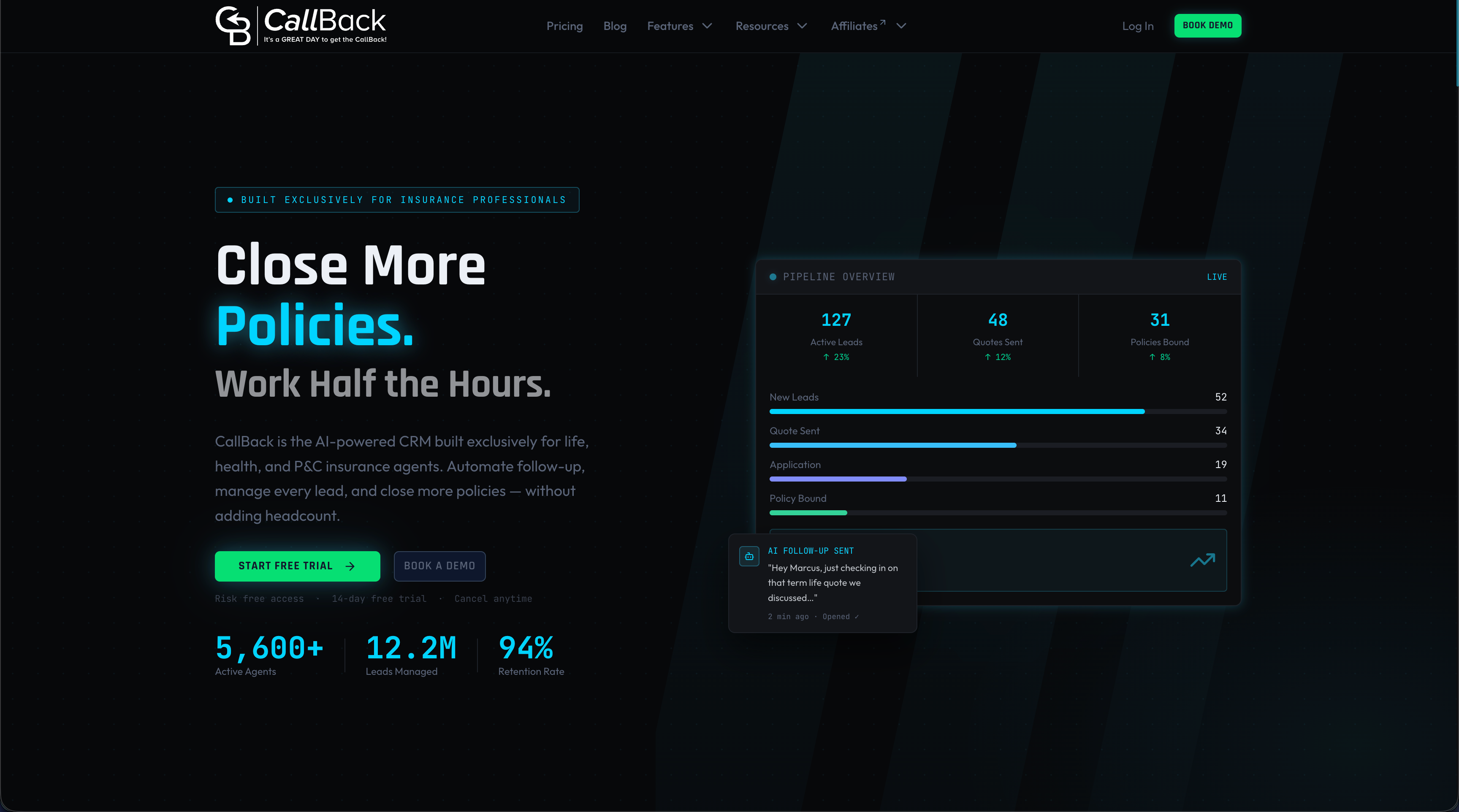
Callbackcrm is built specifically for insurance agents, agencies, and IMOs. Its SMS marketing features connect directly to CRM workflows, so every text message is logged, tracked, and tied to a client record automatically. The platform’s AI-powered lead scoring, automated follow-up sequences, and compliance-ready document storage replace the fragmented tool stacks that slow most agencies down. Agents get a free marketing audit to identify exactly where their current setup is losing leads and creating compliance gaps. The audit takes less than an hour and produces a concrete action plan.
FAQ
What is an IMO marketing support tool?
An IMO marketing support tool is any digital platform or service provided by an Independent Marketing Organization to help insurance agents generate leads, manage clients, automate outreach, and maintain regulatory compliance.
How many marketing tools does a typical insurance agency use?
Performance marketing teams managing complex insurance campaigns typically use 10–20 integrated tools. Top-producing agencies reduce that number by consolidating into a unified platform.
What conversion rate should IMO lead generation programs achieve?
Proven IMO marketing funnels reach conversion rates of 15% or higher. Self-built landing pages without IMO support rarely exceed 5%.
Why does compliance matter in IMO marketing platforms?
State insurance departments and federal regulators require documented evidence of compliant marketing practices. Automated compliance tools generate audit trails and store disclosures automatically, eliminating the manual processes that create regulatory exposure.
What is a Customer Data Platform and why do insurance agents need one?
A Customer Data Platform (CDP) ingests data from all marketing channels to build unified customer profiles. Insurance agents use CDPs to track every prospect interaction across email, SMS, and web before a conversation ever starts.