

TL;DR:
- Automation frees staff to focus on trust-building activities like personalized client conversations.
- It saves 3-5 hours weekly per account manager by automating renewal reminders and follow-ups.
- Simple, focused workflows outperform complex journeys in delivering ROI and operational efficiency.
Many insurance agency owners assume automation strips the human element out of client relationships. The reality is the opposite. Automation handles the repetitive, time-consuming work so your team can focus on what actually builds trust: real conversations, tailored advice, and faster service. Agencies that have made the shift report saving 3-5 hours per account manager every week, just from automating renewal reminders, email sequences, and follow-ups. This article breaks down what marketing automation actually does in an insurance context, why it boosts productivity and retention, and how to start without overcomplicating things.
Table of Contents
- What is marketing automation for insurance agencies?
- How marketing automation boosts agency productivity
- Driving growth and retention with marketing automation
- Personalization versus complexity: What really drives ROI?
- Getting started: Best practices for insurance marketing automation
- Our perspective: Automation only works when it fits your agency
- Unlock insurance growth with smart automation tools
- Frequently asked questions
Key Takeaways
| Point | Details |
|---|---|
| Boost productivity fast | Marketing automation saves each account manager 3-5 hours per week on repetitive tasks. |
| Increase sales and retention | Lead conversion rates can double or quadruple, and client retention rises with automated touchpoints. |
| Simplicity outperforms complexity | Simple, segmented automation beats complex multi-step journeys in ROI and ease of use. |
| Start with high-ROI workflows | Automate renewals, cross-sell campaigns, and lead nurturing first for the biggest impact. |
What is marketing automation for insurance agencies?
Marketing automation is the use of software to execute, manage, and track marketing and sales tasks without requiring manual effort every time. For insurance agencies, that means setting up systems that work in the background while your team focuses on clients.
At its core, automation connects your CRM or AMS (agency management system) to communication channels like email, SMS, and phone. When a prospect fills out a form, the system can instantly send a welcome email, assign a lead score, and notify the right agent. No manual entry. No delay. The sales automation benefits of this kind of integration are immediate and measurable.
Here are the most common tasks insurance agencies automate:
- Policy renewal reminders sent by email or SMS
- Lead nurturing sequences for prospects who haven’t converted yet
- Cross-sell campaigns triggered by policy type or life event
- Client onboarding workflows after a policy is bound
- Review and referral requests after positive service interactions
- Re-engagement campaigns for lapsed or inactive clients
The underlying mechanics are more powerful than most agencies realize. As one industry guide explains, CRM and AMS integration enables data unification, automated workflows, lead scoring, and real-time analytics for ongoing optimization.
“The agencies winning with automation aren’t replacing their people. They’re giving their people better tools, better data, and more time to close.”
When data flows freely between your systems, every touchpoint becomes smarter. Your team sees a full picture of each client, and the automation responds to real behavior rather than guessing. That’s the foundation of modern AI marketing tools built for insurance.
How marketing automation boosts agency productivity
Understanding the mechanics is one step. Seeing the productivity results makes the difference.
The average account manager at an insurance agency juggles dozens of clients, renewal dates, follow-up calls, and new leads at the same time. Without automation, tasks pile up. Important follow-ups get missed. Renewals slip through the cracks. Automation time savings data confirms that automating repetitive tasks like policy renewal reminders, email sequences, and client follow-ups saves staff 3-5 hours per week per account manager.

Here’s what that looks like in practice:
Before automation:
- Manually tracking renewal dates in spreadsheets
- Sending individual follow-up emails one by one
- Logging calls and updating CRM records by hand
- Building email lists manually for each campaign
After automation:
- Renewal reminders trigger automatically 60, 30, and 7 days out
- Follow-up sequences run on schedule without staff involvement
- CRM records update in real time based on client activity
- Segmented lists build themselves based on policy type or behavior
| Task | Manual time per week | Automated time per week |
|---|---|---|
| Renewal reminders | 3 hours | 15 minutes (setup only) |
| Lead follow-ups | 4 hours | 30 minutes (review only) |
| Cross-sell outreach | 2 hours | 20 minutes |
| CRM data entry | 2.5 hours | Near zero |
Those hours add up fast. For a team of five account managers, that’s potentially 15-25 hours recovered every week, time that goes back into selling and servicing. Explore sales automation workflows to see how agencies structure these systems, and review the CRM automation benefits that come with tighter data integration.
Pro Tip: The fastest productivity wins come from renewal reminders and post-bind onboarding sequences. Set these up first before building anything more complex.
Driving growth and retention with marketing automation
Not only does automation free up time, it directly impacts the numbers that matter most.
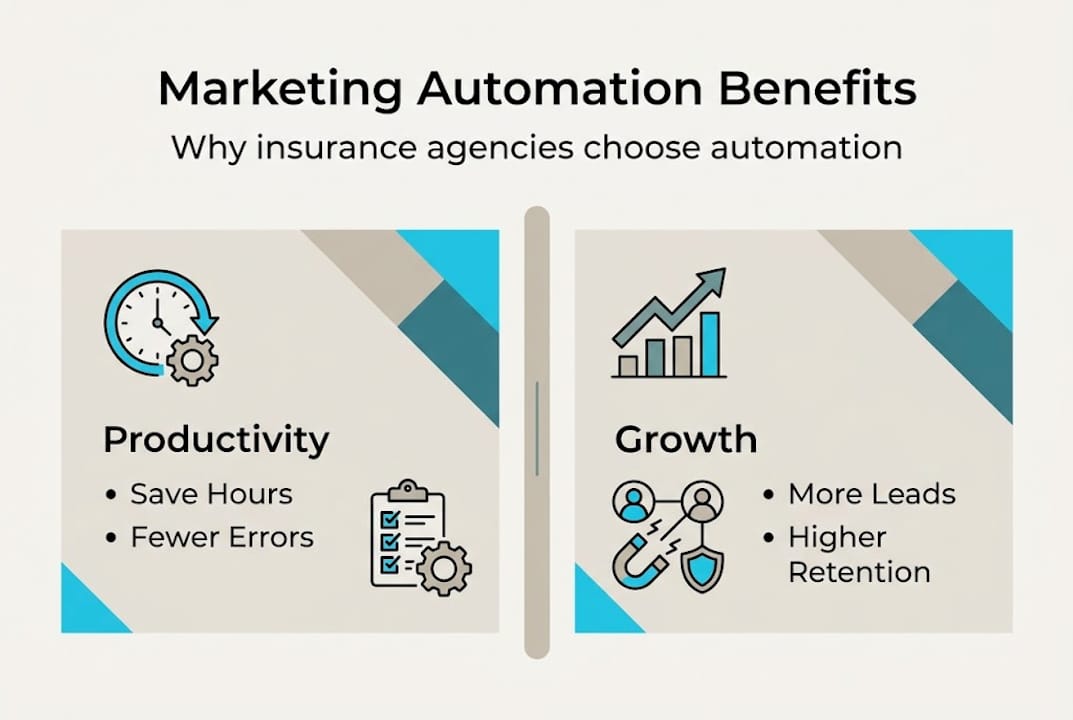
Retention and conversion are the two metrics every agency owner watches closely. Automation moves both in the right direction. Agencies using automation report 2-4x higher lead conversion rates, 2% year-over-year client retention increases, and 30% higher profitability from systematic cross-selling.
The reason is consistency. Automated nurturing sequences keep your agency visible to prospects without requiring a staff member to remember every follow-up. Clients who feel regularly engaged are also far more likely to renew. In fact, clients who receive regular automated touchpoints are 80% more likely to renew their policies.
Here’s how to use automation to move leads through your funnel:
- Capture the lead with a form, landing page, or ad integration
- Score the lead based on behavior, policy interest, and demographics
- Trigger a nurturing sequence with relevant content and offers
- Alert the agent when the lead reaches a high-intent threshold
- Follow up post-sale with onboarding, cross-sell, and referral campaigns
| Metric | Traditional process | Automated process |
|---|---|---|
| Lead conversion rate | Baseline | 2-4x higher |
| Client retention (YOY) | Flat | +2% increase |
| Cross-sell profitability | Inconsistent | +30% from systematic outreach |
| Renewal rate | Variable | 80% more likely with touchpoints |
These results come from marketing automation optimization built around the insurance customer journey. The key is connecting your lead funnel automation to a system that also handles integration for better leads across your marketing and sales channels.
Personalization versus complexity: What really drives ROI?
With automation’s impact evident, it’s critical to understand what types of automation produce the best returns.
Personalization works. That part is clear. But there’s a point where adding more steps, more conditions, and more branching logic starts to hurt results instead of helping. 77% of consumers respond to personalization, yet complex multi-touch journeys with more than five steps show negative ROI in 61% of cases. Simpler segmentation consistently outperforms elaborate automation.
Signs your automation is getting too complex:
- Workflows have more than six decision branches
- Your team can’t explain what triggers a given message
- Leads are receiving contradictory or overlapping communications
- You’re spending more time maintaining workflows than reviewing results
- No one on the team can audit the full sequence without documentation
“The agencies with the best automation results aren’t running the most sophisticated systems. They’re running the most focused ones, built around a few high-value behaviors and clear customer segments.”
For insurance agencies specifically, the right approach is to prioritize AMS-integrated platforms with built-in compliance features. This lets you scale personalization without running into regulatory risk, which is a real concern in insurance marketing.
Pro Tip: Start with behavioral segmentation and basic lead scoring before layering in AI insurance marketing agents or advanced branching. Nail the fundamentals first, then build up.
Getting started: Best practices for insurance marketing automation
Armed with the facts, the next question is how to put marketing automation into practice safely and efficiently.
The agencies that see the fastest results follow a disciplined rollout. They don’t try to automate everything at once. They pick two or three high-impact workflows, measure the results, and expand from there. Start simple with behavioral segmentation and lead scoring before adding AI agents, and make sure your data hygiene and sales-marketing alignment are solid from day one.
First steps for new adopters:
- Audit your current data. Clean up duplicate records, outdated contacts, and missing fields in your CRM or AMS before you automate anything.
- Define your top three workflows. Renewal reminders, new lead follow-ups, and cross-sell campaigns are the best starting points.
- Align sales and marketing. Make sure both teams agree on what a qualified lead looks like and when automation should hand off to a human.
- Set up lead scoring. Assign values to behaviors like email opens, form fills, and page visits so your agents know who to call first.
- Measure before you expand. Run your first workflows for 60 days, review the data, and optimize before adding complexity.
Common pitfalls to avoid:
- Skipping data hygiene before launch (garbage in, garbage out)
- Building workflows without compliance review
- Ignoring opt-out and consent management requirements
- Automating without defining a clear human handoff point
- Measuring vanity metrics like open rates instead of conversion and retention
One area agencies consistently underestimate is email marketing importance. Email is still the highest-ROI channel in insurance, and a well-structured automated email sequence is often the single biggest productivity lever available to a mid-size agency.
Our perspective: Automation only works when it fits your agency
Here’s the honest truth most automation vendors won’t tell you: the majority of agencies that struggle with automation don’t have a technology problem. They have an alignment problem.
They copy what large carriers or big-brand agencies are doing, layer in complex multi-step journeys, and then wonder why results are flat. The workflows don’t match their actual sales process. The messages don’t reflect how their clients actually communicate. The data feeding the system is inconsistent.
Automation is not a plug-and-play solution. It’s a reflection of your process. If your process is unclear, automation will just execute that confusion faster and at greater scale.
The agencies that win are the ones that start with one or two insurance sales automation workflows that map directly to their biggest pain points, usually renewals and new lead follow-up, and build from there. They treat automation as an iterative, data-driven practice, not a one-time setup. That discipline is what separates agencies that see 2-4x conversion lifts from those that abandon their platform after six months.
Unlock insurance growth with smart automation tools
Ready to bring these automation wins to your agency? The strategies covered in this article work best when you have a platform built specifically for insurance workflows, not a generic marketing tool adapted for your industry.
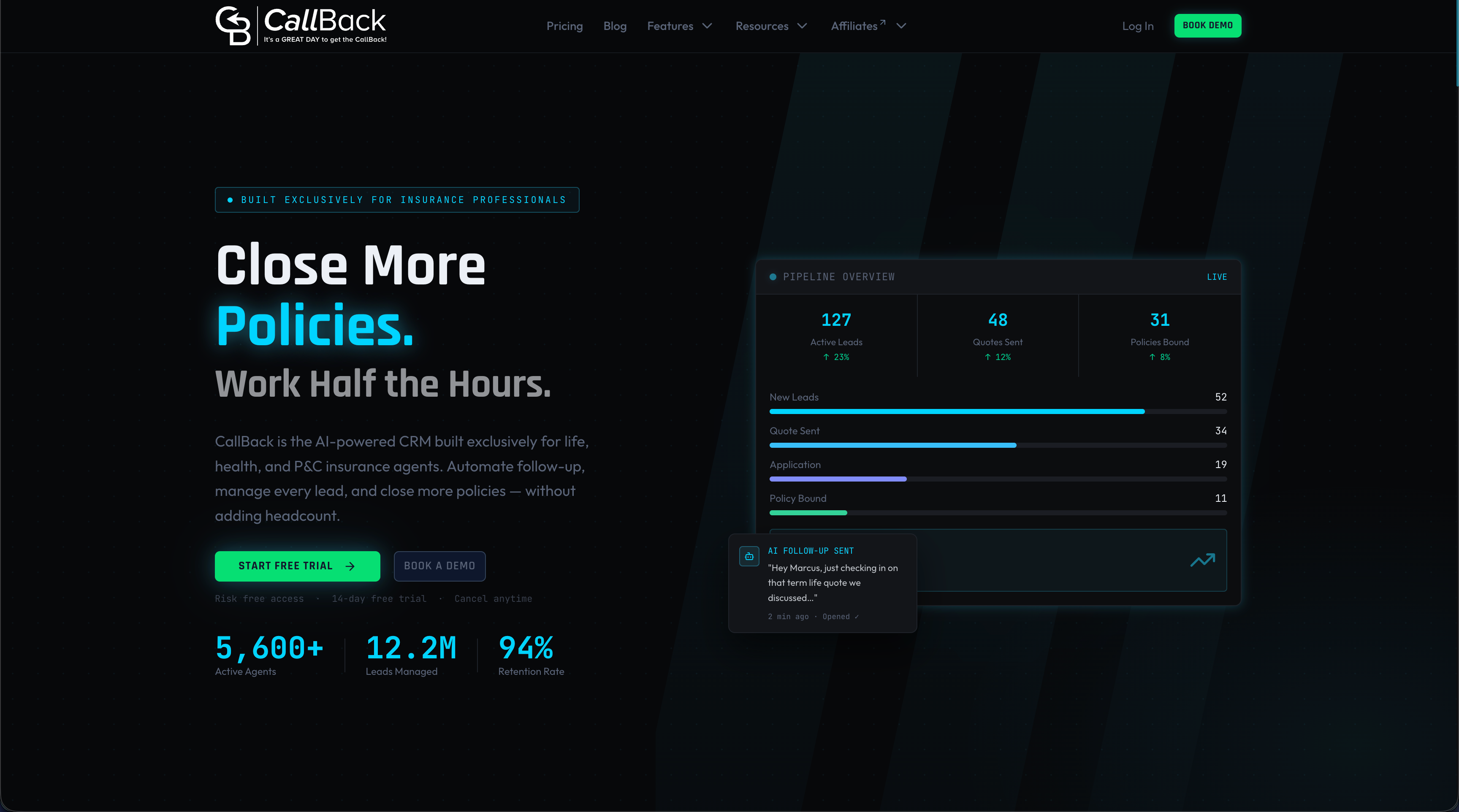
CallBack CRM gives insurance agencies and IMOs an all-in-one AI tool that covers CRM management, lead scoring, email automation solutions, and SMS marketing features, all integrated with your existing systems. You get the compliance-aware workflows, behavioral segmentation, and real-time analytics that actually move the needle. Whether you’re starting with renewal reminders or building a full multi-channel nurturing system, CallBack CRM scales with your agency. Book a demo and see how it fits your process.
Frequently asked questions
What is the main advantage of marketing automation for insurance agencies?
Automation saves staff 3-5 hours per week per account manager by handling repetitive tasks like renewal reminders and follow-ups, freeing your team to focus on higher-value client interactions.
How does marketing automation improve lead conversion rates?
Automated nurturing sequences keep prospects engaged over time, and agencies using automation consistently report 2-4x higher lead conversion rates compared to manual outreach processes.
Can too much workflow complexity reduce marketing ROI?
Yes. Complex multi-touch journeys with more than five steps produce negative ROI in 61% of cases, so starting with simple segmentation and lead scoring delivers better results.
What kinds of campaigns should insurance agencies automate first?
Renewal reminders, new lead follow-ups, and cross-sell campaigns are the highest-impact starting points, especially when run through AMS-integrated platforms with built-in compliance features.