

TL;DR:
- Only 11% of insurance agencies fully align sales and marketing teams, leading to inefficiencies.
- Automation fixes data silos, speeds up follow-ups, and improves compliance and agent retention.
- Successful integration requires addressing regulatory hurdles, defining shared processes, and starting small.
Only 11% of insurance agencies achieve full alignment between their sales and marketing teams. That means the overwhelming majority of agencies are bleeding leads, wasting ad spend, and watching prospects fall through the cracks between departments. If you’ve ever felt like your marketing team and your producers are speaking different languages, you’re not imagining it. This guide breaks down exactly why that disconnect happens, what it costs you, and how automation tools can bridge the gap so your agency starts generating more leads, converting more clients, and retaining more agents.
Table of Contents
- What sales and marketing integration means for insurance agencies
- Benefits of integrating sales and marketing using automation
- Common barriers to integration (and how insurance agencies overcome them)
- Build your integration strategy: In-house, outsource, or hybrid?
- Why most integration advice fails insurance agencies (and what really works)
- Next steps: Automate your integration with the right tools
- Frequently asked questions
Key Takeaways
| Point | Details |
|---|---|
| Alignment boosts leads | Integrating sales and marketing directly increases lead conversion and customer engagement for insurance agencies. |
| Automation reduces attrition | Using automation in onboarding and engagement can prevent up to 85% agent attrition. |
| Outsourcing fills gaps | Partnering with outside experts helps agencies access AI and compliance support cost-effectively. |
| Start with one workflow | Begin your integration journey with a single automated handoff for the fastest impact. |
What sales and marketing integration means for insurance agencies
Integration isn’t just about sharing a spreadsheet or holding a weekly sync meeting. For insurance agencies, it means aligning your goals, your data, and your day-to-day processes so every prospect gets a consistent, seamless experience from first click to signed policy.
That sounds straightforward. It rarely is.
Insurance operates in a regulatory environment that most B2B industries don’t face. Your marketing team wants to move fast, test offers, and push creative campaigns. Your compliance team wants to review every word before it goes out. The result? Regulatory hurdles create an adversarial compliance-marketing dynamic that slows everything down and creates friction between the people who should be working together.
This friction shows up in very specific, costly ways:
- Inconsistent lead definitions: Sales calls a lead “qualified” when marketing considers it cold, so nothing gets followed up properly.
- Data silos: Your CRM doesn’t talk to your email platform, so agents have no visibility into what a prospect has already seen or clicked.
- Wasted spend: Marketing invests in campaigns that generate volume but not quality, because sales never feeds back what’s actually converting.
- Broken handoffs: A prospect fills out a form, gets no follow-up for three days, and buys from a competitor.
These aren’t minor inefficiencies. They compound. And the numbers reflect it: 53% of agencies suffer broken handoffs between sales and marketing due to poor data and unclear processes.
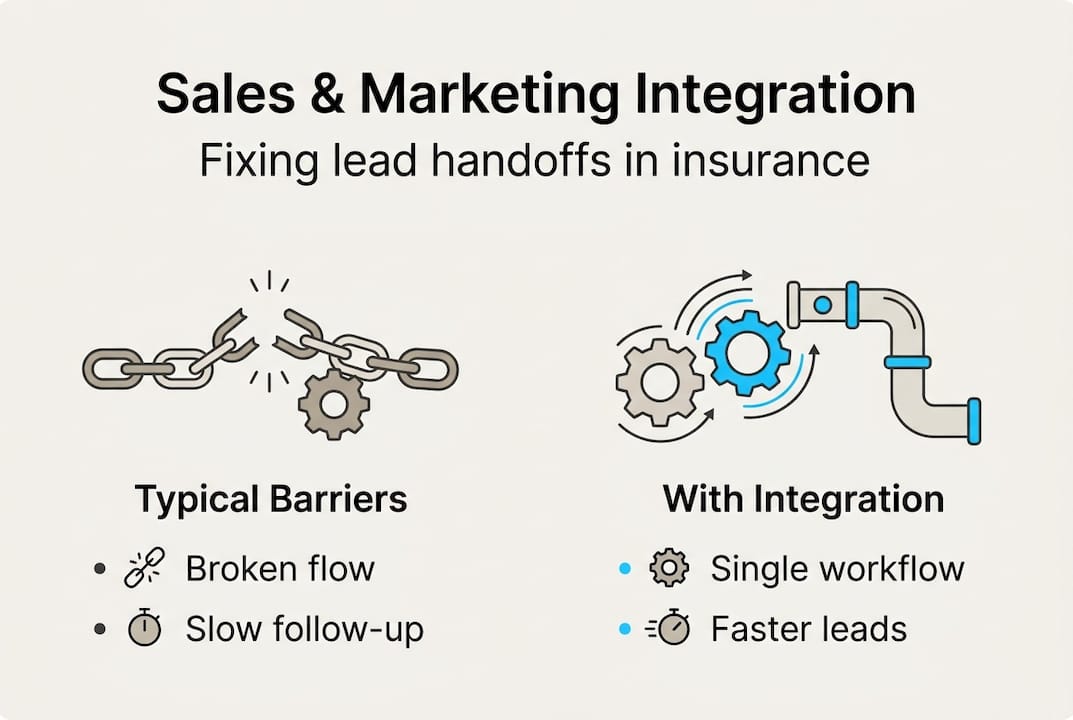
True integration fixes this by creating shared definitions, connected systems, and insurance automation workflows that ensure no lead gets lost and no follow-up gets missed. When you layer in AI in insurance marketing, you add the ability to score leads, personalize outreach, and flag high-value prospects automatically.
Integration is the foundation everything else is built on. Without it, automation is just expensive noise.
Benefits of integrating sales and marketing using automation
Once you understand the problem, the opportunity becomes obvious. Automation tools don’t just speed things up. They remove the human error and communication gaps that cause misalignment in the first place.
Here’s what changes when your agency integrates sales and marketing with automation:
- Lead data flows automatically from marketing platforms into your CRM, so agents always have full context before making contact.
- Follow-up sequences trigger instantly when a lead takes action, cutting response time from days to minutes.
- Compliance documentation gets logged automatically, reducing the manual burden on your team.
- Agent onboarding becomes consistent, which directly impacts retention.
That last point deserves emphasis. Consistent onboarding and engagement via automation can counter the 85% agent attrition rate that plagues the industry. When agents feel supported, informed, and equipped with tools that actually work, they stay.
| Metric | Before integration | After integration |
|---|---|---|
| Lead follow-up speed | 24 to 72 hours | Under 5 minutes |
| Monthly lead volume | Inconsistent | Predictable and scalable |
| Compliance incidents | Frequent manual errors | Automated audit trails |
| Agent retention rate | Low, high turnover | Significantly improved |
The shift isn’t just operational. It’s cultural. When sales and marketing share data and goals, they start pulling in the same direction. Automation in insurance sales makes that collaboration sustainable because it removes the manual tasks that create resentment and blame between teams.
You can also automate customer engagement so that existing clients receive timely renewal reminders, cross-sell offers, and check-ins without your agents lifting a finger.

Pro Tip: Don’t try to automate everything at once. Start with your lead handoff process. Automating that single touchpoint will show measurable ROI within 30 days and build internal buy-in for larger changes.
Common barriers to integration (and how insurance agencies overcome them)
If integration is so valuable, why aren’t more agencies doing it? The answer is that the barriers are real, and most generic advice doesn’t account for the insurance-specific version of these problems.
“53% of insurance agencies experience broken handoffs due to poor data and unclear processes.” That’s not a technology problem. It’s a people and process problem that technology can solve.
Here are the most common barriers and how to get past them:
- Data silos: Your email tool, CRM, and quoting system don’t share data. Fix this by centralizing everything in one platform or using integrations that sync automatically.
- Unclear lead definitions: Sales and marketing argue about what counts as a qualified lead. Fix this by holding one joint meeting to create a written, shared definition.
- Compliance bottlenecks: Every campaign gets stuck in review. Fix this by adopting RegTech tools that pre-approve templates and automate compliance logging.
- Lack of tech expertise: Your team knows insurance, not software. Fix this by using platforms built specifically for agencies, or outsource to a partner who does.
- Resource gaps: You don’t have a dedicated marketing team. Fix this by leveraging AI tools for insurance that handle content, lead scoring, and outreach automatically.
The adversarial marketing-compliance dynamic is the hardest barrier to overcome because it’s cultural, not technical. The agencies that break through it do so by involving compliance early in campaign planning rather than treating them as a last-minute gatekeeper.
Pro Tip: Use a sales automation checklist to audit your current handoff process. You’ll likely find two or three specific points where leads consistently go cold. Fix those first.
Build your integration strategy: In-house, outsource, or hybrid?
Once you’ve identified your gaps, you need to decide how you’ll close them. There are three models, and the right one depends on your agency’s size, budget, and internal capabilities.
Three steps to define your strategy:
- Assess your current state: Map your lead journey from first contact to closed policy. Note every handoff point and every tool involved.
- Evaluate your gaps: Where do leads fall off? Where does your team lack skills or bandwidth? Be honest.
- Select the best-fit model: Match your gaps to the model that addresses them most efficiently.
| Model | Pros | Cons |
|---|---|---|
| In-house | Full control, deep brand knowledge | High cost, slow to scale, skill gaps |
| Outsourced | Access to specialists, faster execution | Less control, requires strong briefing |
| Hybrid | Balances control with specialization | Requires clear role definition |
Outsourcing fills critical skill gaps in areas like SEO and AI, often more affordably than hiring full-time staff. For smaller agencies, this is frequently the smartest path to accessing enterprise-level marketing capabilities without the overhead.
The hybrid model is increasingly popular because it lets you keep producer relationships and product knowledge internal while outsourcing the technical execution of campaigns, automation setup, and analytics.
Regardless of which model you choose, automation platforms make all three work better. Pre-built workflows, plug-and-play integrations, and AI-assisted tools mean you don’t need a developer to connect your systems. A well-structured email marketing process can be running in days, not months, with the right platform.
Why most integration advice fails insurance agencies (and what really works)
Here’s the uncomfortable truth: most articles about sales and marketing integration were written for SaaS companies. They assume you can A/B test your way to alignment in a week, spin up a new campaign overnight, and iterate without regulatory review. That’s not your world.
Insurance agencies that actually achieve integration do three things differently. First, they lead with compliance. They build their automation workflows so that compliance documentation happens automatically, not as an afterthought. This removes the bottleneck that kills most campaigns before they launch.
Second, they align automation to the actual sales process, not an idealized version of it. That means mapping your real workflow, including the messy handoffs and the manual steps, before you automate anything.
Third, they build trust gradually. They don’t try to fix everything at once. They pick the single riskiest handoff, automate it, prove the value, and then expand. This approach creates internal champions instead of internal resistance.
The agencies that stall are the ones that buy a platform, try to implement everything simultaneously, and give up when it gets complicated. Small wins compound. AI-driven CRM tools make this incremental approach practical because they’re designed to grow with you.
Pro Tip: Integrate compliance into your automation workflows from day one. Retrofitting compliance into an existing workflow is far more expensive and disruptive than building it in at the start.
Next steps: Automate your integration with the right tools
You now have a clear picture of what integration requires, what it delivers, and how to approach it strategically. The next step is putting the right tools in place.
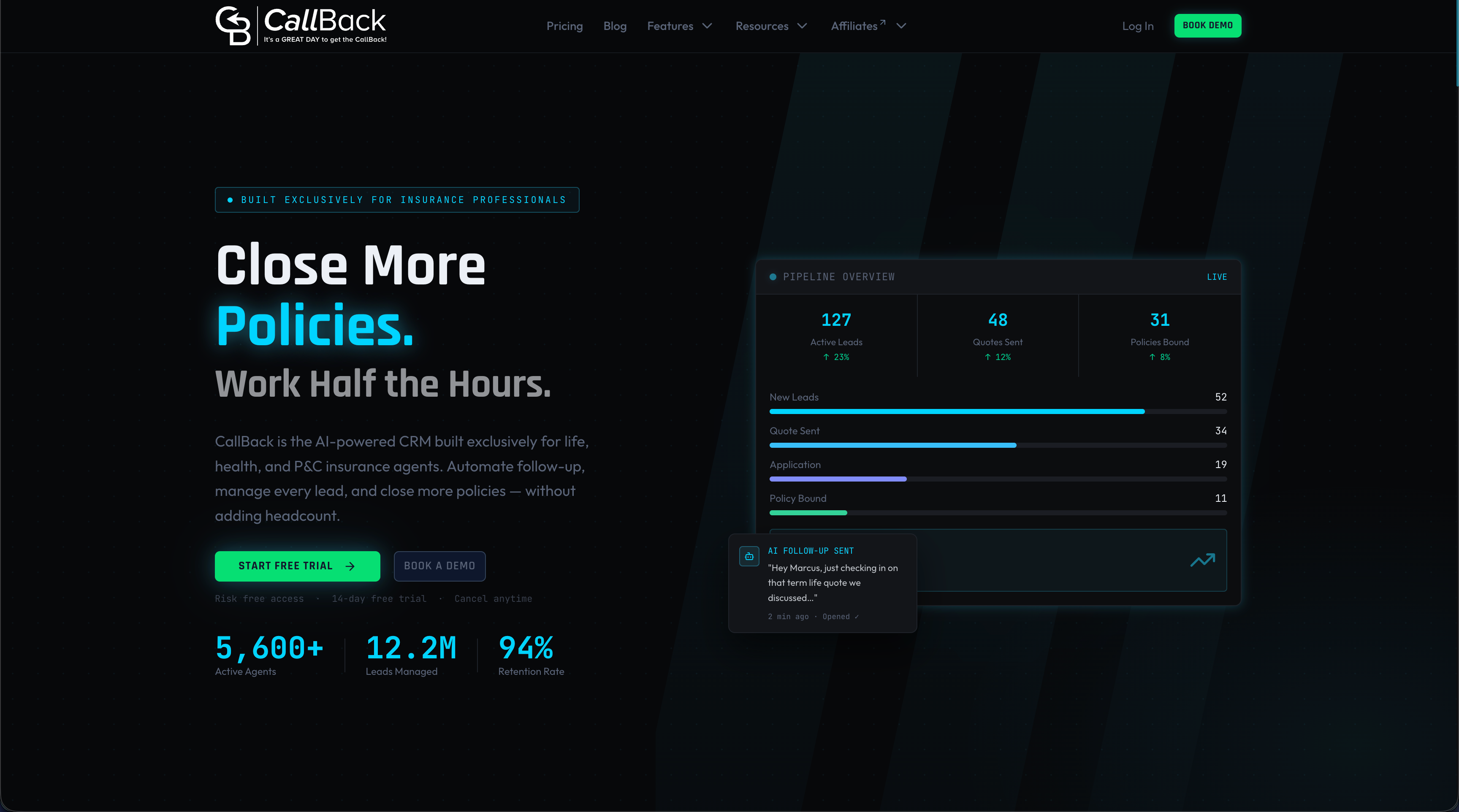
CallBack CRM is built specifically for insurance agents, agencies, and IMOs who want to connect their sales and marketing operations without hiring a team of developers. The platform’s AI-powered sales and marketing tools handle lead capture, follow-up automation, compliance logging, and agent engagement in one connected system. You can launch website and funnel automation to capture and qualify leads automatically, and use SMS marketing for insurance to reach prospects at the moment they’re most likely to respond. Start with one workflow, prove the value, and scale from there.
Frequently asked questions
What is the main reason most insurance agencies struggle to integrate sales and marketing?
Most agencies struggle due to regulatory requirements, poor data integration, and an adversarial relationship between marketing and compliance teams that slows campaign execution and creates broken handoffs.
How does automation specifically help align sales and marketing in insurance?
Automation synchronizes data between teams in real time, triggers follow-ups instantly, and logs compliance activity automatically, which drives higher lead conversion and helps counter 85% agent attrition through consistent engagement.
Is outsourcing marketing integration better than keeping it in-house for insurance agencies?
Outsourcing fills skill gaps in areas like AI and SEO more cost-effectively than building in-house teams, while a hybrid model blends internal product knowledge with external technical specialization.
What is the first step to integrating sales and marketing in an insurance agency?
Start by defining shared lead criteria with both teams and implementing a central CRM or automation platform to coordinate handoffs and eliminate data silos from the beginning.