

TL;DR:
- Ad management tools automate campaign tasks and optimize ad spend using AI-driven systems. They deliver higher ROI, operational efficiency, and better decision-making, especially when implemented gradually with proper tracking. The future of ad management involves agentic systems that combine multiple AI agents and retain institutional knowledge to improve performance continuously.
Ad management tools are defined as software platforms that centralize campaign planning, execution, optimization, and reporting across paid advertising channels. The role of ad management tools has shifted from simple dashboards to AI-driven systems that make real-time decisions without daily human input. Marketing professionals who still run campaigns manually are leaving measurable performance gains on the table. This article breaks down how these tools work, what they deliver, and how to get the most from them in 2026.
How do ad management tools automate and optimize digital advertising campaigns?
Ad management software automates the tasks that used to consume hours of a marketer’s week. Bid adjustments, budget pacing, audience segmentation, and A/B test rotation all run continuously without manual intervention. The result is a system that works around the clock, not just during business hours.

Autonomous ad management tools optimize campaigns 24/7 and reduce customer acquisition costs by 40–60%. That range reflects the compounding effect of removing human lag from bid decisions and budget reallocation. Cross-platform AI orchestration improves blended return on ad spend by 30–50% and cuts media plan creation time by 50%. That time savings alone justifies the switch for most mid-size marketing teams.
The automation stack inside a modern ad management platform typically covers four layers:
- Data ingestion: Pulling performance signals from every connected channel into one unified view
- Algorithmic decisioning: Adjusting bids, budgets, and targeting rules based on live performance data
- AI-assisted creative: Rotating ad variations and flagging underperformers before fatigue sets in
- Automated reporting: Generating performance summaries without manual spreadsheet work
Advertising automation reduces operational hours and error rates, freeing marketers to focus on strategy and creative direction. That shift in focus is where the real competitive advantage lives.
Pro Tip: Set your automated rules to trigger budget reallocation only after a statistically meaningful sample size, not after the first 50 impressions. Premature optimization kills campaigns that would have performed well with more data.
What are the primary benefits of using ad management software?
The benefits of ad management software fall into three categories: financial returns, operational efficiency, and decision quality. Each one compounds the others when the system is set up correctly.
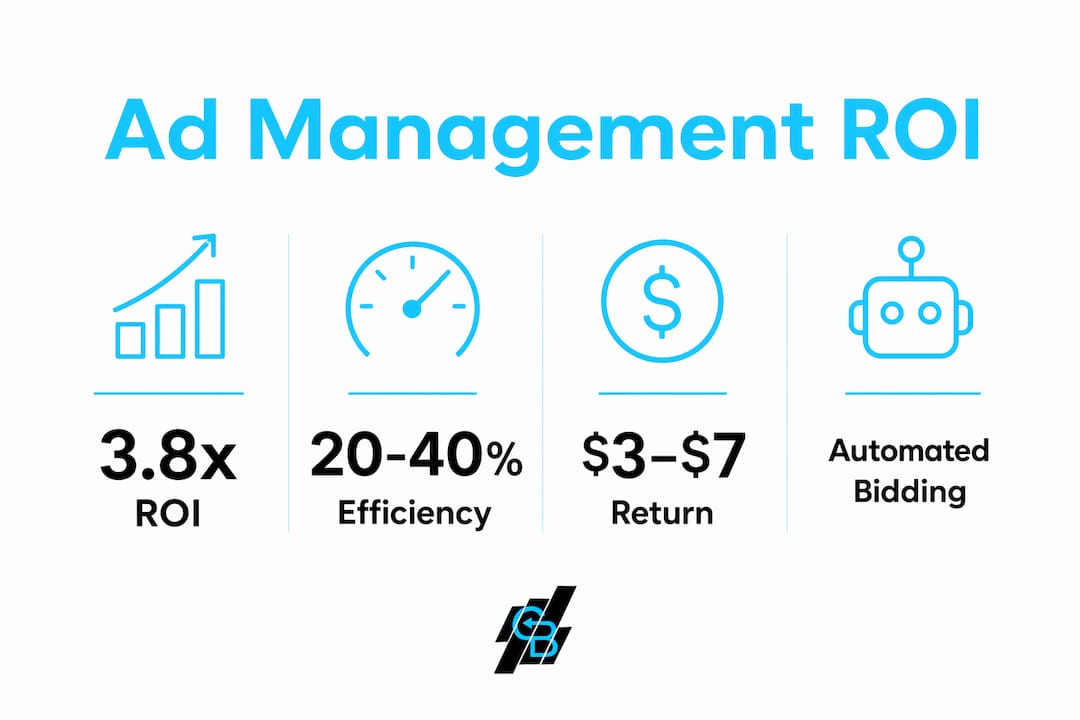
Switching to AI-integrated ad management tools delivers an average 3.8x ROI within 6 weeks. That return breaks down as 40–60% from campaign performance improvements, 25–35% from time savings, and 15–25% from reduced operational costs. The math works out to $3–$7 returned for every $1 invested. For a marketing team spending $10,000 per month on paid ads, that is a meaningful number.
The operational gains are just as significant as the financial ones:
- Reduced manual errors: Automated rules eliminate fat-finger mistakes on bid caps and budget limits that can drain spend overnight.
- Faster campaign launches: Pre-built templates and workflow automation cut setup time from days to hours.
- Consistent performance monitoring: The system flags anomalies the moment they appear, not the next morning when a human checks the dashboard.
- Scalability without headcount growth: A single marketer can manage ten times the campaign volume with automation handling the repetitive work.
- Better data-driven decisions: Unified reporting across channels gives a clear picture of which spend is working and which is not.
Professional ad management oversight delivers efficiency gains of 20–40% compared to self-managed campaigns. Self-managed campaigns tend to suffer from ad fatigue and budget misallocation because no one is watching every signal in real time. Automated systems catch those problems before they become expensive.
The importance of ad management also shows up in strategic focus. When AI handles bid adjustments and audience testing, marketers can spend their time on creative strategy and business objectives. That is the kind of work that actually differentiates a brand.
How can businesses implement ad management tools effectively?
Implementation quality determines whether a business captures the full value of its ad management platform or just adds another subscription to the tech stack. The approach matters as much as the tool itself.
Phased adoption of AI ad management tools yields 40% better results than a sudden full switch. The reason is simple: a phased rollout lets teams validate performance continuity before cutting over entirely. Start with one channel, prove the system, then expand.
The implementation checklist that actually works:
- Audit your tracking first. No automation layer fixes bad data. Verify that pixels fire correctly and that conversion events match your actual business goals.
- Implement Conversion API tracking. Direct server event data bypasses browser limitations and improves measurement accuracy. This is non-negotiable for any campaign running in a privacy-restricted environment.
- Connect native platform AI with third-party intelligence. Native AI handles bidding and audience matching well. Third-party layers add market-level signals like competitor offer changes and seasonal demand shifts.
- Define your success metrics before launch. ROAS is one metric. Research velocity, the speed at which your system learns through experiments, is equally important for long-term performance.
- Automate reporting from day one. Manual reporting is the first thing that breaks under campaign volume. Build the automated dashboard before you need it.
Pro Tip: Before connecting a new ad management platform to your live campaigns, run it in observation mode for two weeks. Let it analyze your existing data without making changes. The insights it surfaces before touching a single bid will tell you exactly where your current setup is leaking money.
Platforms like Callbackcrm integrate ad management support with CRM data, which means your audience segments are built from actual customer behavior rather than platform estimates. That connection between CRM and ad targeting is where data-driven marketing strategies produce results that generic ad tools cannot replicate.
What advanced features define the future of ad management?
The next generation of ad management tools moves beyond automation into what the industry calls agentic systems. These are platforms where multiple AI agents work together, each with defined roles, memories, and skills, continuously improving campaign performance without human prompts.
Agentic ad management systems combine multiple AI agents to handle tasks ranging from creative testing to bid strategy to audience expansion. Each agent retains what it learns and passes that knowledge forward. The system does not repeat failed experiments because it remembers what did not work.
The concept of performance memory is one of the most underrated features in modern ad management. An effective AI-driven ad system retains reusable audience segments, prompts, and landing page data, compounding value over time. Think of it as institutional knowledge that never leaves when a team member does.
| Feature | What it does | Why it matters |
|---|---|---|
| Performance memory | Stores audience segments and test results | Prevents repeating failed experiments |
| Competitive intelligence | Monitors competitor creatives and market saturation | Surfaces signals native AI cannot see |
| Agentic decisioning | Multiple AI agents with defined roles | Continuous improvement without manual input |
| Automated billing | Handles invoicing and financial reconciliation | Reduces errors and accelerates financial cycles |
| Cross-channel orchestration | Coordinates spend across platforms | Improves blended ROAS by 30–50% |
Campaign success depends on integrating competitive intelligence signals that native platform AI cannot access, including competitor creative changes and market saturation data. Native AI is excellent at optimizing within its own platform. It has no visibility into what competitors are doing outside it.
“The market now favors autonomous AI platforms that operate without daily manual input. This shift widens the performance gap between businesses using advanced ad management and those still relying on manual campaign oversight.”
The current market favors autonomous platforms over traditional manual tools, and that gap is widening. Businesses that delay adoption are not standing still. They are falling behind relative to competitors who are compounding performance gains every week.
Human oversight remains necessary despite the automation. AI handles the execution. Humans set the strategic direction, approve creative, and make calls that require business context the algorithm does not have. The best ad management setups treat AI as the engine and the marketer as the driver.
Key Takeaways
Ad management tools deliver measurable ROI when implemented correctly, combining AI automation with human strategic direction to produce results that neither can achieve alone.
| Point | Details |
|---|---|
| Automation drives ROI | AI-integrated tools deliver an average 3.8x ROI within 6 weeks of adoption. |
| Phased rollout outperforms full switch | Phased adoption yields 40% better results than switching all campaigns at once. |
| Tracking quality determines output | Conversion API implementation is non-negotiable for accurate campaign measurement. |
| Performance memory compounds value | Systems that retain audience and test data accelerate optimization over time. |
| Human strategy remains essential | AI handles execution; marketers must set direction and approve creative decisions. |
Why most marketers are using these tools wrong
The biggest mistake I see marketing professionals make with ad management tools is treating them as a set-it-and-forget-it solution. They connect the platform, turn on automation, and check back in a month expecting the numbers to look great. They usually do not.
Ad management software is not a replacement for marketing judgment. It is a force multiplier for good judgment. If your campaign strategy is weak, automation will execute that weak strategy faster and at greater scale. The tool amplifies whatever you put in. That is why the implementation phase matters so much. The businesses that get the best results spend serious time on tracking setup, audience definition, and creative strategy before they let the automation run.
The other mistake is evaluating these tools purely on ROAS. Research velocity, the speed at which your system learns through experiments, is a better long-term indicator of platform value. A system that learns fast will outperform a system with a slightly better current ROAS within a few months. I have seen teams abandon platforms that were actually building compounding value because they were measuring the wrong thing.
The role of AI in marketing is to handle the work that does not require human creativity or judgment. When you use it that way, the returns are real. When you use it as a substitute for strategy, you get expensive mediocrity.
— Kyle
Callbackcrm and the tools that make ad management work
Marketing professionals who want to put these principles into practice need a platform that connects ad management with the full customer journey, not just the click.
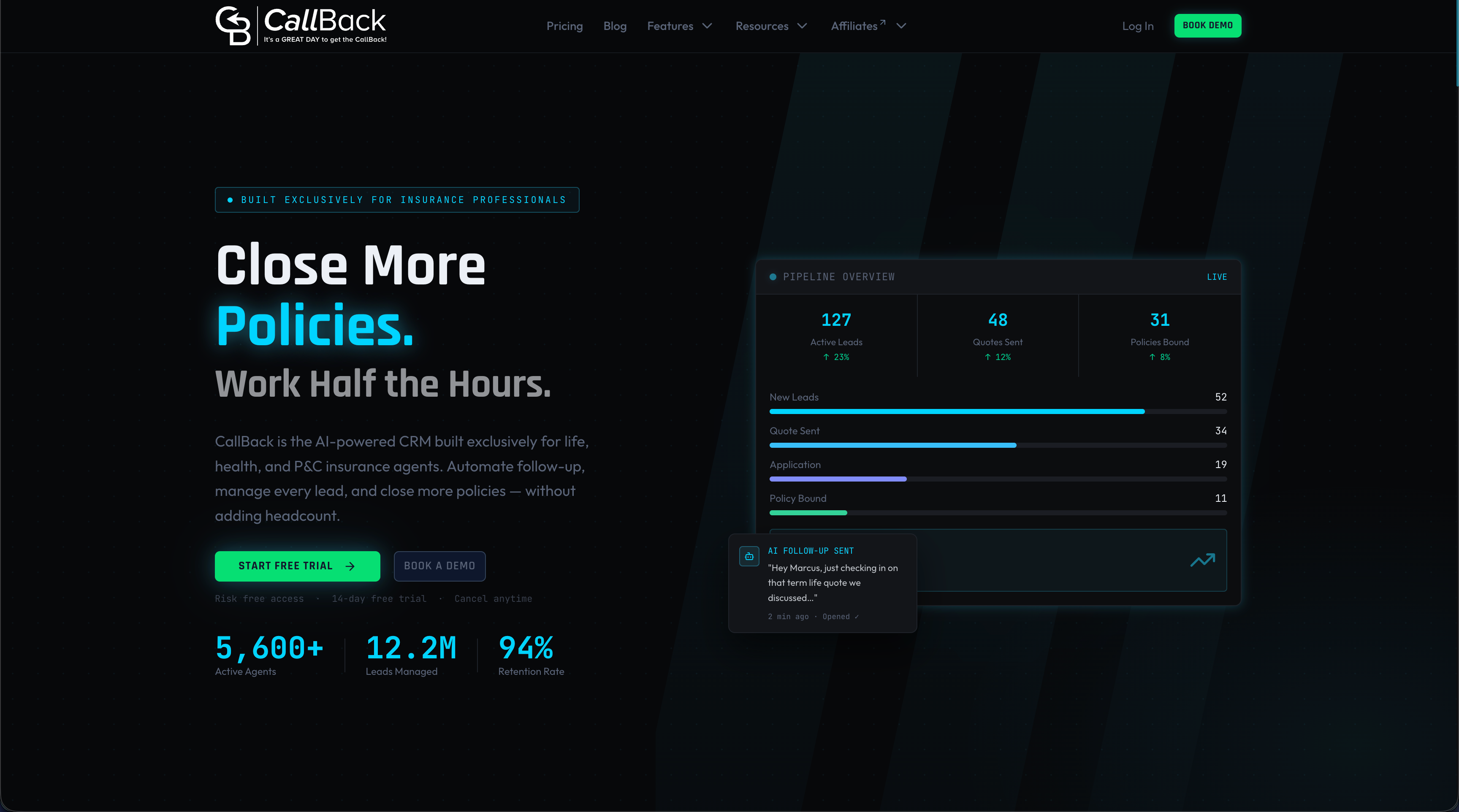
Callbackcrm is built for exactly that connection. Its AI-powered feature suite covers CRM management, automation workflows, email and SMS marketing, funnel builders, and ad management support, all in one platform. For insurance agents and agencies, that means audience segments built from real CRM data feed directly into ad targeting. Campaigns reach the right people because the platform knows who those people are. The automation layer handles follow-up, lead scoring, and outreach so your team focuses on closing, not chasing. If you are ready to see what that looks like in practice, the full features overview is the right place to start.
FAQ
What is the role of ad management tools in digital marketing?
Ad management tools centralize campaign planning, execution, optimization, and reporting across paid channels. They automate bid adjustments, budget pacing, and audience targeting so marketers can focus on strategy rather than manual tasks.
How much ROI can ad management software deliver?
AI-integrated ad management tools deliver an average 3.8x ROI within 6 weeks, returning $3–$7 for every $1 invested across campaign performance, time savings, and reduced operational costs.
What features should I look for in an ad management platform?
Look for automated bidding, cross-channel reporting, Conversion API support, performance memory, and competitive intelligence integration. These features separate platforms that compound value over time from those that simply automate existing processes.
How do I implement ad management tools without disrupting live campaigns?
Use a phased adoption approach, starting with one channel before expanding. Run the platform in observation mode first, verify tracking accuracy, and define success metrics before activating automation on live spend.
What is performance memory in ad management systems?
Performance memory is a system’s ability to retain and reuse audience segments, test results, and creative data across campaigns. It prevents repeating failed experiments and accelerates optimization by building on what already worked.