

TL;DR:
- A strong broker client retention system combines a proactive 90/60/30 renewal cadence, cross-selling, claims advocacy, and AI automation. Building this system boosts retention, reduces costs, and significantly increases profits over time.
The highest-impact broker client retention system combines a proactive 90/60/30 renewal cadence, multi-policy cross-sell, claims advocacy, and AI-powered automation. Together, these tactics make timely, personalized outreach repeatable at scale without adding headcount.
Quick checklist for this week:
- Audit your book for clients you have not contacted in 90+ days
- Flag every single-policy account as a cross-sell priority
- Set a 90-day renewal trigger in your CRM for every upcoming expiration
- Assign a claims follow-up SLA (24-hour first contact, weekly updates until close)
- Schedule one mid-year value touch for your top 20 accounts
- Draft three email templates: renewal review, life-event check-in, win-back
Retention is not a campaign. It is a system. The brokers who build that system consistently outgrow the ones who rely on new production to cover silent attrition.
Table of Contents
- Why client retention is the most profitable lever in your book
- Why broker clients leave (and what to fix first)
- Practical broker client retention strategies that actually work
- What to measure: KPIs and dashboards for retention health
- Technology that scales retention: what to look for
- Research-backed AI tactics that improve retention
- 90-day implementation checklist for broker teams
- How to train broker teams on retention best practices
- How to handle client complaints and resolve conflict
- Client loyalty programs and incentive structures
- Key Takeaways
- What most brokers get wrong about retention
- Callbackcrm puts the 90/60/30 system on autopilot
- Sources and further reading
Why client retention is the most profitable lever in your book
Keeping a client costs 5–7x less than acquiring a new one. A 5% improvement in retention can produce 25%–95% profit growth, according to Bain & Company research. Those numbers are not abstract: if your average client generates $500 per year in commission and costs $300–$500 to replace through marketing, every lost client is a double hit to your bottom line.
The compounding effect matters even more at the book level. An agency that moves retention from 85% to 93% effectively adds eight clients per 100 every year without spending a dollar on acquisition. Over five years, that gap becomes the difference between a stagnant book and one with materially higher valuation and lifetime client value.
Why broker clients leave (and what to fix first)
Price is the most commonly cited reason clients switch, but research consistently shows it is rarely the real driver. The actual cause is perceived indifference: clients who feel their broker has forgotten about them. 68% of clients who leave an advisor never express dissatisfaction beforehand. They simply disappear.
The top churn causes, ranked by frequency:
- Perceived indifference: No contact outside of renewal or a claim
- Poor claims support: Client navigates the process alone and feels abandoned
- Single-policy exposure: No relationship depth; easy to replace with one quote
- Late or out-of-cycle contact: Outreach arrives after the client has already shopped
- Price without value explanation: Rate increase lands with no context or advocacy
Pro Tip: Run a 90-day lapse audit quarterly. Pull every client you have not proactively contacted in 90 days. That list is your immediate retention risk. Work it before renewal season, not during.
Clients who receive proactive claims support retain at rates 18% higher than clients who navigate claims alone. Fix claims advocacy first. It is the fastest single-action retention lever.

Practical broker client retention strategies that actually work
The 90/60/30 renewal playbook
Start retention work 90 days before renewal, not 30. Agencies using automated renewal outreach starting at 90 days retain 8–12 additional clients per 100 compared with agencies that start at 30 days.
- 90 days out: Coverage audit, uncover life or business changes, create value before price enters the conversation
- 60 days out: Formal review meeting or call, present findings, introduce cross-sell options
- 30 days out: Confirm renewal terms, address any objections, confirm payment method
The producer owns the 90-day touch. The 60-day review can be delegated to a service rep for smaller accounts. The 30-day confirmation is administrative and can be automated.
Mid-year touchpoints
Mid-year client contact reduces lapse rates by 22% compared to annual-only contact. For commercial lines, a mid-year loss-run review works well. For personal lines, a seasonal property check or a brief coverage update tied to a market change gives the outreach a clear purpose. The goal is simple: no client should go more than 90 days without hearing something useful from your office.

First 90 days onboarding
The first 90 days set the retention baseline for the entire relationship. A structured sequence:
- Day 1: Welcome email with your contact information and what to expect
- Day 7: Follow-up call to confirm policy documents were received
- Day 30: Cross-sell check (“Want me to run a bundle quote?”)
- Day 60: Value touchpoint, a relevant article or coverage tip
- Day 90: Relationship check-in, open-ended and non-transactional
Top IMOs use a 90-day onboarding plan with mentorship, clear goals, and immediate tool access to raise first-year persistency. The same logic applies to client onboarding.
Claims advocacy protocol
Contact the client within 24 hours of every claim. Explain the process, set expectations, and follow up at least once per week until resolution. After the claim closes, run a coverage review. The claim may have exposed a gap, and that conversation deepens the relationship rather than ending it.
Cross-sell workflows
Multi-policy clients retain at significantly higher rates compared to single-policy clients. That gap is the single most impactful retention lever in a personal lines book. Identify single-policy accounts within the first 90 days of onboarding, script a bundle conversation, and track the multi-policy ratio as a KPI.
Pro Tip: Win-back campaigns for former clients convert at 15%–20%, compared to 1%–3% for cold prospecting. Before buying new leads, run a win-back sequence on your lapsed book from the past 24 months.
Service SLAs and responsiveness
Respond to calls and emails within two hours during business hours. Offer phone, email, and text. Provide a client portal for self-service tasks like certificates and ID cards. Consistent responsiveness often beats high-cost incentive programs for retention because it removes friction at every interaction.
Producer-level retention incentives
Tie a portion of producer compensation to retention, not just production. Agencies that link bonuses to retention see measurable improvements in multi-policy ratios and persistency. Set a retention target per producer (for example, 90%+ policy retention), make it visible on a monthly scorecard, and review it in every performance conversation.
What to measure: KPIs and dashboards for retention health
Track retention at multiple levels. Measuring it is what makes it improve.
| KPI | Formula / Definition | Target Benchmark |
|---|---|---|
| Policy retention rate | Policies retained ÷ policies up for renewal | 90–93% (good); 93–96% (elite) |
| Premium retention | Renewed premium ÷ expiring premium | Above policy retention rate |
| First-year retention | New clients retained at 12 months ÷ new clients written | Above 85% |
| Multi-policy ratio | Clients with 2+ policies ÷ total clients | Above 60% |
| 13-month persistency (life) | Policies in force at 13 months ÷ policies issued | Carrier-specific; affects comp tiers |
| Producer retention rate | Policies retained per producer ÷ renewals managed | Track by producer monthly |
Industry average for personal lines sits at approximately 84–87%. Good agencies reach 90–93%. Elite agencies reach 93–96%. If your retention is below 85%, fix it before spending anything on new business acquisition.
For reporting cadence:
- Weekly: Dashboard check on upcoming renewals and open claims
- Monthly: Producer scorecards with retention rate, multi-policy ratio, and contact frequency
- Quarterly: Book-level retention review, lapse audit, and win-back pipeline review
Technology that scales retention: what to look for
The right technology does not replace producer relationships. It makes sure those relationships happen on schedule. Key functional capabilities for a broker environment:
- Automated renewal workflows: Trigger outreach tasks at 90, 60, and 30 days before expiration without manual setup each cycle
- Life-event triggers: Flag clients for outreach when CRM notes indicate a new baby, business launch, or approaching retirement
- SMS and email sequences: Deliver personalized messages at scale while preserving the advisor tone
- Claims status sharing: Automated updates keep clients informed without requiring a producer call for every status check
- Client portal: Self-service access to certificates, ID cards, and billing reduces inbound service volume
- Analytics and segmentation: Identify at-risk accounts (single-policy, no recent contact, large premium change) before they lapse
Required integrations include your agency management system (AMS) for policy data, a calendar or dialer for scheduling, and a payment system for billing reminders. Without clean policy data flowing into the CRM, automated renewal triggers cannot fire accurately.
Callbackcrm maps directly to these requirements. Its automated client outreach capabilities cover SMS and email sequences, workflow automation, and analytics in one platform built for insurance agencies and IMOs. Short videos (30–45 seconds) also outperform text for complex product messaging, and co-branded content assets give producers ready-made material for client-facing outreach. Callbackcrm’s social media and funnel tools support that content layer as well.
Pro Tip: Before evaluating any platform, map your 90/60/30 workflow on paper first. Then confirm the tool can trigger each step automatically from policy expiration dates in your AMS. If it cannot, the automation will require manual intervention and will not hold.
Research-backed AI tactics that improve retention
Personalized, automated outreach consistently outperforms generic broadcast campaigns in driving long-term client loyalty. The mechanism is straightforward: a renewal reminder that references the client’s specific coverage and recent life changes reads as attentive service. A mass email blast reads as noise.
AI-driven churn prediction and targeted revival of inactive accounts often yield higher ROI than buying new leads. Feed churn models with claims history, recent contact frequency, single-policy flags, and premium change magnitude. Those four data fields identify the accounts most likely to lapse before the renewal conversation even starts.
Practical AI use cases for retention:
- Renewal reminders: Personalized SMS or email triggered by policy expiration date, customized by line of business
- Milestone acknowledgments: Birthday, policy anniversary, or business anniversary notes sent automatically
- Win-back workflows: Automated sequence for lapsed clients, triggered 30 days after cancellation
- Churn-risk scoring: Weekly report flagging accounts with multiple risk signals for producer follow-up
Start with one automation: the 90-day renewal workflow. Measure open rates, response rates, and retention lift over one renewal cycle. Then expand to mid-year touches and win-back sequences. Adding too many workflows at once makes it hard to isolate what is working. Callbackcrm’s AI-powered outreach workflow provides templates for exactly this sequencing.
AI should function as an operational utility, matching the right intervention (cross-sell, renewal nudge, win-back) to the right client profile and freeing producers for the high-value relationship work that automation cannot replicate.
90-day implementation checklist for broker teams
Week 1 (Days 1–7): Data and baseline
- Pull your full client list and flag every account not contacted in 90+ days
- Identify all single-policy accounts and mark them as cross-sell priorities
- Export upcoming renewals for the next 120 days
- Document your current renewal workflow (even if it is just “call at 30 days”)
Week 2 (Days 8–14): Configure workflows
- Set up 90/60/30 renewal triggers in your CRM using policy expiration dates
- Draft three email templates: renewal review invitation, mid-year value touch, win-back
- Define your claims follow-up SLA (24-hour first contact, weekly updates)
- Assign workflow ownership: producer owns 90-day touch, service rep owns 60-day review
Weeks 3–4 (Days 15–30): Train and launch
- Brief your team on the new SLAs and workflow steps
- Send your first mid-year value touch to the top 20 accounts
- Launch a win-back sequence for clients who lapsed in the past 24 months
- Set up producer retention scorecards (policy retention rate, multi-policy ratio)
Weeks 5–12 (Days 31–90): Measure and expand
- Run a weekly dashboard check on open renewals and claims
- Review producer scorecards monthly and discuss retention rates in team meetings
- QA your automated workflows: confirm triggers fire on correct dates and templates render correctly across email clients and SMS
- After 60 days, measure retention rate change on accounts touched by the new workflow versus the prior cycle
Small teams (one to three producers) should prioritize the 90/60/30 workflow and claims SLA first. Teams with a dedicated operations person can run the win-back campaign and mid-year touch program simultaneously. Use the sales automation checklist from Callbackcrm to verify each configuration step.
How to train broker teams on retention best practices
Training works best when it is tied to real account data, not abstract scenarios. Run monthly retention reviews where producers walk through their at-risk accounts and explain what they are doing about each one. That format builds skill faster than a classroom session because the stakes are real.
Cover three core skills in every retention training cycle: how to run a coverage audit, how to script a cross-sell conversation, and how to advocate for a client during a claim. Pair new producers with a senior agent for their first 90-day onboarding cycle so they see the workflow executed before they run it independently.
IMO and FMO leaders should also track agent satisfaction alongside client retention. According to a 2023 survey from NAILBA and Insurance Forums, the average satisfaction rate of insurance agents with their current FMO is 6.3 out of 10. That gap represents a direct opportunity for IMOs that invest in agent communication, lead flow, and support systems. The same engagement principles that retain clients also retain producers.
Tie training outcomes to measurable KPIs. If a producer’s multi-policy ratio improves after cross-sell training, that is evidence the training worked. If it does not, the script or the targeting needs adjustment. Coaching without measurement is just conversation.
How to handle client complaints and resolve conflict
A complaint handled well often produces a more loyal client than one who never had a problem. The key is speed and ownership. Acknowledge the issue within the same business day. Do not transfer the client through multiple staff members before someone takes responsibility.
Follow a four-step resolution process: acknowledge, investigate, resolve, and follow up. After the issue closes, send a brief note confirming the resolution and asking if there is anything else the client needs. That final step is what most agencies skip, and it is what separates a resolved complaint from a retained client.
Document every complaint in your CRM with the issue type, resolution, and time to close. Review that log quarterly. Patterns in complaint types (billing errors, slow certificate turnaround, claims communication gaps) point directly to process failures that, when fixed, reduce future attrition.
Client loyalty programs and incentive structures
Formal loyalty programs in insurance tend to work best when they deliver tangible, service-based value rather than generic rewards. Effective structures include:
- Tiered service levels: Clients with three or more policies receive priority response times and a dedicated service contact
- Annual review guarantee: Every client above a premium threshold receives a formal annual review, scheduled proactively by the agency
- Referral recognition: A handwritten note or a small acknowledgment (gift card, charitable donation in their name) for every referred client who binds coverage
- Long-tenure acknowledgment: A personal note or call from the agency owner at the five-year and ten-year marks
Loyalty programs do not need to be expensive. Consistent responsiveness and proactive service often outperform high-cost incentive structures because they address the actual reason clients leave: feeling forgotten. The program’s value is in the signal it sends, not the dollar amount attached to it.
Key Takeaways
The most effective broker client retention system pairs a proactive 90/60/30 renewal cadence with mid-year value touches, multi-policy cross-sell, claims advocacy, and AI-enabled automation to make every client touch repeatable and measurable.
| Point | Details |
|---|---|
| Start retention at 90 days | Agencies starting outreach 90 days before renewal retain 8–12 more clients per 100 than those starting at 30 days. |
| Mid-year contact cuts lapse rates | One mid-year touchpoint per client reduces lapse rates by 22% compared to annual-only contact. |
| Multi-policy ratio is the top lever | Multi-policy clients retain at 93–95%, significantly higher than single-policy clients. Cross-sell every account. |
| Measure at the producer level | Track policy retention rate, multi-policy ratio, and first-year retention by producer monthly. |
| Callbackcrm automates the cadence | Callbackcrm’s SMS, email, and workflow automation tools map directly to the 90/60/30 renewal and mid-year touch workflows. |
What most brokers get wrong about retention
The conventional wisdom says retention is about relationships, and that is true as far as it goes. But the practical failure is almost always structural, not personal. Producers care about their clients. What they lack is a system that makes the right touch happen at the right time, every time, without relying on memory or goodwill.
The 90/60/30 cadence is not a new idea. What is new is the ability to automate it so that a producer managing 300 accounts gets the same timely prompts as one managing 30. AI does not replace the advisor relationship. It removes the operational friction that causes good advisors to miss the moments that matter.
The brokers who will build the most durable books over the next five years are not necessarily the best salespeople. They are the ones who treat retention as a process, measure it like a KPI, and use technology to make consistency the default rather than the exception. The 90-day plan in this article is a starting point. The compounding effect of running it for 24 months is where the real growth shows up.
Callbackcrm puts the 90/60/30 system on autopilot
Retention tactics only work when they happen on schedule, every renewal cycle, for every client in your book. Callbackcrm gives insurance agents, agencies, and IMOs the automation infrastructure to make that consistency possible without adding staff.
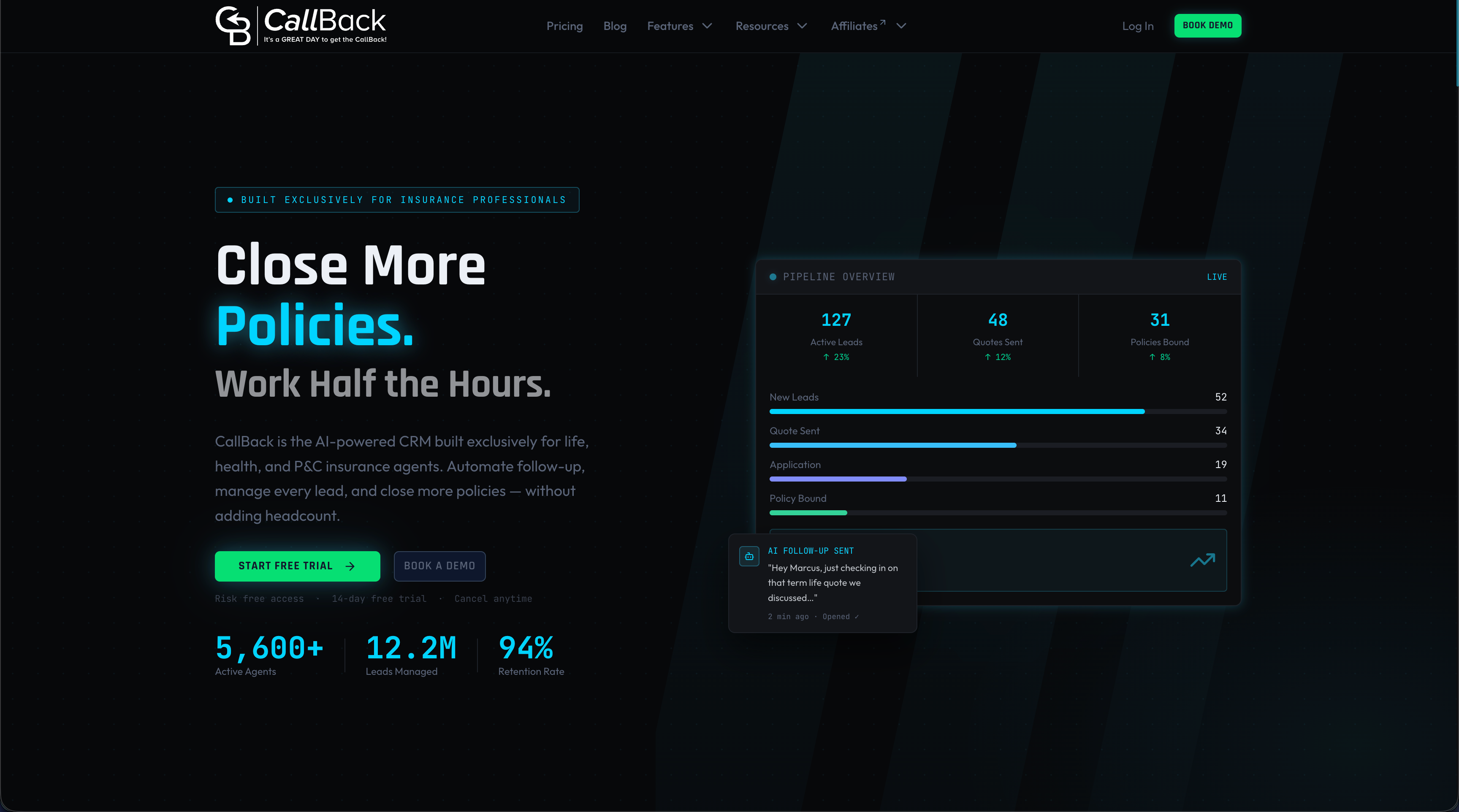
The platform’s workflow automation handles the 90/60/30 renewal triggers, mid-year touch sequences, and win-back campaigns from a single dashboard. SMS marketing features let you deliver personalized renewal reminders and claims updates directly to clients’ phones, with open rates that outperform email alone. The built-in analytics show retention KPIs by producer and by line of business, so you can spot at-risk accounts before they lapse. Callbackcrm also includes website and funnel tools to support client-facing content and referral capture. Start with the 90-day renewal workflow template and measure your retention lift after one cycle. Explore the platform or request a demo at callbackcrm.com.
Sources and further reading
- Agency Customer Retention Strategies: A Comprehensive Analysis for Brokers — Primary source for the 90/60/30 retention data, mid-year touchpoint statistics, claims advocacy lift, and win-back conversion rates used throughout this article.
- Client Retention Strategies for Independent Insurance Agents — Source for the 68% silent-departure finding and the proactive contact framework; underpins the churn-cause analysis.
- The IMO/FMO Playbook: Recruiting, Training and Retaining Top Insurance Agents — Supports the 90-day onboarding recommendations and the agent-satisfaction data from NAILBA and Insurance Forums.
- Co-Marketing Strategies That Help IMOs Recruit and Retain Top Agents — Evidence base for personalized automated outreach outperforming broadcast campaigns; supports AI personalization recommendations.
- Arete: AI for Retention and Lead Revival — Practitioner source for churn-prediction modeling and AI-driven lead revival ROI; informs the AI tactics section.
- Insurance Client Retention Strategies That Actually Work — Source for multi-policy retention benchmarks (93–95% vs. 70–75%) and industry retention rate ranges.
- How to Automate Client Outreach for Insurance Agencies — Callbackcrm step-by-step guide for configuring automated outreach sequences aligned with the 90/60/30 workflow.
- Marketing Automation Checklist for SMBs — Supplementary checklist for agencies setting up automation workflows for the first time.
Recommended
- Client Retention in Insurance: Why It Drives Profit | CallBack CRM Blog
- The Role of AI in Client Retention for Insurance Pros | CallBack CRM Blog
- Customer Engagement Best Practices That Drive Insurance Sales | CallBack CRM Blog
- Reputation Management Explained for Insurance Agents | CallBack CRM Blog