

TL;DR:
- AI-driven client retention uses predictive analytics and personalization to identify and engage at-risk clients proactively. It complements human agents by automating monitoring tasks, enabling more targeted and timely relationship management. Implementing AI effectively requires clean data, disciplined testing, and integration with existing workflows to achieve measurable reductions in churn.
AI-driven client retention is defined as the use of predictive analytics, behavioral modeling, and automated personalization to identify at-risk clients and intervene before they leave. For insurance professionals, the role of AI in client retention has shifted from a competitive advantage to a baseline requirement. Firms using platforms like Darwin AI and Fullcast are already cutting attrition by up to 50% by analyzing dozens of behavioral signals simultaneously. The old model of waiting for renewal season to check in with clients is being replaced by continuous, data-guided relationship management that operates around the clock.
How does AI predict and detect churn risk in insurance portfolios?
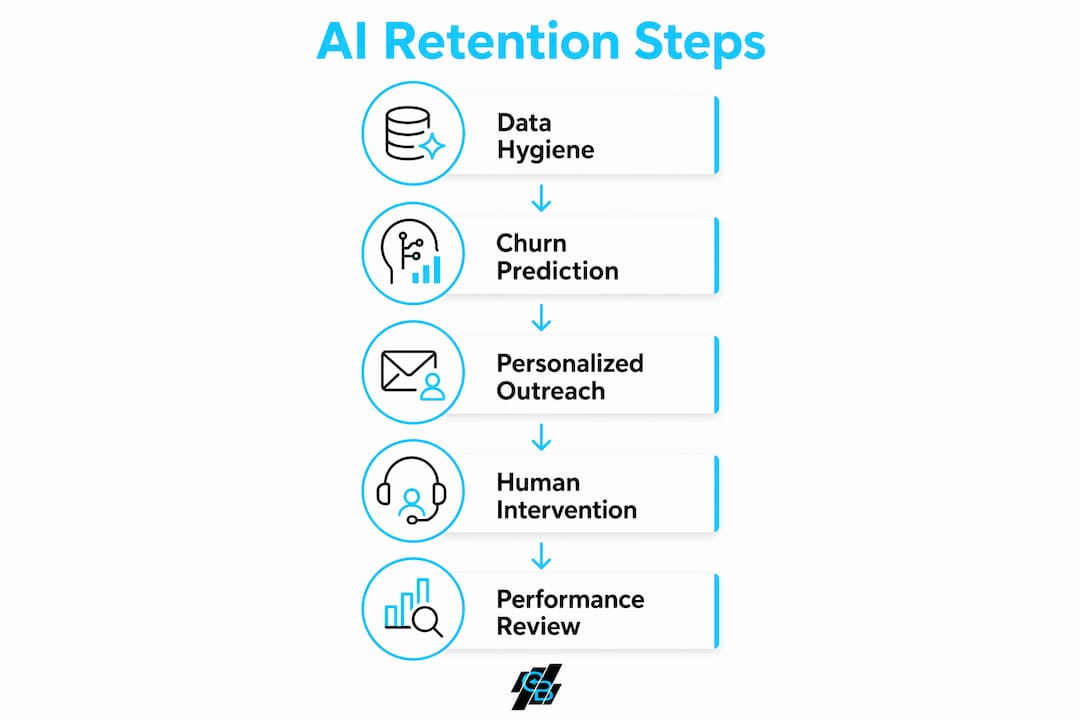
Predictive churn detection is the foundation of every effective AI retention program. AI models analyze between 50 and 100 behavioral signals per client, including policy usage patterns, support ticket frequency, email open rates, and sentiment shifts in communication. Each signal feeds a churn probability score that updates in real time, giving agents a ranked list of clients who need attention before they ever pick up the phone to cancel.
The practical result is striking. Subscription businesses using predictive AI have reduced churn by 25 to 40% within six months. That figure translates directly to insurance: an agency retaining even 5% more of its book of business each year compounds into significant revenue over a three to five year horizon.
Three data inputs matter most for insurance-specific churn models:
- Policy engagement signals: Login frequency to client portals, claims history, and mid-term endorsement requests all indicate how actively a client values their coverage.
- Communication responsiveness: Declining email open rates or unanswered renewal calls are early warning signs that a client’s attention is drifting toward a competitor.
- Life event triggers: Address changes, new vehicle registrations, or business filings often precede coverage shopping. AI flags these events automatically.
Pro Tip: Before deploying any churn model, audit your CRM data for duplicate records and incomplete contact fields. AI scales whatever data quality you feed it. Clean data produces accurate scores; dirty data produces expensive mistakes.
The prerequisite for all of this is data hygiene. Identity resolution, which means linking the same client across multiple touchpoints and policy records, is the unglamorous work that determines whether your AI scores are trustworthy or misleading.
What AI-driven retention strategies should insurance firms prioritize?
The most effective artificial intelligence customer retention strategies move well beyond sending automated renewal reminders. They use client data to determine the right message, the right channel, and the right moment for every individual interaction.
Here are the four tactics with the strongest track record in insurance retention:
-
Hyper-personalized outreach. AI segments clients by coverage type, claim history, life stage, and risk profile, then tailors every communication accordingly. AI-driven personalization improves customer satisfaction by 15 to 20% and increases revenue by 5 to 8%. For an insurance agent, that means fewer generic renewal letters and more conversations that feel relevant to the client’s actual situation.
-
Next-best-action modeling. Rather than guessing whether to offer a discount, a coverage upgrade, or a simple check-in call, next-best-action models calculate which intervention produces the highest retention probability for each client at each moment. This replaces gut instinct with data-guided decisions.
-
AI-powered chatbots and voice agents. Scalable check-ins are impossible with a human-only team. AI voice agents and chatbots handle routine policy questions, collect satisfaction signals, and escalate to a human agent when sentiment turns negative. 56% of consumers are comfortable letting AI handle all brand communications, which means clients are increasingly receptive to these touchpoints.
-
Value optimization over discount dependency. The traditional retention playbook leans heavily on price concessions at renewal. AI changes this by identifying which clients are price-sensitive versus which ones are simply underinformed about the value they already receive. Agents can then direct discounts only where they are genuinely necessary, protecting margins across the rest of the book.
Pro Tip: Test your next-best-action model against a randomized holdout group before rolling it out agency-wide. This gives you clean evidence of what the AI actually caused versus what would have happened anyway.
For a deeper look at AI engagement strategies specific to insurance, the frameworks for audience segmentation and re-engagement campaigns translate directly into retention workflows.
How does AI complement human efforts in insurance client retention?
The most accurate mental model for AI in retention is not a replacement for your agents. It is an intelligence layer that handles the monitoring work no human team could sustain at scale.
AI manages retention signals continuously without fatigue, processing engagement data across an entire client portfolio simultaneously. A human agent reviewing 300 accounts manually would miss the subtle drift in a client’s behavior that signals dissatisfaction three months before renewal. AI catches it on day one.
“The AI Client Retention Manager should be seen as an intelligence layer that automates invisible monitoring work and frees humans to focus on judgment and empathy.” — Collective54
What this means in practice is a clear division of labor. AI handles the 80% of monitoring work: tracking logins, flagging sentiment changes, scoring churn risk, and queuing outreach sequences. Human agents handle the 20% that requires genuine relationship skills: the empathetic conversation when a client has just filed a difficult claim, the nuanced explanation of why a premium increased, and the re-anchoring of value when a client is comparing quotes with a competitor.
Advanced AI does not directly manage relationships but analyzes signal drift to prompt human agents preemptively. The agent receives a notification that a long-term client’s engagement has dropped 40% over the past 60 days, along with a suggested talking point based on that client’s coverage profile. The human then makes the call with context they would never have had otherwise.

This partnership model also protects against the most common failure mode in AI retention programs: the “set-and-forget” trap. Automated sequences that run without human oversight can send the wrong message at the wrong time, damaging the very relationships they were designed to protect.
What steps should insurance firms take to implement AI retention effectively?
Effective implementation starts with data infrastructure, not technology selection. The most sophisticated AI platform produces unreliable results when fed fragmented or inconsistent client records.
| Implementation Stage | Key Action | Common Pitfall |
|---|---|---|
| Data readiness | Audit CRM for duplicates, gaps, and inconsistent field formats | Deploying AI before resolving identity conflicts across policy systems |
| Signal selection | Define 10 to 15 behavioral events most predictive of churn in your book | Tracking vanity metrics like email opens without connecting them to renewal outcomes |
| Controlled testing | Run randomized holdout experiments before full deployment | Assuming correlation equals causation without a proper control group |
| Incentive alignment | Tie agent performance metrics to AI-flagged retention actions | Agents ignoring AI recommendations because compensation still rewards new sales only |
| Active monitoring | Review automated decision logs weekly during the first 90 days | Letting agentic AI sequences run unreviewed after initial setup |
Successful AI retention programs depend on disciplined experimentation and clean data pipelines. The firms that see the strongest results treat their first six months as a learning phase, not a deployment phase.
Platform selection matters too. Insurance workflows require AI tools that integrate with existing policy management systems and CRM platforms without requiring a full technology overhaul. Look for platforms that offer pre-built connectors, SMS and phone outreach capabilities, and transparent model explainability so agents understand why a client was flagged.
For practical guidance on AI in insurance marketing, the same data and segmentation principles that drive lead generation apply directly to retention program design.
What are the measurable impacts and future trends of AI in insurance retention?
The business case for AI-driven retention is no longer theoretical. Insurance firms shifting to AI-assisted retention see improved margins and reduced discounting by prioritizing actions based on customer value and churn risk. BCG’s research on always-on retention models shows that the shift from reactive to predictive engagement fundamentally changes the economics of client management.
| Metric | Typical AI-Driven Improvement |
|---|---|
| Churn reduction | 25 to 50% within 6 to 12 months |
| Customer lifetime value increase | 15 to 25% through targeted re-engagement |
| Service cost reduction | 20 to 30% via AI-handled routine interactions |
| Client satisfaction improvement | 15 to 20% from personalized experiences |
Three trends are reshaping the field in 2026. First, always-on retention engines that monitor every client continuously are replacing the quarterly review model. Second, generative AI copilots are drafting personalized renewal letters, claim follow-up messages, and coverage review summaries at scale. Third, AI-driven loyalty is shifting from transactional rewards to building authentic relationships using behavioral intelligence. The insurance firms that treat AI as a relationship tool rather than a cost-cutting mechanism will hold the strongest competitive position over the next five years.
Key takeaways
AI transforms insurance client retention by combining predictive churn detection, personalized outreach, and human-AI collaboration into a continuous, data-driven retention engine.
| Point | Details |
|---|---|
| Predictive churn detection | AI analyzes 50 to 100 behavioral signals to score churn risk before clients disengage. |
| Personalization drives results | AI-driven personalization improves satisfaction by 15 to 20% and revenue by 5 to 8%. |
| Human-AI division of labor | AI handles continuous monitoring; humans handle empathy and complex relationship repair. |
| Data quality is non-negotiable | Clean, deduplicated CRM data is the prerequisite for accurate AI retention scoring. |
| Experimentation proves impact | Randomized holdout testing separates genuine AI-driven retention gains from coincidence. |
Why most agencies are still getting AI retention wrong
I have watched insurance agencies invest in AI retention tools and then wonder why their churn numbers barely moved. The problem is almost never the technology. It is the assumption that deploying a tool is the same as running a program.
The agencies that see real results treat AI as a discipline, not a feature. They spend the first two months doing nothing but cleaning their data and defining which behavioral signals actually predict churn in their specific book of business. That unglamorous work is what separates a 40% churn reduction from a 5% one.
The other mistake I see constantly is undervaluing the human side of the equation. AI is genuinely excellent at identifying which client is about to leave. It is not good at the conversation that changes their mind. That still requires an agent who knows the client’s history, understands their concerns, and can speak to the value of the relationship rather than just the policy. The agencies winning at retention right now are the ones where agents trust the AI’s signals and act on them with genuine care, not scripted responses.
The future of retention in insurance is not fully automated. It is a model where AI handles the analytical work that used to fall through the cracks and humans show up to every at-risk conversation better prepared than they have ever been. That combination is genuinely hard to compete against.
— Kyle
See how Callbackcrm powers AI-driven retention for insurance agents
Insurance agents using Callbackcrm gain access to AI-powered engagement tools, automated outreach sequences, and predictive client monitoring built specifically for insurance workflows.
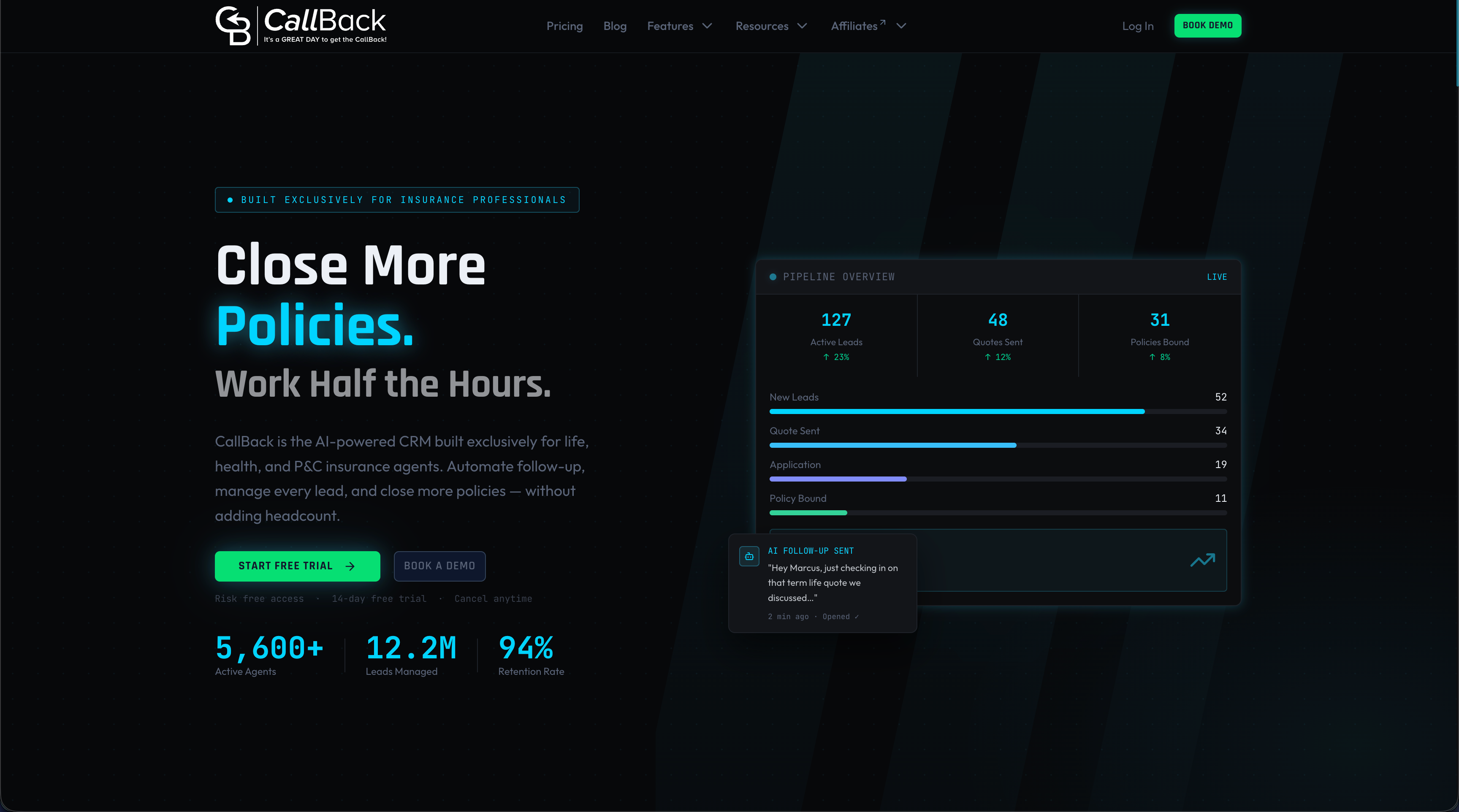
Callbackcrm’s full feature suite includes AI assistants, CRM automation, SMS and email marketing, and lead scoring, all in one platform designed to replace manual retention tasks with intelligent, data-guided actions. The platform integrates with existing insurance workflows without requiring a technology overhaul, and SMS marketing capabilities let you reach at-risk clients on the channel they actually respond to. If you are ready to move from reactive renewal calls to a continuous retention engine, Callbackcrm is built for exactly that.
FAQ
What is the role of AI in client retention?
AI’s role in client retention is to continuously analyze behavioral signals, predict which clients are at risk of leaving, and trigger personalized interventions before churn occurs. It replaces reactive, manual processes with a data-driven system that operates without interruption.
How much can AI reduce churn for insurance firms?
Leading organizations using predictive AI models have cut attrition rates by up to 50%, with most firms seeing measurable churn reductions of 25 to 40% within the first six months of deployment.
Does AI replace human agents in client retention?
AI does not replace human agents. It handles continuous monitoring and data analysis so agents can focus on empathy-driven conversations with clients who have been flagged as at-risk, making every human interaction more informed and better timed.
What data does AI need to predict client churn?
AI churn models require clean, deduplicated client records with behavioral event data such as portal logins, communication responsiveness, claims activity, and life event triggers. Data quality directly determines the accuracy of churn probability scores.
How do insurance firms prove that AI retention programs actually work?
Disciplined experimentation with randomized holdout groups is the standard method for proving causation. Comparing retention rates between clients who received AI-guided interventions and those who did not isolates the actual impact of the program from natural renewal patterns.