

The ‘set it and forget it’ approach to client interaction is no longer effective in today’s insurance landscape. Your clients expect more than annual policy renewals and occasional check-ins. They want continuous, personalized engagement that anticipates their needs and delivers value at every touchpoint. AI-powered automation has transformed how insurance agents and brokers build lasting relationships, moving from reactive service models to proactive, intelligent engagement strategies. This shift isn’t optional anymore. It’s essential for retention, growth, and competitive survival in 2026.
Table of Contents
- Understanding Customer Engagement In Insurance
- AI-Powered Tools Transforming Insurance Customer Engagement
- Strategies For Personalized Engagement And Lead Generation In Insurance
- Ensuring Data Privacy And Human Oversight In Automated Engagement
- Enhance Your Customer Engagement With CallBack CRM
Key takeaways
| Point | Details |
|---|---|
| Continuous engagement required | Modern insurance clients expect ongoing, personalized interactions beyond policy transactions |
| AI enables proactive service | Reinforcement learning and sentiment analysis automate real-time customer responses and emotional feedback |
| Personalization drives conversion | Tailored offers based on behavior patterns and claim history significantly boost profitability |
| Data privacy is non-negotiable | Strict adherence to protection regulations and human oversight maintains client trust |
| Automation enhances efficiency | AI-driven workflows improve retention rates by 90% and customer satisfaction by 91% |
Understanding customer engagement in insurance
Customer engagement in insurance means creating continuous interactions that extend far beyond policy sales and renewals. It’s the ongoing dialogue between you and your clients that builds trust, anticipates needs, and delivers value at every stage of their insurance journey. Customer expectations are rising, and brokers must evolve to become trusted advisors rather than transactional service providers.
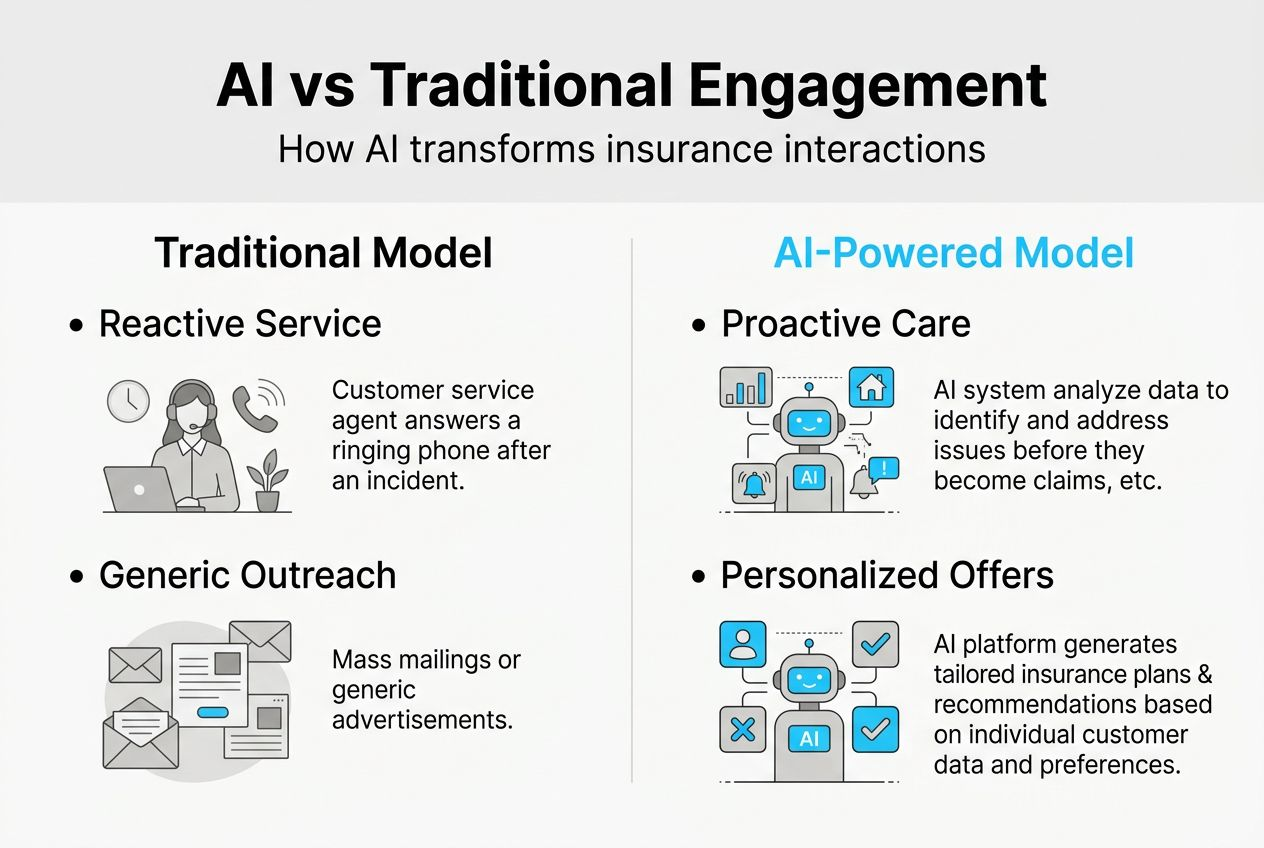
The shift from reactive to proactive client relationships defines modern insurance success. Traditional models waited for clients to reach out with questions or claims. Today’s engagement strategies use data and AI to predict client needs, offer timely solutions, and maintain consistent communication across multiple channels. This transformation directly impacts your bottom line.
Customer engagement has emerged as a crucial factor for building loyalty, increasing renewals, and enhancing business profitability in the intense and competitive insurance industry. When you engage clients continuously, you create emotional connections that transcend price comparisons. You become their go-to resource for risk management, not just a policy provider.
Ignoring engagement trends carries serious risks in competitive insurance markets:
- Loss of clients to competitors offering more personalized service
- Reduced renewal rates as relationships weaken over time
- Missed cross-selling opportunities due to limited client interaction
- Declining referrals from disengaged customer bases
- Inability to differentiate your agency in commoditized markets
The insurance landscape has fundamentally changed. Clients now expect the same level of personalized, responsive service they receive from other industries. They want mobile access, instant answers, and proactive recommendations. Meeting these expectations requires more than good intentions. It demands systematic, technology-enabled engagement strategies that scale across your entire client base.
Implementing effective lead generation tips and understanding the benefits of sales automation form the foundation of modern engagement strategies. These tools allow you to maintain consistent contact without overwhelming your team or sacrificing quality.
AI-powered tools transforming insurance customer engagement
Artificial intelligence has revolutionized how insurance agents interact with clients, moving beyond simple automation to intelligent, adaptive engagement systems. Reinforcement learning and natural language processing sentiment analysis enable real-time emotional feedback during customer interactions. These technologies analyze tone, word choice, and context to gauge client satisfaction and adjust responses accordingly.
Agentic AI systems represent a quantum leap beyond traditional chatbots. While chatbots react to customer inputs with pre-programmed responses, AI agents proactively manage workflows end-to-end, processing claims, detecting anomalies, orchestrating approvals, and knowing when to bring humans into the loop. This distinction matters enormously for insurance operations.
The efficiency gains are remarkable. An integrated framework of NLP and RL demonstrated increased efficiency in automating tasks (92%), retention (90%), and customer satisfaction (91%). These aren’t marginal improvements. They represent fundamental shifts in operational capacity and client experience quality.

AI-enhanced, continuous engagement of clients is crucial for retention in the insurance brokerage industry. The technology enables personalized communication at scale, something impossible with manual processes alone. You can now deliver customized policy recommendations, timely risk alerts, and proactive service outreach to thousands of clients simultaneously.
Key benefits of AI tools for automated workflows include:
- Real-time sentiment analysis adjusting communication tone and content
- Predictive analytics identifying at-risk clients before they churn
- Automated follow-up sequences maintaining consistent client touchpoints
- Intelligent lead scoring prioritizing high-value prospects
- Natural language processing handling routine inquiries instantly
Pro Tip: Despite AI’s impressive capabilities, maintain human oversight for complex or emotionally sensitive situations. AI excels at efficiency and pattern recognition, but human judgment remains essential for nuanced decision-making and relationship building.
Understanding what sales automation entails and exploring the AI advantage for insurance agents helps you identify which tools deliver the greatest impact for your agency. Integration between CRM and marketing systems creates seamless data flow, ensuring AI tools have the information needed to personalize every interaction.
The technology improving client engagement continues evolving rapidly. Staying current with AI capabilities gives you competitive advantages in client retention and acquisition. The agents who embrace these tools now position themselves for sustained growth, while those who resist risk obsolescence in an increasingly automated industry.
Strategies for personalized engagement and lead generation in insurance
Personalization transforms generic outreach into relevant, valuable communication that resonates with individual clients. Personalized offers based on purchase methods, behavior patterns, or claim history can yield a higher conversion rate and boost business profitability. This approach leverages customer data to create targeted messaging that addresses specific needs and circumstances.
The difference between traditional and AI-driven personalized engagement is substantial:
| Approach | Traditional Engagement | AI-Driven Personalization |
|---|---|---|
| Data utilization | Limited to basic demographics | Comprehensive behavioral and transactional analysis |
| Timing | Scheduled campaigns | Real-time, triggered by customer actions |
| Content | Generic messages to segments | Individualized recommendations per client |
| Scale | Manual effort limits reach | Automated delivery to entire customer base |
| Optimization | Periodic review and adjustment | Continuous learning and improvement |
Tailoring content to meet the specific needs and preferences of individual customers, based on data and customer intelligence, improves rapport, communication, and enhances business reputation. This isn’t about manipulation. It’s about relevance. When you understand what matters to each client, you can provide information and solutions that genuinely help them.
Implementing continuous multi-channel lead generation strategies requires a systematic approach:
- Map the complete customer journey from awareness to advocacy
- Identify key touchpoints where engagement adds maximum value
- Deploy AI tools to automate routine communications at each stage
- Create content libraries addressing common questions and concerns
- Monitor engagement metrics to refine messaging and timing
- Integrate email, SMS, social media, and phone outreach seamlessly
Pro Tip: Balance automation with authentic human connection. Use AI to handle routine interactions and data analysis, but reserve personal outreach for milestone moments, complex decisions, and relationship-building conversations that strengthen client loyalty.
The business impact of personalized engagement is clear. Companies like Lemonade have built entire business models around AI-powered personalization, achieving rapid growth by delivering exactly what customers want when they need it. You don’t need to be a tech giant to implement similar strategies. Modern platforms make sophisticated personalization accessible to agencies of all sizes.
Developing an effective lead generation workflow and applying proven lead generation tips creates the foundation for sustainable growth. These systems ensure no prospect falls through the cracks while maintaining the personal touch that distinguishes top-performing agencies.
Personalization extends beyond marketing to every client interaction. Policy reviews become opportunities to recommend coverage adjustments based on life changes detected through data signals. Renewal conversations reference specific claim experiences and evolving risk profiles. Service interactions anticipate needs before clients articulate them. This level of engagement creates stickiness that price competition cannot overcome.
Ensuring data privacy and human oversight in automated engagement
Data privacy and security are paramount when implementing AI-powered engagement tools. Insurance agents and brokers must adhere to strict data protection regulations when using AI-powered tools. The stakes are high. A single data breach can destroy client trust built over decades and expose your agency to significant legal liability.
Key data privacy laws affecting AI use in insurance include the Health Insurance Portability and Accountability Act for health-related data, state-level privacy regulations like the California Consumer Privacy Act, and industry-specific compliance requirements from regulatory bodies. Understanding these frameworks isn’t optional. It’s foundational to responsible AI deployment.
Best practices for protecting client data in automated systems:
- Encrypt all data at rest and in transit using industry-standard protocols
- Implement role-based access controls limiting who can view sensitive information
- Conduct regular security audits and vulnerability assessments
- Maintain detailed logs of data access and AI system decisions
- Use secure cloud providers with robust compliance certifications
- Train staff on data handling procedures and security protocols
Human oversight remains critical even as AI capabilities expand. A common pitfall is over-reliance on AI without proper human oversight, so ensure that complex or sensitive issues are escalated to human agents. AI excels at pattern recognition and efficiency, but it lacks the contextual understanding and empathy required for nuanced situations.
The balance between AI efficiency and ethical responsibility defines sustainable automation strategies. You want systems that enhance your capabilities without replacing the human judgment that clients value. This means designing workflows with clear escalation paths, regular quality reviews, and feedback loops that improve AI performance over time.
Top compliance and privacy safeguards for AI-powered engagement:
- Obtain explicit consent before collecting or using client data
- Provide transparent explanations of how AI systems use customer information
- Allow clients to opt out of automated communications easily
- Regularly review AI decisions for bias or unintended consequences
- Maintain human review processes for high-stakes decisions
- Document AI system logic and decision-making processes
Understanding what sales automation involves and recognizing the benefits of sales automation helps you implement these tools responsibly. The goal is enhancement, not replacement, of human capabilities.
Client trust forms the foundation of insurance relationships. Every technology decision should reinforce that trust rather than undermine it. When you demonstrate commitment to data privacy and maintain appropriate human oversight, you differentiate your agency as both innovative and trustworthy. This combination positions you for long-term success in an AI-powered insurance landscape.
Enhance your customer engagement with CallBack CRM
CallBack CRM delivers the AI-powered automation capabilities insurance agents need to transform customer engagement. Our platform combines intelligent lead management, personalized communication tools, and seamless workflow automation in one comprehensive system. You get the technology advantage of enterprise solutions with the simplicity and affordability independent agencies require.
Our AI business automation features handle routine tasks so you can focus on relationship building and complex client needs. The integrated CRM system manages leads and customers with intelligent scoring and automated follow-up sequences. SMS marketing automation keeps clients engaged with timely, personalized messages that drive action. Experience how CallBack CRM can revolutionize your agency’s engagement strategy with a free demo and marketing audit.
FAQ
What is the difference between a chatbot and an AI agent?
Chatbots are reactive systems that wait for input and respond with pre-programmed answers, while AI agents are proactive systems that initiate actions and make decisions. AI agents can own entire workflows, processing claims, detecting anomalies, orchestrating approvals, and determining when human intervention is needed. This fundamental difference means AI agents deliver far more value for complex insurance operations than simple chatbots.
How does AI improve customer retention for insurance brokers?
AI enables proactive, personalized customer interactions that strengthen relationships and reduce churn. AI-enhanced, continuous engagement of clients is crucial for retention in the insurance brokerage industry. By analyzing customer behavior patterns and sentiment in real time, AI systems identify at-risk clients and trigger appropriate retention strategies before customers consider switching providers. This proactive approach improves satisfaction and loyalty.
What are best practices for data privacy when using AI tools?
Follow applicable data protection laws including HIPAA, CCPA, and industry-specific regulations. Insurance agents must adhere to strict data protection regulations when using AI-powered tools. Use encrypted, secure systems for storing and processing client information, implement role-based access controls, and conduct regular security audits. Maintain human oversight for sensitive issues and provide transparent explanations of how AI systems use customer data.
How can insurance agents balance automation with personal service?
Use AI to handle routine communications, data entry, and initial inquiries while reserving human interaction for complex decisions, emotional situations, and relationship-building moments. Design workflows with clear escalation paths so AI systems know when to involve human agents. This approach maximizes efficiency without sacrificing the personal touch that differentiates top-performing agencies and builds lasting client loyalty.
What metrics should insurance agents track for engagement effectiveness?
Monitor customer satisfaction scores, retention rates, response times, conversion rates from leads to policies, and client lifetime value. Track engagement metrics like email open rates, SMS response rates, and website interaction patterns. Analyze which touchpoints generate the most value and refine your strategies accordingly. Regular measurement ensures your engagement efforts deliver tangible business results rather than just activity.
How quickly can insurance agencies implement AI-powered engagement tools?
Most modern platforms enable implementation within weeks rather than months. Cloud-based solutions like CallBack CRM require minimal technical setup and provide guided onboarding processes. The key is starting with core features like automated follow-up and lead scoring, then expanding to more advanced capabilities as your team gains proficiency. Gradual implementation reduces disruption while delivering immediate efficiency gains.