

Many insurance agents at mid-sized firms know the frustration of juggling endless manual tasks while striving to build meaningful connections with clients. As the insurance industry evolves, automation powered by artificial intelligence holds the promise to transform sales processes and customer engagement. This article explores common misconceptions about sales automation, highlights automation augments human capabilities, and reveals practical strategies for integrating AI tools to boost efficiency and lead engagement.
Table of Contents
- Sales Automation Fundamentals And Misconceptions
- Types Of Sales Automation Technologies
- How Sales Automation Streamlines Sales Tasks
- Ai-Powered Features And Real-World Insurance Use Cases
- Risks, Pitfalls, And Best Practices For Adoption
Key Takeaways
| Point | Details |
|---|---|
| Sales Automation Enhances Human Interaction | Automation does not replace human connection; it enables sales representatives to focus on building relationships by handling routine tasks. |
| AI-Powered Insights Transform Sales | Advanced AI technologies provide valuable insights that facilitate data-driven decision making and optimize customer interactions. |
| Gradual Implementation is Key | Start with automating specific workflows and expand based on measurable results to ensure effectiveness. |
| Balance Technology and Human Expertise | Successful automation requires a mix of technological capabilities and human oversight to maintain a personal touch in customer relationships. |
Sales automation fundamentals and misconceptions
Sales automation represents a strategic approach to streamlining complex sales workflows through intelligent technological solutions. Foundational research reveals that modern sales automation goes far beyond simple task elimination - it’s about creating smarter, more responsive customer engagement systems.
At its core, sales automation involves using software and artificial intelligence to handle repetitive tasks, manage customer interactions, and optimize sales processes. Key components typically include:
- Automatic lead capture and scoring
- Customer communication tracking
- Email and communication scheduling
- Performance analytics and reporting
- Workflow standardization
Many insurance professionals mistakenly believe automation will completely replace human interaction. However, the reality is quite different. Automation augments human capabilities, allowing sales representatives to focus on high-value relationship-building activities while technology handles routine tasks.
Automation doesn’t replace human connection - it enables more meaningful interactions by eliminating administrative overhead.
The most successful sales teams view automation as a collaborative tool. By leveraging AI-powered platforms, agents can spend more time understanding client needs and less time on manual data entry or administrative work. Advanced automation technologies can predict customer behaviors, recommend personalized outreach strategies, and provide real-time insights that transform traditional sales approaches.
Pro tip: Start small by automating one specific workflow, like lead follow-up sequences, and gradually expand your automation strategy based on measurable results.
Types of sales automation technologies
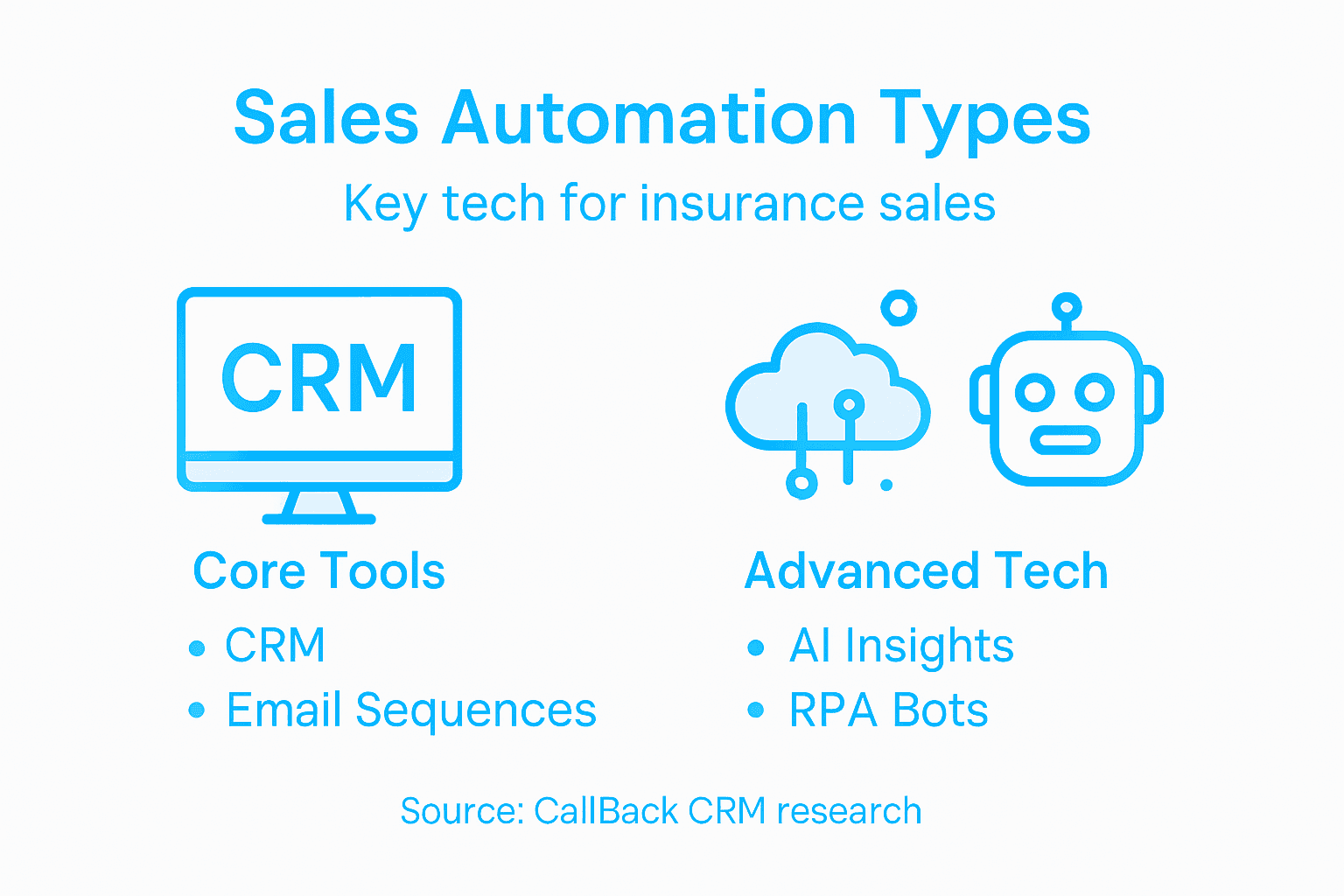
Modern sales automation technologies represent a sophisticated ecosystem of tools designed to transform how businesses engage with potential customers. These technologies range from basic workflow management systems to advanced artificial intelligence platforms that can predict and personalize customer interactions.
The primary categories of sales automation technologies include:
- Customer Relationship Management (CRM) Systems
- Contact tracking and management
- Interaction history logging
- Sales pipeline visualization
- Communication Automation Tools
- Email sequencing
- Scheduled follow-up campaigns
- Template-based messaging
- Lead Generation and Scoring Technologies
- Automatic lead capture
- Behavioral tracking
- Predictive lead qualification
AI-powered technologies are revolutionizing sales automation by introducing unprecedented levels of intelligence and adaptability. Machine learning algorithms can now analyze vast datasets to provide nuanced insights about customer behaviors, preferences, and potential purchasing patterns.
Intelligent automation doesn’t just replace tasks - it transforms entire sales ecosystems by enabling data-driven decision making.
Beyond traditional tools, emerging technologies like robotic process automation and advanced analytics are creating more dynamic and responsive sales environments. Sophisticated automation platforms now integrate multiple technologies to provide comprehensive solutions that adapt in real-time to changing market conditions and customer needs.
Pro tip: Evaluate automation technologies based on their ability to integrate seamlessly with your existing systems and provide actionable, measurable insights.
How sales automation streamlines sales tasks
Sales automation dramatically reduces manual administrative work, transforming how sales professionals spend their time and energy. By automating repetitive tasks, teams can redirect their focus toward high-value customer interactions and strategic relationship building.
Key areas where sales automation streamlines tasks include:
- Lead Management
- Automatic lead scoring
- Instant lead routing
- Prioritization based on engagement
- Communication Workflows
- Scheduled follow-up emails
- Personalized messaging sequences
- Automated response tracking
- Administrative Processes
- Automatic data entry
- Real-time reporting
- Performance tracking
Traditional sales processes often consume significant time with manual data management and administrative overhead. Intelligent automation eliminates these bottlenecks by creating seamless, rules-based workflows that operate with minimal human intervention.

Here’s a comparison of traditional sales processes and sales automation approaches:
| Aspect | Traditional Sales | Sales Automation |
|---|---|---|
| Time Spent | Much on manual tasks | Focus on value activities |
| Data Accuracy | Prone to human errors | Automated, consistent input |
| Lead Prioritization | Manual, often subjective | AI-driven, data-based |
| Scalability | Difficult to expand quickly | Easily scales with growth |
| Customer Insights | Limited, lagging reports | Real-time analytics |
Automation transforms sales from a transaction-driven process to a strategic, insight-powered engagement model.
Advanced workflow technologies now enable sales teams to automatically route leads, generate precise quotes, and manage complex sales pipelines with unprecedented efficiency. By integrating artificial intelligence and rules-based systems, businesses can reduce processing times, minimize human error, and create more predictable sales experiences.
Pro tip: Prioritize automation technologies that integrate directly with your existing CRM and provide clear, measurable performance metrics.
AI-powered features and real-world insurance use cases
Advanced AI technologies are revolutionizing insurance sales by transforming traditional approaches to customer engagement, risk assessment, and personalized service delivery. These intelligent systems go beyond simple automation, creating sophisticated mechanisms that can predict, analyze, and respond to complex customer needs with unprecedented precision.
Key AI-powered features for insurance sales include:
- Predictive Analytics
- Risk score calculation
- Customer lifetime value prediction
- Churn probability assessment
- Intelligent Customer Interaction
- Automated personalized communication
- Dynamic policy recommendation
- Proactive service alerts
- Operational Optimization
- Automated claim processing
- Real-time underwriting decisions
- Fraud detection algorithms
Generative AI technologies are creating new paradigms in insurance sales, enabling more nuanced and contextually aware interactions. These systems can draft personalized policy proposals, generate targeted marketing content, and provide instantaneous customer support with human-like understanding.
AI transforms insurance from a transactional service to a predictive, personalized customer experience.
AI-driven sales automation enables insurance professionals to move beyond reactive strategies, offering proactive solutions that anticipate customer needs before they arise. By analyzing vast datasets, these technologies can identify emerging risks, recommend tailored insurance products, and create more meaningful client relationships.
Pro tip: Implement AI tools incrementally, starting with specific high-impact processes and gradually expanding their integration across your sales ecosystem.
Risks, pitfalls, and best practices for adoption
Sales automation adoption presents complex organizational challenges that extend far beyond simple technological implementation. Insurance professionals must navigate a delicate balance between technological innovation and maintaining the essential human elements of customer relationships.
Key risks and potential pitfalls in sales automation adoption include:
- Technological Challenges
- Data integration complexity
- System compatibility issues
- Potential algorithmic bias
- Organizational Resistance
- Staff technological anxiety
- Fear of job displacement
- Cultural adaptation difficulties
- Operational Vulnerabilities
- Over-reliance on automated systems
- Reduced personal customer interactions
- Potential privacy and security risks
Automated workflows can inadvertently create blind spots if not carefully designed and continuously monitored. Insurance teams must maintain a critical perspective, understanding that technology should enhance rather than completely replace human judgment and emotional intelligence.
Below is a summary of top risks and best practices for adopting sales automation:
| Risk/Pitfall | Consequence | Best Practice |
|---|---|---|
| Staff resistance | Delays or project failure | Offer training and clear communication |
| Data integration issues | Disconnected or lost information | Invest in robust system compatibility |
| Over-reliance on automation | Loss of personal customer touch | Balance tech with human oversight |
| Algorithmic bias | Unfair treatment of clients | Regularly audit and test AI systems |
| Security vulnerabilities | Data breaches, reputation damage | Implement strict data protection |
Successful automation requires a strategic, nuanced approach that respects both technological capabilities and human expertise.
Systematic implementation strategies are crucial for mitigating potential risks. This involves phased rollouts, comprehensive staff training, transparent communication, and establishing clear performance metrics that demonstrate the tangible benefits of automation technologies.
Pro tip: Create a cross-functional team representing sales, technology, and customer experience departments to oversee your automation adoption strategy and ensure holistic implementation.
Unlock the Full Potential of Sales Automation for Insurance Professionals
Many insurance agents and agencies face the challenge of balancing human connection with the efficiency of automation. This article highlights how modern sales automation, including AI-powered lead scoring, personalized customer outreach, and workflow standardization, can transform traditional sales methods while preserving meaningful client interactions. If you are seeking to reduce manual data entry, eliminate cold calling, and leverage predictive analytics to prioritize high-value leads, then adopting intelligent automation is a vital step forward.
CallBack CRM is designed exactly for professionals like you who want to harness the power of AI-driven sales automation without losing the personal touch that builds trust. Our all-in-one platform offers advanced CRM management, automated email and SMS marketing, AI assistants, and seamless workflow automation to streamline every stage of your sales process. With integrations and secure data handling, you can confidently modernize your sales efforts and focus on strategic relationship building.
Discover how CallBack CRM can help you increase efficiency, reduce operational risks, and deliver a truly personalized customer experience. Start with one workflow and expand your automation strategy with measurable results by visiting CallBack CRM today.
Take control of your sales future now by exploring our intelligent solutions tailored for insurance agents and agencies. Visit CallBack CRM to get started and transform your sales approach with AI-powered automation that works for you.
Frequently Asked Questions
What is sales automation?
Sales automation refers to the use of software and artificial intelligence to streamline sales processes, manage customer interactions, and handle repetitive tasks, allowing sales teams to focus on valuable relationship-building activities.
How does sales automation enhance customer engagement?
Sales automation enhances customer engagement by enabling more meaningful interactions. It eliminates administrative overhead, freeing sales representatives to spend more time understanding client needs and fostering relationships.
What types of technologies are used in sales automation?
Sales automation utilizes various technologies including Customer Relationship Management (CRM) systems, communication automation tools, and lead generation technologies, all designed to optimize sales processes and interactions.
What are the benefits of implementing sales automation in my business?
Implementing sales automation can dramatically reduce manual administrative work, improve data accuracy, enable real-time analytics, and allow for scalable sales processes, ultimately leading to increased efficiency and revenue growth.
Recommended
- Optimize Your Lead Funnel: Boost Conversions with Automation
- 5 Ways AI Can Transform Your Small Business in 2025
- Unlock AI Insights: Transform Your Small Business by 2025
- Growth Strategies for Business Success | CallBack Insights
- ChatTrips.si - AI Avtomatizacija, Klicni Agenti, AI Chatboti in Marketing Asistenti | #1 v Sloveniji