

TL;DR:
- Automating lead capture and qualification significantly increases speed, accuracy, and scalability for insurance agencies.
- Ongoing monitoring and data quality are essential to maintain automation effectiveness and compliance.
- Focusing on refining core workflows before adding AI tools ensures operational readiness and maximizes ROI.
Insurance agencies that still rely on manual lead tracking, handwritten follow-up notes, and cold call scripts are leaving serious money on the table. Top-performing agencies are now closing 34% more leads and retaining more clients by letting AI handle the repetitive work. This guide walks you through a practical, step-by-step blueprint for building an AI-powered sales automation system, from workflow mapping and lead capture to follow-up sequences and ongoing optimization. Whether you run a small independent agency or a multi-agent IMO, you will find actionable steps you can start using today.
Table of Contents
- Assess your sales process and prepare for automation
- Automate lead capture and qualification: Step-by-step
- Automate follow-ups, cross-selling, and renewals
- Monitoring, optimization, and common pitfalls
- Why operational readiness beats technology: Our hard-won lesson
- Supercharge your sales process with CallBack CRM
- Frequently asked questions
Key Takeaways
| Point | Details |
|---|---|
| Map and prep first | Preparing sales workflows and clarifying data needs is the key to automation success. |
| Automate high-ROI steps | Lead qualification, follow-ups, cross-selling, and renewals see the biggest gains from automation. |
| Integrate and monitor | Tie your CRM and tools together, then consistently track key metrics like conversions and ROI. |
| Test and refine | Run automation on historical data first, address edge cases, and continuously improve your system. |
| People and process matter | No tech can replace a solid sales process and the human touch in client relationships. |
Assess your sales process and prepare for automation
Before you touch a single piece of software, you need a clear picture of how leads move through your agency. Skipping this step is the single biggest reason automation projects stall or fail. Think of it like renovating a house: you would not start knocking down walls before understanding the floor plan.
Mapping your sales workflow means writing out every touchpoint from first contact to policy binding. That includes how leads arrive, who qualifies them, how follow-ups are scheduled, when renewals are flagged, and how cross-sell conversations begin. Once you see it on paper, the bottlenecks become obvious.
Common bottlenecks to look for:
- Lead qualification delays: Agents manually reviewing every inquiry instead of using scoring criteria
- Missed renewal windows: No proactive outreach until 30 days before expiration
- Inconsistent follow-up: No standard cadence for SMS, email, or calls after initial contact
- Untapped cross-sell signals: Life events like home purchases or new drivers going unnoticed
- Manual data entry: Time lost copying lead info from one system to another
Once you identify where time is being wasted, gather your prerequisites. Clean data is non-negotiable. Duplicate records, incomplete contact fields, and stale policy details will poison any automation you build. Audit your CRM, merge duplicates, and standardize field formats before moving forward.
Pro Tip: Follow the principle of mapping workflows first before layering AI. Automate your most repetitive operational tasks like data entry and appointment reminders before you introduce AI lead scoring or predictive outreach. Trying to run before you walk wastes budget and creates confusion.
Here is a quick reference for what you need in place:
| Tool or requirement | Purpose | Must-have or nice-to-have |
|---|---|---|
| CRM with clean data | Central record for all leads and clients | Must-have |
| Integrated phone/SMS | Outreach and follow-up automation | Must-have |
| Email marketing module | Drip campaigns and renewal sequences | Must-have |
| AI lead scoring module | Prioritize high-value prospects | Nice-to-have initially |
| Reporting dashboard | Track conversion and time saved | Must-have |
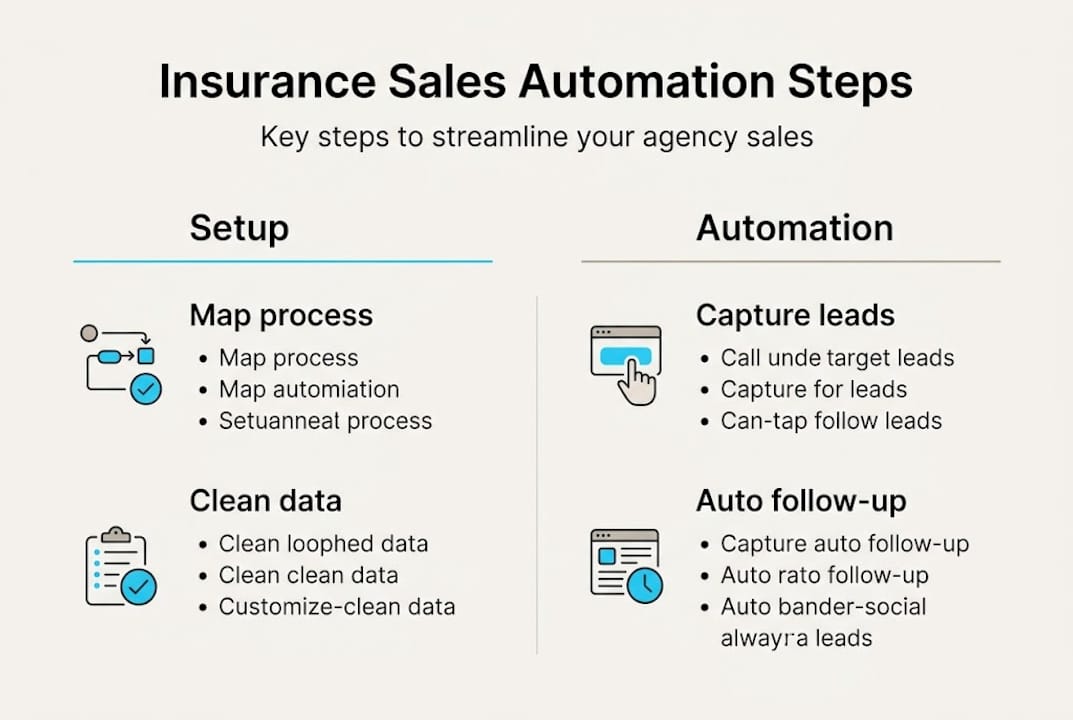
If you want to automate lead generation without rebuilding your entire stack, start by connecting your existing intake forms and call sources to a single CRM. That one step alone eliminates most data fragmentation issues. Reviewing sales funnel automation steps for insurance-specific workflows can also give you a practical checklist before launch.
Automate lead capture and qualification: Step-by-step
With your workflow mapped and your data cleaned, you are ready to execute. Lead capture and qualification is where automation delivers the fastest, most measurable return. Manual qualification is slow, inconsistent, and scales poorly. Automated qualification runs 24/7 and treats every lead the same way.
The seven-step qualification process breaks down like this:
- Define your ideal prospect profile: Age range, coverage type, income bracket, and geography for your target buyer.
- Map all lead sources: Web forms, social media ads, referral programs, call-ins, and any third-party lead vendors.
- Set lead scoring criteria: Assign point values to behaviors like form completions, email opens, page visits, and policy type interest.
- Connect your CRM: Integrate each lead source so every new contact lands in one place automatically, no copy-paste required.
- Configure automation rules: Set triggers so high-scoring leads get an instant SMS or email, and low-scoring leads enter a nurture sequence.
- Test with historical data: Run your scoring model against leads from the past 6 to 12 months to verify accuracy before going live.
- Launch and monitor: Go live, then review results weekly for the first 30 days to catch scoring errors or missed segments.
Here is a side-by-side look at what changes when you automate:
| Factor | Manual qualification | Automated qualification |
|---|---|---|
| Speed | Hours to days | Seconds to minutes |
| Cost per lead | High (agent time) | Low (automated triggers) |
| Accuracy | Inconsistent | Consistent and rule-based |
| Scalability | Limited by headcount | Scales with lead volume |
| Follow-up timing | Delayed | Immediate |
Pro Tip: Never skip the historical data test in step six. Running your model against real past leads reveals blind spots you would never catch in a sandbox environment. It is the single best way to validate your AI lead scoring guide setup before risking live prospects.
Field mapping is another detail that agencies overlook. When a lead fills out a web form, each field needs to map to the exact CRM field it belongs to. Misaligned fields create gaps in your scoring data and break automation triggers downstream. Build a field map spreadsheet before integration, not after. For a detailed walkthrough, the lead generation workflow tutorial covers CRM integration specifics for insurance agencies.
Automate follow-ups, cross-selling, and renewals
Qualified leads entering your pipeline are only valuable if follow-up is fast and consistent. This is where most agencies lose deals: a lead comes in on Friday afternoon, nobody calls until Monday, and the prospect already signed with a competitor. Automation fixes that permanently.
For follow-up sequences, build multi-channel nurture tracks that combine SMS, email, and scheduled call tasks:
- Immediate SMS within 90 seconds of form submission confirming receipt and setting expectations
- Email drip sequence starting day one with relevant coverage information matched to the lead’s profile
- Scheduled call task assigned to an agent within the first business hour of a high-score lead arriving
- Day 3 and Day 7 check-ins via SMS for leads that have not responded
For cross-selling, automated cross-sell outreach starts with segmentation. Pull clients who hold only one policy type and trigger a personalized outreach cadence when life events occur such as a new vehicle, a home purchase, or a new dependent added to a health plan. AI can flag those signals automatically inside your CRM.
Renewal automation is where the numbers get impressive. Building a 120-day renewal sequence means your clients hear from you at the right moments without an agent manually tracking every expiration date:
- Day 120: Educational email about coverage adequacy and review benefits
- Day 90: Personalized SMS with a link to schedule a coverage review call
- Day 60: Email with social proof, testimonials from clients who renewed early
- Day 30: Urgency-based SMS and call task assigned to the agent
- Day 14: Final email with clear renewal link and a coverage summary
Renewal automation sequences drive retention from 86% to 91% and push lead close rates from 22% to 34%. That is not a marginal improvement. That is a structural shift in agency revenue.
“Start early. Our agency added $120K in 6 months and saved 58+ hours per month through automated renewals.”
For a complete look at building these sequences inside a single platform, review the insurance sales automation workflow guide.
Monitoring, optimization, and common pitfalls
Setting up automation is not a one-time event. Agencies that launch and forget quickly see results plateau or decline. Ongoing monitoring is what separates high-performing automated agencies from those that paid for software and saw no return.
Track these four metrics every week:
- Lead response time: Are high-priority leads receiving contact within the first five minutes?
- Conversion rate by source: Which lead channels convert best after automation is applied?
- Time saved per agent: Calculate hours reclaimed from manual tasks weekly and monthly
- ROI: Compare automation costs against closed premium and renewal revenue monthly
Common pitfalls that derail insurance automation:
- Poor data quality: Garbage in, garbage out. Stale or incomplete records break scoring and trigger wrong sequences.
- Skipping pre-launch tests: Launching without testing against historical data leads to mis-qualified leads and wasted outreach.
- No human oversight: Automation should handle volume, but edge cases and nuanced requirements like complex coverage questions or compliance-sensitive communications need human review.
- Ignoring compliance: State regulations on SMS frequency and consent requirements vary. Non-compliance creates liability.
- Chasing metrics in isolation: A high open rate on renewal emails means nothing if conversions are flat.
Pro Tip: Build an escalation rule into every automation sequence. If a lead or client responds with a question that falls outside a standard trigger (like a claim dispute or a coverage complaint), route them immediately to a human agent with full context from the CRM thread. It protects the relationship and keeps you compliant.
For agencies looking to optimize their lead funnel further, reviewing a documented 8X ROI case study within 30 days of launch shows what disciplined measurement and fast iteration can produce.

Why operational readiness beats technology: Our hard-won lesson
Here is the uncomfortable truth that most software vendors will never tell you: the technology is rarely the problem. Agencies that struggle with AI automation almost always have a process problem, not a platform problem.
We have seen agencies spend thousands on cutting-edge AI tools only to see them collect dust because the underlying workflow was still broken. AI is an amplifier. Feed it clean processes and good data, and it multiplies your output. Feed it chaos, and it multiplies the chaos.
The agencies that win consistently are the ones that prioritize core process automation before layering AI on top. They resist off-the-shelf solutions that promise instant transformation and instead focus on repeatable, human-vetted workflows that AI then scales. The human expertise never leaves the equation. It just shifts from doing repetitive tasks to supervising, refining, and building relationships.
Do not chase trendy AI features. Chase workflow discipline. Once your fundamentals are solid, tools like AI in insurance marketing become genuinely powerful instead of expensive distractions.
Supercharge your sales process with CallBack CRM
You now have the roadmap. The next step is putting it into practice with a platform built specifically for insurance agencies.
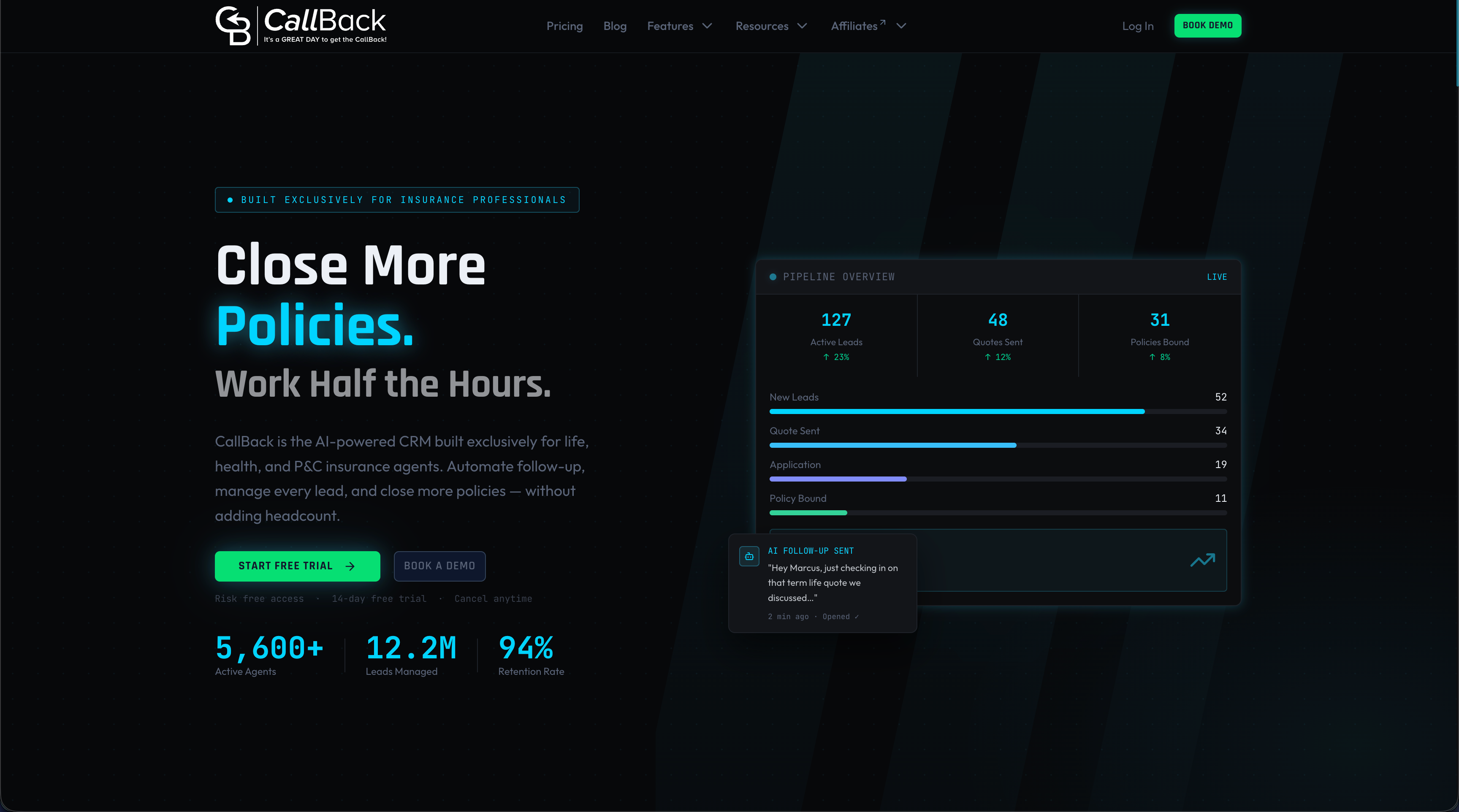
CallBack CRM brings together automation features for lead scoring, follow-up sequences, and renewal campaigns inside one dashboard. You can build and launch website and funnel tools designed to convert insurance leads, then connect them directly to your CRM without any coding. Agencies using CallBack report faster lead response times, higher retention rates, and hours saved every week. Try CallBack CRM free and see how quickly your agency can move from manual to automated without losing the personal touch that builds client trust.
Frequently asked questions
How does AI-powered sales automation help insurance agencies?
AI excels in high-volume tasks like lead qualification and follow-up scheduling, freeing agents to focus on relationship-building and closing. The result is faster response times and measurably higher conversion rates.
What are the first steps for implementing sales automation?
Begin by mapping your workflows and cleaning your CRM data before introducing any AI layer. A solid operational foundation prevents errors and ensures automation delivers consistent results from day one.
How do you measure the success of sales automation?
Focus on lead response time, conversion rates by source, and revenue ROI monthly. Agencies following this approach have seen 8X ROI within 30 days when measurement and iteration are part of the launch plan.
What pitfalls should be avoided with sales automation?
The biggest risks are poor data quality, skipping pre-launch tests, and removing human oversight from the process. Testing and oversight prevent compliance issues and protect conversion rates as your system scales.