

TL;DR:
- Building a structured sales funnel increases lead conversion and scalability for insurance agents.
- Essential funnel stages are lead capture, nurturing, and quick, personalized conversion efforts.
- Regular measurement and human oversight are crucial to optimize automation and maintain success.
You spend hours chasing leads, sending follow-up emails, and leaving voicemails, yet half your prospects vanish before you ever close a deal. That frustration is not a you problem. It is a process problem. Most insurance agents rely on scattered outreach with no system holding it together. This tutorial shows you exactly how to build and automate a sales funnel that captures leads, nurtures them with AI-driven sequences, and converts them into paying clients. By the end, you will have a repeatable, scalable process that works even when you are not at your desk.
Table of Contents
- Understanding the insurance sales funnel
- Preparation: Tools and setup for your sales funnel
- Step-by-step: Building and automating your insurance sales funnel
- Measuring, optimizing, and troubleshooting your funnel
- Our take: What most insurance funnels get wrong
- Next steps: Supercharge your funnel with Callback CRM
- Frequently asked questions
Key Takeaways
| Point | Details |
|---|---|
| Funnel structure matters | A clear sales funnel consistently guides leads from contact to close and reduces lost opportunities. |
| Automate and integrate | Combining CRM, email, and SMS in one platform streamlines lead management and boosts efficiency. |
| AI enhances results | Artificial intelligence powers smarter follow-ups and helps agents convert more leads with less manual work. |
| Measure and optimize | Regularly track funnel metrics and tweak processes to continuously improve conversion rates. |
Understanding the insurance sales funnel
A sales funnel is the structured path a prospect travels from first contact to signed policy. Think of it as a series of intentional steps that filter, educate, and warm up leads until they are ready to buy. Unlike retail or e-commerce funnels, insurance funnels require more trust-building because clients are making long-term financial decisions. That means your funnel needs more touchpoints, more personalization, and more patience built into the design.
The three core stages every insurance funnel must have are Lead Capture, Nurturing, and Conversion. Lead Capture is where a prospect first enters your world, usually through a landing page, ad, or referral. Nurturing is the middle stage where you educate, follow up, and build credibility through emails, SMS, and content. Conversion is the final push where a qualified lead books a call, receives a quote, and signs.
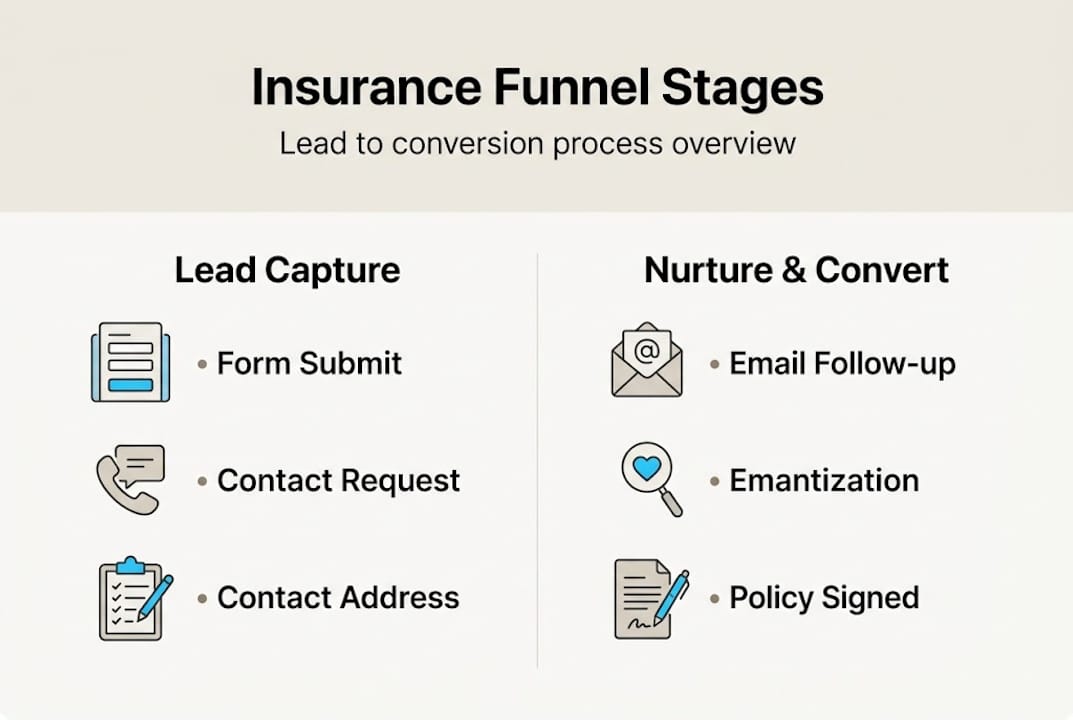
Here is a quick breakdown of each stage and what it demands:
| Funnel stage | Primary goal | Key tools |
|---|---|---|
| Lead Capture | Collect contact info | Landing pages, lead magnets, ads |
| Nurturing | Build trust and qualify | Email sequences, SMS, AI follow-up |
| Conversion | Close the sale | Quote tools, booking links, proposals |
What makes insurance funnels unique is the compliance layer. Every message you send must be accurate, and your timing must respect where the prospect is in their decision process. Rushing a lead from capture to close without proper nurturing is the fastest way to lose them.
“A well-structured funnel does not just generate leads. It creates a predictable system for turning strangers into clients.”
Agents who understand funnel marketing overview report stronger follow-up consistency and higher close rates because every prospect gets the right message at the right time. The funnel management guide also reinforces that agents who actively manage their funnel stages see measurably better results than those who treat outreach as a one-off activity. Structure is not optional. It is the difference between chasing leads and attracting clients.
Preparation: Tools and setup for your sales funnel
Before you build a single landing page, you need the right digital infrastructure in place. Jumping into funnel construction without proper tools is like framing a house without a foundation. The setup phase is where most agents cut corners, and it costs them dearly later.
Here is a comparison of the core tools you need and what each one handles:
| Tool | Purpose | Without it |
|---|---|---|
| CRM platform | Stores and tracks all lead data | Leads fall through the cracks |
| Email automation | Sends timed nurture sequences | Manual follow-up kills your time |
| SMS marketing | Delivers fast, high-open-rate messages | Slower response rates |
| Landing page builder | Captures lead info from ads and traffic | No entry point for prospects |
| Lead scoring | Ranks leads by readiness to buy | You waste time on cold prospects |
The CRM benefits for insurance are well documented. Agents who adopt CRM and sales automation boost sales by 25% compared to those relying on spreadsheets and manual tracking. That number alone should motivate you to get your tech stack right before anything else.
Your digital asset checklist before launch should include:
- A lead magnet (free quote, checklist, or guide)
- At least one optimized landing page with a clear call to action
- A welcome email sequence of 3 to 5 messages
- SMS opt-in confirmation and initial follow-up message
- A calendar booking link for consultations
Common setup mistakes include connecting tools that do not sync properly, which creates data gaps. For example, if your landing page does not push leads directly into your CRM, you are manually entering data, which defeats the purpose of automation. Always test every integration before running paid traffic.

Pro Tip: Before going live, run a test lead through your entire funnel yourself. Check that every email arrives, every SMS fires on time, and your CRM logs the contact correctly. This five-minute test saves hours of troubleshooting later.
For a deeper look at how AI fits into this setup, the guide on building insurance funnels with AI walks through how automation layers into each tool for maximum efficiency.
Step-by-step: Building and automating your insurance sales funnel
With your tools in place, here is exactly how to build and automate each stage of your funnel from opt-in to close.
- Create your lead capture page. Build a focused landing page with one offer, one form, and one call to action. Remove distractions. The goal is a single conversion: getting the visitor’s name, email, and phone number.
- Set up your CRM intake workflow. Every form submission should automatically create a contact record in your CRM, tag the lead source, and trigger the first automation sequence without any manual input.
- Launch your email nurture sequence. Write 5 to 7 emails spaced over 14 days. Each email should educate on one topic: coverage options, common mistakes, cost comparisons, and client stories. Keep each email under 200 words.
- Layer in SMS follow-up. Send an SMS within 5 minutes of a new lead opting in. Speed matters enormously here. Leads contacted within 5 minutes are 9x more likely to convert than those contacted after 30 minutes.
- Apply AI lead scoring. Let your platform score leads based on behavior: email opens, link clicks, page visits, and form completions. High-score leads get prioritized for personal outreach.
- Trigger conversion sequences. When a lead hits a score threshold, automatically send a quote request email and a booking link SMS. This is where AI-powered automation amplifies conversions by acting at exactly the right moment.
- Close and onboard. Once a meeting is booked, send a confirmation sequence with preparation tips. After the call, trigger a proposal or contract workflow immediately.
Pro Tip: Use sales automation workflows to build a “lost lead” re-engagement sequence that fires 30 days after a prospect goes cold. Many agents recover 10 to 15 percent of stalled leads this way.
The lead generation workflow tutorial provides additional sequencing examples you can adapt directly to your niche.
Measuring, optimizing, and troubleshooting your funnel
Once your funnel is live, your job shifts from builder to analyst. A funnel that runs without measurement is just expensive guesswork. You need to know exactly where leads are converting and where they are dropping off.
Here are the key metrics every insurance agent should track:
| Metric | What it measures | Healthy benchmark |
|---|---|---|
| Lead capture rate | Percentage of visitors who opt in | 20 to 35 percent |
| Email open rate | Percentage of emails opened | 25 to 40 percent |
| SMS response rate | Replies or clicks from SMS | 30 to 45 percent |
| Conversion rate | Leads who become clients | 5 to 15 percent |
| Response time | Minutes from opt-in to first contact | Under 5 minutes |
If your capture rate is low, your landing page or offer needs work. If your email open rate is poor, your subject lines or sender reputation is the problem. If your conversion rate is lagging, the issue is usually in the nurture sequence or the timing of your close sequence.
Common issues to troubleshoot:
- Low open rates: Test new subject lines, clean your list, and check if emails are landing in spam
- Lost leads mid-funnel: Add a re-engagement email at day 7 and day 14 for non-responders
- Automation errors: Audit your workflow triggers monthly to catch broken connections
- High drop-off at conversion: Simplify your booking process and reduce friction in the close step
“The agents who win long-term are not the ones with the flashiest funnels. They are the ones who review their numbers every week and make one small improvement at a time.”
The lead generation tips resource confirms that ongoing measurement and optimization are what separate average funnels from top-performing ones. Commit to a weekly 20-minute funnel review. Check your CRM for agents dashboard for drop-off patterns and adjust your sequences accordingly.
Our take: What most insurance funnels get wrong
Here is the uncomfortable truth most funnel tutorials skip: automation without human oversight creates a false sense of security. Agents build a funnel, flip the switch, and assume the machine will handle everything. Then six months later, they wonder why conversions have stalled.
The real mistake is treating your funnel as a one-time build rather than a living system. Markets shift. Prospect behavior changes. What worked in January may not work in July. The agents with the highest-performing funnels are not the ones with the most sophisticated tech. They are the ones who schedule a monthly human check-in, review their deep funnel management insights, and layer personal touchpoints on top of their automation.
Automation handles volume. Humans handle nuance. The winning formula is using AI to identify your hottest leads and then having a real person reach out at that exact moment. That combination, automated identification plus human connection, is what converts at the highest rate. Do not let automation replace your judgment. Let it sharpen it.
Next steps: Supercharge your funnel with Callback CRM
Everything covered in this tutorial becomes significantly easier when your tools are built for insurance from the ground up. Callback CRM brings together every piece of your funnel into one platform, so nothing slips through the cracks.
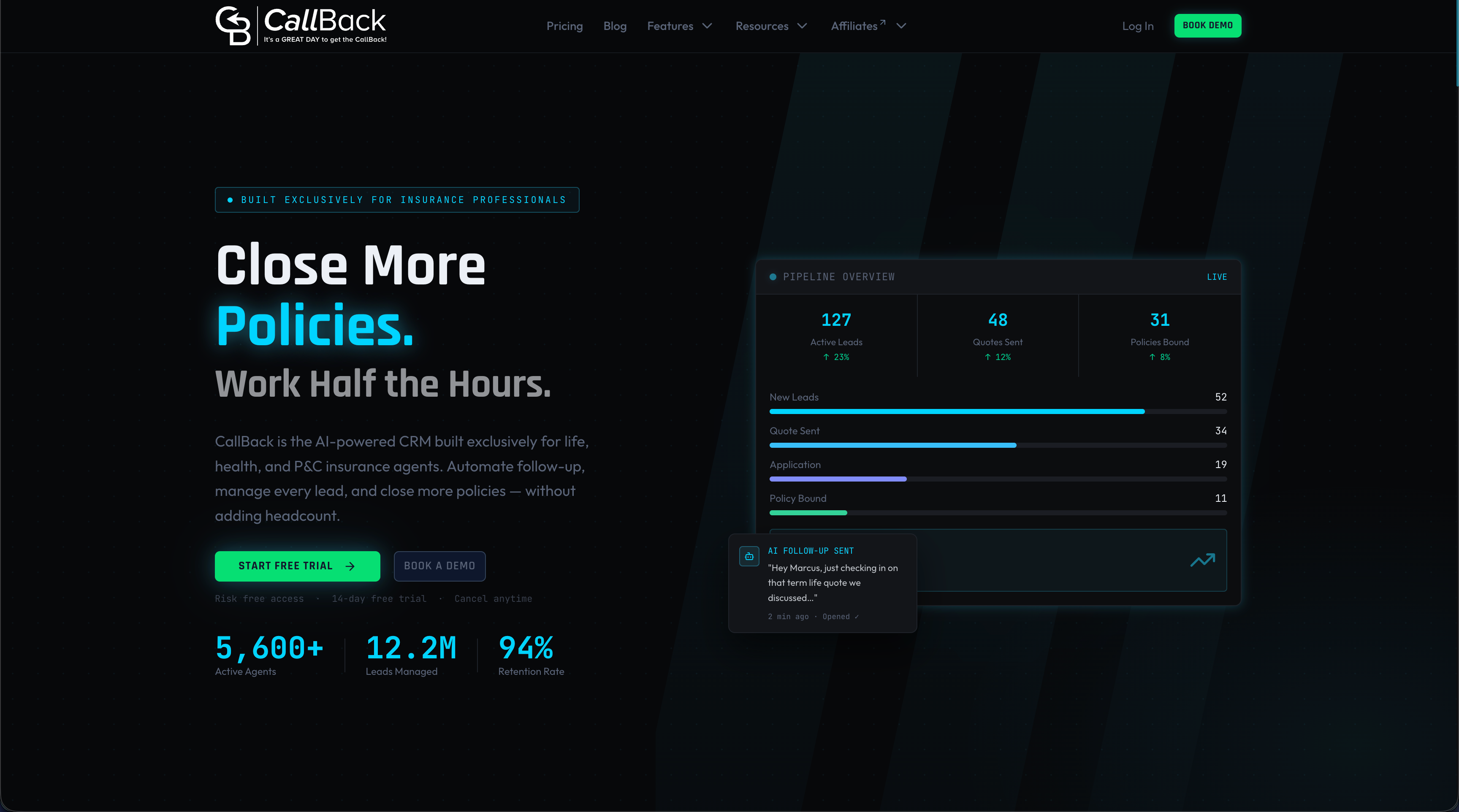
With Callback CRM, you get all-in-one AI features including CRM management, AI lead scoring, automated workflows, and funnel builders designed specifically for insurance agents. Need to fire a follow-up text the moment a lead opts in? The SMS marketing automation handles that instantly. Want to run a 14-day nurture campaign without touching a single email manually? The email marketing solutions make it effortless. Start building your automated insurance funnel with Callback CRM today and turn your lead generation into a predictable, scalable system.
Frequently asked questions
What is an insurance sales funnel and why does it matter?
An insurance sales funnel is a structured process that guides potential clients from initial contact to a closed sale, improving conversion rates through organized follow-up and AI-driven automation. Agents who follow defined funnel stages consistently close more business than those relying on unstructured outreach.
Which tools should I use to build an automated insurance sales funnel?
Essential tools include a CRM, email and SMS marketing automation, and landing page builders, ideally integrated into one platform for seamless operation. A unified CRM and automation stack eliminates data gaps and reduces the manual work that slows most agents down.
How do I know if my insurance sales funnel is working?
Track metrics such as conversion rate, response time, and where leads drop off to determine funnel effectiveness and guide tweaks. Consistent KPI tracking is the fastest way to spot what is working and what needs adjustment.
Can AI really improve insurance sales funnel results?
Yes, AI streamlines follow-up, personalizes outreach, and automates repetitive tasks, which increases conversion rates and saves agent time. The evidence is clear that AI-driven automation produces better funnel outcomes than manual processes at every stage.