

AI-powered CRM systems can increase insurance sales conversion rates by up to 25%, transforming how agents manage leads and engage customers. Insurance professionals face mounting pressure from manual workflows, scattered data, and intense competition. This guide explains how AI CRM drives measurable efficiency gains, automates repetitive tasks, and personalizes customer outreach to help you close more deals and retain clients longer.
Table of Contents
- Introduction To CRM In Insurance
- How AI-Powered CRM Enhances Insurance Sales Efficiency
- Predictive Lead Scoring And Personalization In Insurance CRM
- Common Misconceptions About CRM Use In Insurance
- Framework For Evaluating And Implementing AI CRM In Insurance
- Real-World Impact: Case Studies And Outcomes
- Conclusion: Transforming Insurance Sales With AI CRM
- Explore CallBack CRM’s AI-Powered Features For Insurance
- Frequently Asked Questions About Using CRM For Insurance
Key takeaways
| Point | Details |
|---|---|
| AI automation drives efficiency | Automating manual tasks frees agents to focus on high-value sales activities and relationship building. |
| Predictive lead scoring improves conversions | AI analyzes customer data to identify and prioritize prospects with the highest sales potential. |
| Personalized outreach boosts retention | Tailored communication increases customer trust, loyalty, and long-term policy renewals. |
| Misconceptions slow adoption | Understanding what AI CRM truly does helps agents realize its full business value. |
| Structured evaluation ensures success | A clear framework guides agents through selecting and implementing the right CRM solution. |
Introduction to CRM in insurance
Customer relationship management systems store and organize every customer interaction, policy detail, and sales pipeline stage in one centralized platform. For insurance agents, this means no more scattered spreadsheets or lost follow-up notes. Insurance-specific CRMs accommodate complex agency workflows, multi-line product catalogs, and strict regulatory requirements that generic systems cannot handle.
AI transforms CRM from a simple database into a predictive sales acceleration tool. Traditional CRMs require agents to manually input data, track tasks, and remember follow-ups. AI-powered platforms automate these processes while analyzing patterns to forecast customer needs and recommend next-best actions. Insurance agents without organized data struggle to personalize outreach, prioritize leads effectively, or scale their operations beyond a handful of clients.
Modern AI CRM delivers three core advantages:
- Centralized customer data accessible across your entire agency team
- Automated workflows that trigger follow-ups, reminders, and task assignments
- Predictive analytics that score leads and surface hidden opportunities
Understanding these foundational concepts prepares you to recognize how AI amplifies every aspect of your sales process. Smart lead generation strategies become easier when your CRM automatically identifies prospects ready to buy. When you integrate CRM with your marketing efforts, campaigns become more targeted and ROI improves dramatically.
How AI-powered CRM enhances insurance sales efficiency
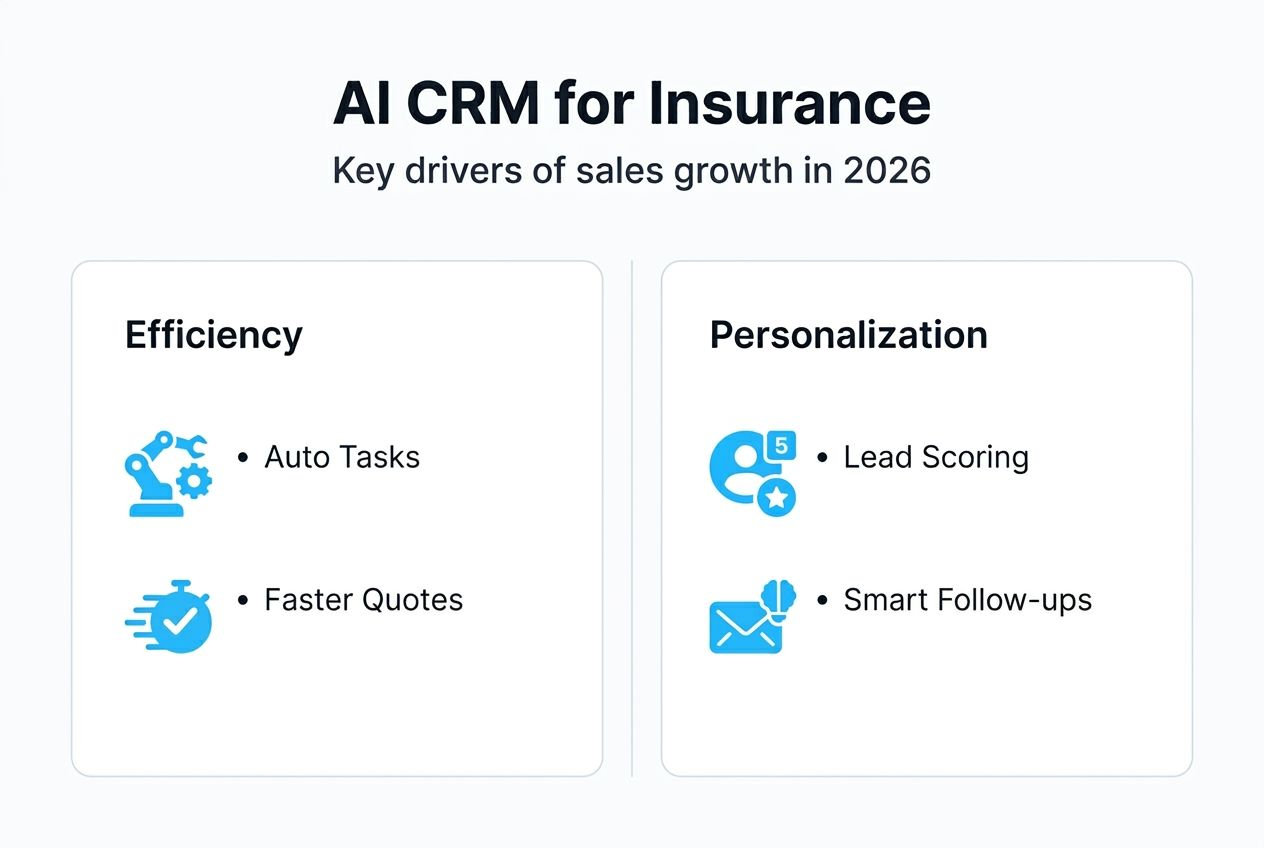
Manual data entry consumes hours every week that could be spent selling policies or building relationships. AI-powered CRM eliminates this burden by automatically capturing lead information from web forms, emails, phone calls, and social media interactions. Automation reduces manual data entry by 40%, giving agents back significant time in their day.
Response speed makes or breaks insurance sales. Prospects contact multiple agents simultaneously, and whoever responds first usually wins the business. AI accelerates your response times by instantly routing new leads to the right agent, triggering personalized follow-up sequences, and alerting your team to high-priority inquiries. Studies show these systems can speed up customer response by up to 25%.
Workflow automation compresses your entire sales cycle by eliminating delays between each stage. Consider how traditional processes work:
- Lead comes in through website form
- Agent manually reviews and assigns lead
- Another agent calls prospect days later
- Follow-up emails require manual creation and scheduling
- Proposal generation happens independently of CRM data
AI CRM streamlines this into an automated sequence that can cut sales cycle time by 20%. The system instantly assigns leads based on agent expertise and availability, triggers immediate personalized outreach, schedules follow-ups automatically, and even generates proposals using stored customer preferences.
This efficiency transformation lets you focus on what actually drives revenue: consulting with clients, explaining complex coverage options, and building trust. Low-value administrative work no longer dominates your schedule.
Pro Tip: Start by automating your three most time-consuming repetitive tasks. Most agents see immediate productivity gains by automating lead assignment, follow-up reminders, and basic email sequences before tackling more complex workflows.
The benefits of sales automation extend beyond time savings. You can learn what sales automation truly means and explore how AI advantages help small businesses compete with larger agencies.
Predictive lead scoring and personalization in insurance CRM
Not all leads deserve equal attention. AI analyzes hundreds of data points, including demographic information, online behavior, engagement history, and external signals to assign each prospect a score reflecting their likelihood to buy. Lead scoring improves conversions by 15 to 25% by ensuring your best agents focus on your best opportunities.

Predictive analytics examines patterns across your entire customer database to identify characteristics shared by your most profitable clients. The system then flags new prospects matching these profiles, letting you prioritize outreach strategically. This approach improves lead qualification accuracy by 30% compared to manual assessment methods.
Personalization goes far beyond inserting a first name into an email template. AI CRM tracks each prospect’s preferences, concerns, communication channel preferences, and policy interests to tailor every interaction. When a customer receives information perfectly aligned with their needs, trust builds naturally. Personalized communication boosts retention by 12% because clients feel understood rather than marketed to.
| Metric | Traditional CRM | AI-Powered CRM |
|---|---|---|
| Lead qualification accuracy | 60-65% | 85-90% |
| Time to first contact | 24-48 hours | Under 5 minutes |
| Personalization depth | Name and company | Full behavioral profile |
| Agent focus on high-value leads | 40% | 75% |
| Customer retention rate | 68% | 80% |
The transformation shows up in daily workflows. Instead of cold calling random prospects, agents receive a prioritized list each morning ranked by conversion probability. Instead of generic email blasts, customers receive policy recommendations based on life events the AI detected through data signals.
Pro Tip: Refine your lead scoring model quarterly by reviewing which scored leads actually converted. Adjust weighting factors based on real outcomes rather than assumptions. Your scoring accuracy will improve continuously as the AI learns from your specific customer base.
When you transform your lead funnel with predictive intelligence, conversion rates climb. Combine this with a solid lead generation workflow and you build a sustainable growth engine.
Common misconceptions about CRM use in insurance
Many agents view CRM as glorified contact management software, missing its strategic value entirely. Modern AI-powered CRM functions as a predictive sales engine that identifies opportunities, automates outreach, and guides agents toward high-probability wins. Treating it merely as a digital Rolodex wastes most of its capabilities and returns minimal value on your investment.
Another widespread misconception claims AI will replace insurance agents, making human expertise obsolete. This fundamentally misunderstands AI’s role. The technology handles repetitive data tasks, pattern recognition, and workflow automation, freeing agents to focus on relationship building, complex problem solving, and consultative selling that requires human judgment. AI augments your capabilities rather than replacing them.
Some agents worry automation eliminates the personal touch customers expect from their insurance professional. The opposite proves true in practice. Automation handles administrative burden, giving you more time for meaningful conversations. Personalization engines ensure every automated touchpoint reflects customer preferences and needs. Clients receive faster responses, more relevant information, and better service overall.
Key misconceptions that slow CRM adoption:
- CRM implementation requires extensive technical expertise (modern platforms offer intuitive interfaces)
- Only large agencies benefit from CRM systems (small agencies gain proportionally larger efficiency advantages)
- AI CRM costs too much for typical insurance operations (ROI typically appears within 3-6 months)
- Customer data privacy concerns make AI CRM too risky (proper platforms meet all regulatory requirements)
- Learning new systems disrupts productivity too much (phased rollouts minimize disruption)
Clearing these myths helps you approach AI CRM with realistic expectations and appropriate enthusiasm. The technology delivers measurable improvements when implemented thoughtfully, not magical overnight transformation. Understanding what it truly does, and what it does not, sets you up for successful adoption and strong returns.
Framework for evaluating and implementing AI CRM in insurance
Use the Insurance AI CRM Success Framework to evaluate solutions systematically across four critical pillars: Efficiency, Intelligence, Personalization, and Compliance. Each pillar addresses specific business needs while supporting your overall growth strategy.
Evaluation criteria for selecting your AI CRM:
- Efficiency pillar: Does the platform automate data entry, lead assignment, follow-up scheduling, and proposal generation? Measure potential time savings across your team.
- Intelligence pillar: Evaluate lead scoring accuracy, predictive analytics capabilities, and integration with your existing data sources. Request scoring model transparency.
- Personalization pillar: Assess communication customization depth, multi-channel orchestration, and behavioral tracking capabilities that enable truly tailored outreach.
- Compliance pillar: Verify the platform meets insurance regulatory requirements, handles customer data securely, and provides audit trails for all interactions.
AI-powered CRM platforms integrate with third-party tools and cloud infrastructure to ensure secure, compliant data handling necessary for insurance agents. This integration capability matters as much as core CRM features.
| Selection Criteria | Must-Have | Nice-to-Have |
|---|---|---|
| Lead scoring accuracy | 80%+ | 90%+ |
| Data security compliance | SOC 2, GDPR | Industry-specific certifications |
| Mobile access | Full CRM functionality | Offline capability |
| Integration options | Email, calendar, phone | Marketing platforms, proposal tools |
| Training and support | 24/7 availability | Dedicated success manager |
Plan a phased rollout to minimize disruption:
- Phase 1 (Weeks 1-2): Import existing customer data, configure basic workflows, train power users
- Phase 2 (Weeks 3-4): Roll out to full team with daily support sessions, monitor adoption metrics
- Phase 3 (Month 2): Activate advanced AI features, refine lead scoring, optimize automation rules
- Phase 4 (Month 3+): Continuous improvement based on KPIs, expand integration ecosystem
Common implementation failure points and fixes:
- Low adoption rates: Tie CRM usage to compensation metrics and showcase early wins publicly
- Data quality issues: Establish data entry standards and use AI validation to catch errors
- Workflow bottlenecks: Map processes before automation to avoid digitizing broken workflows
- Integration gaps: Prioritize connecting systems agents use daily before niche tools
Monitor these KPIs monthly to track success: lead response time, conversion rate by source, average deal size, customer retention rate, and agent productivity metrics. Adjust your implementation based on what the data reveals about real-world usage patterns.
Real-world impact: case studies and outcomes
Insurance agencies implementing AI CRM report measurable business transformation within the first year. A mid-sized independent agency in Texas saw a 35% increase in qualified leads after deploying predictive lead scoring. The system identified prospects most likely to purchase multiple policies, letting agents prioritize outreach strategically rather than working leads chronologically.
Revenue growth tells an even more compelling story. Agencies using AI automation platforms report 20% annual revenue increases attributed directly to improved efficiency and conversion rates. These gains come from faster response times, better lead prioritization, and personalized follow-up sequences that nurture prospects automatically.
Agent productivity improvements free up time for high-value activities that actually require human expertise. Teams report spending 30% more time on consultative selling, relationship building, and complex problem solving after automation handles administrative tasks. This shift improves job satisfaction while driving better customer outcomes.
Quantifiable benefits across case studies:
- 40% reduction in time spent on manual data entry and administrative tasks
- 25% faster customer response times leading to higher win rates
- 15-25% improvement in lead conversion rates through better targeting
- 12% increase in customer retention from personalized engagement
- 30% improvement in lead qualification accuracy reducing wasted effort
These numbers validate the efficiency and personalization claims made throughout this guide. Real insurance professionals using AI CRM daily experience tangible improvements in how they work, how customers respond, and how their businesses grow. The benefits of sales automation and proven growth strategies combine to create competitive advantages that compound over time.
Stories from early adopters inspire confidence in the technology’s practical value. An agency owner in Florida described AI CRM as the difference between managing 200 clients effectively versus struggling with 50. The system handles routine touchpoints automatically while surfacing opportunities that require personal attention, letting small teams punch above their weight class.
Conclusion: transforming insurance sales with AI CRM
AI-powered CRM enables scalable, automated, and personalized insurance sales that were impossible with manual processes. The technology delivers measurable advantages in efficiency, lead quality, conversion rates, and customer retention that directly impact your bottom line. Insurance agents who adopt AI CRM gain competitive advantages as customer expectations evolve and markets become more crowded.
The evidence clearly shows that AI CRM is not a luxury for large agencies but a necessity for any insurance professional serious about growth. Early adopters capture market share while competitors struggle with outdated workflows and scattered data. The question is not whether to implement AI CRM, but how quickly you can realize its benefits.
Explore CallBack CRM’s AI-powered features for insurance
CallBack CRM delivers the comprehensive AI capabilities discussed throughout this guide, purpose-built for insurance agents and agencies. The platform combines intelligent lead scoring, workflow automation, multi-channel marketing, and predictive analytics in one unified system. You get the efficiency gains, personalization depth, and sales acceleration that transform how you acquire and retain clients.
Streamline lead management, automate repetitive workflows, and personalize every customer touchpoint using CallBack’s AI-powered features. The platform integrates seamlessly with your existing tools while providing mobile access, compliance safeguards, and 24/7 support. Explore how AI business automation can revolutionize your agency’s sales process and customer engagement.
Try CallBack CRM free today to experience firsthand how AI transforms insurance sales efficiency and customer relationships. Stop losing deals to faster competitors and start leveraging intelligent automation that identifies opportunities, personalizes outreach, and closes more business with less effort.
Frequently asked questions about using CRM for insurance
How long does it take to see ROI from AI CRM implementation?
Most insurance agencies see measurable ROI within 3-6 months of full implementation. Early gains come from time savings on manual tasks, while conversion improvements build over time as lead scoring models learn from your data.
Can small insurance agencies afford AI-powered CRM systems?
Modern AI CRM platforms offer scalable pricing that fits agencies of all sizes. Small agencies often see proportionally larger efficiency gains because automation has greater impact when teams are lean. Many platforms offer free trials to test value before committing.
Does AI CRM work for independent agents or only large agencies?
AI CRM benefits independent agents significantly by automating tasks that would otherwise require hiring staff. Solo agents use these systems to manage hundreds of client relationships with personalized service that feels one-on-one.
How does AI CRM handle insurance-specific compliance requirements?
Reputable insurance CRM platforms build compliance into their core architecture, including secure data storage, audit trails for all customer interactions, and regulatory reporting features. Always verify a platform meets your state’s specific insurance data requirements before implementation.
What happens to my existing customer data when switching to AI CRM?
Modern CRM platforms provide data migration tools and services to transfer your existing customer information seamlessly. Most vendors offer dedicated migration support to ensure no data loss and minimal disruption during the transition.
How much training do agents need to use AI CRM effectively?
Basic CRM proficiency typically requires 2-4 hours of initial training, with most agents becoming comfortable within two weeks of daily use. Advanced features like custom automation rules may need additional training, but core functions remain intuitive and user-friendly.