

TL;DR:
- Effective CRM adoption for IMOs requires phased implementation, standardized data standards, and AI-driven automation. Building a growth-oriented infrastructure that supports agent retention and engagement is crucial for leveraging CRM technology successfully. Proper oversight, training, and measurement ensure long-term success and improved sales outcomes.
Insurance marketing organizations that treat CRM as a simple contact database are leaving serious money on the table. The real CRM best practices for IMOs go far deeper than storing agent names and policy numbers. They involve building a digital infrastructure that retains agents, nurtures client relationships, maintains compliance, and scales with your network. Most IMOs struggle not because they chose the wrong software, but because they skipped the foundational decisions around workflow design, data standards, and adoption strategy. This guide changes that.
Table of Contents
- Key takeaways
- 1. Define CRM selection criteria built for IMO workflows
- 2. Start with a phased rollout and pilot testing
- 3. Standardize data entry across your entire organization
- 4. Use AI-driven automation for lead nurturing
- 5. Deploy automated appointment booking
- 6. Build a co-branded agent portal
- 7. Implement predictive analytics for agent engagement
- 8. Combine CRM with marketing automation
- 9. Build in AI oversight before going fully autonomous
- 10. Invest in comprehensive training and ongoing support
- 11. Measure performance through KPIs and feedback loops
- My honest take on where most IMOs get this wrong
- How Callbackcrm helps IMOs put these practices into action
- FAQ
Key takeaways
| Point | Details |
|---|---|
| Phased rollout reduces risk | Start CRM implementation with your top producers to build internal proof before wider rollout. |
| AI shifts CRM from storage to strategy | Modern AI-powered CRM predicts behavior, scores leads, and automates engagement at scale. |
| Data quality drives ROI | Quarterly audits and standardized data entry prevent the silent failures that kill CRM projects. |
| Agent portals improve retention | Co-branded portals with pre-approved marketing assets reduce agent turnover and brand drift. |
| Automation cuts manual workload | AI-enabled CRM can cut manual tasks by up to 40%, freeing teams for high-value work. |
1. Define CRM selection criteria built for IMO workflows
Before you evaluate a single platform, you need a clear set of requirements specific to how IMOs actually operate. Generic CRM tools are built for sales teams selling widgets. Your environment is different. You’re managing distributed agent networks, carrier relationships, compliance obligations, and marketing support across dozens or hundreds of producers.
Start with these four criteria:
- Compliance and data security. Your CRM must support audit trails, role-based access controls, and data encryption. If it can’t handle state-level regulatory reporting or carrier data requirements, it’s not built for your world.
- Integration with insurance systems. The platform needs to connect with your quoting tools, carrier portals, and email marketing infrastructure. Unified data foundations and analytics are what unlock predictive AI benefits later.
- Scalability for agent networks. A CRM that works for 20 agents needs to perform just as well for 500. Check how the platform handles hierarchical data structures, multiple sub-agencies, and bulk communications.
- Customizability. You should be able to build custom fields, pipelines, and automations that mirror your recruiting, onboarding, and retention workflows without hiring a developer.
Pro Tip: Ask every CRM vendor for a reference from an IMO or FMO of similar size. General insurance agency references don’t tell you how the platform performs at your scale.
2. Start with a phased rollout and pilot testing
One of the most consistent CRM implementation mistakes IMOs make is trying to roll out the platform to their entire agent network at once. The result is predictable: low adoption, bad data, and a demoralized operations team.
A phase-in approach starting with your top 10% of producers minimizes resistance and builds internal proof of concept. These agents are motivated, tech-comfortable, and results-oriented. When they succeed, their numbers become your internal case study for selling the rest of the network on adoption. It’s far more persuasive than any vendor webinar.
Run a 60 to 90 day pilot. Track specific metrics from day one: lead response time, appointment conversion rate, and follow-up completion rate. Use those results in town halls and training sessions when you expand.
3. Standardize data entry across your entire organization
Inconsistent data is the hidden killer of CRM projects. When one agent enters “John Smith” and another enters “Smith, John,” and a third enters the same client under a different email address, your reporting breaks down and your automation misfires.

CRM projects fail most often when organizations focus solely on technology while ignoring process design. Standardization means creating field-level rules, required entry formats, and dropdown menus instead of open text fields wherever possible. It also means designating a CRM administrator who owns data quality.
Build quarterly data audits into your calendar. Deduplicate contacts, archive inactive records, and update agent status fields on a consistent schedule. Boring? Yes. High-impact? Absolutely.
4. Use AI-driven automation for lead nurturing
Manual follow-up at IMO scale is not sustainable. An agent recruiter managing 200 prospects cannot personally track every touchpoint. This is where AI-driven CRM automation earns its cost many times over.
Modern AI-powered CRM predicts customer behavior to automate engagement and personalize outreach at scale. That means trigger-based email sequences that fire when an agent completes onboarding, automated SMS follow-ups for warm leads who haven’t booked an appointment, and dynamic content that adjusts based on a contact’s engagement history.
Pro Tip: Don’t automate everything at once. Map your three most time-consuming manual workflows first, automate those, and measure the results before adding more.
5. Deploy automated appointment booking
Response speed is one of the biggest differentiators in agent recruitment and client conversion. When a prospect expresses interest and doesn’t hear back for 48 hours, you’ve likely lost them.
Automated booking modules can reduce response-to-booking time by over 60% within 90 days of launch. Pair your CRM with a scheduling tool that lets prospects self-book directly from email campaigns or landing pages. This removes friction, cuts the back-and-forth, and gets prospects into your pipeline faster. For IMOs managing high volumes of agent appointments or client meetings, this single feature can transform throughput.
6. Build a co-branded agent portal
This is one of the most underleveraged CRM strategies for IMOs. A dedicated portal inside your CRM, stocked with pre-approved marketing assets, gives your agents a digital toolkit they can actually use. They get branded flyers, email templates, social media content, and product guides. You get brand consistency and a reason for agents to stay in your ecosystem.
Comprehensive agent portals with pre-approved marketing assets help maintain brand standards while empowering local agents, and they measurably reduce agent turnover. When agents feel supported rather than just contracted, they produce more and stay longer.
7. Implement predictive analytics for agent engagement
Most IMOs track activity. The best IMOs predict it. Predictive analytics inside your CRM flags agents who are showing early signs of disengagement, before they submit a transfer letter or stop answering calls. It identifies which prospects are most likely to convert based on behavioral signals. It tells you where to focus attention across a network of hundreds of agents without manually reviewing every contact record.
AI-powered CRM systems combine predictive analytics, automated actions, and integrated communication tools customized for IMO workflows to boost both productivity and agent retention. This is the kind of insight that transforms how you allocate your recruiting and support resources.
8. Combine CRM with marketing automation
Your CRM and your email marketing tool should not be two separate systems. When they are, data falls through the cracks. A contact updates their email in one system but not the other. A campaign goes out to unsubscribed agents. Compliance flags get missed.
Integrated marketing automation within your CRM creates a single source of truth. Every campaign touchpoint, email open, link click, and reply logs directly against the contact record. Your team can see the full engagement history without toggling between platforms. For IMOs running multi-step recruiting campaigns alongside client retention sequences, this integration is what makes both programs actually work.
9. Build in AI oversight before going fully autonomous
A common mistake in AI-powered CRM deployments is turning automation to full autonomy too quickly. The result is misaddressed emails, off-tone communications, and compliance-sensitive messages going out without review.
A man-in-the-middle approval process helps build trust in AI automation before full autonomy. The AI drafts the message. A human reviews and approves before it sends. Over time, as you calibrate the system’s accuracy and tone, you can extend autonomy incrementally. Successful AI CRM deployments require human oversight initially for trust-building and error monitoring. This is not a limitation of the technology. It’s just smart risk management.
10. Invest in comprehensive training and ongoing support
Technology doesn’t drive adoption. People do. The most capable CRM on the market will collect dust if your team doesn’t know how to use it, or doesn’t believe it’s worth their time.
Structured training should happen at three points: initial onboarding, 30 days post-launch, and quarterly refreshers. Cover not just the mechanics of the tool but the specific workflows your team uses daily. Record training sessions so agents can revisit them independently.
Ongoing support matters just as much as the initial training. Designate internal CRM champions inside your operations team who can answer questions, flag issues, and advocate for process improvements. This internal layer of support dramatically improves long-term adoption.
Pro Tip: Tie CRM usage to recognition, not just compliance. Publicly acknowledge top producers who use the system consistently. Culture changes when the platform becomes associated with success.
11. Measure performance through KPIs and feedback loops
You can’t improve what you don’t measure. Effective CRM for IMOs requires a defined set of key performance indicators reviewed on a regular cadence: lead-to-appointment conversion rate, agent onboarding completion time, client touchpoint frequency, and campaign engagement rates.
Set up automated dashboards that give your leadership team a real-time view without pulling manual reports. Schedule monthly CRM reviews with your operations team to identify where workflows are breaking down and where agents are falling through the cracks. Pair quantitative metrics with qualitative feedback from agents. They are closest to the day-to-day experience and often the first to spot friction that the data hasn’t surfaced yet.
Also consider tracking AI marketing outcomes like lead source attribution and engagement scoring trends over time. These metrics tell you whether your investment in AI-powered tools is actually moving the needle.
My honest take on where most IMOs get this wrong
I’ve seen IMOs spend six figures on CRM implementations that never got off the ground. Not because the software was bad. Because the organization treated the CRM as an IT project rather than a growth strategy.
The IMOs that get it right are the ones that understand what they’re really building. They’re not buying a contact database. They’re building a growth infrastructure for their agent network. IMOs that provide a “Business in a Box” including CRM, automated nurturing, and personal branding retain agents better than those focusing solely on commissions. That shift in thinking changes everything about how you implement the technology.
What I’ve learned from watching successful deployments is that the real differentiator is almost never the software. It’s the quality of data standards, the discipline of phased rollout, and the willingness to invest in human training alongside the technology. AI-powered personalization is genuinely powerful. But it only works when the underlying data is clean, the workflows are mapped, and your team trusts the system enough to use it every day.
The IMOs winning right now are the ones that boost leads through AI while simultaneously building the kind of agent support infrastructure that makes leaving your IMO feel like a step backward for any producer. That combination of technology and relationship depth is very hard to replicate.
— Kyle
How Callbackcrm helps IMOs put these practices into action
If you’re ready to move from theory to execution, Callbackcrm was built for exactly this. It’s an all-in-one platform designed specifically for insurance agents, agencies, and IMOs that want to use AI to do what manual processes can’t.
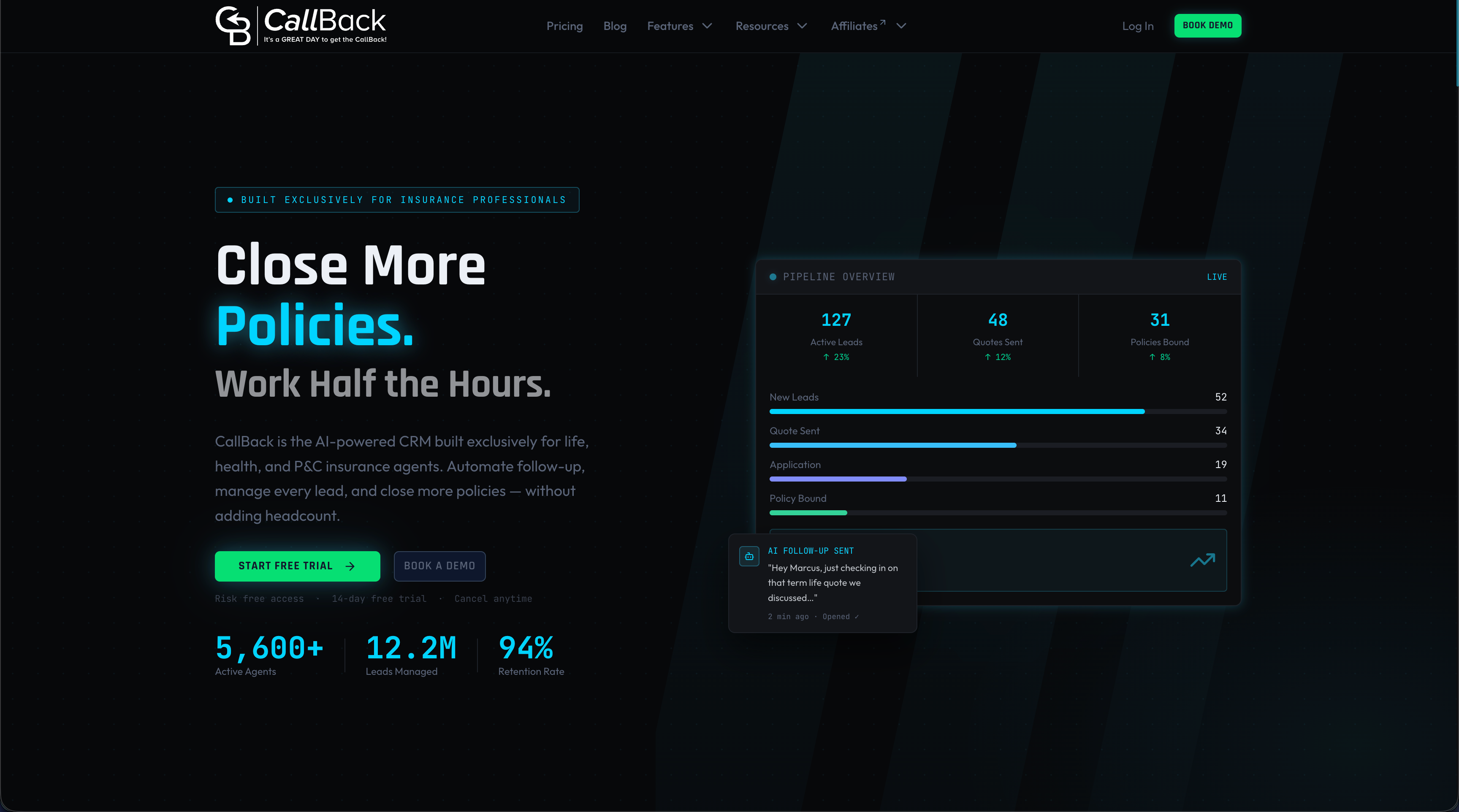
Callbackcrm includes CRM management, automated email and SMS campaigns, AI lead nurturing, co-branded agent portals, compliance tools, and a full suite of 50+ features in one platform. The email marketing automation tools alone let you build multi-step sequences, track engagement per contact, and trigger follow-ups based on real behavior rather than guesswork. Everything runs on Google Cloud with 24/7 support. For IMOs that want to improve CRM efficiency without managing five separate tools, Callbackcrm is worth a close look.
FAQ
What are the most important CRM best practices for IMOs?
The most impactful practices are phased rollout starting with top producers, standardized data entry with quarterly audits, and combining AI-driven automation with human oversight for lead nurturing and compliance.
How does AI improve CRM for insurance marketing organizations?
AI transforms CRM from passive data storage into an active system that scores leads, predicts agent disengagement, and automates personalized outreach at a scale no manual process can match.
How long does CRM implementation typically take for an IMO?
A phased rollout with a pilot group typically shows measurable results within 60 to 90 days. Full network deployment with training and optimization generally takes three to six months depending on organization size.
Why do CRM projects fail in IMOs?
Most CRM failures come from focusing on the technology alone while neglecting data standards, change management, and structured training. Without agent buy-in and clean data, even the best platform underperforms.
What KPIs should IMOs track in their CRM?
Track lead-to-appointment conversion rate, agent onboarding completion time, email campaign engagement rates, and client touchpoint frequency. Review these monthly and adjust workflows based on what the data shows.