

TL;DR:
- Nearly half of sales professionals now use AI tools in their CRM weekly, yet many insurance agencies hesitate to adopt due to complexity and misunderstanding. AI transforms CRM into an operational backbone, automating routines and surfacing insights that drive growth and retention in 2026. Successful implementation relies on incremental adoption, strong data governance, and focusing on measurable outcomes rather than feature overload.
Nearly half of sales professionals now use AI tools in their CRM at least weekly, yet most insurance agencies still feel stuck between wanting to modernize and fearing they’ll invest in tools they don’t fully understand. The gap between knowing AI matters and actually deploying it effectively is wide, and it’s costing agencies real money and real clients. This guide cuts through the noise on 2026’s most important CRM trends, explains what’s actually changed in how these systems work, and gives you a clear path to adopting AI-driven tools without drowning in complexity or feature bloat.
Table of Contents
- How CRM is transforming for insurance in 2026
- AI-driven workflows and agent experience: From pilots to real ROI
- The personalization imperative: Retention, trust, and proactive communication
- Overcoming complexity: Realizing CRM AI value and avoiding feature overload
- Why measured AI adoption in CRM beats chasing features
- Take your agency further with the right CRM solution
- Frequently asked questions
Key Takeaways
| Point | Details |
|---|---|
| AI is central to 2026 CRM | Automation and personalized workflows in insurance CRMs drive competitive advantage. |
| Personalization improves retention | Advanced CRM platforms deliver proactive, customized service that cuts churn. |
| Overcome feature overload | Adopt CRM features incrementally and focus on clear, measured value to avoid complexity. |
| Governance is non-negotiable | Effective data and AI governance ensure compliance, trust, and smooth deployment. |
| Workflow-first CRM adoption wins | Treat CRM as a workflow enabler, not just a contact database, for real results. |
How CRM is transforming for insurance in 2026
Think about what a CRM used to be: a digital contact list with some notes attached. You stored names, policy numbers, and renewal dates. That was it. In 2026, that model is essentially obsolete for any agency serious about growth.
Today, AI CRM in insurance functions as the operational backbone of your entire agency, connecting every touchpoint, automating routine decisions, and surfacing insights you couldn’t generate manually. The shift isn’t subtle. It’s a complete rethink of how customer data flows, gets acted on, and creates value.
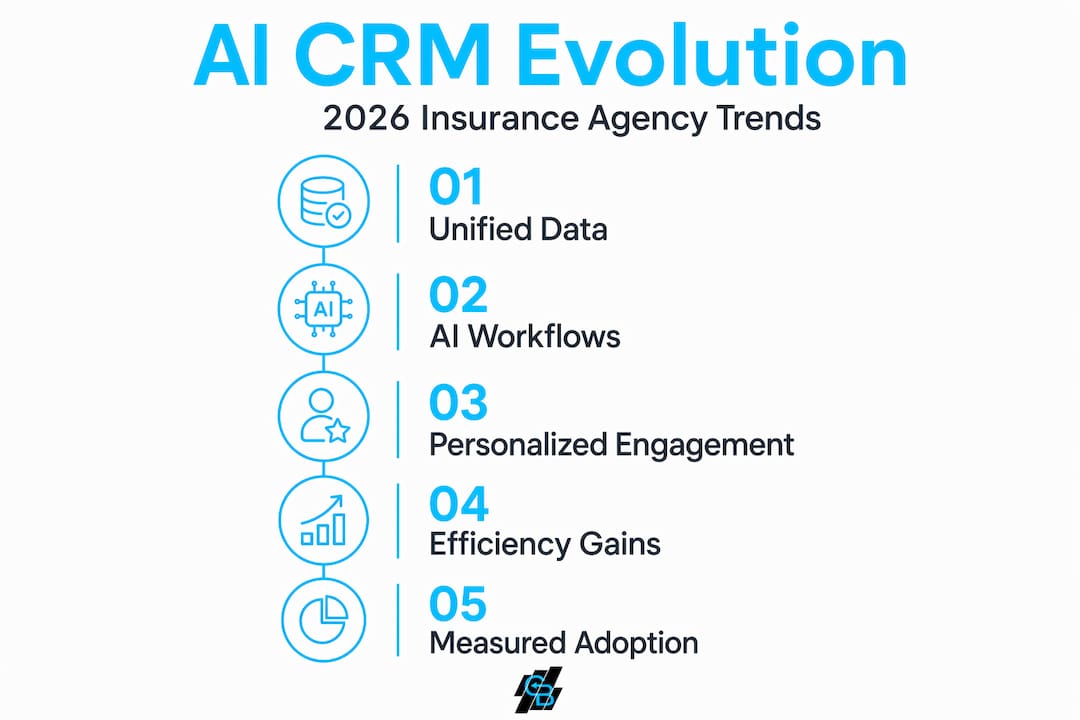
CRM trends in 2026 are centered on two priorities: making customer data genuinely usable for AI models, and building governance structures that accelerate work instead of blocking it. Both priorities demand that agencies get serious about data quality, ownership rules, and integration with existing systems. Garbage data fed to a smart AI still produces garbage outputs. This is why the best agencies invest in cleaning and connecting their data before layering on automation.
For insurance specifically, 2026 tech spending is emphasizing moving AI beyond isolated pilots and embedding it directly into core business processes like underwriting support, first notice of loss (FNOL) triage, and broker workflow orchestration. Omnichannel customer journeys, where clients can start a claim on their phone and finish with an agent seamlessly, are also becoming standard expectations rather than differentiators.
Here’s a quick look at how traditional CRM compares to what modern AI-driven platforms deliver:
| Feature | Traditional CRM | AI-driven CRM (2026) |
|---|---|---|
| Contact management | Manual entry, static records | Auto-updated, AI-enriched profiles |
| Lead scoring | Rule-based or manual | Predictive, behavior-driven scoring |
| Communication | Agent-initiated, templated | Proactive, personalized, triggered by signals |
| Workflow automation | Basic task reminders | End-to-end process orchestration |
| Data governance | Siloed and inconsistent | Centralized, auditable, policy-governed |
| Reporting | Backward-looking dashboards | Predictive analytics with action recommendations |
| Client retention tools | Renewal reminders | Churn prediction and proactive outreach |
The CRM benefits for agents compound quickly once data governance is in place. Agents spend less time on admin, more time advising clients, and the system flags opportunities before they slip away.
“In 2026, CRM is no longer a tool you use. It’s the infrastructure your agency runs on. The agencies that treat it that way will outgrow those that don’t.”
Data ownership is one area that deserves more attention than most agencies give it. Knowing exactly who can access which client records, how long data is retained, and what governance responsibilities fall on agency leadership isn’t just a compliance checkbox. It’s a prerequisite for deploying AI responsibly and building client trust.
AI-driven workflows and agent experience: From pilots to real ROI
Understanding where CRM is headed is one thing. Turning that understanding into daily efficiency gains for your agents is another. Let’s get concrete about how AI-powered workflows actually function inside an insurance agency.
The operationalizing of AI inside core business processes means your CRM isn’t just logging interactions. It’s routing incoming FNOL calls to the right specialist based on claim type, policy value, and agent availability. It’s flagging renewal opportunities 90 days out with a recommended outreach script based on the client’s history. It’s automating policy personalization suggestions when a client’s life event is detected, like adding a new vehicle or moving to a new address.

AI-powered customer engagement in insurance produces measurable results across the entire client lifecycle. Here’s what agencies are seeing when they fully integrate AI into their workflows:
| Workflow area | Manual process time | AI-assisted time | Efficiency gain |
|---|---|---|---|
| Lead qualification | 45 minutes per lead | 8 minutes per lead | 82% reduction |
| Policy renewal outreach | 3 hours per batch | 20 minutes per batch | 89% reduction |
| FNOL triage and routing | 15 minutes per call | 3 minutes per call | 80% reduction |
| Cross-sell identification | Weekly manual review | Real-time alerts | Near-instant |
| Client satisfaction follow-up | Monthly batch emails | Event-triggered, personalized | Continuous |
Insurance AI personalization and proactive communication are now expected drivers of retention, as carriers try to offset churn and rebuild trust in an environment where premiums keep rising and clients have more options.
To actually embed AI into your agency’s daily operations, follow these steps in order:
- Audit your current data. Identify what client data you have, where it lives, and how accurate it is. AI needs clean inputs.
- Map your highest-friction workflows. Find the three tasks that consume the most agent time with the least strategic value. These are your first automation targets.
- Connect your data sources. Integrate your policy management system, email platform, and phone system with your CRM so the AI has a full picture.
- Start with one automated workflow. Launch a single automation, such as automated renewal reminders with personalized messaging, and measure its impact over 60 days.
- Train your team before you scale. Introduce the new workflow with hands-on practice sessions. Agents who understand why the AI makes certain recommendations will trust it and use it effectively.
- Review and expand. Once the first workflow shows clear ROI, replicate the model for the next friction point.
Pro Tip: Change management is the most underestimated part of CRM adoption. Before launching any new AI feature, hold a 30-minute team session explaining exactly what the tool does, what it doesn’t do, and how it makes agents’ jobs easier. Agencies that skip this step see adoption rates drop by more than half.
Explore AI insurance marketing steps to complement your workflow automation with smarter lead generation and outreach. And for a full breakdown of what’s working right now, the 2026 AI engagement strategies guide offers practical, tested approaches for your agency.
The personalization imperative: Retention, trust, and proactive communication
Automating your back-office workflows is only part of the equation. The front-facing side, how clients actually feel about your agency, is where CRM’s personalization capabilities become critical.
Retention pressure in 2026 is real. Premiums are climbing, trust in carriers is fragile, and clients are more willing to shop around than they were five years ago. AI-enabled personalization and proactive communication are no longer extras. They’re the mechanism by which agencies hold onto their book of business.
Personalization in CRM means more than inserting a client’s first name in an email. It means using behavioral and transactional data to deliver the right message, through the right channel, at the right moment. Here’s exactly how your CRM can personalize the client journey:
- Life event detection. When a client’s data shows a new home purchase, marriage, or new driver on a policy, your CRM triggers a relevant cross-sell conversation automatically.
- Risk-based check-ins. Clients in high-risk zones get proactive alerts about coverage gaps or seasonal risks before an event occurs, not after.
- Policy anniversary outreach. Rather than a generic renewal notice, the CRM sends a personalized summary of the client’s claims history, current coverage, and a tailored recommendation.
- Claims support communication. When a claim is filed, the system sends real-time status updates and connects the client with the right specialist, reducing inbound calls and client anxiety.
- Lapsed engagement alerts. If a client hasn’t interacted with your agency in 90 days, the system flags them and initiates a check-in sequence before they start looking elsewhere.
- Sentiment tracking. AI can analyze communication tone across emails and chats to identify frustrated or disengaged clients and escalate them to a human agent proactively.
Pro Tip: Don’t just use AI to automate templates. Pull insights from the CRM’s behavioral data to inform what you say, not just when you say it. A client who filed two claims in the past year needs a different conversation than one who has never called. The AI knows the difference. Use that.
The agencies that boost sales with CRM in 2026 are the ones treating every client interaction as a data point that improves the next interaction. Retention isn’t just about not losing clients. It’s about deepening relationships over time through relevant, timely communication.
Overcoming complexity: Realizing CRM AI value and avoiding feature overload
Here’s the part nobody talks about enough: most agencies that fail with CRM adoption don’t fail because they chose the wrong platform. They fail because they tried to do everything at once.
CRM time-to-value risks include complexity from feature overload and difficulty understanding how to deploy AI for real end users. Vendors are increasingly expected to help agencies understand not just what AI can do, but how to start using it and how to measure value at each step of adoption.
Frontline sales AI adoption is common in CRM workflows, with regular weekly usage but also significant anxiety about job displacement, which makes training and clear guardrails essential for any agency rolling out new capabilities.
The good news is that you can get genuine ROI from CRM AI without activating every feature your platform offers. The key is incremental adoption with clear measurement.
Follow this framework for smarter CRM deployment:
- Define your outcome first. Before choosing any feature, identify what business result you’re trying to improve: retention rate, conversion rate, or agent capacity.
- Choose one workflow to automate. Pick the single highest-impact, lowest-complexity task and build that automation first.
- Set a 60-day measurement window. Track one or two KPIs (key performance indicators) before and after the automation goes live.
- Document what worked. Create a simple internal playbook so the next workflow automation benefits from what you learned.
- Expand from a position of confidence. Add new features only after the previous one has shown measurable value and strong team adoption.
Pitfalls to actively avoid during CRM deployment:
- Overbuying features. Paying for modules you won’t use for 12 months is a budget drain and a distraction.
- Skipping staff training. Agents who don’t understand the AI’s recommendations will ignore them or distrust the system.
- Poor data governance. Without clear rules about legal risks of scaling your tech operations, data errors multiply and compliance exposure grows.
- Measuring the wrong things. Tracking login rates instead of business outcomes tells you nothing useful about CRM ROI.
- Going live without a rollback plan. If a new automation causes problems, you need a way to pause it quickly while you fix it.
“The agencies that thrive with AI-powered CRM in 2026 won’t be the ones who activated the most features. They’ll be the ones who mastered fewer features more completely.”
Use AI marketing tools for insurance to complement your CRM automation with smarter lead generation, and make sure your integrated CRM and marketing setup is connected so data flows cleanly between both systems.
Why measured AI adoption in CRM beats chasing features
Let’s be honest about something. The CRM market in 2026 is flooded with features. Every platform update brings new AI capabilities, new automation options, and new integrations. For insurance agents managing a busy book of business, this creates a paradox: the tools designed to save time can eat time when you try to implement all of them.
The agencies we see thrive are not the ones chasing every new feature. They’re the ones that treat their CRM as a workflow engine with a specific job to do, not as an app store where more is always better. They define their own CRM adoption framework, stick to it, and measure results before adding complexity.
Buy-in from your team matters more than any single feature. An AI lead scoring tool that your agents don’t trust will be ignored. A simpler automated follow-up sequence that agents believe in will run consistently and produce results. Culture and process adoption are the multipliers that make technology investments pay off.
Governance is the other underappreciated factor. Knowing who owns which data, who can modify automation rules, and how changes get reviewed keeps your CRM healthy over time. Without governance, well-intentioned changes create conflicts, data quality degrades, and the AI starts making recommendations based on flawed inputs.
The advice on CRM and marketing integration that actually moves the needle focuses on alignment between systems rather than the sophistication of any single system. When your CRM, email, and lead generation tools share the same data and logic, your agency operates as a unified machine rather than a collection of disconnected tools.
The agencies that will win in 2026 define what success looks like for their specific book of business, adopt deliberately, and scale from wins rather than from FOMO (fear of missing out).
Take your agency further with the right CRM solution
Understanding CRM trends is only valuable if you can translate them into action for your agency. The practical next step is finding a platform built specifically for insurance workflows, not a generic sales tool you have to adapt.
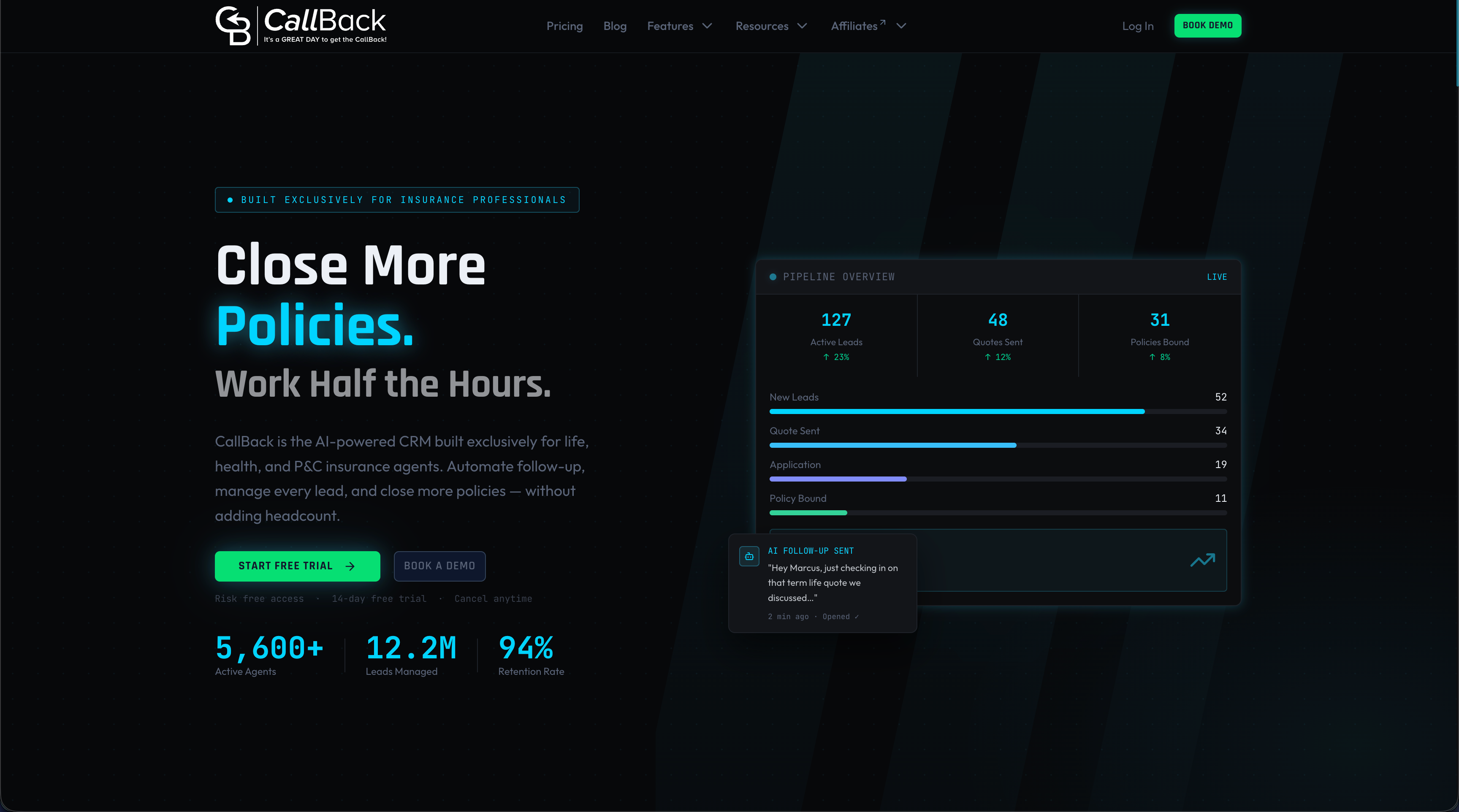
CallBack CRM brings together AI CRM features built for insurance agencies, including lead scoring, automated workflows, omnichannel outreach, and retention tools that work out of the box. You don’t need a developer or a six-month implementation project. The platform also includes website and funnel tools so your digital presence and your CRM work from the same system. If you’re ready to replace fragmented tools with a unified, AI-driven platform designed for agents, explore what CallBack CRM can do for your agency and start with a demo to see it in action.
Frequently asked questions
What is the biggest CRM trend for insurance agencies in 2026?
The biggest trend is embedding AI into core workflows for better customer engagement and efficiency, moving beyond isolated pilots to full workflow orchestration across the agency.
How does AI personalization help insurance agents retain clients?
AI allows agents to proactively communicate, customize policies, and anticipate client needs. AI-enabled personalization directly addresses the churn pressure carriers face as premiums rise and client trust wavers.
What is the main risk of adopting advanced CRM systems?
The main risk is complexity and feature overload, which delays ROI and frustrates staff. CRM time-to-value risks are highest when agencies try to deploy too many capabilities at once without a clear adoption roadmap.
How often do sales professionals use AI in CRM as of 2026?
Frontline AI usage in CRM is already widespread, with a significant share of sales professionals reporting at least weekly use, though many also report anxiety about how AI will affect their roles.
How can agencies avoid CRM deployment pitfalls in 2026?
Adopt AI one workflow at a time and prioritize governance, training, and value measurement before expanding. Avoiding feature overload means starting with your highest-impact, lowest-complexity process and building confidence before scaling.