

TL;DR:
- Insurance agencies adopting AI-driven sales automation gain faster lead engagement, improve closing rates, and outpace manual process competitors.
- Effective automation enhances personalized communication, streamlines compliance, and provides real-time analytics to inform smarter decisions.
- The key to success lies in strategic implementation focused on customer experience, not just technology features.
Insurance agencies that hesitate to embrace AI-driven sales automation are already losing ground to competitors who engage leads faster, nurture relationships more effectively, and close deals with far greater consistency. The gap between agencies running manual processes and those powered by intelligent automation is widening every quarter. Conversion boosts of up to 35% separate the early adopters from the holdouts. This guide breaks down the most impactful advantages of sales automation for insurance agents in 2026, offering practical insights and real-world context so you can make confident decisions about modernizing your operations.
Table of Contents
- Why insurance sales automation matters in 2026
- 1. Supercharged lead management and qualification
- 2. Personalization at scale—without losing the human touch
- 3. Data-driven decisions: Analytics, compliance, and insights
- Side-by-side: The core benefits at a glance
- Our perspective: The biggest mistake agents make with automation
- Take your agency to the next level with CallBack CRM
- Frequently asked questions
Key Takeaways
| Point | Details |
|---|---|
| Boost sales conversions | Automated lead management delivers faster follow-up and higher sales rates for insurance agencies. |
| Personalize at scale | AI-driven messaging allows agencies to connect authentically with more customers without sacrificing quality. |
| Strengthen compliance | Automation provides better data tracking and compliance safeguards to reduce regulatory risk. |
| Data fuels smarter decisions | Advanced analytics uncover trends and customer needs, guiding better marketing and sales choices. |
Why insurance sales automation matters in 2026
The traditional insurance sales playbook—cold calls, manual follow-ups, spreadsheet pipelines—is losing effectiveness fast. Today’s prospects expect fast, relevant responses. They compare multiple carriers, read reviews, and make decisions before many agents even return their first call. If your process relies on manual outreach, you are competing at a serious disadvantage.
The 2026 competitive landscape rewards speed, personalization, and data literacy. Agencies that have adopted modern tools are reporting that automation brings a 35% sales boost compared to manual approaches. That is not a marginal improvement. That is the difference between growing your book of business and watching it stagnate.
Understanding marketing automation benefits specific to insurance is the starting point. Not all automation tools are equal, and not all of them are built with insurance compliance and relationship dynamics in mind. When evaluating a solution, you want to demand the following from your platform:
- AI-powered lead scoring that ranks prospects by conversion likelihood
- Seamless integrations with carrier systems, email, SMS, and calendars
- Built-in compliance controls for TCPA, CAN-SPAM, and state-specific regulations
- Customizable workflows that reflect your agency’s unique sales process
- 24/7 technical support and ongoing onboarding resources
A marketing automation guide for 2026 reinforces that the agencies winning in this environment are not just automating for automation’s sake. They are selecting tools that align with their specific growth goals and client demographics. The next step is understanding exactly how each advantage plays out in practice.
1. Supercharged lead management and qualification
Your pipeline is the engine of your agency. Without a steady, well-qualified flow of leads, everything else stalls. The problem with manual lead management is simple: humans miss things. Leads fall through the cracks, follow-up emails get delayed, and high-value prospects get the same attention as low-intent browsers.
AI-powered automation changes the equation entirely. Here is how a well-structured automated lead management process typically works:
- Lead capture: A prospect fills out a form on your website, engages with an ad, or responds to an SMS campaign. The system captures that contact immediately, no manual entry needed.
- AI scoring: The platform analyzes the lead’s behavior, demographics, and source to assign a priority score. Warm, high-intent leads rise to the top automatically.
- Instant trigger: Within seconds, the lead receives a personalized welcome message via email or SMS, while your calendar is updated with a follow-up reminder.
- Nurture sequence: If the lead does not convert immediately, they enter a structured drip sequence that delivers relevant content based on where they are in the decision cycle.
- Agent alert: When a lead hits a certain engagement threshold (opened three emails, visited the pricing page twice), your system alerts you to make a personal outreach move.
This kind of system means automating your lead funnel is not just about saving time. It is about ensuring that every lead gets optimal attention at the right moment. Automated lead management can increase sales team efficiency by at least 35%, which means your team closes more without working more hours.
The real-world scenario looks like this: An agency with four producers starts using AI lead scoring. They stop wasting afternoon blocks chasing tire-kickers and focus their energy on the top 20% of leads the system identifies. Within two months, their close rate improves noticeably, and their producers report less burnout and higher job satisfaction. AI tools for qualifying leads are central to this kind of outcome.

Pro Tip: When you configure your lead scoring model, map the criteria to your agency’s best historical clients. Look at which attributes (coverage type, zip code, referral source, annual premium range) correlated with fast closes and high retention. Program those variables into your scoring weights so the AI learns from your real-world data, not just generic insurance benchmarks. Platforms like lead nurturing automation tools give you the flexibility to tune these parameters over time.
2. Personalization at scale—without losing the human touch
Once your lead funnel is running efficiently, the next challenge is connection. Insurance is still a relationship business. Clients want to feel known, understood, and valued—not like they are receiving a generic blast from a faceless company. The fear many agents have about automation is that it makes communication feel robotic.
That fear is valid when automation is done poorly. When it is done well, the opposite happens.
“AI should generate the outreach draft or skeleton while humans ‘humanize’ content and preserve relationship context.” — AI Sales Automation: Keeping the Human Touch in Insurance
This principle is the key to making personalization at scale actually work. Your AI platform handles the research, the drafting, and the scheduling. You add the nuance, the personal note, the specific detail that makes a client feel like they matter. Together, the result is outreach that feels individual even when it reaches hundreds of contacts.
Consider the different outreach paths a well-configured system can manage simultaneously:
- New leads: A first-touch SMS that references the specific product they inquired about, followed by an email with a relevant case study and a soft calendar invite
- Policy renewals: An automated reminder 90 days out that includes the client’s current coverage summary, a one-click option to schedule a review call, and a personal note field your system pulls from the last interaction log
- Cross-sell opportunities: A triggered message after a client files a claim on their auto policy, gently introducing a home or life product that fits their profile
Knowing how to use AI for better client engagement means building these paths once and letting them work continuously. Your producers still handle the relationship-critical moments: the needs analysis call, the policy delivery, the claim support conversation. But all the in-between touchpoints are handled consistently and on time. Explore the range of AI marketing tools that support this kind of layered communication strategy.
The result is that clients feel like your agency is always on top of their needs, even when your team is focused on new business development.
3. Data-driven decisions: Analytics, compliance, and insights
Personalization and lead management are powerful, but their true potential only emerges when you understand what is working and why. This is where the analytics layer of sales automation becomes indispensable.
Modern platforms deliver dashboards that show you exactly how your pipeline is performing in real time. You can see email open rates, SMS response rates, funnel drop-off points, and conversion timelines all in one place. More importantly, you can act on that data immediately.
Here is a sample comparison of key metrics agencies typically see before and after adopting automation:
| Metric | Manual process | With automation |
|---|---|---|
| Average lead response time | 4 to 8 hours | Under 2 minutes |
| Email open rate | 18% to 22% | 32% to 40% |
| Policy renewal close rate | 58% | 74% |
| Compliance check completion | Irregular | 100% automated |
| Producer time on admin tasks | 40% of day | Under 15% of day |
The numbers tell a clear story. Speed matters enormously in insurance sales, and automation is the only realistic way to achieve sub-two-minute response times at any real scale.
Data-rich automation platforms help agencies adjust messaging on the fly and remain compliant with evolving regulations. Compliance is not a side concern in insurance. TCPA violations, improper email disclosures, and failure to document consent can result in serious financial penalties. A quality automation platform tracks consent across every channel, stores communication records automatically, and alerts you when regulation changes require action.
Understanding CRM and compliance together is how forward-thinking agencies protect themselves while growing aggressively. The two goals are not in conflict when your platform is built with insurance in mind.
Pro Tip: Set up automated alerts for at-risk policies and approaching renewals in your analytics dashboard. Flag any client who has not had an outbound touchpoint in 60 days, whose policy is within 120 days of renewal, or whose coverage has not been reviewed since a major life event. These alerts keep your retention strategy proactive rather than reactive, and they are one of the highest-ROI features available in insurance analytics strategies.
Side-by-side: The core benefits at a glance
With each advantage covered in depth, it helps to see the full picture in one place. This comparison table maps the core benefits of sales automation to their practical business impact and how quickly agencies can typically implement each capability.
| Benefit | Business impact | Implementation ease |
|---|---|---|
| AI lead qualification | Higher close rates, less wasted outreach time | Moderate: requires scoring model setup |
| Automated follow-up sequences | Fewer leads lost, better conversion timelines | Easy: templates available out of the box |
| Personalized multi-channel outreach | Stronger client relationships, better retention | Moderate: workflow design needed |
| Real-time analytics dashboard | Faster, smarter business decisions | Easy: most platforms activate this immediately |
| Compliance automation | Reduced legal risk, cleaner records | Easy to moderate: depends on state requirements |
| Renewal and cross-sell triggers | Increased average client lifetime value | Easy: built on existing policy data |
| AI-assisted content creation | Faster outreach with consistent quality | Easy: AI generates, agents refine |
Top sales automation benefits include lead qualification, increased engagement, data-driven insights, and improved compliance processes. The table above shows that most of these are not difficult to implement. The real barrier is not technology. It is deciding to start.
When you evaluate which features to prioritize for your agency, think about your current biggest bottleneck. If leads are slipping through the cracks, start with lead management and scoring. If retention is your challenge, build your renewal workflows first. If your producers are overwhelmed with admin, focus on automating follow-up and data entry. Use the platform comparison for 2026 to match specific tools to your priorities, and run through a sales automation checklist before you commit to a platform.
Our perspective: The biggest mistake agents make with automation
Most agents who struggle with automation make the same error. They treat it as a technology project instead of a sales strategy. They focus on features, integrations, and price tiers—and they never spend enough time thinking about the experience they want their clients to have.
Automation is a delivery mechanism. What you deliver still depends entirely on how well you understand your clients, your market, and your value proposition. An agency with a clear sense of what makes their service different will use automation to amplify that difference consistently. An agency without that clarity will just send faster emails to confused prospects.
The counterintuitive truth is that more automation, done right, actually makes your agency feel more personal. Because every touchpoint is timely, relevant, and contextually aware, clients perceive your team as highly attentive. They do not know a workflow is running in the background. They just know you remembered their renewal, sent them exactly the right article about life insurance after their second child was born, and followed up within minutes of their inquiry. That experience builds trust faster than any manual process ever could.
The agents who get the most from automation are the ones who invest time upfront in mapping their ideal client journey, then let the technology execute it flawlessly. That is a business strategy conversation before it is ever a software conversation.
Take your agency to the next level with CallBack CRM
If the advantages covered in this article describe the kind of agency you want to build, the right technology partner makes all the difference.
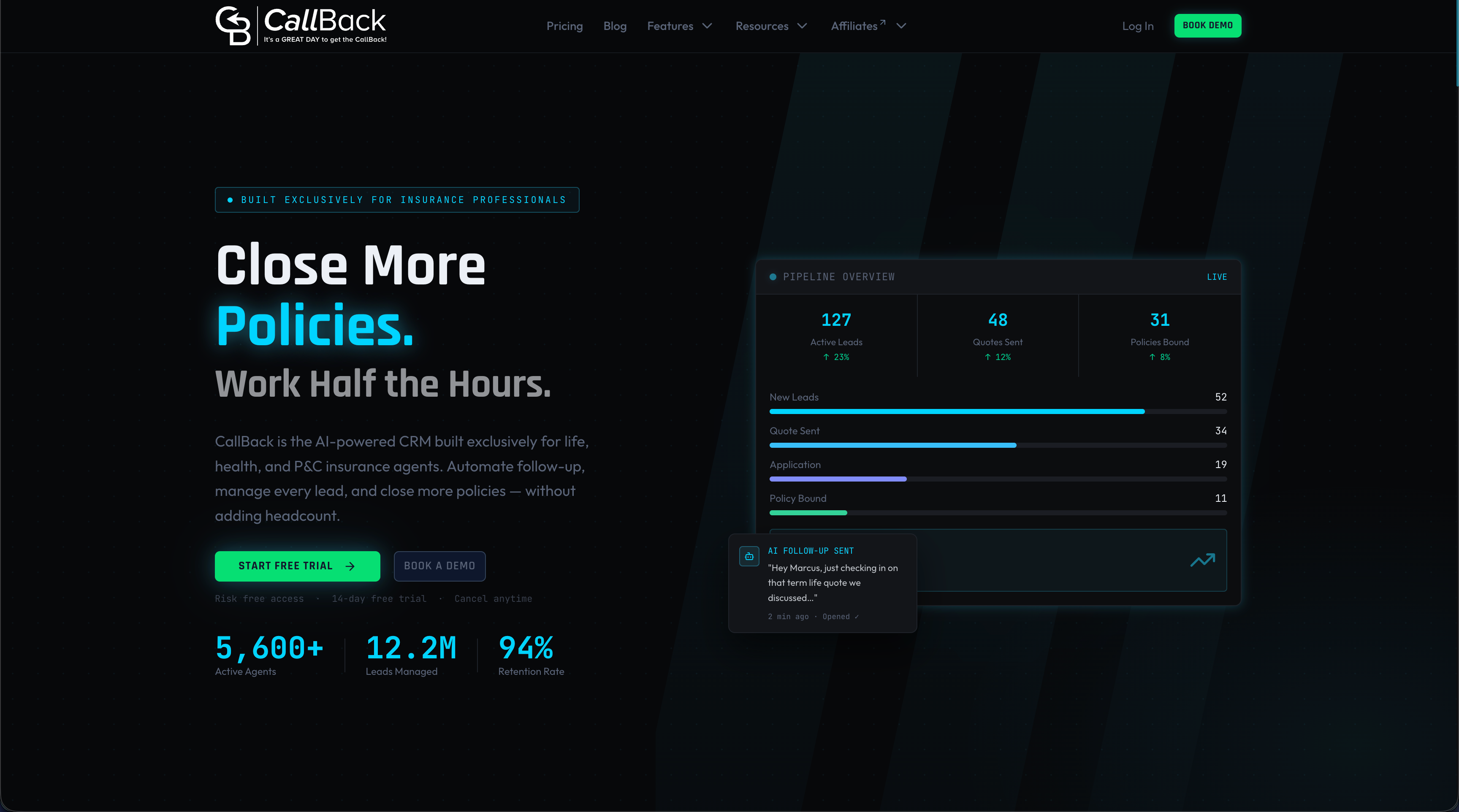
CallBack CRM is built specifically for insurance agents, agencies, and IMOs who are serious about growth. The platform brings together AI-powered lead scoring, automated email and SMS sequences, multi-channel personalization, real-time analytics, and compliance tracking in one unified system. You do not need to stitch together a dozen tools or hire a tech team to make it work. Everything is designed for insurance sales professionals who want to close more, stress less, and scale without sacrificing the relationships that make this business meaningful. Visit callbackcrm.com to see how the platform can transform your agency’s operations starting today.
Frequently asked questions
What is the biggest advantage of sales automation for insurance agents in 2026?
The biggest advantage is the ability to qualify and follow up with leads instantly, delivering a 35% or more boost in conversion rates compared to manual processes.
How can automation personalize insurance sales outreach?
Automation uses AI to draft tailored messages and reminders, which agents then refine to preserve a genuine personal connection, as AI generates drafts while humans humanize them.
Is sales automation difficult to implement for smaller agencies?
Most automation tools in 2026 are cloud-based and designed for fast onboarding, making implementation far simpler and faster than it was even two or three years ago.
What compliance features do sales automation platforms offer?
Modern platforms help agencies stay compliant by tracking consent across all channels, automating recordkeeping, and alerting users when regulation changes require action, as data-rich platforms support ongoing compliance automatically.