

TL;DR:
- Data-driven marketing enhances engagement, lead quality, retention, and ROI for insurance agents.
- AI tools automate tasks and improve personalization, but require careful implementation and oversight.
- Success depends on incremental tool adoption, data integration, compliance, and human judgment.
Most insurance agents believe their referral network and a solid cold-calling script are enough to stay competitive. That assumption is costing them clients. The insurance market is shifting fast, and agents who rely on gut instinct alone are watching higher-converting competitors pull ahead. Data-driven marketing changes the equation by replacing guesswork with precision. When you use customer behavior, analytics, and AI-powered tools to shape every touchpoint, you stop wasting budget on the wrong prospects and start building relationships that actually convert. This guide walks you through the strategies, tools, and common pitfalls so you can start applying these methods to your agency today.
Table of Contents
- Why data-driven marketing is transforming insurance
- Key AI-powered tools and platforms for insurance marketers
- Challenges: Pitfalls, compliance, and data integration
- Smart data strategies for boosting customer engagement
- Our take: Building insurance marketing that actually delivers
- Upgrade your insurance marketing with powerful AI tools
- Frequently asked questions
Key Takeaways
| Point | Details |
|---|---|
| Personalization drives results | AI-powered personalization can boost customer engagement by 30% in insurance marketing. |
| Incremental adoption wins | Gradually building on existing tools is more effective than overhaul approaches. |
| Compliance and oversight matter | Maintaining TCPA/CMS compliance and human checks prevents costly data and attribution errors. |
| Blend AI with human insight | Using AI as a partner, not a replacement, leads to better client relationships and higher ROI. |
Why data-driven marketing is transforming insurance
Data-driven marketing is not a buzzword. It is a method. At its core, it means using customer data, behavioral patterns, and analytics to make every marketing decision, from which prospects to target to what message to send and when. For insurance agents, this translates into knowing which clients are most likely to lapse, which prospects are ready to buy, and which cross-sell offers will land.
The biggest misconception is that this approach is only for large carriers or national brokers with massive tech budgets. That is simply not true. AI tools have made personalization at scale accessible to independent agents and small agencies. The barrier to entry has dropped significantly in recent years.
Here is why it matters in practice:
- Higher engagement rates: Targeted messaging outperforms generic blasts every time.
- Better lead quality: Predictive scoring surfaces prospects most likely to convert.
- Improved retention: Behavioral triggers let you reach clients before they shop around.
- Stronger ROI: Every dollar goes further when you know who you are talking to.
The numbers back this up. Personalization boosts customer engagement by 30%, which is a meaningful lift for any agency trying to grow without proportionally growing headcount.
“The shift from volume-based outreach to insight-driven engagement is not optional for agencies that want to stay relevant. It is the new baseline.”
What makes AI-driven customer engagement so powerful for insurance specifically is the nature of the product. Insurance is a trust-based, long-term relationship. When your outreach feels relevant and timely rather than generic, you build that trust faster. A client who receives a renewal reminder tailored to their specific policy and life stage is far more likely to stay than one who gets a mass email blast.
Data-driven marketing also gives you feedback loops that traditional methods never could. You can measure open rates, click-through rates, conversion rates, and lifetime value all in one place, and adjust your strategy in real time.
Key AI-powered tools and platforms for insurance marketers
Understanding the benefits is one thing. Knowing which tools deliver them is another. The AI-powered marketing stack for insurance agents generally falls into four categories.
- CRM platforms with AI capabilities: These go beyond contact management. They score leads, flag at-risk clients, and automate follow-up sequences based on behavior.
- Automated segmentation engines: These group your audience by policy type, purchase history, demographics, and engagement level so your messaging is always relevant.
- Predictive analytics tools: These analyze historical data to forecast which clients are likely to lapse, upgrade, or refer, giving you a head start on retention and growth.
- Personalization engines: These dynamically adjust email content, landing pages, and offers based on individual client profiles.
Here is how a traditional CRM compares to an AI-driven platform:
| Feature | Traditional CRM | AI-driven CRM |
|---|---|---|
| Lead scoring | Manual | Automated, predictive |
| Follow-up | Scheduled by agent | Triggered by behavior |
| Segmentation | Basic (age, location) | Multi-variable, dynamic |
| Reporting | Static dashboards | Real-time, actionable insights |
| Personalization | Limited | Automated at scale |
The AI marketing tools available today can handle tasks that used to take hours of manual work. But there is an important caution here. AI oversight importance is real: AI serves as a co-pilot, not a replacement, and human oversight is critical for preventing errors that can damage client relationships.

Pro Tip: Build your AI stack incrementally. Start with one tool, master it, and measure results before adding the next layer. Agents who try to automate everything at once often end up with a fragmented system that creates more confusion than clarity. Explore AI tools for agents that integrate cleanly with your existing workflow.
Challenges: Pitfalls, compliance, and data integration
Getting the tools in place is just the beginning. The agents who struggle with data-driven marketing are not usually failing because the strategy does not work. They are failing because they ran into avoidable traps.
Here are the most common pitfalls:
- Tool overhaul syndrome: Replacing every system at once causes disruption, data loss, and team burnout.
- Misattribution of direct traffic: Not all website visits come from your last email. Ignoring this skews your ROI calculations.
- Overvaluing easy channels: Email open rates feel good but do not always predict revenue. Focus on conversion metrics.
- Siloed data: When your CRM, email platform, and phone system do not talk to each other, you get incomplete client pictures.
- Dark social blind spots: Referrals shared via text or private messaging are nearly impossible to track, which means your best leads often look like they came from nowhere.
Compliance is non-negotiable. TCPA (Telephone Consumer Protection Act) and CMS (Centers for Medicare and Medicaid Services) regulations govern how you contact prospects and clients. Violations carry serious financial penalties.
| Challenge | Risk | Mitigation |
|---|---|---|
| TCPA violations | Fines per contact | Use opt-in workflows and consent tracking |
| Dark social | Attribution gaps | Use UTM parameters and ask clients directly |
| Data silos | Incomplete insights | Integrate platforms via API or unified CRM |
| Tool overhaul | Workflow disruption | Incremental upgrades, not full replacements |
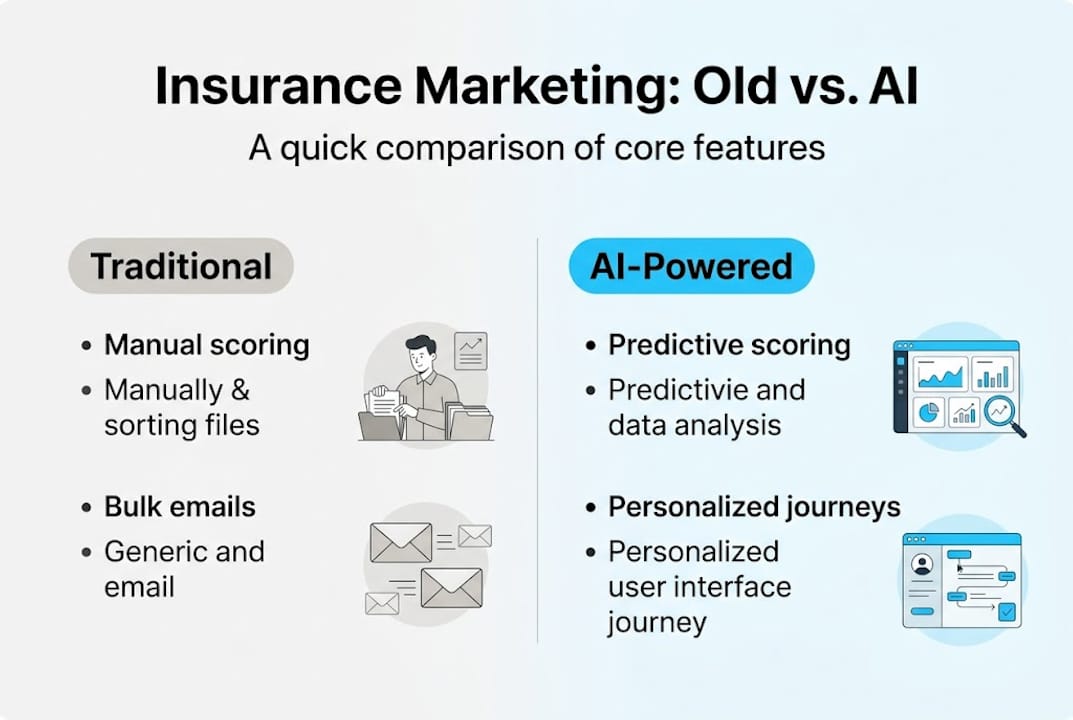
According to AI challenges and compliance research, pitfalls include tool overhaul syndrome, misattribution of direct traffic, and overvaluing easy channels. All three are fixable, but only if you know to look for them.
Pro Tip: Before adding any new tool, audit your current data flow. Know where your leads come from, how they move through your pipeline, and where they drop off. A CRM for sales boost that maps this journey clearly is worth more than five disconnected apps.
“The agents winning with data are not necessarily using the most tools. They are using the right tools, connected properly, with clean data flowing through them.”
Smart data strategies for boosting customer engagement
Once you have your tools in place and your compliance guardrails set, the real work begins. Here are the action steps that move the needle on engagement and retention.
- Integrate your data sources first: Connect your CRM, email platform, and any lead sources into a single system. You cannot personalize what you cannot see.
- Shift your focus to lifetime value (LTV): Short-term lead volume feels productive, but LTV focus matters more than short-term volume. Only about 50% of insurance executives are at an advanced AI adoption level, which means there is still a real competitive edge available to agents who make this shift now.
- Automate personalized outreach: Use behavioral triggers to send the right message at the right time. A client who just had a life event, like a new home purchase or a new baby, is primed for a coverage review conversation.
- Build human touchpoints into your automation: AI handles the volume; your team handles the relationship. Schedule personal check-ins at key milestones and let automation handle everything in between.
- Measure what matters: Track retention rates, cross-sell conversion, and LTV alongside standard engagement metrics. These numbers tell you whether your strategy is actually building a better book of business.
Pro Tip: Never let AI send a message you have not reviewed at least once. Automated systems can produce errors or off-brand language that confuses clients. Human oversight is your quality filter. Explore AI-driven engagement strategies and customer engagement strategies that build this human-AI balance into the workflow from the start.
The agents who get the best results treat their data strategy like a living system. They review it regularly, test new approaches, and adjust based on what the numbers show.
Our take: Building insurance marketing that actually delivers
Here is the uncomfortable truth most marketing vendors will not tell you: more tools do not equal better results. We have seen agencies spend significant budget on AI platforms only to see minimal improvement because they skipped the fundamentals. Clean data. Clear goals. Human judgment applied at the right moments.
The incremental approach wins every time. Start with one workflow, automate it well, measure it honestly, and build from there. Agents who try to leap from zero to fully automated in one quarter almost always end up reverting to old habits because the transition is too disruptive.
AI is a co-pilot; results come from careful human oversight and incremental integration. That is not a limitation of the technology. It is a feature. The agents who treat AI as a thinking partner rather than a magic solution are the ones building sustainable, scalable agencies.
Success in data-driven insurance marketing is not about using every tool available. It is about knowing your clients well enough to master AI insurance marketing in a way that feels personal, not automated.
Upgrade your insurance marketing with powerful AI tools
Ready to put these strategies to work? Here is how CallBack CRM helps agents execute data-driven marketing smarter and faster.
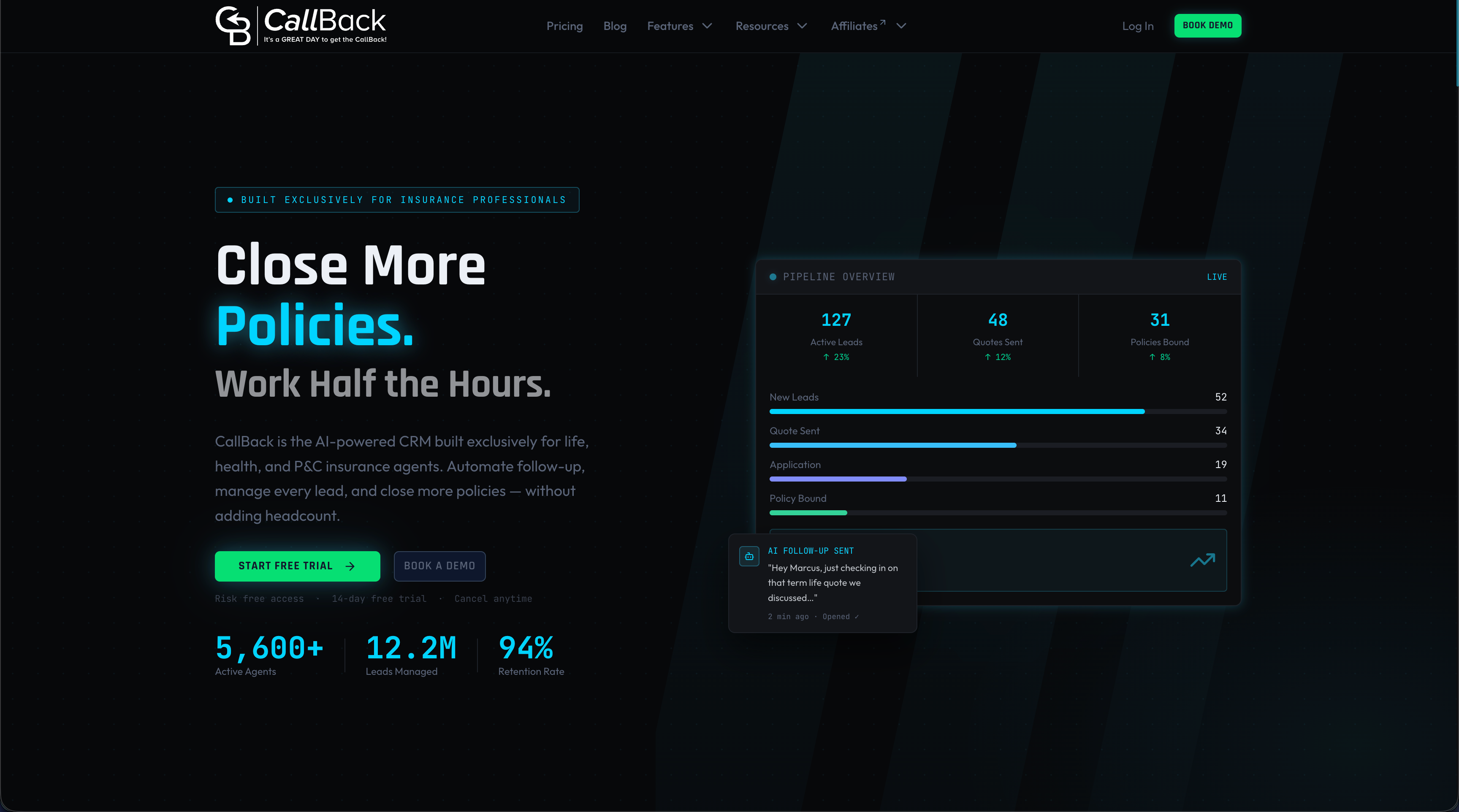
CallBack CRM brings together the AI features for insurance agents need in one connected platform: CRM management, automated email and SMS sequences, lead scoring, behavioral triggers, and real-time reporting. You can also build websites and funnels designed specifically for insurance lead generation, all without needing a separate tech stack. Whether you are just starting with data-driven marketing or looking to scale what is already working, CallBack CRM gives you the tools to do it without the complexity.
Frequently asked questions
What is data-driven marketing in insurance?
Data-driven marketing uses customer information and analytics to target, personalize, and optimize insurance campaigns for better engagement and ROI. Personalization boosts engagement by 30%, making it a measurable advantage for agents who adopt it.
Which AI-powered tools are best for insurance marketing?
CRM platforms with automated segmentation, predictive analytics, and personalization engines are best for scalable insurance marketing. AI as co-pilot means human oversight remains essential for accuracy and compliance.
How can I avoid compliance pitfalls when using customer data?
Work with tools that support TCPA and CMS compliance, use incremental upgrades, and ensure human oversight for data quality. Compliance and oversight are not optional steps; they are built into every responsible data-driven workflow.
What does ‘dark social’ mean for insurance marketers?
Dark social refers to sharing and referrals that are not directly trackable, such as links shared via text message or private chat, making attribution and insight challenging. Dark social tracking challenges create attribution gaps that can distort your understanding of where your best leads actually come from.