

TL;DR:
- Optimizing each stage of the sales funnel, especially handoffs, significantly increases insurance revenue.
- Tracking key metrics and fixing the biggest leak first ensures continuous, data-driven sales improvement.
Sales funnel optimization is the strategic process of improving each stage of the customer journey to maximize conversions and revenue. For insurance sales and marketing professionals, this is not a nice-to-have. It is the difference between a pipeline that compounds revenue and one that quietly hemorrhages deals at every handoff. The importance of sales funnel management becomes clear when you realize that most revenue losses are not caused by bad products or weak pricing. They are caused by friction, misalignment, and untracked drop-offs that nobody is measuring.
Why prioritize sales funnel optimization: the measurable case
The numbers make the argument faster than any theory. Businesses with documented sales funnels generate 2.3 times more ROI and grow 19% faster than those without. That gap is not explained by product quality or market size. It reflects the compounding effect of knowing exactly where prospects stall and fixing those points systematically.

Nurtured leads buy 47% larger deals than leads that receive no structured follow-up. For insurance agencies selling complex products like group benefits or commercial lines, that deal size difference translates directly into commission and retention revenue. A single optimized nurture sequence can outperform months of cold outreach volume.
The benefits of funnel optimization also show up in cost efficiency. When you tighten lead qualification early, your sales team stops burning hours on prospects who were never going to close. Customer acquisition costs fall, sales cycles shorten, and win rates climb. The sales funnel acts as a control system, allocating resources based on evidence rather than gut instinct.
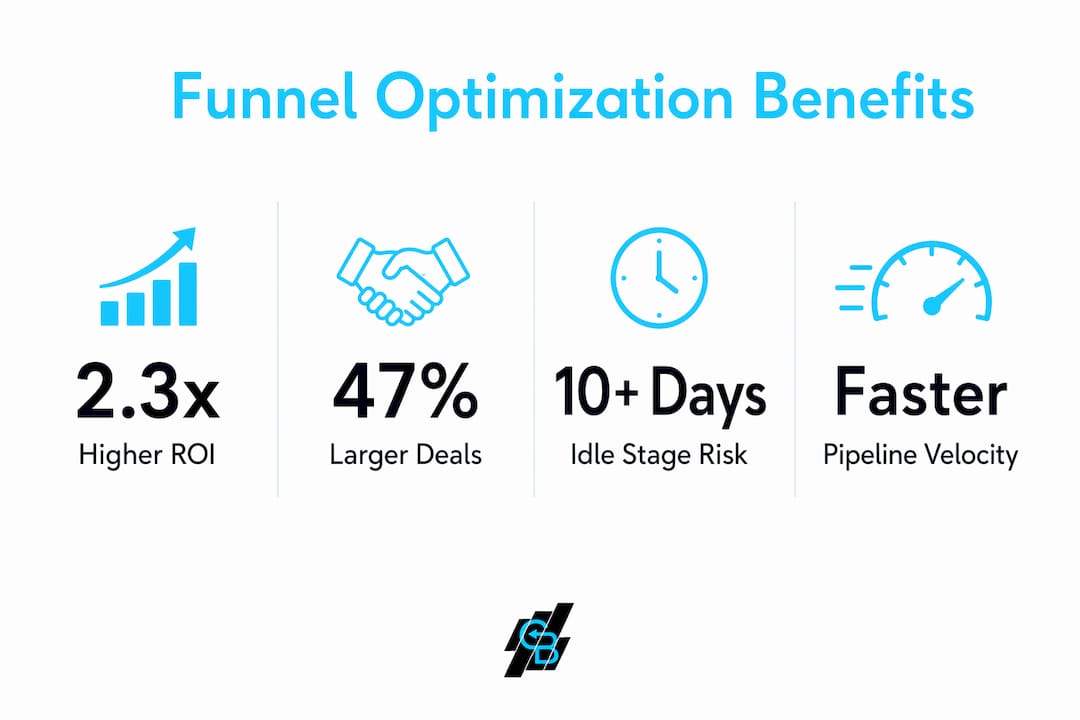
Pipeline velocity is the metric that ties all of this together. It measures how fast qualified opportunities move from first contact to closed deal. Optimizing the funnel increases velocity by removing the friction points that cause deals to stall between stages. For insurance teams managing dozens of active opportunities across multiple product lines, even a 20% improvement in velocity produces a measurable revenue lift within a single quarter.
| Benefit | Impact |
|---|---|
| ROI growth | 2.3x higher ROI with documented funnel processes |
| Deal size | Nurtured leads close 47% larger deals |
| Sales alignment | Aligned teams see 38% higher win rates |
| Pipeline velocity | Faster stage progression reduces cycle length |
How do funnel leaks occur, and why do stage transitions matter most?
Most drop-off does not happen inside a single stage. Conversion drop-offs mainly happen at transitions between stages, which means the handoff from marketing to sales, the gap between demo and proposal, and the final step before purchase are where deals actually die. Fixing those transitions produces faster gains than polishing any individual stage in isolation.
In insurance sales, the marketing-to-sales handoff is a chronic weak point. Marketing qualifies a lead based on form fills or ad clicks, then passes it to a sales rep who has no context on what the prospect actually read, watched, or asked about. The rep starts from zero. The prospect feels like they are repeating themselves. That friction alone kills a significant share of warm leads before a real conversation begins.
The demo-to-proposal gap is equally damaging. Prospects idle over 10 days between a demo and a proposal are, statistically, already lost. Insurance buyers move on to competitors, get distracted by internal priorities, or simply lose the urgency they felt during the demo. A structured follow-up protocol with a defined SLA for proposal delivery closes that gap before it becomes a lost deal.
Pro Tip: Audit your funnel and identify the single stage transition with the highest drop-off rate. Fix that one point before touching anything else. Trying to optimize every stage simultaneously dilutes focus and makes it impossible to attribute improvements to specific changes.
The risk of focusing on volume at the top of the funnel compounds these transition problems. Misaligned targeting wastes rep time and decreases morale. When your pipeline is full of poorly qualified leads, every downstream stage becomes harder, slower, and more expensive. The fix starts at the entry point, not at the close.
What practical strategies work for insurance funnel optimization?
Tightening your Ideal Customer Profile is the highest-leverage starting point. For insurance teams, this means defining the specific business sizes, industries, coverage needs, and decision-maker roles that your product actually serves well. Broad targeting fills your funnel with noise. Precise targeting fills it with buyers who already have the problem you solve.
Early lead qualification saves more sales resources than any other single practice. Build a qualification framework that scores leads on budget, authority, need, and timeline before a rep invests significant time. Tools like Callbackcrm’s AI-powered lead scoring automate this process, flagging high-fit prospects and deprioritizing those unlikely to close. This keeps your insurance sales funnel focused on real opportunities.
Behavior-triggered nurture sequences are significantly more effective than time-triggered ones. Reaching out the day a prospect revisits your pricing page or downloads a product guide produces far higher engagement than a scheduled drip email sent on day seven regardless of what the prospect has done. Insurance buyers research extensively before committing. Meeting them at the moment of active research is a direct conversion lever.
Here are four practical strategies insurance teams can implement immediately:
- Tighten ICP targeting by filtering leads against defined firmographic and behavioral criteria before they enter the active pipeline.
- Deploy self-serve content that answers the regulatory and product complexity questions insurance buyers ask during the research phase, reducing the need for repetitive sales calls.
- Align marketing and sales messaging around the same value propositions. Highly aligned companies see 38% higher sales win rates, and the alignment starts with shared definitions of a qualified lead.
- Maintain CRM data hygiene by standardizing field inputs, deduplicating records, and auditing contact data quarterly. Dirty data produces false signals that send reps chasing dead opportunities.
Pro Tip: Build a shared lead definition document that both your marketing and sales teams sign off on. This single artifact eliminates the most common source of handoff friction and gives you a clear standard for measuring lead quality over time.
How does data-driven measurement sustain sales funnel efficiency?
Measurement is not a reporting exercise. It is the mechanism that tells you which funnel changes actually worked and which ones just felt productive. Without baseline metrics, every optimization is a guess.
Start by establishing four core metrics for each funnel stage: conversion rate, average time in stage, win rate by lead source, and deal size by segment. These four numbers reveal where your funnel is healthy and where it is bleeding. For insurance teams managing multiple product lines, tracking these metrics separately by product category exposes performance differences that aggregate numbers hide.
A/B testing is the most reliable way to identify impactful changes. Test one variable at a time: outreach timing, subject lines, proposal formats, or follow-up cadence. Running multiple simultaneous tests makes it impossible to know which change drove the result. A disciplined testing cadence, with a defined review period and a clear success metric, produces compounding improvements over time.
Here is a four-step measurement framework for insurance sales teams:
- Establish baselines by pulling 90 days of historical data on conversion rates, stage duration, and win rates before making any changes.
- Track stage velocity weekly to catch new leaks as they emerge. Stage velocity tracking reveals pipeline delays that conversion rate snapshots miss entirely.
- Run structured A/B tests on one variable per cycle, with a minimum two-week test window to collect statistically meaningful data.
- Schedule monthly funnel audits to review the full pipeline, identify declining stages, and prioritize the next optimization target.
Data hygiene and lifecycle orchestration are the highest-priority foundations for sustaining funnel performance. Dirty CRM data sends reps after contacts who have already churned, bought from a competitor, or changed roles. Clean data means every outreach effort is directed at a real, current opportunity.
Funnel optimization pitfalls vs. best practices in insurance sales
The most common mistakes in insurance sales funnels are not random. They follow predictable patterns that show up across agencies of every size.
| Common Pitfall | Best Practice |
|---|---|
| Reflexive discounting to close stalled deals | Build urgency and value during discovery, before pricing becomes the focus |
| Ignoring stage transition drop-offs | Audit handoff points first; fix the largest leak before optimizing individual stages |
| Volume-focused top-of-funnel targeting | Define a tight ICP and qualify leads early to protect rep time and morale |
| Skipping CRM data audits | Schedule quarterly data hygiene reviews to maintain signal accuracy |
| Misaligned marketing and sales messaging | Create shared lead definitions and unified value propositions across both teams |
Reflexive discounting trains buyers to wait for price cuts, which erodes pricing integrity across your entire book of business. The correct response to a stalled deal is not a discount. It is a discovery conversation that rebuilds urgency around the cost of inaction.
Insurance sales carry specific complexity that amplifies these pitfalls. Regulatory compliance requirements, multi-stakeholder decision processes, and long policy review cycles all create natural stall points. The teams that outperform their peers treat these complexity factors as qualification criteria, not obstacles. If a prospect cannot navigate the compliance requirements of your product, they are not a fit. Qualifying that out early saves everyone time.
Optimizing for funnel volume instead of fit creates downstream inefficiencies and morale problems that compound over time. A pipeline full of low-fit leads demoralizes reps, inflates cost per acquisition, and produces churn even when deals do close.
What I’ve learned about funnel optimization in insurance sales
The teams I have seen make the fastest revenue gains are not the ones with the most sophisticated technology. They are the ones that picked one broken transition in their funnel and fixed it completely before moving on. That discipline is rarer than it sounds.
Insurance sales has a specific challenge that most generic funnel advice ignores: the buyer’s decision is not just financial. It involves regulatory understanding, risk tolerance, and often multiple internal stakeholders who each need different information. A funnel that treats every prospect identically will lose deals at the education stage, not the close stage. Tailored content that addresses compliance questions and product complexity directly is not a nice touch. It is a conversion requirement.
The other pattern I keep seeing is leadership that approves funnel optimization as a project but never commits to the measurement cadence that makes it sustainable. Optimization without consistent measurement reverts to gut-feel selling within two quarters. The sales automation workflow that supports your funnel is only as good as the review process behind it.
Cross-team alignment between marketing and sales is the multiplier that makes every other optimization work better. When both teams share a lead definition, a messaging framework, and a weekly pipeline review, the handoff friction that kills most funnels disappears. That alignment does not require new technology. It requires a shared document and a standing meeting.
— Kyle
How Callbackcrm helps insurance teams optimize their funnels
Insurance sales and marketing teams that want to put these practices into action need a platform built for their specific workflow, not a generic CRM adapted for insurance as an afterthought.
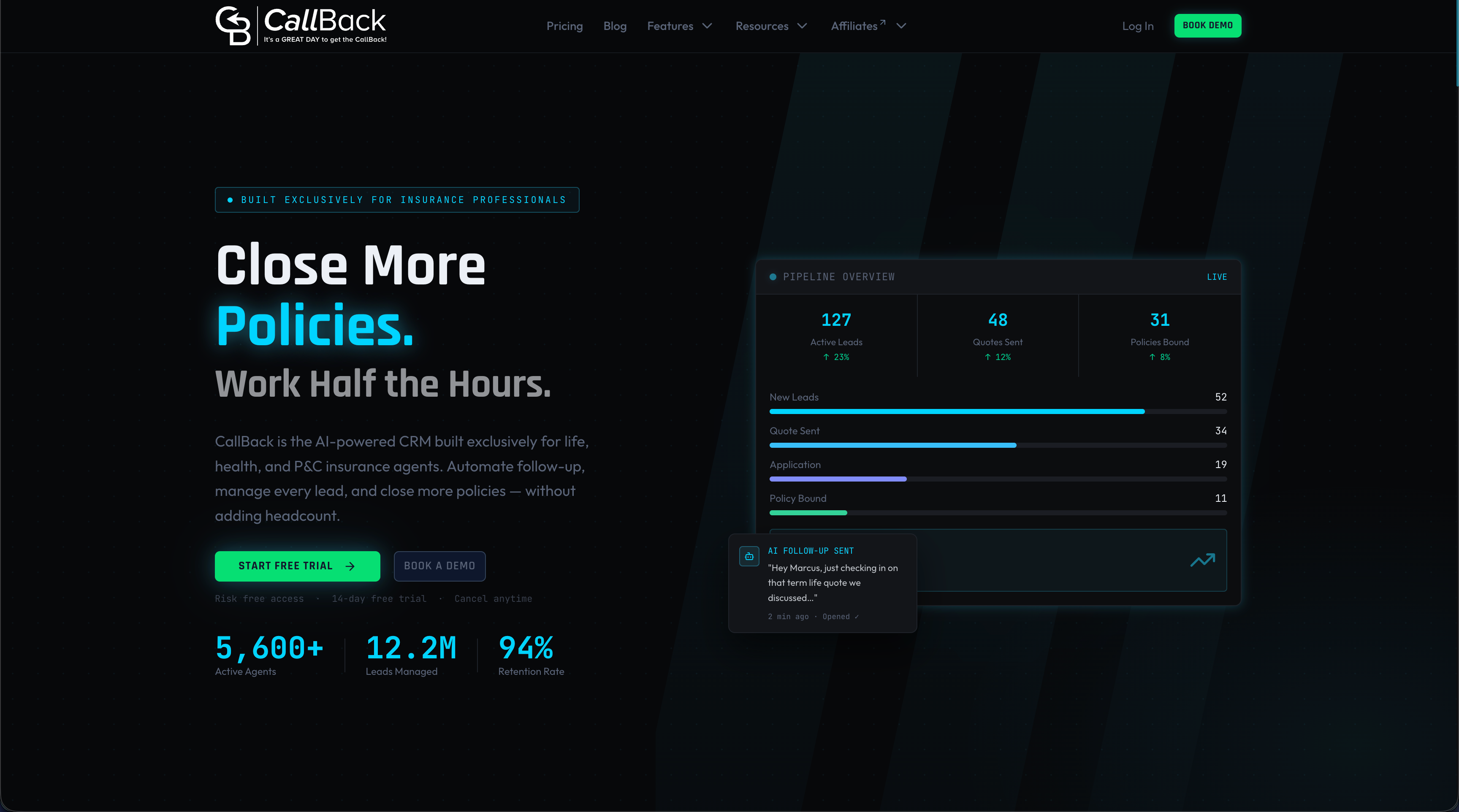
Callbackcrm is designed specifically for insurance agents, agencies, and IMOs. Its AI-powered lead scoring qualifies prospects automatically, so your reps focus on high-fit opportunities from the first contact. Behavior-triggered SMS marketing sequences reach buyers at the exact moment they re-engage with your content. The integrated funnel and website builder tracks every stage conversion in one place, giving you the clean data your measurement cadence depends on. Explore the full feature set and start a free trial to see what a purpose-built insurance funnel platform actually looks like in practice.
FAQ
What is sales funnel optimization?
Sales funnel optimization is the process of improving each stage of the customer journey to increase conversion rates and reduce drop-off between stages. It covers everything from lead targeting and qualification to nurture sequences and closing protocols.
Why do most insurance sales funnels underperform?
Most insurance funnels lose deals at stage transitions, particularly the marketing-to-sales handoff and the demo-to-proposal gap, rather than within individual stages. Fixing those handoff points produces faster improvement than optimizing any single stage in isolation.
How does nurturing leads improve deal size?
Nurtured leads buy 47% larger deals than leads that receive no structured follow-up, because consistent, relevant outreach builds trust and keeps the buyer engaged through a longer decision process.
What metrics should insurance teams track for funnel performance?
Track conversion rate, average time in stage, win rate by lead source, and deal size by segment for each funnel stage. These four metrics reveal where your pipeline is healthy and where it is losing revenue.
How often should you audit your sales funnel?
Monthly audits are the minimum for a high-performance funnel. Weekly stage velocity tracking catches new leaks between audits before they compound into significant revenue losses.
Key takeaways
Sales funnel optimization drives measurable revenue growth by fixing stage transitions, tightening lead quality, and sustaining performance through consistent data-driven measurement.
| Point | Details |
|---|---|
| Prioritize stage transitions | Most funnel drop-off happens at handoffs between stages, not within individual stages. |
| Nurtured leads close bigger | Structured nurture sequences produce 47% larger deals than unmanaged lead follow-up. |
| Align marketing and sales | Shared lead definitions and unified messaging produce 38% higher win rates. |
| Measure before optimizing | Establish baseline metrics across four dimensions before making any funnel changes. |
| Fix one leak at a time | Auditing and resolving the largest single leak first produces faster, attributable gains. |