

TL;DR:
- SMS marketing automation automatically sends personalized messages triggered by customer actions to boost engagement and revenue. It achieves high open rates and responses and is highly effective when combined with CRM data and behavioral triggers.
SMS marketing automation is the process of automatically sending personalized text messages triggered by customer actions or schedules to boost engagement and conversions without manual sending. The role of SMS marketing automation goes far beyond convenience. Messages reach a 98% open rate, with 90% read within 3 minutes, and SMS generates a 209% higher response rate than email. For marketing professionals and business owners, those numbers represent a direct line to customers that no other channel matches. Platforms like Callbackcrm build entire customer engagement systems around these advantages, combining CRM data, AI-powered triggers, and two-way messaging into a single workflow.
What are the key benefits of SMS marketing automation?
SMS automation delivers measurable results across every stage of the customer lifecycle. The combination of high open rates, fast read times, and behavioral triggers creates a channel that outperforms most alternatives on pure engagement metrics.

The financial case is equally strong. Automated SMS sequences generate nearly 5x more revenue per message than manual campaigns, with automated sends earning $0.74 per message compared to $0.15 for manual sends. That gap exists because automation fires messages at the exact moment a customer is most likely to act, not when a team member gets around to sending.
Key benefits marketing teams report include:
- Higher engagement rates. A 98% open rate means your message gets seen. Email averages well below 30% by comparison.
- Faster lead conversion. Top-performing businesses respond to new leads in under one minute through automation, while 57% of businesses take up to 30 minutes manually. Speed wins deals.
- Personalization at scale. Merge fields pull in names, policy details, appointment times, or purchase history automatically. Every message feels one-to-one even when thousands go out simultaneously.
- Reduced manual workload. Workflows run without staff intervention. Your team focuses on conversations that require human judgment, not repetitive sends.
- Stronger customer retention. Businesses automating customer communication report significantly higher customer satisfaction than those relying on manual outreach. Consistent, timely messages build trust over time.
Pro Tip: Use SMS automation alongside your email sequences rather than replacing them. Combining both channels increases total touchpoints without doubling your workload, and you can use email and SMS together to reinforce the same message across two high-performing channels.
How does SMS marketing automation work?
SMS automation operates on a trigger-and-workflow model. A trigger is any defined event, such as a form submission, a purchase, an appointment booking, or a set date, that tells the system to send a specific message. The workflow defines what happens next: a single message, a multi-step sequence, or a branch based on whether the customer replied.
Here is how a standard SMS automation setup works from start to finish:
- Define the trigger. Choose the customer action or schedule that starts the sequence. Common triggers include new lead opt-ins, abandoned carts, appointment confirmations, and policy renewal dates.
- Build the message sequence. Write each message in the workflow. Use merge fields to pull in the customer’s name, product, or relevant detail from your CRM. Keep messages under 160 characters when possible to avoid multi-part sends.
- Set timing rules. Decide how long after the trigger each message fires. A welcome message goes out immediately. A follow-up might go out 24 hours later. Appointment reminders typically send 24 hours and 1 hour before the scheduled time.
- Connect your CRM. CRM integration ensures conversation history follows the customer across marketing, sales, and support teams. Without it, a sales rep has no context when a customer replies to an automated message.
- Configure two-way messaging. Set up keyword responses for common replies like “STOP,” “YES,” or “MORE INFO.” For nuanced replies, route the conversation to a human agent through a shared inbox.
- Test before launching. Send test messages to internal numbers. Check merge fields populate correctly. Confirm opt-out keywords trigger immediate unsubscribes.
Pro Tip: Build a human handoff rule into every workflow. When a customer replies with anything outside your defined keywords, flag the conversation for a live agent. AI-powered SMS chatbots handle roughly half of inbound replies automatically, but the other half needs a real person to avoid frustrating customers.
The technical layer matters less than the strategic layer. Triggers must map to real customer behavior, not arbitrary schedules. A message sent three days after a lead opts in because “that’s when the sequence fires” performs far worse than one sent within 60 seconds of the opt-in event.
What are the most effective SMS automation workflows?
The highest-ROI workflows share one trait: they fire at a moment of clear customer intent. The following use cases consistently deliver the strongest results.
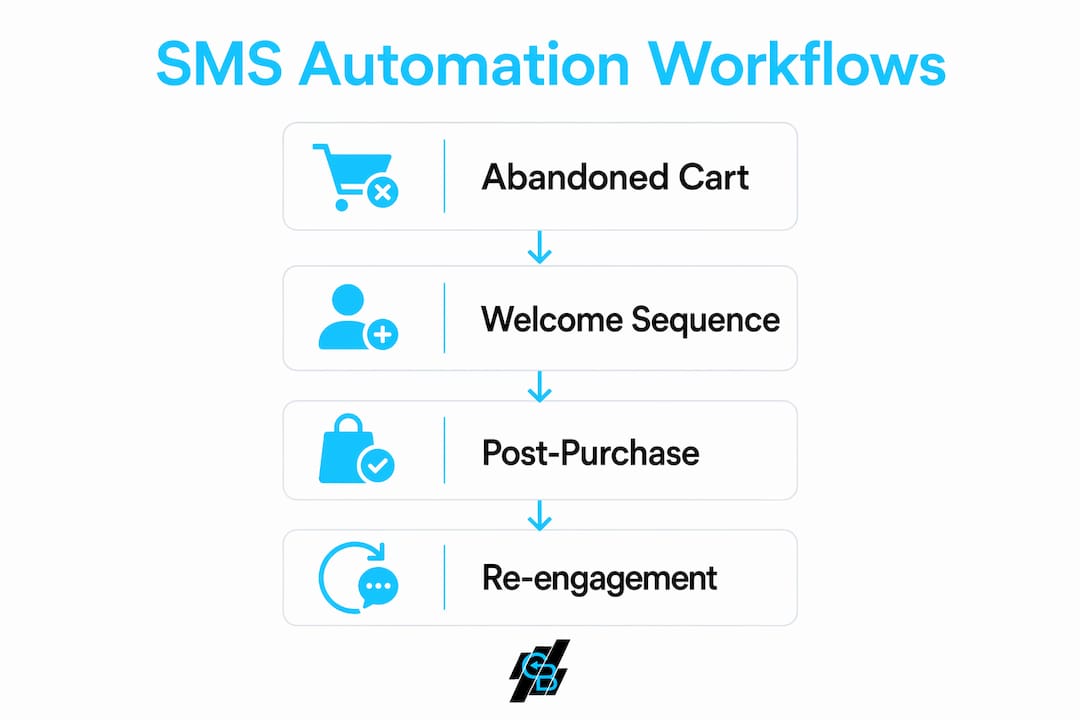
| Workflow | Trigger | Key Result |
|---|---|---|
| Abandoned cart recovery | Cart left without purchase | Recovers 10–15% of lost sales |
| Welcome and onboarding | New subscriber or lead opt-in | Converts 50% more subscribers than email welcome sequences |
| Post-purchase follow-up | Order confirmed or policy issued | Increases repeat purchases by 20–30% |
| Appointment reminder | Booking confirmed | Reduces no-show rates significantly |
| Lead nurturing sequence | New lead enters CRM | Moves prospects through the funnel with timed, relevant messages |
| Re-engagement campaign | No activity for 60–90 days | Reactivates lapsed customers before they churn permanently |
Abandoned cart recovery deserves special attention. The window between a customer leaving and a competitor winning them over is short. An SMS sent within 15 minutes of cart abandonment catches the customer while the purchase intent is still active. A follow-up 24 hours later catches those who needed more time to decide.
Welcome sequences work because first impressions set expectations. A new subscriber who receives a warm, personalized message within seconds of opting in is far more likely to engage with future messages than one who waits days for any contact.
Post-purchase follow-ups are underused by most businesses. A simple message asking for a review, offering a related product, or confirming a renewal date turns a one-time buyer into a repeat customer. For insurance agents, this is where automation workflows pay dividends at renewal time.
Re-engagement campaigns require a lighter touch. Customers who have gone quiet do not need aggressive selling. A single message acknowledging the gap and offering something of value, such as a discount or a useful resource, performs better than a hard pitch.
What best practices should marketers follow for SMS automation?
The most common failure in SMS automation is treating the channel like a broadcast medium. SMS is personal. Customers gave you their phone number, and they expect you to respect that access.
Segmentation is the single most important setup decision. Sending the same message to your entire list guarantees high opt-out rates. Segment by behavior, purchase history, lifecycle stage, or geography. A customer who just bought does not need a welcome offer. A lead who has not responded in 90 days needs a different message than one who clicked your last link yesterday.
Compliance is non-negotiable. Every SMS program requires explicit opt-in consent before the first message. Every message must include a clear opt-out path, typically “Reply STOP to unsubscribe.” Consent records must be stored and accessible. Violating TCPA regulations in the United States carries per-message fines that can reach thousands of dollars per violation.
Additional best practices that protect your program:
- Limit frequency. Two to four messages per month is the standard ceiling for most audiences. More than that and opt-out rates climb fast.
- Time your sends correctly. Send between 9:00 AM and 8:00 PM in the recipient’s local time zone. Messages arriving at 6:00 AM or 11:00 PM damage your brand.
- Measure and iterate. Track open rates, click-through rates, conversion rates, and opt-out rates per workflow. A marketing automation checklist helps teams audit each workflow systematically before and after launch.
- Handle replies properly. Avoiding over-messaging and managing inbound replies correctly are the two biggest factors in keeping opt-out rates low.
- Personalize beyond the first name. Reference the specific product, policy, or action the customer took. Generic messages with a name tag are not personalization. True personalization references context.
Volume-based automation, sending as many messages as possible, is the fastest way to destroy a list. Strategic lifecycle triggers, messages sent because a customer did something specific, are what drive revenue.
Key Takeaways
SMS marketing automation drives revenue by firing personalized, behavior-triggered messages at the exact moment customers are most likely to act, backed by a 98% open rate and nearly 5x higher revenue per message than manual sends.
| Point | Details |
|---|---|
| Open rate advantage | SMS reaches a 98% open rate, with 90% of messages read within 3 minutes. |
| Revenue per message | Automated sequences earn $0.74 per message versus $0.15 for manual campaigns. |
| Speed to lead | Automation responds to new leads in under one minute, beating the 57% who take up to 30 minutes. |
| CRM integration is required | Connecting SMS to your CRM unifies conversation history across marketing, sales, and support. |
| Segmentation prevents opt-outs | Volume-based sending raises opt-out rates; lifecycle triggers tied to customer behavior protect your list. |
Why SMS automation is the channel most marketers underestimate
I have worked with marketing teams that spend months perfecting email sequences and almost no time on SMS. The reasoning is usually the same: “SMS feels intrusive.” That belief costs them real money.
The intrusion argument gets the causality backward. SMS feels intrusive when it is done badly, meaning generic messages, bad timing, and no relevance to what the customer actually did. Done well, SMS feels like a business that pays attention. A customer who just submitted a quote request and gets a personalized reply in 45 seconds does not feel intruded upon. They feel taken care of.
The speed-to-lead advantage is the piece I find most underappreciated. Most businesses know they should follow up fast. Very few have built a system that actually does it. Automation removes the human bottleneck entirely. The message goes out the moment the trigger fires, regardless of whether it is 2:00 PM on a Tuesday or 9:00 PM on a Friday.
The other thing I have seen consistently: businesses that integrate SMS with their CRM and treat it as a two-way channel, not a broadcast tool, get dramatically better results. Customer retention improves when customers feel heard, not just messaged. Building reply handling into your workflow from day one is not optional. It is what separates a program that grows from one that burns out its list in six months.
The role of mobile marketing will only expand. Customers are on their phones. The businesses that build real, responsive SMS programs now will have a structural advantage over those who treat it as an afterthought.
— Kyle
How Callbackcrm puts SMS automation to work for your business
Callbackcrm builds SMS automation directly into its CRM, so triggers fire from real customer data, not disconnected lists. Every workflow connects to live contact records, which means your sales team sees the full conversation history the moment a lead replies.
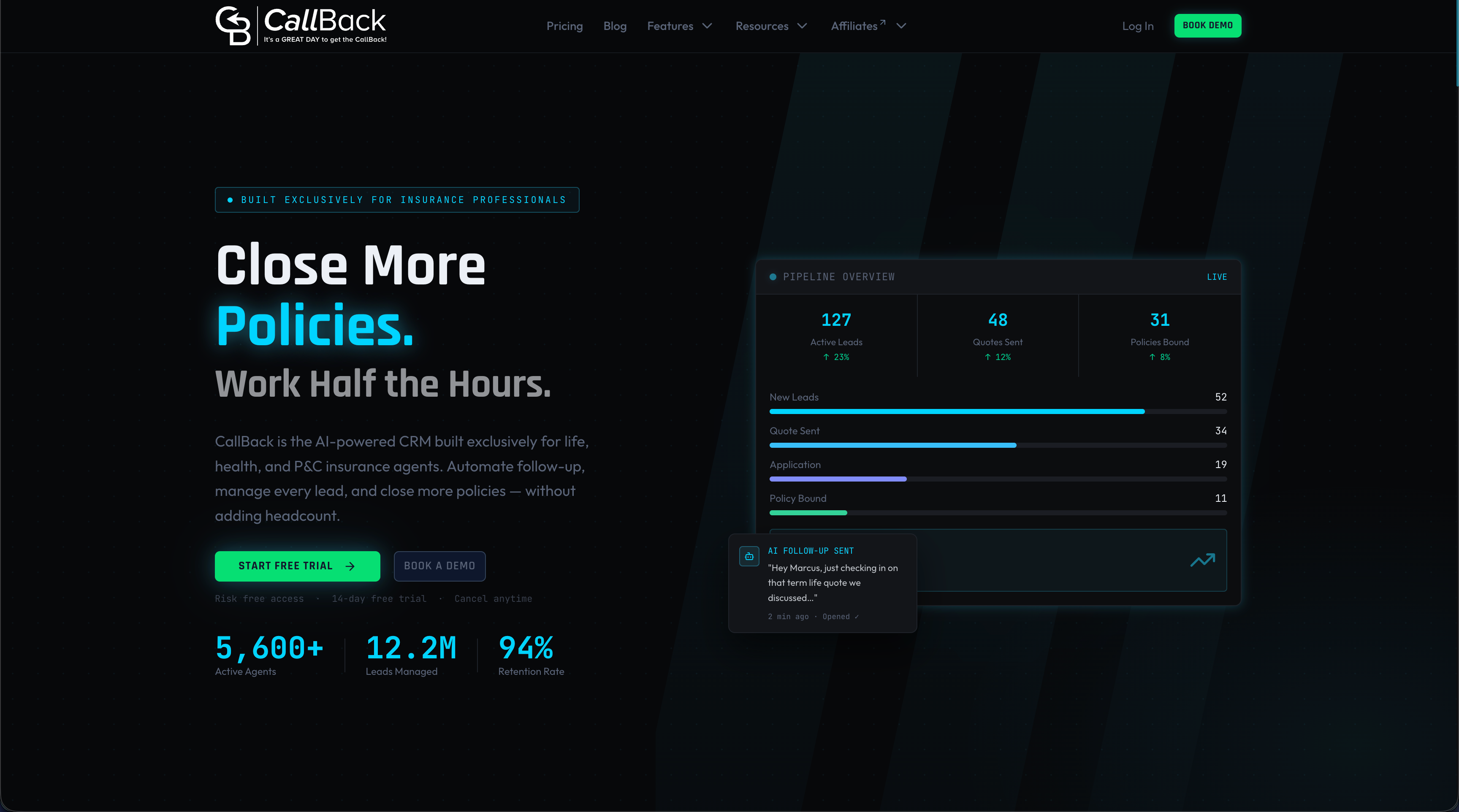
The platform supports two-way messaging with a shared inbox, so automated sequences hand off to human agents without losing context. Compliance tools handle opt-in and opt-out management automatically. Merge fields pull from CRM fields to personalize every message at scale. If you are ready to build SMS workflows that actually convert, the SMS marketing features inside Callbackcrm give you the infrastructure to do it right. You can also use the SMS segment calculator to estimate costs before you launch.
FAQ
What is SMS marketing automation?
SMS marketing automation is the process of sending text messages triggered by customer actions or schedules without manual sending. It uses workflows, merge fields, and CRM data to deliver personalized messages at scale.
Why does SMS outperform email for engagement?
SMS achieves a 98% open rate with 90% of messages read within 3 minutes, compared to email open rates that typically fall well below 30%. The response rate for SMS runs 209% higher than email.
What triggers can start an SMS automation workflow?
Common triggers include new lead opt-ins, abandoned carts, appointment bookings, post-purchase events, and inactivity periods. Any defined customer action or date stored in your CRM can serve as a trigger.
How do I avoid high opt-out rates with SMS automation?
Segment your audience by behavior and lifecycle stage, limit sends to two to four messages per month, and always send during business hours in the recipient’s time zone. Volume-based sending without strategic triggers is the primary cause of opt-out spikes.
Does SMS automation require CRM integration?
CRM integration is required for effective SMS automation. Without it, conversation history fragments across teams, personalization relies on static data, and human agents lack context when customers reply to automated messages.