

TL;DR:
- Insurance marketing tools include CRM, automation, and compliance systems that help agents generate leads and manage campaigns effectively. Choosing the right tools depends on identifying specific bottlenecks, with insurance-native CRMs and workflow compliance tools providing the most immediate benefits. Partner organizations like FMOs and IMOs support agencies but do not replace specialized marketing software.
Insurance marketing organization tools are software platforms and partner programs that agents and brokers use to generate leads, manage client relationships, and run compliant marketing campaigns. The three core categories are insurance-native CRMs, general marketing automation platforms, and workflow compliance systems. A fourth category, partner organizations like FMOs and IMOs, is often confused with software but serves a fundamentally different role. Effective 2026 insurance marketing requires shifting focus from vanity metrics like open rates to bound policy metrics such as quote-to-bind rate and client retention. Knowing which tool category solves which problem is the fastest way to improve your agency’s results.
1. Types of insurance marketing organization tools: the core categories
Insurance marketing automation tools break into three distinct software categories: insurance-native platforms, general marketing tools, and workflow compliance systems. Each category solves a different problem. Choosing the wrong category for your bottleneck is the most common reason agents waste budget and delay results. Understanding the boundaries of each category before you buy saves months of frustration.

The three software categories work alongside a fourth category: partner organizations. FMOs, IMOs, and MGAs are not software. They are business partners that provide contracts, compliance oversight, and training. Agents who confuse these two categories often expect their IMO to solve a technology problem, or expect their CRM to replace the strategic support an IMO provides.
2. Insurance-native CRM and marketing automation platforms
Insurance-native CRMs are purpose-built for the workflows agents run every day. Core features include renewal automation, quote-to-bind tracking, compliance-ready communication templates, and policy administration integration. These platforms treat a policy as the central data object, not a generic contact record.
The practical advantage is speed. Generic CRMs require months of custom configuration and third-party integration to replicate features that insurance-native platforms ship out of the box. That configuration time costs money and delays results. Producer accountability dashboards, for example, are standard in insurance-native tools but require custom builds in general platforms.
Key features agents should look for in this category:
- Renewal automation with policy expiration triggers
- Quote-to-bind pipeline tracking by producer and product line
- Compliance-ready email and SMS templates
- Policy administration system integrations
- Client retention scoring based on engagement history
Pro Tip: Before signing a contract, ask the vendor how long a typical agency takes to go live. If the answer is longer than 30 days, the platform likely requires heavy customization that will delay your ROI.
Callbackcrm falls into this category. It combines CRM management, AI-powered lead scoring, and multi-channel outreach in a single platform built for insurance agencies and IMOs. The platform handles data entry, renewal follow-ups, and prospect identification with AI automation, reducing the manual overhead that slows most agencies down.
3. General marketing automation tools and their role in insurance marketing
General marketing platforms excel at multichannel campaign execution, audience segmentation, and inbound lead generation. Their strength is breadth. They connect to hundreds of third-party tools and support complex email journeys, paid ad retargeting, and content marketing workflows.
The limitation for insurance agents is compliance. General platforms are not built with state insurance regulations in mind. Agents must layer compliance customization on top of standard features, which requires additional engineering time and often a third-party integration. HubSpot, for example, requires extensive configuration to meet the compliance and workflow needs of insurance agencies, often costing more time and money than a specialized platform.
General tools work best in these situations:
- Broad content marketing and SEO-driven inbound lead generation
- Agencies with a dedicated marketing team that can manage compliance customization
- Campaigns that span multiple industries or product lines beyond insurance
- Situations where an insurance-native CRM handles compliance and the general tool handles top-of-funnel awareness
The key insight is that general tools complement insurance-native platforms. They rarely replace them. Agents who try to run their entire marketing operation on a general platform typically end up rebuilding insurance-specific features from scratch.
4. Workflow and compliance automation tools
Compliance automation tools manage the approval, routing, and audit trail requirements that regulated insurance communications demand. These are not CRMs or campaign tools. They sit between your marketing team and your outbound communications, making sure every message has been reviewed, approved, and logged.
Marketing compliance and audit readiness are increasingly critical in 2026. State regulators have raised expectations for documentation of marketing communications, especially in Medicare Advantage and life insurance markets. A compliance tool creates a defensible record of every campaign approval.
Core features in this category include:
- Campaign approval workflows with role-based routing
- Regulatory evidence collection and storage
- Audit trail logs tied to individual communications
- Integration hooks for CRM and email platforms
- Version control for marketing templates
Pro Tip: Prioritize a compliance tool when your agency markets Medicare Advantage, ACA plans, or any product with state-specific advertising rules. The cost of a compliance tool is a fraction of the cost of a regulatory fine.
These tools integrate with both insurance-native CRMs and general marketing platforms. They do not replace either. Think of them as the compliance layer that sits on top of your existing stack, adding accountability without replacing execution capability.
5. Understanding insurance marketing organizations: FMOs, IMOs, and MGAs
FMOs, IMOs, and MGAs are strategic business partners, not software vendors. They provide agent contracts, carrier appointments, compliance oversight, training programs, and back-office support. They support thousands of agents but do not provide execution marketing software platforms.
The confusion between marketing organizations and marketing software is common and costly. An agent who joins an IMO expecting it to solve their lead generation problem will be disappointed. An agent who buys a CRM expecting it to replace the contracting and compliance support an IMO provides will face the same result.
Here is how to think about the distinction:
- FMOs and IMOs provide carrier access, contracting, and compliance oversight at the organizational level.
- MGAs provide underwriting authority and product access for specific lines of business.
- Insurance-native CRMs and automation tools handle day-to-day marketing execution.
- Workflow compliance tools manage campaign approvals and regulatory documentation.
- General marketing platforms support broad audience reach and content distribution.
Evaluating an FMO or IMO requires different criteria than evaluating software. Look at their carrier portfolio, their compliance support depth, and their training resources. Look at their lead programs only as a supplement, not a replacement for your own marketing tools. The right organizational partner and the right software stack work together. Neither substitutes for the other.
6. How to choose the right combination of marketing tools
The right tool depends on your agency’s primary bottleneck. Agents often choose tools with broad features without matching them to their specific marketing challenge, which causes implementation delays and lower ROI. Identifying your bottleneck first saves time and money.
Unifying fragmented data across customer records, product lines, and claims history is the foundation of effective personalization. Dynamic, personalized journeys outperform generic campaigns because they respond to individual client behavior rather than sending the same message to every contact.
| Bottleneck | Best tool category | Key capability needed |
|---|---|---|
| Renewal retention | Insurance-native CRM | Policy expiration triggers, retention scoring |
| New business pipeline | Agency-focused CRM | Producer dashboards, lead routing |
| Compliance risk | Workflow compliance tool | Approval workflows, audit trails |
| Top-of-funnel awareness | General marketing platform | SEO, paid ads, content distribution |
| Disconnected tool stack | Workflow orchestration platform | API integrations, unified reporting |
| Budget-constrained agencies | Entry-level general platforms | Email automation, basic segmentation |
Agencies managing multiple disconnected tools need a workflow orchestration layer. Insurance-native platforms function as the system of record with built-in compliance and renewal workflows, but layering a workflow orchestrator provides flexibility to connect multiple specialized tools for broader marketing execution.
Budget matters too. Smaller agencies with simple needs can start with entry-level general platforms for email automation and basic segmentation, then add an insurance-native CRM as their book of business grows. The goal is not to buy every category at once. The goal is to match your current bottleneck with the tool category that solves it directly.
Pro Tip: Map your agency’s top three marketing failures from the past 12 months before evaluating any tool. If two of three failures involve renewals, start with an insurance-native CRM. If two involve compliance, start with a workflow tool.
Key takeaways
The most effective insurance marketing tech stack combines an insurance-native CRM for compliance and renewals, a workflow compliance tool for audit readiness, and a general platform for top-of-funnel reach.
| Point | Details |
|---|---|
| Match tools to bottlenecks | Identify your top marketing failure before choosing a tool category. |
| Insurance-native CRMs save time | Purpose-built platforms go live faster and require less custom configuration than general tools. |
| FMOs and IMOs are not software | Partner organizations provide contracts and compliance support, not marketing execution platforms. |
| Compliance tools reduce regulatory risk | Workflow approval systems create audit trails required for regulated insurance communications. |
| Measure quote-to-bind, not vanity metrics | Bound policy rates and client retention are the metrics that reflect real marketing performance. |
What I’ve learned about building insurance marketing tech stacks
Most agents I talk to have the same problem. They bought a general marketing platform because it had a great demo, then spent six months trying to make it behave like an insurance tool. The compliance workarounds alone cost more in staff time than a purpose-built platform would have.
The agents who get this right build in layers. They start with an insurance-native CRM as their system of record. They add a compliance tool when their product mix includes regulated lines. They use a general platform only for the top-of-funnel work their CRM does not handle well, like content marketing or paid social. That layered approach is not complicated. It just requires being honest about what each tool is actually good at.
The metric shift matters too. Unified CRM-to-ad-platform feedback loops enable accurate calculation of customer acquisition cost and real-time quote-to-bind tracking. Agencies that measure quote-to-bind and retention instead of open rates and clicks make better decisions faster. The data tells you which campaigns actually produce revenue, not just activity.
Hybrid staffing models combining internal ownership with fractional specialists work better than trying to hire every marketing skill full-time. Fractional support for paid search or analytics gives you expertise without the overhead. The technology stack and the team structure need to match each other. A sophisticated platform with no internal owner produces the same result as no platform at all.
— Kyle
Callbackcrm’s SMS marketing tools for insurance agencies
Insurance agents need more than email to keep clients engaged through renewal cycles. Callbackcrm’s SMS marketing features are built specifically for insurance workflows, connecting directly to CRM data to send compliant, personalized messages at the right moment in the policy lifecycle.
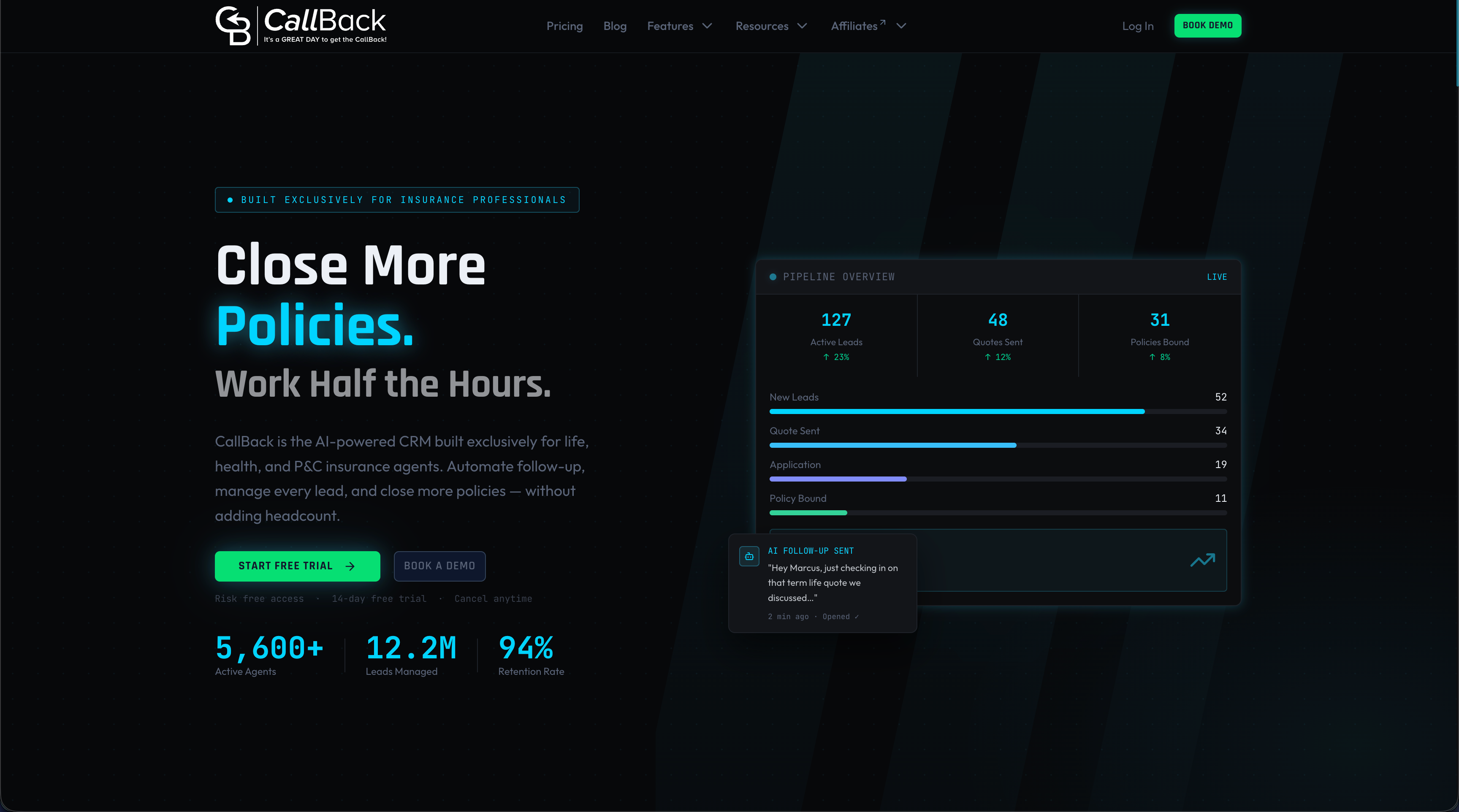
Callbackcrm combines SMS automation with AI-powered lead scoring, renewal triggers, and multi-channel outreach in one platform. Agents can send targeted renewal reminders, follow up on quotes, and re-engage lapsed clients without manual effort. The platform’s AI marketing tools identify high-value prospects and personalize outreach based on behavior, so every message reaches the right contact at the right time. Request a demo to see how Callbackcrm fits your agency’s marketing workflow.
FAQ
What are the main types of insurance marketing organization tools?
The main categories are insurance-native CRMs, general marketing automation platforms, and workflow compliance tools. Each category solves a different marketing bottleneck for agents and brokers.
How do FMOs and IMOs differ from marketing software?
FMOs and IMOs are strategic business partners that provide carrier contracts, compliance oversight, and training. They do not provide day-to-day marketing execution software.
Why do insurance agents need insurance-native CRMs instead of general platforms?
Insurance-native CRMs include built-in renewal automation, quote-to-bind tracking, and compliance-ready templates. General platforms require months of custom configuration to replicate those features.
What metrics should insurance agents track in their marketing tools?
Quote-to-bind rate and client retention are the most reliable indicators of marketing performance. Vanity metrics like open rates do not reflect actual revenue impact.
When should an agency add a compliance automation tool?
Agencies marketing Medicare Advantage, ACA plans, or any product with state-specific advertising rules should prioritize a compliance tool. It creates the audit trail regulators require and reduces the risk of fines.