

TL;DR:
- Combining efficiency with empathy is key to successful client engagement and scalable growth.
- Use targeted segmentation and automation to strengthen top-tier client relationships and boost retention.
- Balancing human interaction with AI and automation builds trust, satisfaction, and long-term loyalty.
Balancing high-touch service with scalable growth is one of the hardest problems insurance agents face. You want every client to feel like your only client, but you also need to grow your book of business without burning out. The good news is that the gap between personal and scalable is closing fast. CRM tools boost productivity by 29%, and responding to a lead within five minutes makes you nine times more likely to convert. The agents winning right now are not choosing between efficiency and empathy. They are combining both, deliberately and strategically.
Table of Contents
- Set clear engagement goals and audience segmentation
- Leverage automation tools for scalable, personal engagement
- Build hybrid and omnichannel client journeys
- Drive retention and cross-sell with proactive, data-driven outreach
- Master emotional intelligence and transparency for real trust
- Why the best-engaged agents rethink the human/automation balance
- Take your customer engagement strategy further
- Frequently asked questions
Key Takeaways
| Point | Details |
|---|---|
| Set measurable goals | Define retention, satisfaction, and response time targets before launching engagement strategies. |
| Combine automation with empathy | Use CRM and AI to automate routine tasks, but maintain a human touch for complex or emotional situations. |
| Adopt omnichannel outreach | Engage clients across phone, email, and digital portals to match preferences and boost loyalty. |
| Personalize for retention | Utilize client data to time reviews, cross-sell, and referral campaigns for longer-lasting relationships. |
| Continuously refine approach | Regularly solicit feedback and fine-tune your mix of automation and human contact for best results. |
Set clear engagement goals and audience segmentation
Before you pick a single tool or send a single message, you need to know what success looks like. Too many agents jump straight into tactics without defining what they are actually trying to improve. Are you trying to shorten response times? Increase renewal rates? Raise your Net Promoter Score? Pick two or three measurable goals and anchor everything else to them.
Segmentation is equally important. Not every client deserves the same level of attention, and that is not a harsh thing to say. It is smart business. Start by grouping your book by revenue contribution, policy type, or risk profile. Your top 20% of clients likely generate 80% of your revenue, so that is where your highest-touch strategies should go.
Once you have your segments, audit your current touchpoints. Where are clients hearing from you? Renewals, claims, and onboarding are the obvious ones. But what about the quiet months in between? Those gaps are where clients drift.
When defining customer engagement goals, use industry benchmarks to calibrate your targets. The industry average retention sits at 84%, but top-performing agencies push that to 93 to 95 percent. That gap is not luck. It is the result of deliberate, goal-driven engagement.
Here are the key areas to audit before building your strategy:
- Renewal touchpoints: Are clients hearing from you 60 to 90 days before renewal, or only when the invoice arrives?
- Claims follow-up: Do you check in after a claim closes, or does the relationship go quiet?
- Onboarding sequence: Does every new client get a structured welcome series, or just a policy document?
- Cross-sell triggers: Are you tracking life events that signal a coverage need?
Pro Tip: Rank your clients by revenue contribution and build a dedicated engagement calendar for your top 20%. Even a quarterly personal check-in can dramatically improve retention and referral rates for that segment.
Leverage automation tools for scalable, personal engagement
Once you have mapped your audience and goals, the next step is implementing the right automation tools. The fear most agents have is that automation makes things feel cold. Done right, it does the opposite. It frees you up to be more human where it counts.

Start with your CRM. A well-configured CRM does not just store contacts. It triggers follow-ups, scores leads, and flags at-risk clients before they lapse. CRM automation reduces routine queries by 80%, which means your team spends less time on repetitive tasks and more time on high-value conversations. Understanding why use CRM systems is the first step toward building a scalable practice.
AI chatbots handle the 24/7 questions that would otherwise fall through the cracks. Policy status, payment confirmations, basic coverage questions. These are not conversations that need a licensed agent. Let automation handle them and reserve your expertise for the moments that matter.
Here is a practical sequence for rolling out automation in your agency:
- Map every routine client interaction in your current workflow.
- Identify which ones follow a predictable script (renewals, payment reminders, onboarding emails).
- Build automated sequences for those touchpoints in your CRM.
- Set escalation triggers so anything complex routes immediately to a human agent.
- Review response rates monthly and adjust messaging based on open and reply data.
“Combining AI-powered engagement with empathy delivers a 20% conversion uplift” (WIFITalents, 2026).
| Tool type | Best use case | Human escalation needed? |
|---|---|---|
| Email automation | Renewals, onboarding, drip campaigns | Rarely |
| AI chatbot | FAQs, policy status, payment queries | For complex issues |
| CRM workflows | Lead scoring, follow-up triggers, task alerts | For high-value leads |
| SMS automation | Appointment reminders, quick confirmations | For complaints |
The automation role in sales is not to replace the agent. It is to make sure no lead or client ever falls through the cracks because of bandwidth.
Build hybrid and omnichannel client journeys
While automation adds efficiency, maintaining hybrid and omnichannel connections is crucial for trust and satisfaction. Clients do not think in channels. They think in conversations. They want to start a question via text and finish it with a phone call, and they expect you to remember the whole thread.
The data backs this up. Hybrid journeys produce 23% higher satisfaction compared to single-channel approaches, and omnichannel strategies consistently boost long-term loyalty. Even in a digital-first world, 70% of clients still want access to a human agent for anything beyond routine transactions.
Here are the core channels every insurance agency should have active:
- Phone: Still the preferred channel for claims and complex policy questions.
- Email: Best for documents, policy summaries, and longer-form communication.
- SMS: High open rates make it ideal for reminders and quick confirmations.
- Client portal: Self-service for certificates, payment history, and policy documents.
- Social messaging: Growing channel for younger policyholders and initial inquiries.
| Channel | Satisfaction rate | Best moment to use |
|---|---|---|
| Phone | High | Claims, renewals, complex issues |
| SMS | Very high | Reminders, confirmations |
| Moderate to high | Onboarding, policy delivery | |
| Portal | Moderate | Self-service, document access |
A practical example of a hybrid engagement strategies journey looks like this: onboard a new client with an automated email and SMS welcome series, then have their agent call to confirm coverage details and answer questions. The automation handles the logistics. The call builds the relationship.
Pro Tip: Start your omnichannel rollout with just two moments: renewals and claims follow-up. Nail those before expanding to other touchpoints. Small pilots reveal what your clients actually prefer before you invest in a full build-out.
Using AI for omnichannel coordination means your team always has context, regardless of which channel the client used last.
Drive retention and cross-sell with proactive, data-driven outreach
With multiple touchpoints in place, maximize relationship value with targeted, data-driven approaches. Reactive agents wait for renewals. Proactive agents use data to spot opportunities before the client even knows they have a need.
Policy reviews are your most underused tool. A structured annual review is not just a compliance checkbox. It is a chance to identify coverage gaps, introduce new products, and remind clients why they chose you. Clients who feel reviewed and advised are far less likely to shop around.
The numbers are compelling. Multi-policy clients churn at under 5%, compared to much higher rates for single-policy holders. And referrals from existing clients convert at 30% or more above average. Your best leads are already in your book.
Here is how to run a data-driven outreach campaign:
- Pull your book and flag every single-policy client.
- Match them against life event triggers (new home, new baby, business launch).
- Build a personalized outreach sequence tied to that trigger.
- Schedule a review call and use the conversation to introduce relevant coverage.
- After the call, send a follow-up summary with a referral ask built in.
The best incentives for loyalty and referral programs include:
- Exclusive policy review sessions with senior agents.
- Gift cards or charitable donations in the client’s name.
- Early access to new coverage options or premium discounts.
- Recognition in your agency newsletter or social channels.
Using engagement tools for retention means you are not just reacting to churn. You are preventing it before it starts.
Master emotional intelligence and transparency for real trust
Ultimately, no technology replaces genuine connection. Here is how to keep trust center stage. Emotional intelligence is not a soft skill in insurance. It is a revenue driver. The moments that matter most to clients, a denied claim, a rate increase, a coverage gap discovered after a loss, are also the moments where empathy either saves or ends the relationship.
Transparency about AI is now a baseline expectation. 85% of clients want transparency about when they are interacting with AI, and 71% expect personalized outreach tied to major life events. If a chatbot is handling an inquiry, clients should know that. If an AI flagged their renewal for review, you can mention it. Honesty builds credibility.
Emotional intelligence best practices for insurance agents:
- Acknowledge before advising: When a client calls about a claim, lead with empathy before moving to process.
- Name the emotion: Saying “I understand this is stressful” is more powerful than jumping to solutions.
- Follow up after resolution: A quick call or text after a claim closes shows you care beyond the transaction.
- Be honest about limitations: If you cannot help immediately, say so and give a clear timeline.
- Signal AI clearly: Use language like “Our system flagged this for you” to set accurate expectations.
“Transparency and acknowledgment of customer emotions build trust more quickly than digital efficiency alone.”
The AI marketing tools for EQ that work best are the ones that surface the right information so agents can show up informed and empathetic, not the ones that try to replace that human moment entirely.
Why the best-engaged agents rethink the human/automation balance
Here is the uncomfortable truth most engagement guides skip: automation without intention erodes trust. Agents who automate everything, including the moments that call for a real voice, often see their NPS scores drop even as their efficiency metrics improve. Clients notice when a condolence message feels templated.
The best agents we see succeeding in 2026 are not the most automated. They are the most deliberate. They use data to decide when to automate and when to show up personally. They build feedback loops, reviewing NPS scores and client comments quarterly, and they adjust the mix based on what they learn.
The contrarian view worth holding: going all-digital is not a competitive advantage. It is a risk. Especially in high-stakes moments like claims or life events, the human call still outperforms any chatbot. The agents who automate customer engagement for insurance leads effectively use automation to create space for more meaningful human interactions, not to eliminate them.
Pro Tip: Schedule quarterly one-on-one reviews with your top-tier clients. Use automation for everything else. That combination is what separates agencies with 93% retention from those stuck at the industry average.
Take your customer engagement strategy further
These best practices only work when you have the right infrastructure behind them. Knowing what to do is one thing. Having tools that execute it consistently is another.
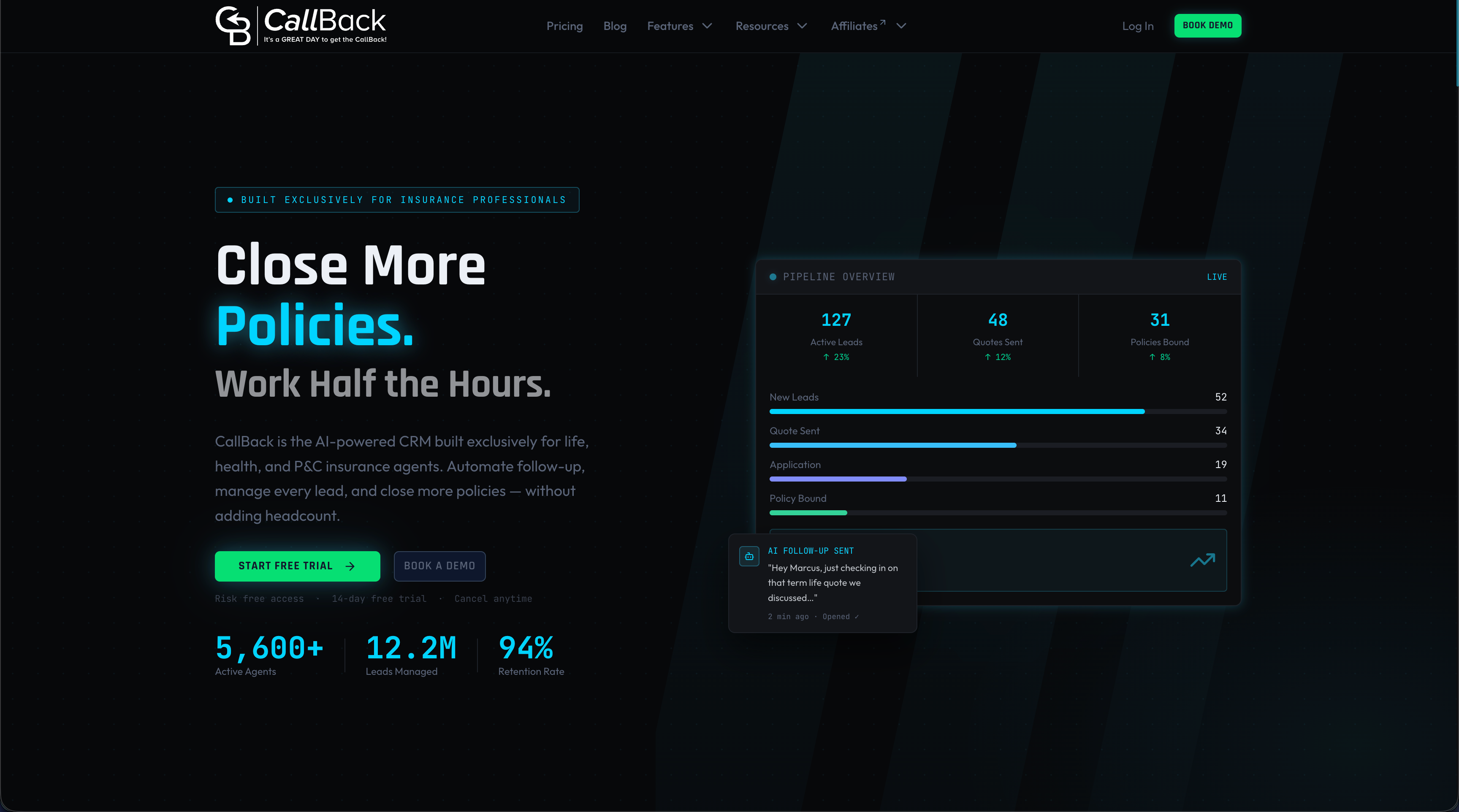
CallBack CRM is built specifically for insurance agents and agencies who want to combine omnichannel communication, AI-powered automation, and real CRM analytics in one platform. From multichannel messaging and automated workflows to a full feature suite that covers every stage of the client journey, it is designed to make these strategies operational, not theoretical. Explore email automation to keep every client touchpoint on schedule, or build websites and funnels that capture and convert leads before your competitors do.
Frequently asked questions
What’s the quickest way to improve insurance client engagement?
Implement a CRM with AI-powered workflows to cut response times and automate follow-ups. Responding within five minutes makes you nine times more likely to convert a new lead.
How does omnichannel engagement improve policyholder loyalty?
Hybrid omnichannel journeys produce 23% higher satisfaction scores by meeting clients on the channels they actually prefer, which directly increases renewal rates and long-term loyalty.
When should agents prioritize human contact over automation?
Human interaction is essential during claims, complex coverage questions, and emotional moments. 85% of clients prefer a real agent for sensitive or high-stakes situations where empathy matters most.
What engagement metrics matter most in insurance?
Focus on client retention rate, lead response time, and NPS or CSAT scores. A 5% retention improvement can translate to a 25 to 95% increase in profitability, making retention your highest-leverage metric.