

TL;DR:
- AI-powered engagement tools can increase revenue by up to 28% and cut sales cycles by half.
- These tools improve efficiency through automated, personalized communication based on behavioral data.
- Starting with renewal automation and ensuring data quality are key for maximizing ROI.
Most insurance agents believe the path to more sales runs through more calls. More dials, more follow-ups, more hustle. That belief is understandable, but it leaves serious revenue on the table. AI-powered customer engagement tools can boost revenue by 28% and cut sales cycles by up to 50%, even for small agencies. This guide breaks down exactly what these tools are, how they work in real insurance workflows, and what measurable results you can expect when you stop relying on volume alone and start working smarter.
Table of Contents
- What are customer engagement tools?
- Key benefits for insurance agents and brokers
- Mechanics of AI and automation: How the tools actually work
- Expert perspectives and nuanced challenges
- What most agents miss about customer engagement tools
- Streamline your insurance sales with CallBack CRM
- Frequently asked questions
Key Takeaways
| Point | Details |
|---|---|
| Faster sales cycles | AI-powered engagement tools help insurance agents close deals up to 50% faster by focusing on high-value leads. |
| Improved customer satisfaction | Smart engagement platforms can boost customer satisfaction scores between 15-20% by personalizing interactions. |
| Reduced operating expenses | Automation and AI cut agency operating costs by as much as 30% with streamlined processes. |
| Practical quick wins | Start with automated renewals and follow-ups for easy measurable improvements in retention and revenue. |
| Data quality and compliance | Maintaining clean CRM data and obeying industry regulations is crucial for getting the full benefits from engagement tools. |
What are customer engagement tools?
Customer engagement tools are platforms and software that help you communicate with prospects and clients in a structured, automated, and personalized way. For insurance agents, this means more than just a contact list. It means having systems that track behavior, trigger the right message at the right time, and keep every lead moving through your pipeline without manual effort.
The core categories include:
- CRM platforms that centralize client data, policy history, and communication logs
- AI chatbots that qualify leads in real time, 24 hours a day
- Predictive analytics tools that score leads based on behavior and likelihood to buy
- Email and SMS automation that sends renewal reminders, policy updates, and follow-ups automatically
- Reputation management tools that monitor reviews and client feedback
One of the most powerful combinations is AI chatbots integrated with your CRM. AI chatbots integrated with CRM allow real-time lead qualification in insurance, meaning a prospect who visits your website at 11 PM on a Sunday gets an immediate, intelligent response instead of waiting until Monday morning when they have already moved on to a competitor.
The difference between manual and AI-powered engagement is not just speed. It is consistency, personalization, and scale.
| Factor | Manual engagement | AI-powered engagement |
|---|---|---|
| Lead response time | Hours to days | Seconds to minutes |
| Follow-up consistency | Depends on agent memory | Automated, never missed |
| Personalization | Generic or manual | Data-driven, dynamic |
| Renewal reminders | Calendar-based, easy to skip | Triggered automatically |
| Lead scoring | Gut feeling | Behavioral data and AI |
| Scalability | Limited by team size | Scales without added staff |
Understanding customer engagement strategies built around AI helps agents move away from reactive outreach and toward a proactive system where the platform does the heavy lifting. The AI-powered engagement process typically starts the moment a prospect fills out a form or clicks an ad, and it runs continuously until the policy is sold and renewed.
For agents and brokers managing dozens or hundreds of clients, this kind of systematic communication is not a luxury. It is the only realistic way to stay competitive without burning out your team.
Key benefits for insurance agents and brokers
The business case for customer engagement tools is not theoretical. The numbers are real and they apply directly to insurance agencies of all sizes.
Here is what the data shows:
| Benefit | Typical outcome |
|---|---|
| Revenue growth | 5 to 28% increase |
| Sales cycle reduction | Up to 50% faster |
| Cost-to-serve reduction | 20 to 30% lower |
| Customer satisfaction (CSAT) | 15 to 20% improvement |
| Expense ratio improvement | Up to 2 percentage points |
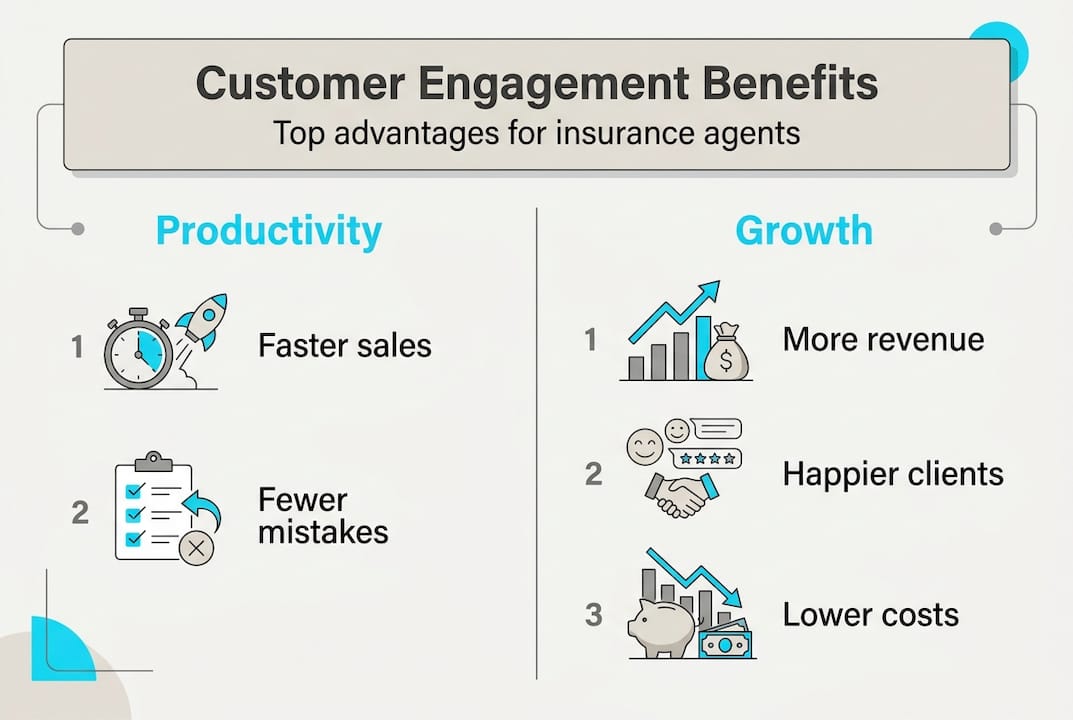
AI tools improve expense ratios by 2 points, boost CSAT by 15 to 20%, grow revenue by 5 to 8%, and reduce cost-to-serve by 20 to 30%. For an agency spending $500,000 annually on operations, a 25% reduction in cost-to-serve is $125,000 back in your pocket every year.

Beyond the cost savings, the revenue side is equally compelling. When you boost insurance leads with AI tools that prioritize your hottest prospects, your agents spend less time chasing cold contacts and more time closing warm ones. That shift alone can move your close rate significantly.
The top benefits agents report include:
- Faster lead response: Automated follow-up within seconds dramatically increases contact rates
- Higher renewal retention: Automated reminders reduce lapse rates without manual effort
- Better lead prioritization: AI scoring tells you who to call first, not who called last
- Reduced admin burden: Data entry, tagging, and follow-up scheduling happen automatically
- Scalable outreach: One agent can manage a pipeline that previously required three
The CRM sales boost comes not from replacing your agents but from removing the friction that slows them down.
Pro Tip: Start with renewal automation before anything else. Renewals are your easiest win because the relationship already exists. Automating renewal reminders typically shows measurable retention improvement within the first 90 days.
Mechanics of AI and automation: How the tools actually work
Knowing the benefits is one thing. Understanding how these tools actually function in your daily workflow is what turns theory into results.
Here is a step-by-step look at how a modern AI engagement system works in an insurance agency:
- Lead enters the system. A prospect fills out a form, clicks an ad, or chats with your website bot. Their information is captured automatically into your CRM.
- AI scores the lead. Predictive analytics score leads by behavior and churn likelihood. The system assigns a priority score based on factors like policy type interest, time on site, and prior engagement.
- Instant qualification happens. An AI chatbot asks qualifying questions in real time, filtering out low-intent visitors and flagging high-value prospects for immediate agent follow-up.
- Automation sequences begin. Based on the lead score and answers, the system triggers a personalized email or SMS sequence. A prospect interested in life insurance gets different content than one shopping for commercial coverage.
- Agent gets a prioritized task. Your agent sees a ranked list of leads to contact, complete with context about what the prospect looked at and how they responded to automated messages.
- Renewals and follow-ups run in the background. Existing clients receive automated touchpoints tied to policy milestones, birthdays, or renewal windows, without any manual scheduling.
The key to making this work is integration. Your AI-driven engagement tools need to connect with your existing systems so data flows without gaps. An AI CRM for agents that sits in a silo does not deliver the same results as one that talks to your email platform, your website, and your policy management system.
“Start small, measure speed-to-lead and contact rates first. Agencies that track these two metrics from day one see 3x faster ROI from their engagement tools.” Forrester, 2026
Pro Tip: Set up a simple speed-to-lead dashboard in your CRM before launching any AI tool. If you cannot measure your current response time, you cannot prove the improvement.
Expert perspectives and nuanced challenges
While the mechanics promise big gains, experts warn that maximizing ROI requires careful attention to detail and industry compliance. Not every agency that adopts AI engagement tools sees immediate results, and understanding why separates the agencies that thrive from those that struggle.
The most common pitfalls include:
- Poor data quality: AI is only as good as the data it trains on. Duplicate records, missing fields, and outdated contact info will corrupt lead scoring and trigger the wrong messages.
- Compliance gaps: Insurance outreach is regulated. Automated SMS and email campaigns must comply with TCPA, CAN-SPAM, and state-specific rules. Customer resistance and data quality issues are top challenges, and compliance is critical for outreach.
- Over-automation: Agents who remove all human touchpoints from the process often see CSAT drop. Automation should support your agents, not replace the relationship.
- Chasing complexity: Many agencies invest in advanced AI pilots before mastering basic automation. The ROI on a well-configured renewal reminder sequence often beats a complex predictive model.
ROI benchmarks vary widely. Some agencies report returns as high as 500% from targeted AI campaigns. More typical results land in the 10 to 20% revenue improvement range in the first year, with compounding gains as data quality improves.
Experts at AI marketing tools providers consistently recommend starting with your existing CRM and layering AI features rather than replacing everything at once. Integration with your policy administration system is especially important for renewal automation to work correctly.
“The agencies winning with AI are not the ones with the most sophisticated tools. They are the ones focused on customer retention over pure lead generation.” McKinsey, 2025
The next-best experience principles from McKinsey emphasize that AI works best when it serves the customer’s needs at each interaction, not when it optimizes purely for conversion. For insurance agents, this means using AI engagement strategies for agents that prioritize trust and long-term relationships over short-term close rates.
What most agents miss about customer engagement tools
Here is the uncomfortable truth: most agents who invest in AI engagement tools focus on the wrong thing first. They want the flashiest feature, the most advanced chatbot, or the most complex scoring model. What actually moves the needle is simpler and less exciting.
Forrester’s 2026 insurance tech research makes a clear call: the shift is from modernization to intelligence, and the priority must be customer experience amid rising premiums. Agents who chase technology for its own sake miss this entirely.
The agents seeing the best results are the ones who started with automation for faster leads on simple, high-frequency tasks like renewals and follow-ups. They measured onboarding outcomes from week one. They fixed their data before adding AI. And they treated automation as a way to give their best agents more time with their best clients, not as a way to reduce headcount.
Intelligence over modernization means asking: “Does this tool make my clients feel better served?” If the answer is yes, it belongs in your stack. If it just looks impressive in a demo, it probably does not.
Streamline your insurance sales with CallBack CRM
If you are ready to put these principles into practice, CallBack CRM was built specifically for insurance agents and agencies who want to automate engagement without losing the personal touch.
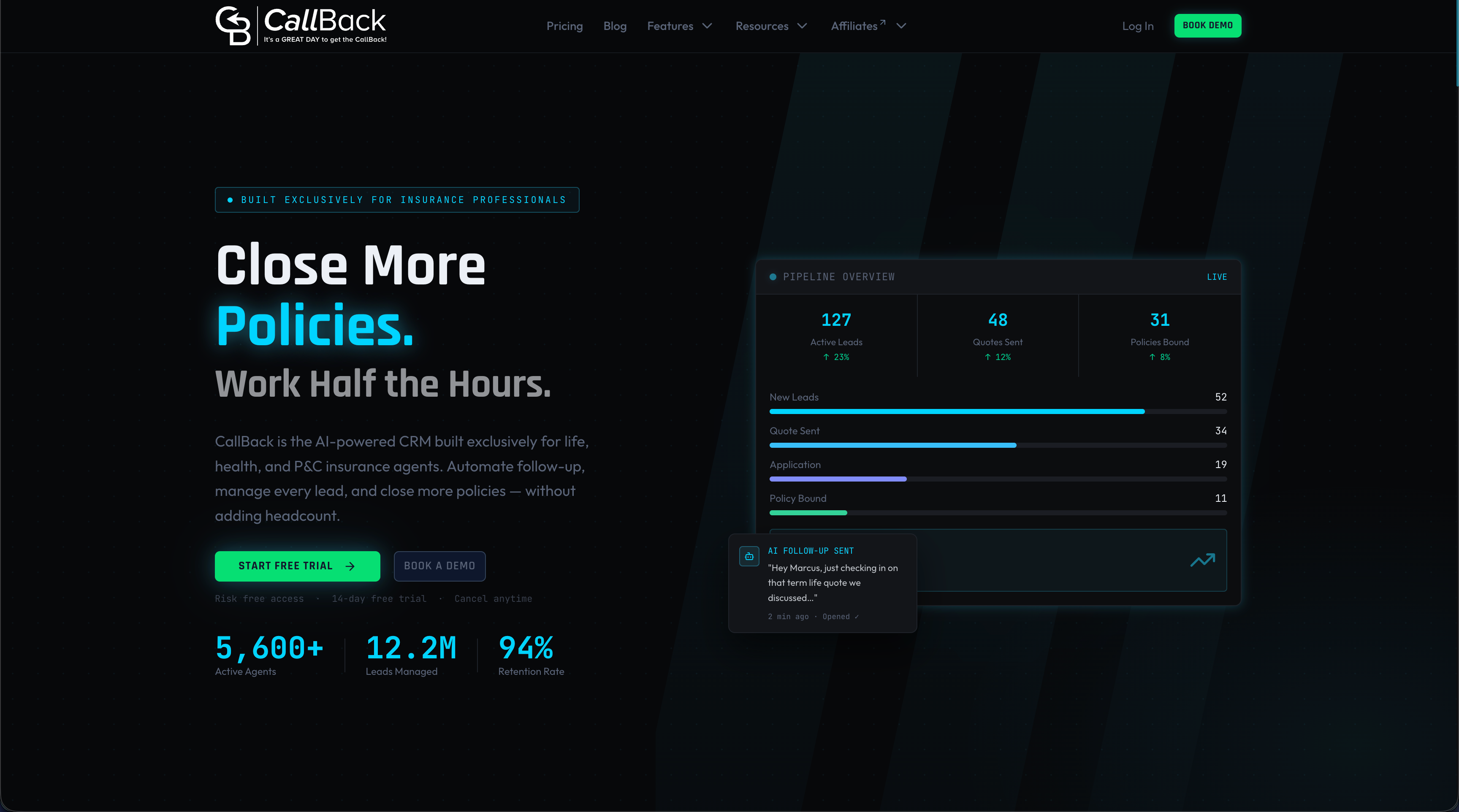
The platform brings together AI lead scoring, email marketing automation, SMS campaigns, CRM management, and renewal workflows in one place. You can explore the full feature set to see how each tool connects, or go straight to the automation features that agents use most to cut response times and increase retention. CallBack CRM gives your team the infrastructure to scale without adding overhead, so you can focus on relationships while the platform handles the repetition.
Frequently asked questions
How do customer engagement tools improve lead quality for insurance agents?
AI-driven CRM tools score and prioritize leads based on behavioral data, so agents spend time on prospects most likely to close rather than working through unqualified lists.
Can customer engagement tools help reduce agency operating expenses?
Yes. AI tools reduce cost-to-serve by 20 to 30% and improve expense ratios by up to two points, which adds up to significant savings for mid-size agencies.
What are common challenges when deploying AI-powered customer engagement solutions?
Customer resistance and data quality are the most frequently cited obstacles, alongside the need to meet insurance-specific compliance requirements for automated outreach.
Which features should agents prioritize in a customer engagement platform?
Lead scoring, automated renewal reminders, personalized email and SMS sequences, and deep CRM integration deliver the fastest and most measurable ROI for most insurance agencies.
Is automation or personalization more important for insurance retention?
Both are essential, but they serve different roles. Automation ensures timely outreach never gets missed, while personalized interactions build the trust that keeps clients from shopping around at renewal time.