

TL;DR:
- Insurance agencies must adopt AI with a focus on empathy, speed, personalization, and seamless integration.
- Automated communications and process automation significantly improve client satisfaction and operational efficiency.
- Agentic AI will autonomously resolve most routine issues by 2029, reducing costs and freeing staff for complex tasks.
The pressure on insurance agencies to modernize has never been this intense. 91% of customer service leaders face executive demands to adopt AI in 2026, and the agencies that move first are already pulling ahead. But knowing where to start is the real challenge. This article breaks down proven, practical AI-powered engagement strategies built specifically for insurance agents and agencies. You will walk away with a clear framework, real-world examples from industry leaders, and actionable tips you can adapt to your own book of business.
Table of Contents
- Set the foundation: Criteria for effective customer engagement in 2026
- Leverage automated communications for empathy and efficiency
- Streamline operations with AI-powered process automation
- Use agentic AI for autonomous customer issue resolution
- Why the best tips are not one-size-fits-all: Tailoring AI engagement for your agency
- Upgrade your customer engagement with AI-powered tools
- Frequently asked questions
Key Takeaways
| Point | Details |
|---|---|
| Adopt AI empathy | AI tools can outperform humans in drafting empathetic, clear communications at scale. |
| Automate core processes | Automation of underwriting and claims review dramatically increases speed and reduces costs. |
| Enable autonomous support | Agentic AI will soon handle most customer issues alone, freeing human agents for high-value work. |
| Customize your approach | Effective customer engagement strategies are tailored to your agency’s size and unique client needs. |
Set the foundation: Criteria for effective customer engagement in 2026
Before you bolt AI tools onto your existing workflow, you need a clear picture of what effective customer engagement actually looks like in 2026. The insurance market has shifted. Clients expect fast, personalized, and empathetic service at every touchpoint, and they are comparing you not just to other agencies but to every digital experience they have with any brand.
Effective AI-powered engagement for insurance agencies rests on four pillars:
- Empathy: Automated messages must still feel human. Clients dealing with claims or renewals are often under stress, and cold, robotic communication drives them away.
- Speed: Response time is a competitive differentiator. AI tools that can reply instantly, triage inquiries, and route complex issues to agents give you an edge.
- Personalization: Generic outreach does not convert. AI that draws on client history, policy data, and behavioral signals creates messages that actually resonate.
- Automation: Repetitive manual tasks like follow-up emails, appointment reminders, and lead scoring should run without human input so your team can focus on relationships.
AI-readiness is equally important. An engagement tool that cannot integrate with your CRM, email platform, or quoting system will create friction rather than eliminate it. Workflow integration is not optional. It is the difference between a tool that saves you hours each week and one that collects dust.
The AI strategies for insurance landscape is expanding rapidly, and agencies that evaluate tools against these four pillars will make smarter investments. Those that chase trends without a framework often end up with disconnected software stacks that nobody uses.
Stat to know: 91% of customer service leaders feel direct executive pressure to adopt AI, signaling that inaction is no longer a neutral choice for agencies.
Setting these criteria upfront keeps your team aligned and ensures every AI investment you make moves the needle on the things that matter most to your clients and your bottom line.
Leverage automated communications for empathy and efficiency
Knowing what to look for is a great start. Now let’s get into how leading agencies are putting automated communications to work.

The most compelling proof point right now comes from one of the biggest names in the industry. Allstate uses GPT to draft nearly all of its daily claims emails, achieving measurable improvements in empathy, clarity, and consistency at scale. That is thousands of client interactions per day handled with a level of tone and care that would be impossible to maintain manually.
You do not need Allstate’s budget to replicate this approach. Here is a step-by-step process for automating empathetic outreach at your agency:
- Audit your current touchpoints. List every client communication your team sends manually, from renewal notices to claim status updates to lapsed policy alerts.
- Identify the high-volume, repeatable messages. These are your best candidates for AI-assisted drafting. Think follow-up emails after a quote, birthday messages, or policy anniversary check-ins.
- Build dynamic templates. Use client data fields like name, policy type, claim status, and agent name to personalize each message automatically.
- Set empathy guidelines. Define the tone your agency wants to maintain, and train or configure your AI tool to reflect it. Warmth, clarity, and brevity go a long way.
- Review and iterate. Run A/B tests on subject lines and message length. Let the data tell you what your clients respond to.
The benefits extend beyond client satisfaction. Automated communications reduce manual errors, ensure compliance with message timing, and free up your producers to have more meaningful conversations. AI-driven emails for agents can also be configured to trigger based on specific client behaviors, such as opening a quote but not completing it, making your outreach feel timely rather than intrusive.
Pro Tip: Personalize templates using dynamic client data fields such as policy type and renewal date. A message that references a client’s specific situation outperforms a generic follow-up every single time.
Streamline operations with AI-powered process automation
Automated communications are just one layer. The deeper opportunity is using AI to transform core operational workflows, and the results from industry leaders are hard to ignore.
Aviva’s use of machine learning across its underwriting and claims operations is one of the clearest benchmarks available. Aviva’s AI reduces medical underwriting review time by 50% and has saved the company £100M in claims costs. Those are not incremental gains. They represent a fundamental shift in how insurance operations can run when AI is embedded into the process.
Here is a snapshot of where process automation delivers the biggest returns for insurance agencies:
| Process area | AI impact | Key benefit |
|---|---|---|
| Underwriting review | 50% faster decision time | Lower operational costs |
| Claims processing | Reduced manual review | Faster payouts, fewer errors |
| Lead scoring | Real-time prospect ranking | Higher conversion rates |
| Policy renewals | Automated outreach triggers | Reduced lapse rates |
| Compliance documentation | Auto-generated audit trails | Lower compliance risk |
For independent agencies and IMOs, the practical starting points are lead scoring, renewal automation, and claims communication. These three areas share a common trait: they involve repetitive, data-driven tasks that are ideal candidates for automation.
The key areas where agencies see early wins include:
- Automating data entry from inbound leads into the CRM
- Triggering renewal outreach sequences 90, 60, and 30 days before expiration
- Flagging high-priority claims for faster human review
Exploring data-driven insurance automation is where most forward-thinking agencies start because the ROI is measurable and relatively quick. If you want a broader view of how these tools fit together, AI engagement strategies for insurance offers a helpful roadmap for sequencing your investments.
Use agentic AI for autonomous customer issue resolution
With core processes running more smoothly, the next frontier is AI that does not just assist your team but acts on behalf of your agency without waiting for a human to trigger it.
This is what agentic AI means. Unlike traditional automation, which follows a fixed script or decision tree, agentic AI can interpret context, make decisions, and take action autonomously. For insurance agencies, this opens the door to resolving most routine service issues without any staff involvement.
The scale of what is coming is significant. Agentic AI will autonomously resolve 80% of common customer service issues by 2029, reducing costs by 30%. For agencies operating on thin margins, that kind of cost reduction can be transformative.
Here is how agentic AI compares to traditional automation approaches:
| Feature | Traditional automation | Agentic AI |
|---|---|---|
| Decision-making | Rule-based, fixed paths | Context-aware, adaptive |
| Issue resolution | Requires human handoff | Resolves autonomously |
| Learning over time | Static | Improves with each interaction |
| Handles edge cases | Rarely | Frequently |
| Client experience | Often feels scripted | Feels more natural |
For agencies considering AI-driven engagement tools, agentic AI represents the logical next step after mastering basic automation. It is not as distant as it sounds. Many of the top AI tools for insurance are already incorporating agentic capabilities into their platforms.
Pro Tip: Start small when deploying agentic AI. Apply it first to FAQs, policy status checks, and simple claims inquiries. Once you see reliable resolution rates, you can expand its scope gradually without risking client relationships.
The real payoff is what your team can do with the time they get back. When routine queries are handled automatically, producers and service staff can focus on complex cases, cross-selling opportunities, and the human conversations that genuinely require their expertise.
Why the best tips are not one-size-fits-all: Tailoring AI engagement for your agency
Reading about what Allstate and Aviva are doing is genuinely useful. But there is a risk in treating those case studies as a direct blueprint. Agencies that try to implement enterprise-scale AI strategies overnight often end up overwhelmed, underserved, and skeptical of AI altogether.
The uncomfortable truth is that the best AI engagement strategy for your agency depends almost entirely on your context. How many producers do you have? What is your client mix? Do you specialize in commercial lines, personal lines, or both? Are you running a lean independent shop or managing a regional network of agents? These variables change everything.
Smaller agencies often see faster results by starting with one or two tightly scoped automations, such as a renewal reminder sequence or an AI-assisted follow-up email after a quote, rather than trying to transform everything at once. Pilot projects let you measure impact, learn what your clients actually respond to, and build internal confidence before scaling.
Reviewing engagement best practices for insurance with your specific client base in mind is far more valuable than copying a competitor’s strategy. The agencies winning right now are not the ones with the most AI tools. They are the ones using the right tools in the right places, adjusted to fit how their business actually works.
Upgrade your customer engagement with AI-powered tools
Everything covered in this guide, from empathetic automated communications to agentic AI, points in the same direction: agencies that build smarter engagement systems now will have a significant advantage as the market keeps evolving.
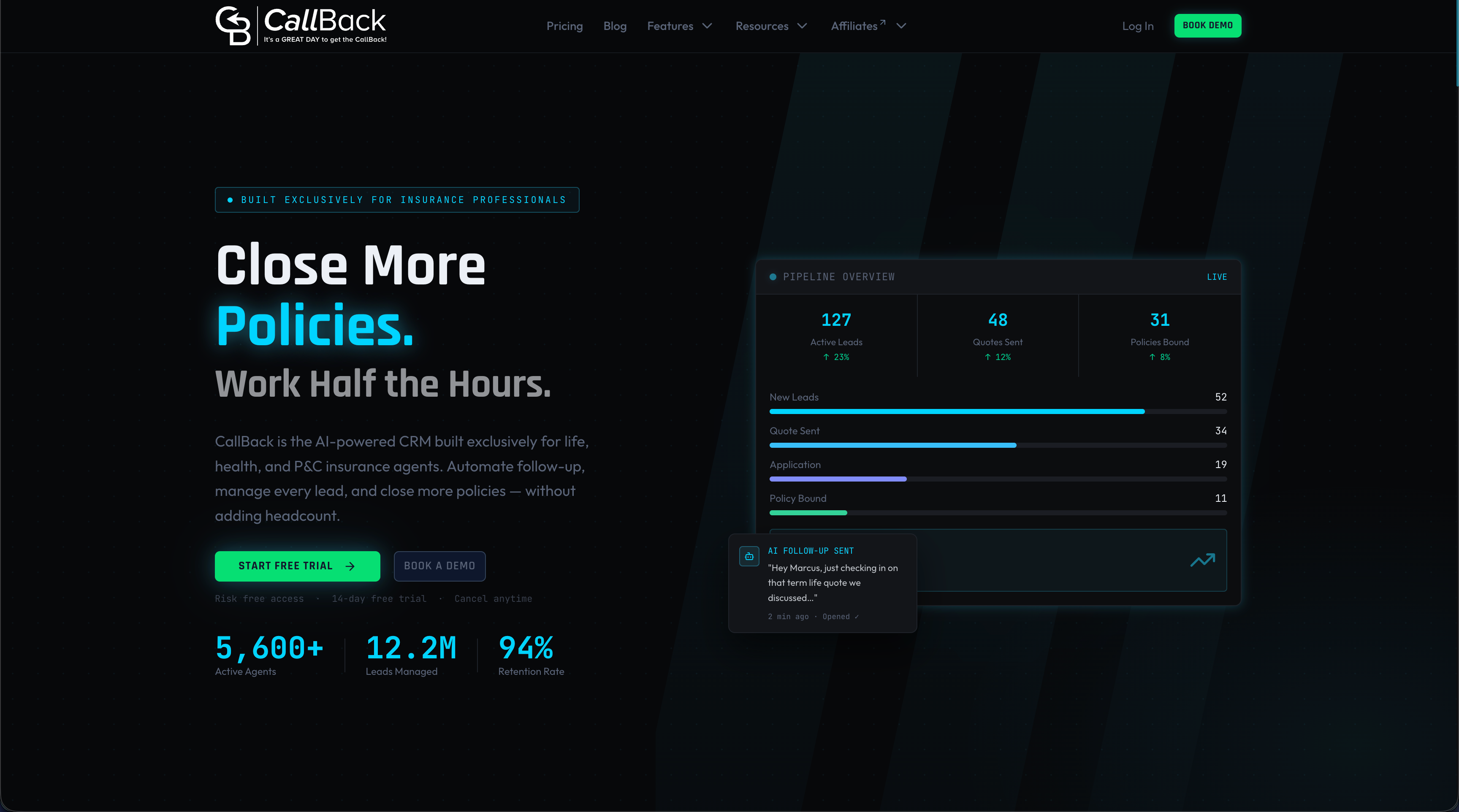
CallBack CRM is built for exactly this kind of growth. The platform brings together AI engagement features including CRM management, AI assistants, email and SMS marketing, and automation workflows in one place. Whether you want to automate insurance tasks like lead scoring and follow-up sequences or build out insurance website tools to capture and convert more leads, CallBack CRM gives your agency the infrastructure to act on what you learned here. Start your trial and see what your workflow looks like when AI does the heavy lifting.
Frequently asked questions
What is the most important customer engagement tip for insurance agents in 2026?
The top tip is implementing AI-powered automation for empathetic, rapid client communications. Allstate’s GPT-driven approach to daily claims emails shows how automation can improve tone and consistency at scale.
How can AI help reduce operational costs for insurance agencies?
AI automates underwriting, claims processing, and routine customer service, cutting review time and lowering overhead. Aviva’s AI cut medical underwriting review time by 50% and saved £100M in claims costs.
What is agentic AI and why does it matter for customer engagement?
Agentic AI takes autonomous action to resolve service issues without waiting for human input, freeing your staff for complex, high-value work. 80% of common issues will be resolved this way by 2029, reducing costs by 30%.
Why are insurance leaders under so much pressure to adopt AI in 2026?
Executive expectations have shifted dramatically as AI proves its ability to improve satisfaction and cut costs. 91% of customer service leaders now face direct pressure from leadership to implement AI-powered solutions.