

TL;DR:
- Most insurance agencies use multiple tools that often lack proper integration, causing leads to slip through the cracks. Successful engagement requires unified data, mapped customer journeys, and orchestrated workflows to deliver personalized, timely interactions. Building an omni-channel engagement system involves data integration, automated sequences, AI-driven lead scoring, and continuous measurement for improvement.
Most insurance agencies already have a CRM, some automation, and maybe an AI tool or two. Yet leads still slip through the cracks, response times stay sluggish, and conversion rates plateau. The problem isn’t a shortage of technology. It’s that tools without integrated strategies create noise, not results. As omnichannel and unified data integration are now recognized as the core requirements for closing the engagement gap, this guide walks you through a practical, step-by-step approach to deploying AI, automation, and data orchestration in ways that actually move the revenue needle.
Table of Contents
- Understanding the engagement gap in insurance
- Requirements for successful customer engagement
- Step-by-step: Building your omni-channel engagement engine
- Common mistakes and how to verify success
- Why orchestration, not just automation, changes the game
- Next steps: Solutions for smarter engagement
- Frequently asked questions
Key Takeaways
| Point | Details |
|---|---|
| Integration is essential | Customer engagement improves only when tools and data are genuinely connected across every system. |
| Orchestration drives results | Coordinating AI, automation, and staff actions is the secret to visible leaps in lead generation and conversion. |
| High-gain journeys matter | Focus engagement efforts on the friction points that most affect insurance customer experience and sales. |
| Metrics validate progress | Regularly measure outcomes like lead quality, speed-to-contact, and client satisfaction to fine-tune engagement efforts. |
Understanding the engagement gap in insurance
Before jumping into solutions, it’s essential to clarify what causes the engagement gap in modern insurance teams.
The engagement gap is the space between the customer experience your clients expect and what your current tools actually deliver. For insurance agents, this gap shows up as unanswered leads, generic follow-up emails, and prospects who ghost you after the first touchpoint. Every missed interaction has a price tag. Studies consistently show that slow response times and impersonal outreach are the top reasons prospects choose a competitor.
Many agencies respond by adding more channels. A new SMS tool here, a chatbot there. But more channels without unified data just scatter your conversations across silos. A prospect who fills out a form on your website, sends a Facebook message, and later calls your office might feel like three separate people to your team because your systems aren’t talking to each other. Reviewing customer engagement best practices can help you see where these disconnects most commonly appear.
Here’s a comparison of what typical engagement tool stacks look like versus what a unified platform delivers:
| Feature | Siloed tools | Unified platform |
|---|---|---|
| Lead data location | Spread across 3-5 apps | Single, centralized CRM |
| Communication history | Fragmented by channel | Full cross-channel timeline |
| Automation triggers | Manual or limited | Event-based, intelligent |
| Reporting | Channel-by-channel | Unified engagement dashboard |
| Personalization | Generic | Data-driven and contextual |
The trend is clear: 76% plan to invest in omnichannel engagement technologies in 2026. But the agencies that will actually close the engagement gap are those that prioritize integration over addition. Learning more about AI in engagement reveals how data unification amplifies the impact of every channel you use.
Key warning signs your agency is experiencing the engagement gap:
- Leads contact you more than once before getting a response
- Follow-up sequences aren’t tailored to where a prospect is in the buying journey
- Your team spends significant time manually updating contact records
- You can’t tell which campaigns are actually driving closed deals
“Adding new technology without addressing data integration and workflow orchestration is like putting a new engine in a car with no steering wheel. Power without direction doesn’t get you anywhere.”
Requirements for successful customer engagement
Now that you see what’s missing in most engagement efforts, here’s what you’ll actually need to succeed.
Successful engagement doesn’t happen by accident. It requires deliberate preparation before you automate a single workflow or launch a new campaign. The agencies that see measurable gains share a few common traits: they’ve unified their data, mapped their customer journeys, and connected their tools into a coherent system. As operational success with AI engagement depends directly on integration and workflow orchestration, preparation isn’t optional. It’s the foundation.

Here’s a side-by-side look at what a siloed approach costs you compared to what orchestrated engagement delivers:
| Dimension | Siloed approach | Orchestrated engagement |
|---|---|---|
| Lead follow-up | Manual, inconsistent timing | Automated, triggered within minutes |
| Data accuracy | Often outdated or duplicated | Synced and clean in real time |
| Agent workload | High, repetitive tasks | Focused on high-value conversations |
| Customer experience | Generic and reactive | Personalized and proactive |
| Reporting visibility | Hard to attribute outcomes | Clear, closed-loop reporting |
What you need before going further:
- A unified CRM that captures every interaction across email, SMS, calls, and web touchpoints
- Integrated AI and automation tools that share data and trigger actions based on real behavior
- Mapped customer journeys that identify the two or three high-gain paths where engagement has the biggest payoff
- Staff alignment so your team understands which interactions are automated and which require personal attention
- Clean, consolidated data so AI and automation have accurate inputs to work with
Understanding automation and orchestration at a systems level will save you from the most common and costly setup mistakes.
Pro Tip: Before you add any new engagement tool, audit whether your existing systems can share data with it. A tool that can’t send and receive information from your CRM will create another silo rather than close one.
Step-by-step: Building your omni-channel engagement engine
With all requirements in place, it’s time to build your engagement engine step by step.
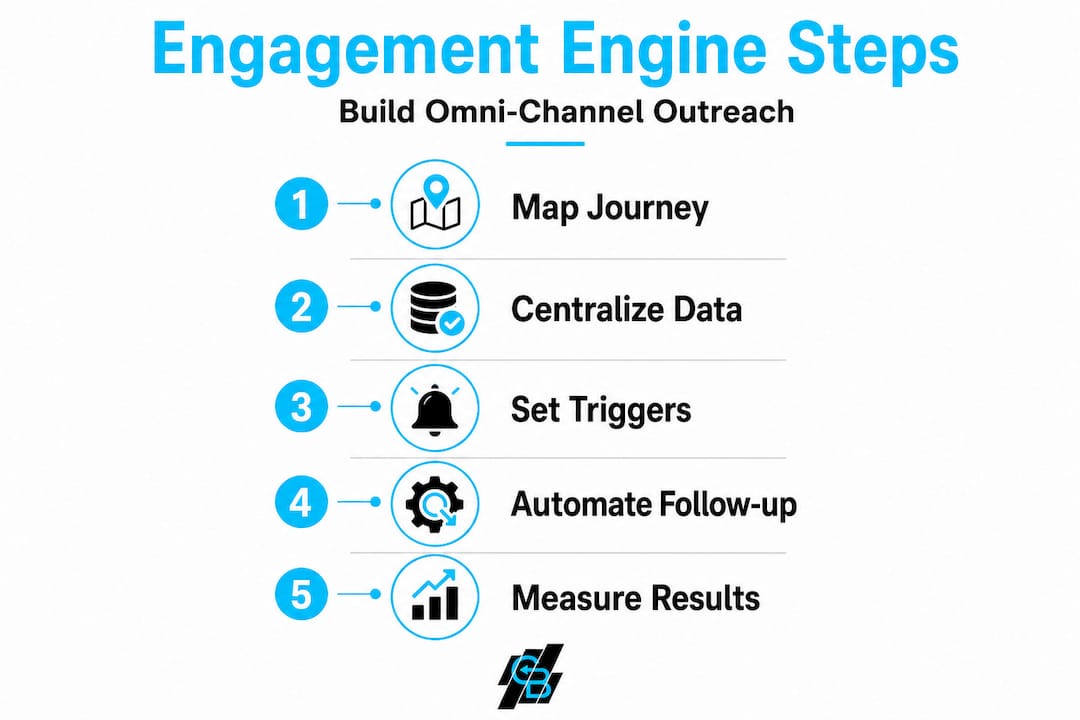
The goal here is not to automate everything. It’s to design engagement around high-gain journeys and then orchestrate both the front-stage interactions clients see and the back-office processes that support them. Think of it as choreography. Every system, team member, and touchpoint plays a coordinated role.
Here are the core stages for building your engine:
- Map your two or three highest-value customer journeys. These might be a new quote request, a policy renewal, or a referral from an existing client. Focus on the paths with the highest conversion potential first.
- Integrate your data sources. Connect your CRM to your website forms, email platform, SMS tool, and any lead sources you use. Every interaction should write to a single contact record automatically.
- Build automated outreach sequences. Create timed, personalized email and SMS workflows triggered by specific behaviors, such as opening a quote, visiting a pricing page, or going silent for seven days.
- Layer in AI-assisted lead scoring. Use AI to rank leads by engagement level and likelihood to convert, so your agents focus their personal attention on the prospects who are most ready to buy.
- Measure and iterate. Set up real-time dashboards to track response times, engagement rates, and conversion data. Review weekly and adjust sequences that underperform.
Here’s a summary of what each stage requires:
| Stage | Action | Key tools or resources |
|---|---|---|
| Journey mapping | Identify high-gain paths | CRM data, sales history |
| Data integration | Unify contact records | CRM connectors, API sync |
| Automated outreach | Build triggered sequences | Email/SMS automation |
| AI lead scoring | Prioritize follow-up | AI scoring models in CRM |
| Measurement | Track KPIs and iterate | Analytics dashboards |
Exploring proven AI strategies for insurance will show you which automation triggers generate the strongest engagement lift. You can also find more detail in resources on how to boost insurance leads with AI to sharpen your outreach sequences.
Pro Tip: Set up a behavioral trigger specifically for disengagement. If a prospect hasn’t opened an email or responded to an SMS in ten or more days, automatically shift them to a re-engagement sequence with a different message format and offer. Catching early drop-off is far cheaper than trying to revive a cold lead weeks later.
Common mistakes and how to verify success
A great process can still fail unless you spot and avoid these traps, and measure what matters.
Most agencies don’t fail because they chose the wrong tools. They fail because they implemented those tools in isolation, expected results too quickly, or never established a clear baseline for measuring improvement. Recognizing these patterns early can save you months of wasted effort.
The four most common engagement mistakes:
- Partial automation. Automating only one stage of the customer journey, like the initial inquiry response, while leaving the rest to manual follow-up. This creates inconsistency and lets leads go cold between stages.
- Unintegrated data. Running campaigns from a list that isn’t connected to your live CRM data. You end up sending irrelevant messages to the wrong people at the wrong time.
- Channel overload. Trying to maintain active engagement across seven channels simultaneously without the bandwidth to do any of them well. Two or three well-integrated channels outperform six disconnected ones every time.
- Skipping the orchestration layer. Treating automation as a collection of individual tasks rather than a coordinated system. This is where most investments in AI and automation fail to deliver visible results.
The orchestration layer is the key differentiator between automation that reduces internal workload and automation that actually improves what customers experience. Without it, efficiency gains stay internal and never reach the people you’re trying to convert.
Metrics you should track to verify improvement:
- Lead response time: Are you reaching new leads within five minutes of their first contact?
- Lead quality score: Is AI scoring helping your agents prioritize higher-value conversations?
- Conversion rate by journey stage: Where are prospects dropping off, and is it improving over time?
- Customer satisfaction and retention: Are policy renewals and referral rates trending upward?
- Email and SMS engagement rates: Open rates and click-through rates tell you if your messaging is resonating.
For guidance on specific automation workflow tips, you’ll find detailed frameworks for setting up each stage of your measurement process. Run a formal quarterly review where you pull all five metrics, compare them against the previous quarter, and identify the one or two workflow changes most likely to move the needle. Small, targeted adjustments compound quickly over three to four cycles.
Why orchestration, not just automation, changes the game
Reflecting on common agency journeys, here’s what years of hands-on engagement transformation has taught us.
Almost every agency we’ve worked with hit the same wall. They invested in automation, saw a modest efficiency gain, and then wondered why their close rates hadn’t moved. The answer is almost always the same: they automated tasks, but they didn’t orchestrate experiences.
Automation is about replacing a manual step. Orchestration is about making sure every step in the customer’s journey connects intelligently to every other step, whether that’s a follow-up email, a live call from an agent, or a renewal reminder sent at exactly the right moment in the policy cycle. These are fundamentally different goals.
Here’s the contrarian truth most platforms won’t tell you: the new AI tool you’re eyeing probably won’t help you if your data isn’t unified and your processes aren’t mapped first. We’ve seen agencies spend thousands on advanced AI features and get marginal results because the underlying workflow wasn’t orchestrated. The tool was generating smart recommendations that no one acted on because they landed in the wrong inbox at the wrong time.
The agencies that achieve real, measurable gains share one habit. They resist the temptation to add features and instead invest in tightening the connections between the features they already have. They follow actionable AI engagement tips to configure their systems correctly before scaling, then layer in new capabilities once the foundation is stable.
Our honest recommendation: draw your customer journey on a whiteboard before you touch a single automation setting. Map every touchpoint, every handoff, and every moment where a prospect could fall through a gap. That visual will tell you more about where your revenue is leaking than any analytics dashboard.
Next steps: Solutions for smarter engagement
Ready to bridge your engagement gap? Here’s where you can accelerate your journey.
The strategies in this guide work best when they’re backed by a platform built specifically for insurance teams. CallBack CRM brings together every tool discussed here, including unified CRM data, AI-powered lead scoring, automated email and SMS sequences, and real-time reporting, into a single connected platform.
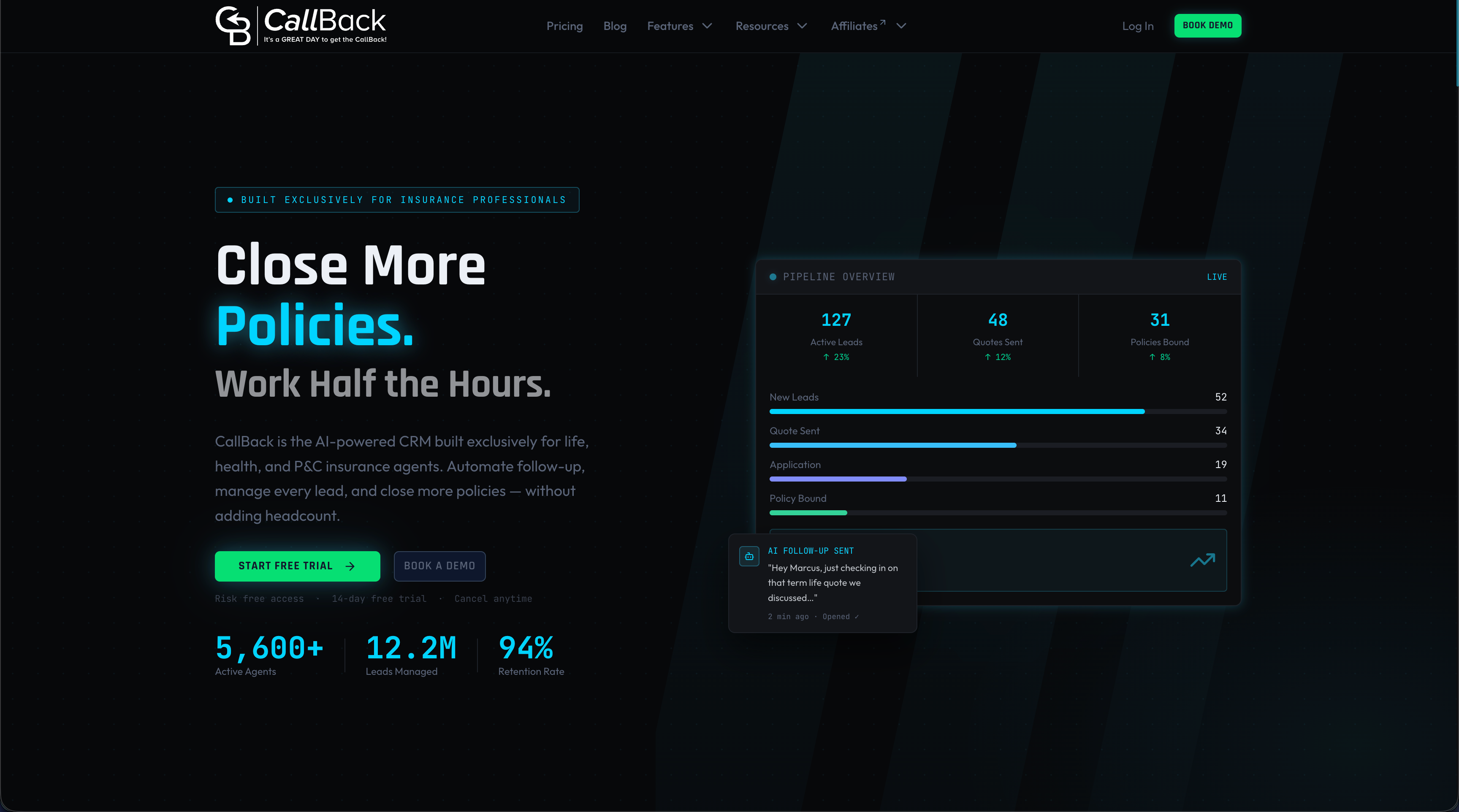
Start with the email automation features to build your first triggered outreach sequences without a complex setup. Then explore the full suite of all-in-one engagement features to see how every tool connects into the orchestrated engagement engine your agency needs. Whether you’re a solo agent or managing a growing team, CallBack CRM is built to scale with your process and remove the manual work that slows you down.
Frequently asked questions
What is the engagement gap in insurance customer interactions?
The engagement gap is the disconnect between technology investments and actual improvements in customer experience, often caused by poor data integration. As tools alone don’t close the gap, unified omnichannel strategies are required to bridge it.
How can AI improve customer engagement for insurance agents?
AI helps agents automate outreach, personalize messaging, and orchestrate workflows, but success depends on integrating data across all systems. Operational success with AI is directly tied to how well those systems share and act on data together.
What metrics should insurance agencies track to verify engagement success?
Track lead response times, conversion rates, customer satisfaction, and retention to measure the real impact of your engagement process. Reviewing these four metrics quarterly gives you a clear picture of where your workflows are performing and where they need adjustment.
Is omnichannel engagement necessary for small insurance agencies?
Even small agencies benefit significantly from omnichannel strategies, provided they ensure integration across marketing, sales, and service systems. In fact, 76% plan to invest in omnichannel technologies in 2026, reflecting how broadly this need is recognized across agencies of all sizes.