

TL;DR:
- Most marketing teams mistakenly believe they practice omnichannel engagement by sending messages across multiple platforms. True omnichannel involves coordinating customer interactions with unified data and seamless journey continuity across all channels. Success requires integrated technology, data quality, and a customer-centric approach that reduces effort and enhances consistency.
Most marketing teams believe they’re doing omnichannel engagement because they send emails, run SMS campaigns, and maintain a social media presence. They’re not. What is omnichannel engagement, really? It’s the practice of coordinating customer interactions across every channel so that the customer journey feels continuous and connected. Not separate campaigns running in parallel. One relationship, picked up and continued wherever the customer happens to show up next.
Table of Contents
- Key Takeaways
- What omnichannel engagement actually means
- Omnichannel vs. multichannel: the real difference
- Benefits and practical applications
- Technology that makes omnichannel work
- My honest take on where teams go wrong
- How Callbackcrm supports your omnichannel strategy
- FAQ
Key Takeaways
| Point | Details |
|---|---|
| Omnichannel means continuity | Each interaction builds on the previous one using shared data, so customers never repeat themselves. |
| It’s not about channel count | Having many channels doesn’t make a strategy omnichannel. Integration and unified data do. |
| Omnichannel beats multichannel | Multichannel operates in silos; omnichannel unifies channels into one coherent customer journey. |
| Technology is the backbone | Unified customer profiles, identity continuity, and CRM integration are prerequisites, not optional upgrades. |
| Journey orchestration is the engine | Timing, channel selection, and message sequencing must be coordinated by data, not guesswork. |
What omnichannel engagement actually means
The definition of omnichannel engagement goes well beyond showing up on multiple platforms. It means that each interaction builds on the previous ones, so the customer never has to re-introduce themselves or restart a conversation. When someone reads a policy overview email, clicks through to your website, then calls your team an hour later, your agent already knows what they looked at and what questions are likely forming in their mind.
Here are the core characteristics that define true omnichannel engagement:
- Unified customer data. Every channel feeds into and reads from a single customer record. The email platform, CRM, chat tool, and phone system all share the same context.
- Channel continuity. A conversation started in one channel carries forward to the next without friction. No resets, no “Can you verify your information again?”
- Journey orchestration. The logic that determines when, where, and how customers are contacted is driven by behavior, timing, and data rather than scheduled blasts.
- Consistent messaging. The tone, offer, and information a customer receives should align across every surface they encounter.
The piece most teams underestimate is journey orchestration. You’re not just managing channel presence. You’re managing sequencing. If a prospect opens an SMS, clicks a link, and bounces from a landing page, the next message they receive should acknowledge that behavior and address the hesitation. That requires connected systems and intentional logic, not just a marketing calendar.
Pro Tip: Map your customer journey before you build your tech stack. Identify the moments where customers currently “restart” their experience, and treat each one as a specific problem to solve with data integration.
An omnichannel strategy connects touchpoints like email, SMS, mobile apps, websites, and physical stores into one coordinated customer relationship. For insurance agents and agencies, this is particularly powerful because the sales cycle is long and trust-dependent. Every disconnected interaction chips away at the relationship you’re trying to build.
Omnichannel vs. multichannel: the real difference
This is where most marketing teams get lost. The confusion is understandable because multichannel customer engagement sounds sophisticated. You’re reaching customers by email, SMS, phone, and social. But in a multichannel setup, those channels operate independently. Your email platform doesn’t know what your SMS tool just sent. Your call center agent has no record of the chat conversation that happened yesterday.
Omnichannel eliminates that silo problem entirely by integrating all of those channels into a single, coherent journey. The difference isn’t channel quantity. It’s data flow and customer experience continuity.
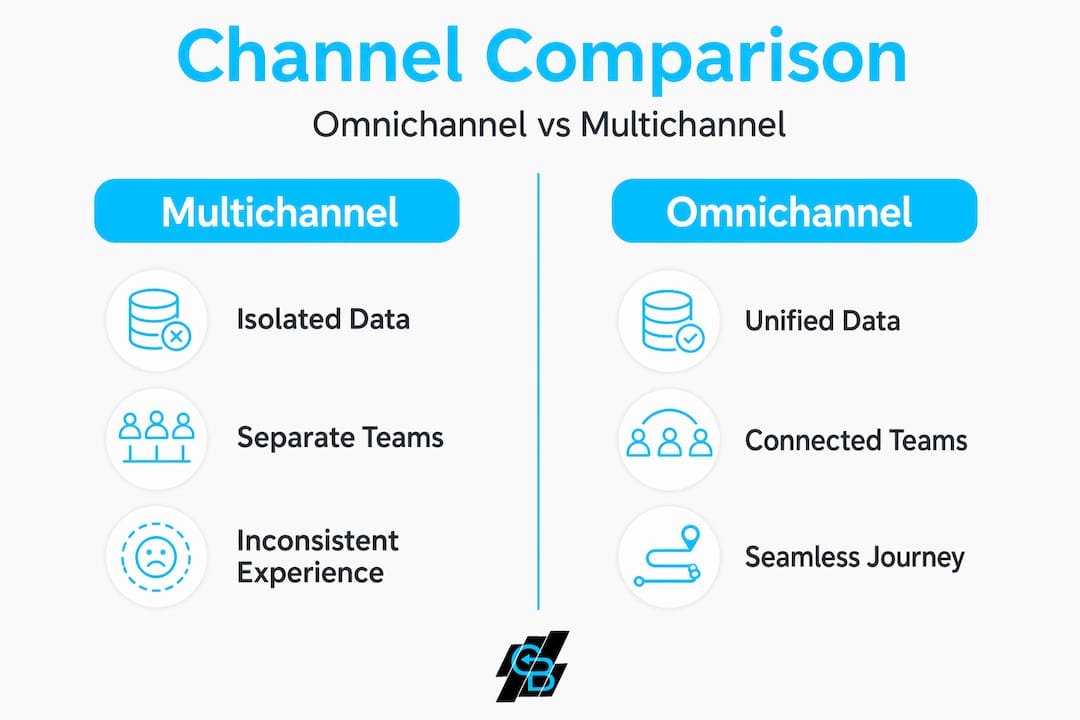
Here’s a side-by-side comparison:
| Factor | Multichannel | Omnichannel |
|---|---|---|
| Channel integration | Channels operate in silos | All channels share data in real time |
| Customer experience | Inconsistent across touchpoints | Continuous and context-aware |
| Data flow | Separate records per channel | Single unified customer profile |
| Agent/rep visibility | Partial view of customer history | Complete cross-channel history |
| Messaging consistency | Varies by channel team | Coordinated by shared logic |
| Customer effort | High (often must repeat themselves) | Low (context carries forward) |
The impact on customer satisfaction is significant. When customers moving between SMS, website, chat, email, and phone find that each new channel has no memory of what came before, the experience feels impersonal and transactional. It signals that you see them as a contact, not a relationship.
For omnichannel marketing strategy to work, the shift must happen at the infrastructure level, not just the campaign level. You can’t duct-tape multichannel tools together and call it omnichannel. The data connections and shared logic have to be built in.
Benefits and practical applications
Understanding what omnichannel engagement is theoretically is one thing. Seeing what it does for your team’s results is another. The benefits of omnichannel engagement show up in concrete, measurable ways across marketing, sales, and customer service operations.
The clearest benefit is relevance. When your data-driven journey orchestration uses what a customer actually did to shape what they receive next, engagement rates climb. You’re not guessing at interest. You’re responding to demonstrated behavior.

Beyond open rates and click-throughs, consider what omnichannel does for trust. A prospect who gets a follow-up SMS that references their earlier web inquiry doesn’t feel stalked. They feel seen. That distinction matters enormously in high-consideration purchases like insurance. It signals that your team is organized, attentive, and professional.
For contact centers specifically, omnichannel engagement unifies all touchpoints into a continuous, contextual conversation. Agents gain full customer context before picking up the phone. That means shorter calls, fewer escalations, and customers who feel their time is respected. It also allows agents to skip the introductory friction and move directly into solving problems.
There are real implementation pitfalls to watch for. Many teams rush to connect platforms before auditing their data quality. If your CRM is full of duplicate records or incomplete contact profiles, piping that data across channels just spreads the problem.
Pro Tip: Before integrating platforms, run a data quality audit on your CRM. Deduplication and standardization of contact records will determine the ceiling of your omnichannel execution quality.
The most common mistake, though, is treating omnichannel as a cross-channel campaign task rather than a customer effort reduction problem. Your goal isn’t to coordinate your team’s outreach schedule. It’s to make the customer’s experience feel effortless at every step.
Technology that makes omnichannel work
You cannot build omnichannel engagement on good intentions and disconnected software. The technology layer is what makes continuity possible, and it has specific requirements. Here’s what that infrastructure needs to include:
-
Unified customer data platform. A single, real-time customer profile that all channels can read and write to. This is what enables consistent messaging, suppression logic, and frequency caps across channels. Without it, you risk sending conflicting signals or bombarding customers with redundant outreach.
-
Identity and context continuity. When a customer switches channels, the system needs to instantly recognize their intent and past interactions. This means matching email addresses to phone numbers to app profiles to web sessions. Gaps here cause experience resets that undermine everything else.
-
CRM integration with marketing automation. Your CRM needs to be the source of truth that feeds your marketing and engagement platforms. When these systems talk to each other in real time, your agents and automated workflows operate from the same picture.
-
AI-powered orchestration layer. AI is what makes journey orchestration scalable. Instead of manually building every conditional path, AI evaluates customer signals, predicts next-best actions, and personalizes timing and channel selection automatically.
-
Cross-channel analytics. You need attribution and engagement data that spans every channel, not per-platform reports. If you can only see how your SMS campaign performed independently of the email thread it was part of, you’re missing the full picture.
The integration challenge is real, especially for teams working with legacy tools or multiple point solutions. The multi-channel marketing approach many teams inherited was never designed with data sharing in mind. Moving toward genuine omnichannel often requires consolidating onto fewer, better-integrated platforms rather than adding more connectors.
My honest take on where teams go wrong
I’ve watched marketing teams spend months and serious budget on omnichannel projects, only to end up with a slightly better-organized version of what they already had. The issue is almost never the technology. It’s the framing.
Most teams define success as “we’re now present on five channels.” What they should be measuring is how often customers have to repeat themselves, or how many handoff points create confusion in the journey. Those are the signals that tell you whether your omnichannel investment is actually working.
In my experience, the teams that get this right stop thinking about omnichannel as a marketing coordination problem and start treating it as a customer relationship architecture problem. The question isn’t “Are we sending consistent messages?” The question is “Does the customer feel like they’re talking to one organization with full memory of who they are?”
That reframe changes everything. It means your data strategy, your technology decisions, and your training programs all point at the same goal: reducing the effort a customer has to expend to get value from you. I’ve seen AI-driven engagement strategies accelerate this significantly when the underlying data infrastructure is solid. But AI on top of fragmented data just automates confusion faster.
Start with the customer experience you want to deliver. Then build backward to the systems that make it possible.
— Kyle
How Callbackcrm supports your omnichannel strategy
Knowing what omnichannel engagement requires is one thing. Having a platform that executes it across your marketing and sales operations is another. Callbackcrm was built for exactly this kind of connected engagement.
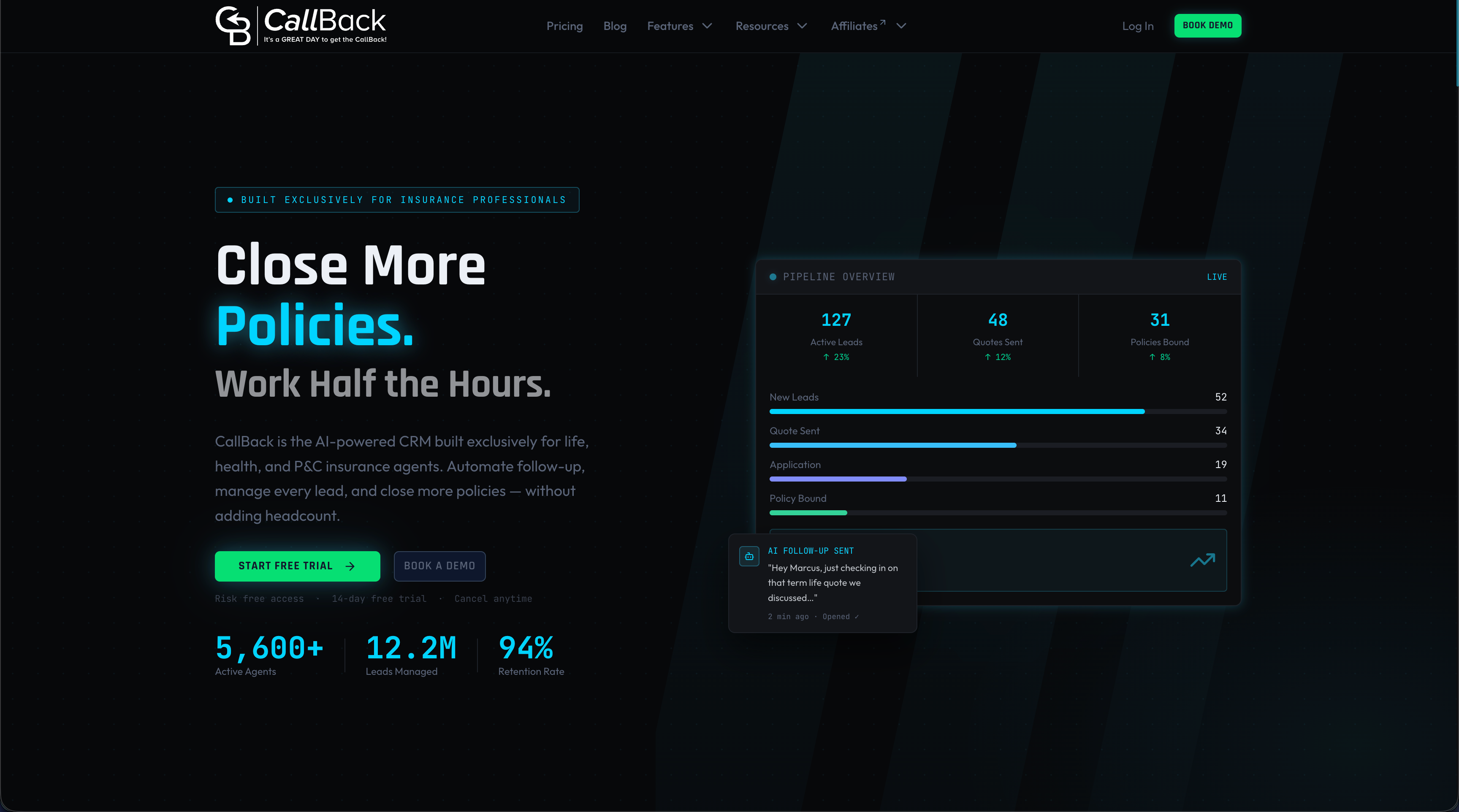
With 50+ integrated features covering CRM, email, SMS, automation workflows, AI assistants, funnel builders, and social media management, Callbackcrm gives insurance agents and agencies a single platform where every customer interaction is tracked, shared, and used to shape the next one. No siloed tools pulling in different directions. Everything connected from day one.
The SMS marketing capabilities alone give you real-time, behavior-triggered outreach that feeds directly into your CRM record. Your team sees every touchpoint in one place, and your automations respond based on what customers actually do, not just what list they’re on. That’s omnichannel engagement working as it should.
FAQ
What is the definition of omnichannel engagement?
Omnichannel engagement is the practice of coordinating customer interactions across multiple channels so that each touchpoint builds on the previous one, creating a continuous and connected customer journey powered by shared data.
How is omnichannel different from multichannel?
Multichannel means being present on many channels that operate independently. Omnichannel integrates those channels so customer context, history, and intent carry across every touchpoint without interruption.
What are the main benefits of omnichannel engagement?
The core benefits include higher customer trust and loyalty, fewer friction points in the buying journey, better agent efficiency, and more relevant personalized communications driven by real-time behavioral data.
What technology do you need for omnichannel engagement?
You need a unified customer data platform, identity continuity across channels, CRM integration with marketing automation, AI-powered orchestration, and cross-channel analytics that give you a complete view of every interaction.
Why do so many omnichannel implementations fail?
Most fail because teams treat omnichannel as a marketing coordination task rather than a customer effort reduction problem. Poor data quality and siloed legacy platforms prevent the continuity that makes omnichannel work in practice.