

TL;DR:
- Sales engagement software automates multi-channel outreach and significantly boosts response rates with AI-driven personalization. It complements CRM systems by executing outreach sequences and automating logging, enabling reps to focus on high-value interactions. Proper adoption, with balanced automation and manual touchpoints, is crucial for maximizing its measurable productivity gains.
Sales engagement software is defined as a multi-channel outreach automation and orchestration platform that helps sales teams execute, track, and optimize every interaction with prospects across email, phone, SMS, and social channels. Unlike a CRM, which stores contact data and deal history, sales engagement software is the execution layer that puts that data to work. Platforms like Gong Engage, Salesloft, and Outreach are the recognized industry standard for this category, often called sales engagement platforms or SEPs. Teams using AI-driven SEPs report 34% higher response rates compared to manual outreach. That single number explains why adoption has accelerated sharply among sales organizations of every size.
What is sales engagement software and how does it work?
Sales engagement software works by building structured, repeatable sequences of outreach touches across multiple channels and automating the delivery, logging, and follow-up of each step. A rep sets up a cadence, say five emails, two calls, and a LinkedIn message over 14 days, and the platform executes that sequence based on prospect behavior and timing rules. Every reply, open, click, and call outcome feeds back into the system automatically.

The integration with CRM platforms like Salesforce or HubSpot is what separates a true SEP from a basic email tool. Activity data syncs bidirectionally, so managers see pipeline health in the CRM while reps manage daily tasks inside the engagement platform. This eliminates the manual logging that, without automation, consumes 60 to 70% of rep time on administrative work alone.
AI adds a third layer on top of sequencing and integration. Modern platforms monitor buyer signals, such as email opens, website visits, and job changes, and then recommend the next best action for each prospect. Salesloft calls this rhythm-based selling, where AI monitors buyer signals to surface which prospects deserve attention right now rather than forcing reps to work a static list.
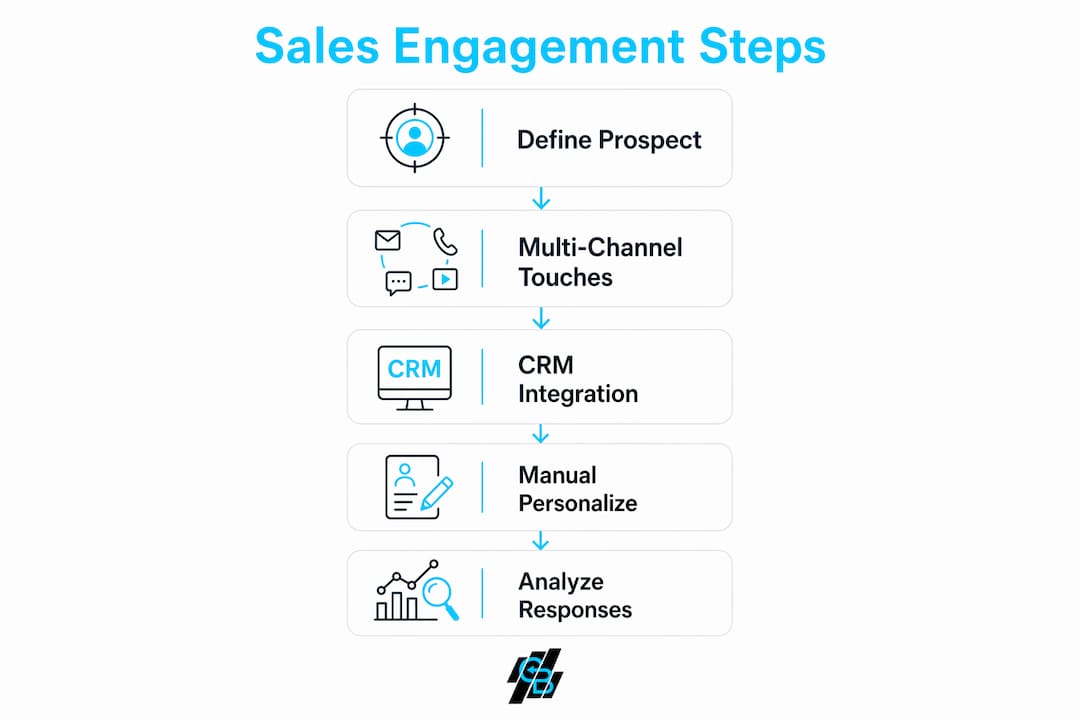
Here is how a typical sales engagement workflow runs in practice:
- Import and segment: Prospect data pulls from the CRM or a prospecting tool, segmented by industry, role, or deal stage.
- Assign a sequence: Reps or managers assign the right cadence template based on the prospect’s profile and intent signals.
- Automated execution: Emails send at AI-optimized times, call tasks appear in the rep’s queue, and social steps prompt manual actions with pre-written copy.
- Engagement tracking: Opens, replies, and call outcomes log automatically back to the CRM without rep input.
- AI-driven adjustment: The platform flags hot prospects, pauses sequences for unresponsive contacts, and surfaces coaching insights for managers.
Pro Tip: Set up at least one manual step inside every automated sequence. A personalized LinkedIn message or a handwritten note at step three signals authenticity that no automation can replicate, and it dramatically improves reply rates on the steps that follow.
What are the key benefits of sales engagement software?
The measurable gains from adopting a sales engagement platform fall into three categories: speed, scale, and intelligence. Each one compounds the others.
- Higher response rates. Teams using Gong Engage saw 34% higher response rates, and SpotOn’s sales team created 30% more top-of-funnel opportunities while converting 20% more of them into revenue. These are not marginal improvements. They reflect what happens when outreach timing, channel mix, and message quality are all optimized simultaneously.
- Recovered selling time. Without automation, administrative tasks consume 60 to 70% of a rep’s day. Platforms that auto-log calls, sync email activity, and schedule follow-ups give that time back to actual selling conversations.
- Smarter prospect prioritization. AI-powered platforms act as enablement engines that generate personalized content and surface high-intent signals, so reps spend their energy on prospects most likely to convert rather than working through a flat list.
- Consistent multi-channel presence. A single rep can maintain personalized, multi-touch communication with hundreds of prospects simultaneously. That scale was previously impossible without a large team.
- Data-driven coaching. Managers gain visibility into which sequences convert, which reps need support, and where deals stall. This shifts coaching from gut feel to evidence.
“The shift in sales leadership is toward using AI as an enablement engine that generates personalized content for high-quality human touch at scale.” — How Sales Engagement Platforms Work
The compounding effect matters here. A rep who spends less time on admin, contacts more prospects with better-timed messages, and receives coaching on what actually works does not just perform incrementally better. The productivity gap between that rep and one working without a platform widens every week.
How does sales engagement software compare to CRM and other sales tools?
The most common source of confusion in this category is treating a CRM and a sales engagement platform as interchangeable. They are not. They are complementary, and understanding the distinction determines whether you deploy them correctly.
A CRM is a system of record. Salesforce, HubSpot, and Zoho CRM store contact data, deal stages, account history, and forecasting data. They answer the question: What do we know about this prospect? A sales engagement platform is the execution layer. It answers: What should we do next, and when?
| Feature | CRM | Sales engagement platform |
|---|---|---|
| Primary function | Data storage and pipeline reporting | Outreach execution and sequencing |
| Automation focus | Workflow triggers and deal stage updates | Multi-channel cadence delivery |
| AI application | Lead scoring and forecasting | Next best action and message optimization |
| Rep daily use | Updating records and reviewing pipeline | Managing tasks, calls, and email sequences |
| Manager use | Forecasting and deal review | Coaching on engagement quality and cadence performance |
Three distinct platform types exist within the sales engagement category itself. CRM-native tools like Salesforce Engage sit inside the CRM and offer basic sequencing without leaving the platform. Standalone SEPs like Outreach and Salesloft offer deeper sequencing, analytics, and AI features but require integration setup. Intelligence-led platforms like Gong Engage layer conversation intelligence on top of engagement, connecting what reps say on calls to how prospects respond in subsequent outreach.
Pro Tip: If your team is under five reps, a CRM-native engagement tool is often sufficient. Once you cross ten reps with distinct territories or personas, a standalone SEP pays for itself within one quarter through recovered admin time alone.
Best practices and common pitfalls when adopting sales engagement software
Adoption failure is the most expensive outcome in this category. The platform works. The team does not use it correctly. The result is wasted spend and no measurable improvement.
The most common pitfalls, and how to avoid them:
- Over-automation without human steps. Over-automation leads to sequence fatigue, where prospects receive robotic, templated messages at predictable intervals and disengage entirely. Set realistic cadence limits, typically no more than eight to ten touches over three weeks, and include at least two manual personalization steps per sequence.
- Data pollution from poor CRM sync. Improper CRM sync degrades forecasting and reporting accuracy. Define clear rules for which activities log to the CRM, which fields sync bidirectionally, and how duplicates are handled before you go live.
- Treating the platform as a monitoring tool. Reps resist platforms they perceive as surveillance. Adoption improves when platforms reduce admin tasks and when managers use analytics for coaching on interaction quality, not just call volume counts.
- Skipping manager-led cadence governance. Sequences built without manager input often reflect individual rep preferences rather than what actually converts. Managers should own the master cadence library and review performance data weekly.
- Ignoring multi-channel strategic orchestration in favor of email only. Teams that use SEPs purely for email automation capture a fraction of the platform’s value. Phone, SMS, and LinkedIn steps consistently outperform email alone for certain buyer personas.
The cultural shift required for successful adoption is as significant as the technical setup. Reps need to see the platform as a tool that makes their job easier, not a quota-tracking mechanism. That framing starts with leadership and gets reinforced through early wins shared publicly across the team.
What are the leading sales engagement tools in 2026?
The market has consolidated around a handful of platforms that each take a distinct approach to the core problem of outreach execution.
| Platform | Standout capability | Best fit |
|---|---|---|
| Gong Engage | AI Composer generates personalized emails from call data | Revenue teams wanting conversation intelligence tied to outreach |
| Salesloft | Rhythm-based selling with AI-prioritized prospect queues | Mid-market and enterprise teams with complex sales motions |
| Outreach | Deep sequencing logic and workflow automation | High-volume outbound teams with dedicated ops support |
| Yesware | Lightweight email tracking and templates | Small teams or individual reps starting with engagement tools |
Gong Engage’s AI Composer is worth highlighting specifically. It pulls context from recorded sales calls and uses that data to generate follow-up emails that reference what the prospect actually said. That level of AI-driven personalization at scale was not commercially viable three years ago.
Choosing between these platforms depends on three factors: team size, sales motion complexity, and your existing tech stack. A 50-person outbound team with Salesforce as its CRM has different requirements than a 10-person insurance agency running a consultative inbound motion. Matching the platform to the motion matters more than chasing the most feature-rich option.
Key takeaways
Sales engagement software delivers measurable gains only when multi-channel sequencing, CRM integration, and AI-driven prioritization work together under a clear adoption strategy.
| Point | Details |
|---|---|
| Core definition | Sales engagement software automates and orchestrates multi-channel outreach across email, phone, SMS, and social. |
| CRM distinction | CRM stores data; sales engagement platforms execute outreach. Both are required for a complete sales stack. |
| Measurable impact | AI-driven platforms produce 34% higher response rates and recover up to 70% of rep time lost to admin tasks. |
| Adoption risk | Over-automation and poor CRM sync are the two leading causes of failed platform deployments. |
| Tool selection | Match platform choice to team size, sales motion, and CRM integration needs rather than feature count alone. |
Why most teams underuse their sales engagement platform
I have watched sales teams spend five figures on Outreach or Salesloft and then use it as a glorified email scheduler. The platform gets blamed for flat results when the real problem is that no one defined what a good sequence looks like before the tool went live.
The teams I have seen extract real value from these platforms share one habit: they treat the sequence library as a living asset. They review which cadences convert, kill the ones that do not, and build new ones based on what their best reps actually say on calls. That feedback loop is what separates a 34% response rate lift from a 3% one.
The other thing I would push back on is the assumption that more automation equals more efficiency. The balance between automation and human touch is where most teams get it wrong. The best-performing sequences I have reviewed always include a step where the rep writes something original. Not a template. Not a spin-tag. A sentence that proves a human read the prospect’s LinkedIn post or listened to their earnings call.
AI is genuinely changing what is possible here. Tools that connect call intelligence to outreach copy, like Gong Engage’s AI Composer, are closing the gap between scale and personalization in a way that felt theoretical two years ago. But the underlying principle has not changed. Prospects buy from people they trust, and trust requires evidence of attention. The platform is the infrastructure. The rep is still the product.
— Kyle
See how Callbackcrm handles sales engagement for insurance teams
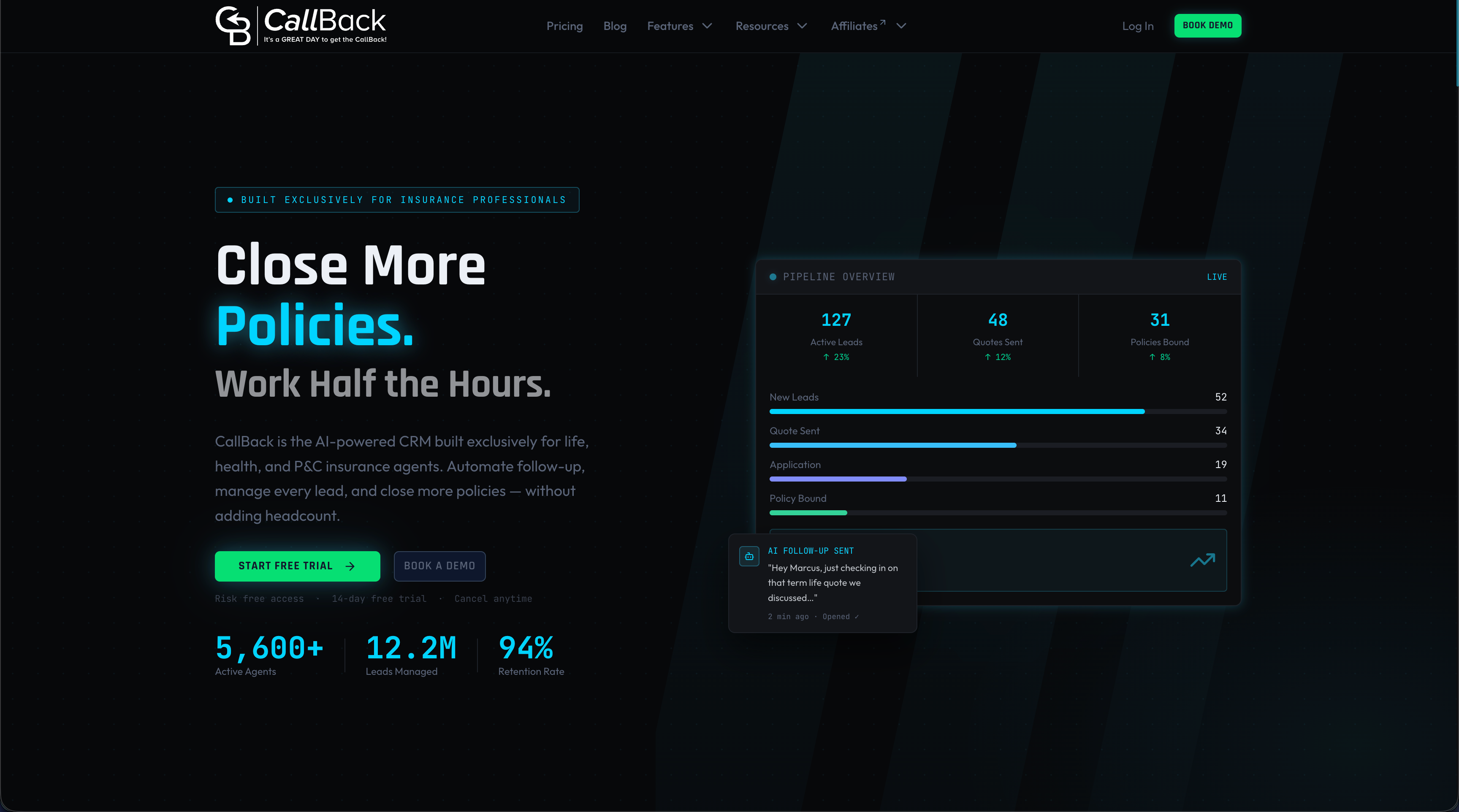
Callbackcrm is built specifically for insurance agents, agencies, and IMOs who need the full stack of sales engagement capabilities without stitching together five separate tools. The platform combines AI-powered multi-channel outreach, automated follow-up sequences, lead scoring, and CRM management in one place. You can explore all 50+ features including AI assistants, SMS marketing, and workflow automation that replace the manual tasks eating your team’s selling time. If you want to see how SMS-driven engagement fits into a modern insurance sales motion, Callbackcrm’s multi-channel tools are built for exactly that workflow.
FAQ
What is the difference between a CRM and a sales engagement platform?
A CRM stores contact data, deal history, and pipeline records. A sales engagement platform executes outreach by automating sequences across email, phone, SMS, and social channels and syncing activity back to the CRM.
How does sales engagement software improve response rates?
AI-driven platforms optimize send timing, personalize messaging using prospect data, and maintain consistent multi-channel follow-up. Teams using platforms like Gong Engage report 34% higher response rates compared to manual outreach.
What are the top features of sales engagement software?
The core features are multi-channel sequencing, CRM integration, AI-powered prioritization, automated activity logging, and analytics for coaching. Advanced platforms add conversation intelligence and AI-generated email copy.
Who benefits most from sales engagement software?
Sales teams with more than two or three reps benefit most, since manual admin tasks consume 60 to 70% of rep time without automation. Larger teams with defined outbound motions see the fastest ROI.
What is the biggest risk when adopting a sales engagement platform?
Over-automation and poor CRM data sync are the two primary failure points. Setting cadence limits, including manual personalization steps, and defining clear sync rules before launch prevents both issues.